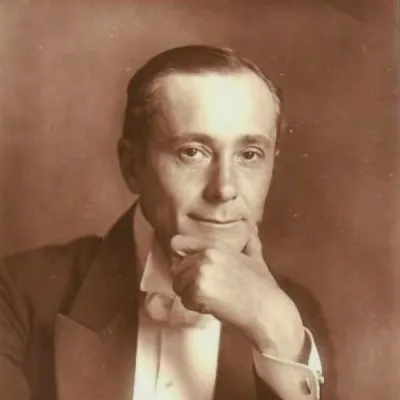
Alfred Abel
Human Design Chart
Biography
Alfred Abel — Manifestor with Profile 6/2
Manifestor 6/2 — Design at a Glance
Alfred Abel was a Manifestor. His design marked him as a pioneer and visionary whose task was to actively lead the world into a new direction. Similar to a Roman emperor, he had great plans but did not wage the necessary wars himself. Instead, he delegated tasks to others to expand his realm. This style of leadership inevitably polarized: His often far-reaching thinking caused some to love and follow him while others misunderstood or even hated him. Misunderstanding was thus a central pain point in his design.
To navigate this dynamic and attract the right followers, his strategy required proactive informing. He had to enlighten others timely and precisely about his intentions and visions. When Alfred Abel acted according to this strategy and followed his inner authority, he was rewarded with a feeling of inner peace. However, if he lived against his design – for example, by constantly fighting in the details or lacking communication – he instead felt persistent, deep anger. His path therefore lay in clearly communicating his vision to reduce resistance and achieve the inner state of peace intended for him.
Emotional Authority
Alfred Abels design points to a tendency towards emotional turbulence: His inner truth was not immediately accessible but hidden behind a constant wave of emotional ups and downs. The defined Solar Plexus Center functioned as his internal authority – a mechanism that always took precedence over all other defined centers independently. This configuration meant that Alfred Abel saw the world through the filter of his current mood. What might be seen as inspiring in one moment could appear negative in the next. His immediate feeling was merely a snapshot, not a reliable compass for long-term orientation.
Quick, spontaneous decisions made from intense emotions often had negative consequences because they were based on fleeting impulses rather than deeper clarity. The mechanics of his design required patience and strategic delay. Alfred Abel needed to learn not to make important decisions immediately but to "sleep on them." Only when the initial emotional heat subsided and distance was created did calmness set in. This process of multiple checks was essential for distinguishing his mood from his actual inner truth. Only through this conscious time delay could he ensure that his actions were based on clear, unclouded insight rather than fleeting whims.
The 6/2 Profile — Role Model / Hermit
Alfred Abels Design points to a two-phase life path: initially characterized by experiments, later by deep reflection. As a 6/2 Profile ("Role Model / Natural Talent"), the energy of Line 3 was active before his 30th year. During this phase, the principle of trial and error dominated; Alfred Abel learned through personal action and withdrew after failures to gather experience. This early period was marked by nonconformity and a search for new social models, with Line 6 still appearing inexperienced.
After his Saturn return, Line 6 became fully active. Alfred Abel then showed a need for intensive introspection – metaphorically retreating into a "cave on the mountain." Here he evaluated his earlier experiments from a distance, leading to healing and self-awareness. The energy of Gate 22 promoted maturity and alignment between form and content; it enabled mutations in his self-understanding and generative leadership qualities through social interaction.
Simultaneously, Line 2 with its strictness and inflexibility was active. It required knowing one's own process and letting ideas mature. If these were not developed, boredom ensued; Alfred Abels Design indicated that he had to integrate his inner visions through selective waiting and deep imagination rather than projecting them prematurely outward. The result of this long phase was a mature wisdom that attracted others to partake in his ability for deep introspection.
Triple Split Definition — Defined & Open Centers
Alfred Abel lived with a massive, constant internal structure: Head, Ajna, Throat, G Center, Heart, Solar Plexus, and Root were defined. This created a permanent mental pressure (Head/Ajna), which transitioned into continuous conceptualization and speaking (Ajna/Throat). He had a firm identity and direction (G) as well as willpower (Heart), but these needed to be filtered through his emotional authority (Solar Plexus); decisions required waiting for the emotional wave. His Root Center provided constant, set stress pressure for forward movement.
In contrast, Sacral and Spleen were open: He had no constant life energy flow (Sacral) and no spontaneous intuition/life wisdom (Spleen). These open centers made him situationally vulnerable to conditioning by the environment, especially regarding energy levels and health perception. The challenge was not to force or impulsively release the immense pressure of defined centers (especially mental pressure and emotional waves), but to use strategy and authority to manage timing and resonance with the environment (open centers).
The mechanics showed a strong contrast between the dense, permanently active inner world (7 defined centers, including mental and emotional authority) and situational dependency in vitality and intuition areas (2 open centers). The focus was on integrating constant mental-emotional pressure with the need to take breaks and not absorb environmental energy.
Channels for inspiration, pioneering spirit, emotional depth and drive.
Alfred Abel's social impact depended crucially on his internal mood. His design tended to magnetically attract through voice and presence, but only when he felt emotionally ready for it. This dynamic was primarily shaped by the Openness Channel 22-12. This channel connects Solar Plexus Center with Throat Center. Gate 22 delivers the emotional wave while Gate 12 exerts a natural restraint that regulates openness and limits it to people with high mutative potential. The mechanics are 'juxta', meaning this property was constantly present but its expression strength depended on current emotional ebb or flow. If Alfred Abel was forced into social engagement at the low end of his wave, harshness and misunderstanding were shown. Spontaneous openness, however, generated a transformative effect as his voice through larynx mutation (Gate 12) not only conveyed information but created emotional resonance.
Additionally, further channels influenced his experience. The Awareness Channel 61-24 connects Head and Ajna Center. Here it was about waiting for inspiration (Gate 61) and its rational processing by Gate 24, leading to sudden insights that could not be controlled. The Initiation Channel 51-25 connects Heart Center. It brought competitive energy (Gate 51) with the ability for universal love and recognition of beauty (Gate 25), thus strengthening others through 'shocks' towards individuation if invited. The Recognition Channel 30-41 connects Root and Solar Plexus. Gate 41 generated a desire for new experiences, intensified by the emotional intensity of Gate 30, leading to an intense need to deeply feel life and fulfill desires.
Individual Gates like 47 (Purpose from Confusion), 11 (Visual Assessment) or 17 (Logical Succession) supported these patterns by seeking collective meaning-making or enabling strategic planning. Alfred Abel thus lived in a constellation that required patience: Waiting for emotional clarity to effectively use his unique voice and insights, rather than acting impulsively.
Individual Circuitry — Circuit Signature
Alfred Abel appeared as a Triple-Defined individual whose design did not possess an independent driving force but was situatively activated by the environment. He functioned as a mirror for three parallel, non-integrated energy fields: Knowledge, Centering, and Purpose circuits. This fragmentation meant he had access to deep knowledge, inner strength, and emotional depth, yet could not live them as continuous self-driven unity; they only became effective through exchange with others.
His Knowledge Circuit included two separate parts: Head and Ajna Centers along with Throat and Solar Plexus Centers. This brought pulsating creativity and a drive for transformation (Channel 24-61) as well as openness to new impulses (Channel 12-22). Since these centers were not connected, there was no direct link from idea to emotional expression form.
The Centering Circuit linked Identity and Heart Centers through the Initiation Channel (25-51), giving inner stability, courage for individuality, and firm self-worth. Without connection to Throat Center, however, these convictions often remained internally without external expression.
The Purpose Circuit connected Solar Plexus and Root Centers via the Recognition Channel (30-41). Here he cyclically processed emotional waves from the past to reflect their meaning. This energy was wave-like and served communal learning from past experiences.
Overall, this configuration shaped a person with intense internal resources whose effectiveness strongly depended on external triggers. The separated groups – Head/Ajna, Throat/Solar Plexus/Root, Identity/Heart – formed isolated power fields that did not interconnect but existed side by side. Alfred Abel had to find these energies always in contact with the environment as his design offered no internal integration.
Left Angle Cross of Informing 1
Alfred Abels Human Design legte eine tiefergehende Motivation fest, die sich durch den archetypischen Rahmen des Linken Kreuzes der Mitteilung definierte. Sein Lebensmuster war weniger von äußeren Zielen als vielmehr vom inneren Prozess der Kommunikation geprägt, der als Mittel zur Klärung und Verbindung diente. Dies zeigte sich nicht als bloßer Austausch von Informationen, sondern als ein fundamentales Bedürfnis, innere Zustände zu ordnen und durch Ausdruck nach außen zu tragen.
Die Herausforderung in diesem Muster lag darin, diese Mitteilung authentisch und ohne Verzerrung durchzuführen. Das Leben wurde durch den Impuls geprägt, Dinge auszudrücken, zu erklären oder zu vermitteln, um sowohl innere Klarheit als auch äußere Resonanz zu finden. Es handelte sich um eine Struktur, die oft unbewusst wirkte und Alfred Abel dazu antrieb, seine eigene Realität durch das Sprechen und Formulieren erst wirklich greifbar zu machen. Die Kommunikation war hier kein Werkzeug im strategischen Sinne, sondern der eigentliche Weg zur Selbstvergewisserung und zum Kontakt mit anderen. Ohne diesen Prozess der Artikulation blieb die innere Landschaft unstrukturiert; durch ihn entstand Verbindung. Dieses Muster prägte seine Art, sich in der Welt zu bewegen: stets auf der Suche nach der richtigen Formulierung, um das Unsichtbare sichtbar und das Verwirrende verständlich zu machen.
Saturn Return · Uranus Opposition · Chiron Return · 2nd Saturn Return — Life Cycles
Alfred Abels Lebensverlauf folgte einer klaren Struktur, die durch drei zentrale Zyklen geprägt war. 1904, im Alter von 25 Jahren, erhielt er seine erste Anstellung am Deutschen Theater Berlin. Dies markierte den ersten Saturn-Return: ein Zeitpunkt, an dem sich jahrelange Vorarbeit verdichtete und eine tragfähige berufliche Basis entstand.
Sein Design fand seinen Höhepunkt während des Chiron-Returns. 1927, mit 48 Jahren, spielte Alfred Abel die Rolle des hochmütigen Beherrschers Joh Fredersen in *Metropolis*. Dieser Zyklus steht für Blüte und Erfüllung; hier zeigte sich sein Inkarnationszweck am deutlichsten, als er seine künstlerische Kraft voll entfalten konnte. Es war ein Moment der Bestätigung, in dem das eigene Potenzial sichtbar wurde.
Der zweite Saturn-Return brachte jedoch eine existenzielle Wende. 1935, im Alter von 56 Jahren, wurde Alfred Abel aufgrund seiner jüdischen Herkunft aus der Reichsfachschaft Film ausgeschlossen. Dieser Zyklus testete die zuvor errichteten Strukturen und zwang zur Neuorientierung angesichts äußerer Zwänge. Die Abfolge dieser Ereignisse verdeutlichte den Rhythmus seines Designs: Aufbau, Blüte und schließlich eine harte Prüfung, die seine Resilienz forderte.
Manifestor · Emotional Authority — Synthesis
Alfred Abel war ein Vorreiter, dessen Leben von einem tiefen inneren Druck geprägt war, neue Wege zu gehen und seine Visionen auszudrücken (Manifestor, Head-Ajna-Definition). Dieser Drang zur Individualisierung, gespeist aus dem Wissens-Schaltkreis, manifestierte sich in einer Fähigkeit, andere durch Inspiration und die Vermittlung von Erkenntnissen zu bewegen (Channel 24-61, Gate 47). Gleichzeitig war er ein Mensch, der tief in seinen Emotionen verwurzelt war (Emotional Authority), was ihm eine besondere Sensibilität für das Erleben und Verstehen anderer verlieh – besonders im Zusammenspiel mit dem Sinnfindung-Schaltkreis.
Ein zentrales Paradox lag darin, dass Abel zwar von einem starken Willen zur Selbstverwirklichung getrieben wurde (definiertes Heart-, G-Center), gleichzeitig aber auch ein tiefes Bedürfnis nach Bestätigung und Anerkennung besaß (Gate 8). Diese Spannung zwischen dem Wunsch nach unabhängiger Gestaltung und der Sehnsucht nach Zugehörigkeit prägte seinen Weg, wobei die Fähigkeit zur emotionalen Einsicht (Channel 30-41) ihm half, die eigenen Grenzen zu erkennen und in Einklang mit den Bedürfnissen anderer zu handeln.
4 Defined Channels
Incarnation Cross - Left Angle Cross of Informing 1
Solar Return
The Solar Return shows the moment when the sun returns to its exact birth position - your personal solar year.
Life Cycles
Discover the life cycles with a detailed triple view (birth chart, cycle chart, composite).
Human Design Profile
- Type
- Manifestor
- Strategy
- To inform others before acting
- Authority
- Emotional Authority
- Profile
- 6/2 - Role Model / Hermit
- Definition
- Triple Split
- Incarnation Cross
- Left Angle Cross of Informing 1
- Date of Birth
- 12.03.1879 23:45
- Place of Birth
- Leipzig, Germany
Frequently Asked Questions
What was Alfred Abel's Human Design type?
What Profile did Alfred Abel have in Human Design?
What Authority did Alfred Abel possess?
What incarnation cross did Alfred Abel have?
When was Alfred Abel born?
Discover your own Human Design
Are you also a Manifestor? Find out in a personal reading how to use your initiation power peacefully and dissolve resistance.
More Personalities
Back to overviewSissy Spacek

Anémone

Ann-Margret

Arletty

Arno

Artus