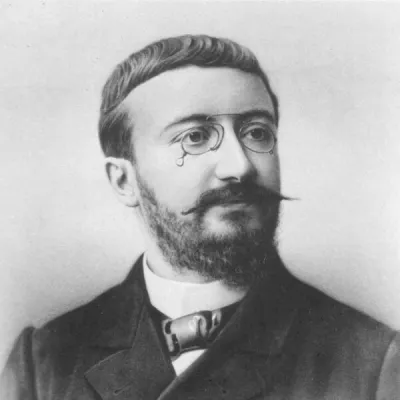
Alfred Binet
Human Design Chart
Biography
Human Design Analysis: Alfred Binet as Generator 2/4
Generator 2/4 — Design at a Glance
Alfred Binet possessed high and enduring sacral energy that enabled him to engage in intensive work. His design showed him as someone who used his strength most effectively when reacting to impulses rather than initiating independently. This configuration worked on the principle of a „workhorse“: strong and resilient, as long as there was energy available for the task.
The central mechanism of his generator lay in responding to signals from the environment. When his sacral center gave a clear „yes“, his action led to deep fulfillment and materialization power. Conversely, frustration and energy loss occurred when he forced things without inner resonance or if he was prevented from pursuing his heart project while still full of power.
The motto „React, don’t initiate“ served as the key to avoiding burnout. Alfred Binet could not be stopped when using his energy in harmony with this design. However, living against this structure and constantly trying to initiate led him to a feeling of persistent frustration. His deepest satisfaction came from acting instinctively whenever life gave him a signal he could respond to.
Sacral Authority
Alfred Binet’s decision-making was based on a clear inner structure: the sacral authority served as the primary instance. As a generator, his strategy of reacting was inseparable from this authority, simplifying his process. He did not act proactively but waited for external stimuli to react. This mechanism manifested physically through a specific „gut feeling“ – audible signals like grunting or humming – and energetic surges as confirmation of the right choice. With resonance, he felt vital energy and enthusiasm, enabling him to perform tasks with great satisfaction and without compulsion.
Additionally, the spleen center acted as a supporting instance. Being activated and possibly directly linked to the sacral center, it gave Alfred Binet the ability for quick, spontaneous reactions. This ensured immediate access to his instinctive perception and physical well-being, which he trusted fully. A prerequisite for this clear sacral response was an open emotional center that ensured no emotional waves overlapped with direct physical confirmation. Through this configuration, he lived in a state allowing him to immerse himself entirely in what energized him, guided by a reliable inner voice rather than external pressure or intellectual analysis.
The 2/4 Profile — Hermit / Opportunist
Alfred Binet’s design laid a fundamental tension between the deep need for withdrawal and the desire for community. As a person with Profile 2/4, „Natural Talent / Networker“, he constantly oscillated between two poles: Line 2 of the Hermit and Line 4 of Community. This configuration created an inner pendulum requiring clear communication of his current state – whether seeking company or solitude. In his „Me-Time“, Alfred Binet immersed himself in internal processes to gain clarity. Only after satisfying this need for peace did he return from „his cave“ to spend time with his favorite people. This shift was essential, enabling him to reflect on the knowledge of his network during alone-time and develop brilliant ideas from it. Line 2 brought a lifelong developmental line projecting that new beginnings could start but only became clear upon calling. Success here led to further success, provided patience was maintained. Line 4 added limitation and fixity in dealing with shocks, yet offered through Uranus influence the ability for invention and discovering opportunities in crises. Alfred Binet’s strategy involved using these specific reactions and remaining learnable despite fixity when new chances were recognized. Thus, he transformed network knowledge through isolated reflection into innovative concepts by utilizing the tension between solitude and connection as a creative motor.
Triple Split Definition — Defined & Open Centers
Alfred Binet's design established a tendency towards constant, reliable expression and inner stability. His defined centers – Throat, G Center, Heart, Sacral, Spleen, and Root – acted as steady energy sources for communication, identity, willpower, vitality, intuition, and stress management. This shaped him into someone who operated from within: his voice (Throat) conveyed messages clearly; the G Center gave him a sense of direction and self-love; the Heart Center provided the strength of will to fulfill promises; the Sacral Center generated daily life energy for satisfying activities; the Spleen offered spontaneous, intuitive insights about health in the present moment; and the Root supplied the drive to move forward.
At the same time, his open centers – Head, Ajna, and Solar Plexus – exposed him to situational influences. The open Head Center made him vulnerable to mental confusion or taking on foreign questions without identifying them as his own. The open Ajna Center reflected environmental concepts, which could lead to interpreting others' ideas as personal truth. The open Solar Plexus Center absorbed emotions from the environment, putting him at risk of personalizing other people's moods or conflicts and feeling emotionally unstable, even though these states did not originate with him. This openness allowed him to act as a mirror for mental and emotional fields but challenged him to avoid identifying with these transient energies and instead trust his defined inner resources.
Channels for intuition, pioneering spirit and natural maturation.
Alfred Binet's design shows a tendency towards cyclic meaning-making and intuitive self-discovery. He was someone who thoroughly experienced situations to distill wisdom from them while also articulating spontaneous insights in the present moment. This configuration combined the need for individual initiation with a deep connection to the collective rhythm.
Channel 53-42 connects the Root Center to the Sacral Center through Gate 53 (Beginnings) and Gate 42 (Growth). The process of learning was structured by complete cycles, requiring Alfred Binet to bring experiences to a satisfying conclusion before starting new ones. This reflection served to translate gained lessons into information for others, thus creating collective history.
Channel 51-25 connects the Heart Center through Gate 51 (Shock) and Gate 25 (Spirit of Self). Here, competitive energy, always wanting to be first, merged with the ability for universal love. Alfred Binet had the power to strengthen others through the "shock" of initiation into their individuality. This channel drove him to transcend boundaries and set a bold example for the collective through personal triumphs, learning to accept initiations only when they came from outside.
Channel 57-20 connects the Spleen Center with the Throat Center via Gate 57 (intuitive insight) flowing directly into Gate 20 (Now). This gave Alfred Binet the ability to articulate profound self-knowledge and existential truth in the moment. His verbal outbursts of pure intuition reached the core of a matter faster than deliberate thought, living from the certainty of what needs to be done without thinking, and supporting others in awakening their inner survival intelligence.
Additionally, Gate 54 (Success/Illumination) fueled his drive for worldly as well as mystical knowledge. Gate 46 (Devotion/Body) promoted full engagement with the process. Gate 41 (Evolution/Sense) propelled him from experience to experience, and Gate 15 (Collective Rhythm) anchored him in the natural flow of society. The design gates 18, 23, 52, 8, and 27 complemented this picture through aspects of correction, understanding, concentration, contribution, and care.
Individual Circuitry — Circuit Signature
Alfred Binet's design featured a tendency towards impulsive, innovative flashes of inspiration that he expressed acoustically and pulsatingly to the world. This mode of expression resulted from the knowledge circuit linking his Throat Center directly with his Spleen Center. Through Channel 20-57, creative inspiration flowed immediately into his voice, transforming new knowledge and initiating change.
Additionally, a separate inner strength was evident through the centering circuit. Here, Channel 25-51 connected the Identity Center to the Heart Center. This created courageous convictions and self-worth, but remained without direct access to the Throat Center, so these internal certainties were often hard to verbalize.
Parallel to this, the meaning-finding circuit operated as a third independent force. Channel 42-53 linked the Sacral Center with the Root Center. This configuration directed energy towards emotional waves from the past and finding meaning in past experiences, shared with the collective.
Due to the triple definition, these three circuits existed side by side as separate, non-directly connected systems. Alfred Binet navigated between impulsive creative expression (Spleen-Throat), inner emotional strength (Identity-Heart), and cyclical meaning-finding from the past (Sacral-Root). None of these energies flowed seamlessly into one another; they shaped his experience as parallel existing, distinct forces.
Right Angle Cross of Penetration 2
Alfred Binet's Human Design chart indicated a tendency towards deep, often painful insight. His chart included the right intersection cross 2, which described not an easy intuition but a process of penetrating into the harsh realities of life. It was about pushing through resistance and suffering to reach a truth that lay not on the surface but at the core of experience.
For Alfred Binet, this meant his path to clarity involved breaking through illusions. He did not seek superficial validation but rather a structure that could withstand the pressure of existence. The mechanics of this cross showed a dynamic of transformation through confrontation. What initially appeared as an obstacle or pain became a tool for self-discovery. Alfred Binet lived with the task of integrating these deep insights without being overwhelmed by their weight. It was a process of endurance, where breaking through personal boundaries became the source of his inner strength. His design challenged him to see truth and validate it through personal experience. This shaped an attitude of serious engagement with the essential, far from superficial solutions or quick answers.
Saturn Return · Uranus Opposition · Chiron Return — Life Cycles
Alfred Binet's development followed a clear cyclical pattern of anchoring and later unfolding. In 1883, at age 26, he began his research work at Jean-Martin Charcot's neurological laboratory. This marked his first Saturn Return, a phase where years of groundwork condenses into a solid professional structure, and serious scientific work finds its place.
Later, his design showed the transition to the bloom phase. In 1905, at age 48, he applied the Binet-Simon test for the first time. This fell during his Chiron Return cycle (around ages 49-51), which in Human Design is not a healing process of old wounds but an achievement cycle. Here, one's incarnation cross unfolds increasingly; if lived according to strategy and authority, the inner meaning and purpose become experiential. Binet's breakthrough was thus no random discovery but the concrete effect of this cycle, where his deeper life mission manifested in life – not as a neutral event but as effective implementation of his design. The mechanics describe here the path from structural anchoring through Saturn to meaningful realization through Chiron.
Generator · Sacral Authority — Synthesis
Alfred Binet lived a life deeply influenced by the connection between inner drive and external reaction. His Generator profile with sacral authority points to someone fulfilled by work that stems from internal agreement. The defined throat, connected with the G Center and heart, suggests a clear expression of personal identity – an ongoing need to communicate authentically and advocate for values. This manifested in his ability to react from the gut (sacral center) while simultaneously guiding others through the connection between heart and G Center. The alternation between solitude (line 2) and community (line 4) in his profile indicates a rhythm of intense reflection alternating with exchange within a network – a cycle of inner work and outer expression.
A central paradox in Binet's design lies in the tension between his defined heart and open centers for mental awareness (Ajna) and emotions (solar plexus). The heart signals strong will and the ability to manifest things, while openness in other centers means constant intake of information and feelings from the environment. This likely led to an internal struggle between the need for control and receptivity to external influences – a dance between pursuing personal goals and adapting to others' needs.
3 Defined Channels
Incarnation Cross - Right Angle Cross of Penetration 2
Solar Return
The Solar Return shows the moment when the sun returns to its exact birth position - your personal solar year.
Life Cycles
Discover the life cycles with a detailed triple view (birth chart, cycle chart, composite).
Human Design Profile
- Type
- Generator
- Strategy
- To respond - wait for something to respond to
- Authority
- Sacral Authority
- Profile
- 2/4 - Hermit / Opportunist
- Definition
- Triple Split
- Incarnation Cross
- Right Angle Cross of Penetration 2
- Date of Birth
- 08.07.1857 18:00
- Place of Birth
- Nice, France
Frequently Asked Questions
What was Alfred Binet's Human Design type?
What Profile did Alfred Binet have in Human Design?
Which Authority guided Alfred Binet?
What incarnation cross did Alfred Binet have?
When was Alfred Binet born?
Discover your own Human Design
Are you also a Generator? Find out in a personal reading how to use your sacral energy correctly and discover deep satisfaction.
More Personalities
Back to overviewAaliyah

Alexia

Angèle

Anne-Marie

Arcángel

Arno