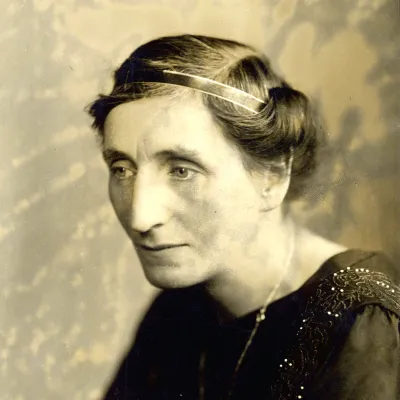
Alice Salomon
Human Design Chart
Biography
Alice Salomon was the third of eight children, and the second daughter, of Albert and Anna Salomon. Like many girls from affluent families in this period, she was denied further education, despite her ambition to become a teacher. This ended in 1893 when she was 21, and she recorded in her autobiography that this was "when her life began".
In 1900 she joined the Bund Deutscher Frauenvereine ("Federation of German Women's Associations" - BDF hereinafter). In due course she was elected deputy chairman, and kept this role until 1920. (The Chairman was Gertrud Bäumer). The organisation supported destitute, abandoned, or single mothers and aimed to prevent their children being neglected.
From 1902 to 1906 she studied economics at the Friedrich Wilhelm University in Berlin, though she had no relevant qualification. Her publications were sufficient for university entrance. She earned her doctorate in 1908. Also in this year she founded a Soziale Frauenschule ("Social Women's School") in Berlin, which was renamed "Alice Salomon School" in 1932 and is now called Alice-Salomon-Fachhochschule für Sozialarbeit und Sozialpädagogik Berlin ("Alice Salomon College of Further Education for Social Work and Social Sciences of Berlin").
In 1909 she became secretary of the Internationalen Frauenbund ("International Women's Federation"). She converted from Judaism to the Lutheran Church in 1914. In 1917 she was made chairman of the Konferenz sozialer Frauenschulen Deutschlands ("Conference of German Women's Social Schools") that she herself had founded; by 1919 sixteen schools belonged to it.
In 1920 she resigned from the BDF from fear of anti-semitic propaganda. Five years later, she founded theDeutsche Akademie für soziale und pädagogische Frauenarbeit ("German Academy for Women's Social and Educational Work") which was directed by Hilde Lion.
The Human Design of Alice Salomon: Generator 4/6
Generator 4/6 — Design at a Glance
Alice Salomon revealed herself as someone with tremendous endurance, comparable to a workhorse. Her design indicated that she possessed a great deal of sacral energy, which she used for her tasks if they resonated internally. As a Generator, her strength did not lie in spontaneous initiation but rather in reacting to impulses from the environment. Her successful strategy involved waiting for signals and then acting only when her gut feeling gave a clear "yes."
This mechanism protected her from two typical pitfalls: first, she avoided wasting energy on things that did not resonate with her internally, which would otherwise quickly lead to burnout. Second, she could work on her heart projects as long as the inner motivation was present without being distracted by external pressures. If Alice Salomon lived according to this principle – reacting rather than initiating – her system rewarded her with a feeling of deep satisfaction and fulfillment. When she acted against this design or ignored her internal signals, frustration arose and her energy waned. Her path was characterized by the ability to make decisions from the gut and then work persistently thereafter, enabling her to effectively translate her potentials into reality.
Sacral Authority
Alice Salomon was a Generator whose decision-making was shaped by sacral authority. This inner leadership manifested not in the Head Center but as a direct physical reaction to external stimuli. Her design required waiting for these impulses: a gut feeling or an energy surge that expressed itself through sounds like grunting or affirming "mm-hm." As long as her Emotional Center remained open and did not generate deceptive waves, she could trust this bodily truth. When her sacral motor was engaged, she felt vital and possessed inexhaustible energy. She approached her tasks with joy, free from constant purposefulness, since the action itself was rewarding. Additionally, a supportive spleen authority worked in tandem. This gave her the ability for quick, spontaneous reactions and an instinctive access to physical well-being. She could reliably rely on this immediate perception, making her decisions precise and efficient. The combination of waiting for the impulse and this swift spleen intuition created an efficient mechanism: Alice Salomon acted only when her body confirmed it, thereby conserving energy and working with great enthusiasm where her natural resonance lay.
The 4/6 Profile — Opportunist / Role Model
Alice Salomons' design set a tendency towards a deep internal tension that developed over the course of her life. Her Profile 4/6 initially marked her as someone who enjoyed and engaged in much experimentation, particularly in the realm of relationships and friendships. During this phase, her later Line 6 still acted similarly to a Line 3, fostering her curiosity and openness.
However, once Line 6 became active, a characteristic conflict emerged: the desire to belong to a community (Line 4) stood in opposition to the need to withdraw and contemplate the meaning of life (Line 6). This field of tension between Heart and Head could be confusing but was central to her development.
In her later years, she was expected to meet the high standards of a wise role model. This primarily happened through cooperation with other people. Throughout this process, her large heart remained cautious, so as not to open up to the wrong individuals and get hurt. Line 6 at Gate 60 conveyed inflexibility and strictness as part of her role. She accepted limitations without compromise, enabling deep changes. Her intuitive judgment helped her apply toughness appropriately. Mutations in her life were often the result of a long period of waiting and endurance.
Split Definition — Defined & Open Centers
Alice Salomons design revealed a tendency towards constant mental pressure. The definition between the Head Center and Ajna Center created a perpetual state of questioning, understanding, and inspiration. This process was not always clear; confusion and doubt were part of it. Since there was no direct energy available to implement these thoughts, struggling against this condition led to frustration. Instead, she acted as a source that encouraged others to think by waiting for the right moment to bring her questions into the world.
Her power source lay in the defined Sacral Center. As a Generator, Alice Salomon possessed enormous vital energy that felt like a constant hum. This energy was only available with correct reaction – through an inner yes or no to external stimuli. Initiating actions without such response led to resistance and exhaustion. Her strategy involved waiting for life to speak to her before acting with full sacral power. This ensured the necessary endurance for long-term tasks.
Additionally, the defined Spleen Center shaped her intuition and body awareness. She had a reliable instinct for health and well-being that worked in the present moment. Spontaneous warning signals helped her protect herself and make decisions that served her survival. In contrast, the G Center was open. Alice Salomon lacked a fixed identity or direction. She tended to blend with her environment and absorb others' energy. This made her vulnerable in relationships and places; false environments led to feelings of misalignment. She learned to wait for others to show her the correct path and love rather than actively seeking it.
The open Heart Center lacked consistent willpower. Attempts to prove herself through promises or competitive thinking often ended in failure and self-doubt. The challenge was letting go of the pressure to prove her worth. Similarly, the Solar Plexus Center being open made her susceptible to the emotions of her environment. She absorbed foreign feelings and could personalize them as her own, leading to emotional instability. Confrontations she often avoided out of fear of rejection. By releasing these absorbed emotions and trusting her inner authority, however, she found calmness and clarity.
Channels for change, values, clarity and care.
Alice Salomon was characterized by a fundamental disposition towards evolutionary change and the ability to logically structure complex relationships. Her design featured the Channel of Mutation 60-3, connecting the Root Center with the Sacral Center. This connection generated a pulsating rhythm of inner tension and sudden renewal. She had to learn to accept the limitation of Gate 60 and move beyond the confusion of a new beginning at Gate 3 to live mutation as a natural process.
Parallel to this, her mind organized information through the Channel of Acceptance 17-62. This channel connected Ajna Center with Throat Center and enabled her to translate visual patterns of Gate 17 into detailed language at Gate 62. This gave her the gift of presenting opinions and facts in such a structured way that they were understood and accepted by others.
Her mental work was determined by the Channel of Awareness 61-24. Inspirational impulses from Head Center (Gate 61) matured into sudden insights in Ajna Center (Gate 24). She knew that knowledge happens at its own pace and cannot be forced.
On the level of action, the Channel of Preservation 27-50 was active. It connected Sacral with Spleen Center and endowed her with natural care (Gate 27) as well as a deep understanding of traditional values and laws (Gate 50). This helped her protect and nurture communities.
Additionally, she carried Gates like Gate 56, which translated mental processes into illustrative narratives, and Gate 35, seeking change through experience. Gate 5 supported her life rhythm through habits while Gate 45 in Throat Center expressed willpower and tribal connection. This configuration marked her as someone who initiated change, created structures, and stabilized communities through clear communication and a caring attitude.
Individual Circuitry — Circuit Signature
Alice Salomons design showed a split structure where two independent energetic blocks worked parallel to each other. One block connected the Sacral, Root, and Spleen Centers; the other Head, Ajna, and Throat Centers. This separation meant that her physical life force was not directly fused with her mental expression ability but existed as separate forces alongside one another.
The Knowledge Circuit formed two distinct segments: on one side, the connection between Head and Ajna Center (intellectual inspiration), on the other side Sacral and Root Center (mutation). This shaped a tendency to grasp new ideas through inner intuition while simultaneously anchoring energy for radical departures from the norm in the body. The Understanding Circuit connected Ajna with Throat Center, translating logical insights into clear communication – free of emotional coloring. Finally, the Protector Circuit ensured instinctive care and protection of survival, especially in familial contexts, through the connection between Sacral and Spleen Centers. This configuration described a person who combined intellectual clarity with deeply rooted instincts for preserving their loved ones, where both areas acted energetically independently from each other.
Right Angle Cross of Laws 1
Alice Salomon carried the right cross of laws. This configuration set a specific life task: she was meant to help reveal the hidden regularities of the universe and bring these insights into her own time. Her design was geared towards uncovering deeper truths that were initially invisible to others, making them accessible so they could be accepted by society. It wasn't just theory but practical communication of knowledge that shaped everyday life and understanding of their environment. Alice Salomon showed herself as someone who embodied the role of a bearer of new laws – someone who saw what was there and showed it to others so they could use it. This energy drove her not only to learn but also actively teach and enlighten. Her focus lay in translating complex connections into understandable forms that were effective within the social or spiritual context of her time. The right cross of laws meant for her a constant challenge to communicate her visions clearly enough to be heard, understood, and lived by others. She was a channel for knowledge that expanded the boundaries of what was then known and enabled new perspectives.
Saturn Return · Uranus Opposition · Chiron Return · 2nd Saturn Return — Life Cycles
Alice Salomons design shaped a clear orientation towards structure and long-term responsibility, which showed as a driving force in her career. This inclination towards institutional anchoring became visible in 1900 at the age of 28 when she joined the German Women's League and later became deputy chairwoman. This marked her first Saturn return, a cycle where years of groundwork often condenses into tangible results and establishes initial stable positions in life.
Ten years later, in 1910 at the age of 38, another phase of change began. She was elected to the Central Committee of the German Association for Poor Relief and Charity together with Martha Rösing and Agnes Neuhaus under Wilhelm Polligkeit. This coincided with her Uranus opposition, a period often bringing unexpected turns or new responsibilities that challenge and expand the existing environment.
Her Chiron return around 1920 at the age of 48 led into a phase of fulfillment where her life purpose increasingly unfolded. In this year she stepped down from the board of the German Women's League – a step not to be seen as a crisis but rather part of the natural differentiation of her role within this fulfillment cycle. The final consolidation of this structure occurred in 1929 with her second Saturn return at age 57, when she founded the International Association of Schools of Social Work. This closed the circle of long-term development where personal authority was translated into sustainable institutional forms.
Generator · Sacral Authority — Synthesis
Alice Salomons design showed through a strong sacral generator type (sacral energy), defined by a clear head center. This constant mental pressure to question and understand things nurtured a deep engagement with the world, creating a foundation for her work. The profile as networker/role model pointed towards a life path marked by the desire for community (line 4) and simultaneously the need for independent thinking (line 6) – a dynamic that became particularly evident in later years. Reoccurring career events during significant cycles (Saturn return, Uranus opposition) confirmed her ability to generate energy and channel it into concrete projects.
A central paradox lay in the combination of this tireless energy giving and an internal conflict between belonging and autonomy. The knowledge circuit design with its pulsating format strengthened creative power while the mutation (channel 3-60) required constant realignment and adaptation to changing circumstances. This tension between the need for validation from others and inner melancholy over letting go of old patterns shaped her path and revealed itself in phases of professional advancement, but also during moments of crisis and realignment.
4 Defined Channels
Incarnation Cross - Right Angle Cross of Laws 1
Solar Return
The Solar Return shows the moment when the sun returns to its exact birth position - your personal solar year.
Life Cycles
Discover the life cycles with a detailed triple view (birth chart, cycle chart, composite).
Human Design Profile
- Type
- Generator
- Strategy
- To respond - wait for something to respond to
- Authority
- Sacral Authority
- Profile
- 4/6 - Opportunist / Role Model
- Definition
- Split Definition
- Incarnation Cross
- Right Angle Cross of Laws 1
- Date of Birth
- 19.04.1872 17:30
- Place of Birth
- Berlin, GER
Frequently Asked Questions
What was Alice Salomon's Human Design type?
What Profile did Alice Salomon have in Human Design?
What Authority did Alice Salomon possess?
What incarnation cross did Alice Salomon have?
When was Alice Salomon born?
Discover your own Human Design
Are you also a Generator? Find out in a personal reading how to use your sacral energy correctly and discover deep satisfaction.
More Personalities
Back to overviewAaliyah

Alexia

Angèle

Anne-Marie

Arcángel

Arno