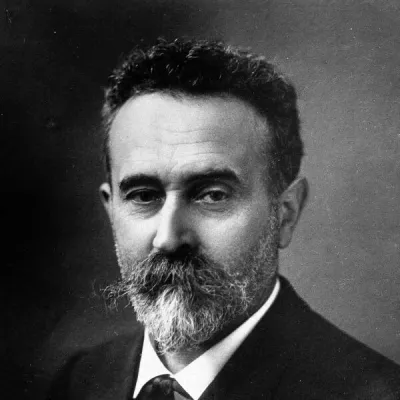
Alphonse Bertillon
Human Design Chart
Biography
He is also the inventor of the mug shot. Photographing of criminals began in the 1840s only a few years after the invention of photography, but it was not until 1888 that Bertillon standardized the process.
He died 13 February 1914.
What does Manifesting Generator 1/3 mean for Alphonse Bertillon?
Manifesting Generator 1/3 — Design at a Glance
Alphonse Bertillon had a hybrid energy configuration: as an Manifesting Generator, he combined the constant power of the Sacral Center with direct connection to the Motor Centers in his throat. This gave him the ability to skip steps and quickly draw results into his life. However, his design required a precise balance between the urge for immediate action and the necessity to respond to impulses.
The mechanics of his type created an internal conflict: The speed could lead to important stages being skipped, which inevitably led to catching up on missing steps and thus causing frustration – the core of non-self-experience for this type. Furthermore, Alphonse Bertillon tended to pursue several projects simultaneously as he responded to numerous stimuli. Without constant confirmation from his Sacral Center, this creative drive quickly turned into exhaustion.
Success only occurred when he operated in a „Play Mode“ and respected his authority as well as strategy. He had to wait until life spoke to him and check whether his inner center reacted with a clear „Yes“. As long as this resonance existed, parallel work was not a burden but rather a source of deep satisfaction. The rule of finishing one thing before starting another did not suit his nature; variety and fun were essential to channel his immense power constructively and avoid frustration.
Sacral Authority
Alphonse Bertillon was a Generator whose inner decision-making authority lay in the sacral center. This configuration simplified his process: His strategy and his authority were identical. He responded to external stimuli rather than initiating them. His decisions came from his gut, visible as somatic signals like grunting or a loud „Hmm“. Such physical responses marked the right path.
With appropriate reaction, he felt a surge of energy and inexhaustible power. He lived with great enthusiasm for his tasks, free from purposefulness. His life task was to immerse himself in what energetically spoke to him.
Additionally, an activated Spleen Center acted as a supportive instance. This gave him speed and spontaneity in responding. He had immediate access to his instinctive perception and physical well-being, which he could reliably trust. This combination of sacral vitality and spleen-induced quickness shaped the way he designed life: through direct, energetically grounded responses to the environment without hesitation or excessive thinking.
The 1/3 Profile — Investigator / Martyr
Alphonse Bertillon showed himself as someone whose judgments were based on a double check: theoretical foundation and practical testing. His Human Design Profile 1/3, the „Researcher/Experimentor“, defined an identity living in the tension field between deep need for self-sufficiency (Line 1) and drive to experiment (Line 3). Line 1 emphasized the necessity of a stable base; Alphonse Bertillon had to take care of himself first and create a foundation before acting. This sometimes generated fear about implementation, as there was a feeling of not knowing enough yet. But Line 3 challenged him to gain competence through experience. It represented a learning process by trial and error, driven by discipline and material ambition. For Alphonse Bertillon, authenticity was only achieved when both lines were integrated. If he valued something well, he had previously examined it intellectually as well as practically on his heart and gut level. This profile lives from „trial and error“; fears about implementation resisted the necessity of learning through mistakes. Line 3 started individually to trigger a collective adaptation process. Alphonse Bertillon's design thus described a life task: not just collecting insights but validating them through personal experience. His judgment was trustworthy because it had gone through the complete cycle from planning to practical testing. Authenticity emerged only from this combination of knowledge and lived practice.
Triple Split Definition — Defined & Open Centers
Alphonse Bertillon presented a design with remarkable inner stability. Six defined centers formed the mechanical foundation of his identity and energy. The defined G Center provided him with a reliable sense of self-identity and a clear direction for his life path, while the defined Heart Center supplied willpower and control over resources. His vital energy source came from the defined Sacral Center, which generated constant energy and responded to questions with either a yes or no answer. The defined Spleen Center fostered spontaneous intuition and an awareness of health in the present moment, supported by the physical pressure of the defined Root Center for movement. The defined Throat enabled a consistent expression of these inner mechanisms in the world.
In contrast, Head, Ajna, and Solar Plexus Centers were open. This meant that mental clarity and emotional stability were not consistently present but rather situational and dependent on the environment. Alphonse Bertillon was susceptible to taking up external thoughts and feelings. The open Head Center could confront him with doubts or questions that were not his own concerns, while the open Ajna Center tended to interpret others' answers as his own opinions. The open Solar Plexus absorbed emotional waves from the surroundings, which could lead him to experience foreign moods as his own instability. This openness required an awareness that thoughts and feelings often originated externally to avoid getting entangled in their vortex. Instead, this receptivity served to feel the emotional climate and take mental inspiration from various sources without identifying with them.
Channels for willpower, rhythm and meaningful struggle.
Alphonse Bertillon showed a fundamental disposition marked by a deep inner flow. His design tended to integrate other people into a shared energy flow through authentic timing and magnetic presence. This effect was based not on emotional fluctuation or intellectual arrogance but on the biological logic of life's current.
The Rhythm Channel 5-15 connected his Sacral Center with the G Center. Gate 5 held fast to fixed habits and rituals, while Gate 15 integrated the diversity of society into this flow. This combination created a universal life rhythm that acted as a magnetic monopoly in the G Center. Alphonse Bertillon was permanently carried forward by the current of life; his timing appeared natural and effortless to others. When aligned with his inner rhythm, he drew his environment into this stream and directed groups forward. This channel is the cornerstone of all biological processes, unaffected by emotional waves or intellectual logic. Instead, Gate 15 projected an impersonal love for humanity that bound all forms of life together.
In addition to this central flow, other energies were at work. The Money Line Channel 21-45 connected Heart and Throat, implying a strong need for control over material resources and personal methods. Here it was about the will to take responsibility while maintaining independence. The Life Struggle Channel 38-28 added a stubborn determination to find individual meaning and fight against external distractions. This created a driving force for individuation.
Additionally, Gates like Gate 41 (evolutionary development), Gate 31 (leadership), and Gate 27 (care) were at play. Gate 62 brought logical detail work and pattern recognition, while Gate 58 exerted pressure towards perfectionism. Alphonse Bertillon lived in the tension between this natural flow and the drive for control and meaning-making. His design promoted an existence structured by internal rhythms but also required a struggle for personal integrity and material stability.
Tribal Circuitry — Circuit Signature
Alphonse Bertillon oscillated between three distinct energetic poles. His design was marked by a triple definition, which meant he was not bound to a single role but responded situationally to the environment. This separation created parallel forces rather than a continuous flow.
In the Knowledge Circuit, the Life Struggle Channel connected the Spleen Center with the Root Center. This generated pulsating energy focused on the search for individual identity and new knowledge. It was about expressing one's unique path through creative intuition and recognizing patterns in the present moment.
Parallel to this, the Understanding Circuit was at work. Here, the Rhythm Channel connected the Identity Center with the Sacral Center. This connection allowed a focused, visual strategy for future planning. These were logical, rational insights free from emotional coloring aimed at structurally improving society.
The third pole was the Ego Circuit, which linked Throat and Heart Centers. The Money Line Channel here promoted cooperative resource building within a group. It was about material well-being through giving and taking as well as mutual support. Since this circuit lacked a connection to the Sacral Center, it lacked constant life force; Alphonse Bertillon therefore needed rest periods to sustainably generate these resources.
These three areas—individual creativity, rational strategy, and cooperative resource generation—existed alongside each other. They shaped his actions as reactions to external demands without one of these energies dominating or merging with the others.
Right Angle Cross of the Unexpected 1
Alphonse Bertillon's Human Design configuration carried the archetypal imprint of the 'Right Cross of the Unexpected 1'. This configuration defined his deeper life dynamics and formed the karmic backdrop of his existence. It established a specific pattern of unpredictability that shaped his experience.
This cross described a reality in which the unexpected was not an exception but the rule. It was a structure where challenges and opportunities alike emerged out of nowhere. Alphonse Bertillon lived within a field that did not function according to linear, predictable patterns but rather was marked by sudden turns. The mechanics of this cross showed itself as a constant confrontation with the unpredictable. There was no guarantee of stability in the traditional sense; instead, life demanded from him an attitude towards the surprising.
The emphasis lay on the way this unpredictability determined his steps. Whether as an obstacle or an opening, the unexpected was the constant companion. Alphonse Bertillon had to move within a framework where plans were often disrupted by external, uncontrollable factors. The cross created a density of experiences that fed from confrontation with the new and unplanned. It was not passive submission to fate but active participation in a life whose rhythm was dictated by surprises. This dynamic shaped his essence sustainably.
Saturn Return · Uranus Opposition · Chiron Return · 2nd Saturn Return — Life Cycles
Alphonse Bertillon's Human Design laid out a tendency towards structured, systematic breakthroughs. In 1880, at the age of 27, he developed the first closed system for personal identification. This marked his first Saturn Return: a phase in which years of groundwork often condenses into a solid result and inner discipline becomes outwardly effective.
Ten years later, in 1893 at the age of 40, he received the red ribbon of the Legion of Honor. This Uranus Opposition signaled a turning point through unexpected recognition or structural shift that confirmed his previous work and opened new perspectives.
The Chiron Return around the age of 50 is an achievement cycle in which one's purpose increasingly unfolds. In 1902, at 49 years old, he became the first person in Europe to identify a murderer through fingerprints. This showed the bloom of his life task: applying his specific knowledge to solve complex problems where means and action become one.
His second Saturn Return around age 60 often brings final consolidation or an end cycle. In 1913, Alphonse Bertillon fell seriously ill and died the following year. This cycle concluded his evolutionary journey by leading previously built structures into their final form.
Manifesting Generator · Sacral Authority — Synthesis
Alphonse Bertillon lived a life marked by a profound drive towards systematization and control – a continuum that manifested through his Human Design. As an Manifesting Generator with sacral authority, he possessed the energy to quickly set things in motion (Design), yet needed confirmation from his body for correctness and meaningfulness (Authority). This combination led to a work style characterized by swift action but always based on seeking the right timing and inner approval. His Profile as Researcher/Experimentator (Profile) reinforced this process, constantly testing and refining new methods – a cyclical loop of theory and practice (Cycles). The defined Throat Center and G Center (Centers) gave him the ability to clearly communicate his insights and find a firm identity in his work.
A central paradox lay in the tension between his manifesting energy and the need for sacral confirmation. He was destined to set things in motion (Design), yet his success depended on listening to the inner voice of his body. This led to a dynamic where he could both act quickly and pause – an interplay between initiation and reaction. The connection from Root Center to Spleen Center (Circuit) pointed towards a strong instinctual basis, which was complemented by the need for logical validation in the Mind Circuit. This tension pushed him toward new insights but also challenged him to find balance between rapid progress and thorough review.
3 Defined Channels
Incarnation Cross - Right Angle Cross of the Unexpected 1
Solar Return
The Solar Return shows the moment when the sun returns to its exact birth position - your personal solar year.
Life Cycles
Discover the life cycles with a detailed triple view (birth chart, cycle chart, composite).
Human Design Profile
- Strategy
- To respond - wait for something to respond to
- Authority
- Sacral Authority
- Profile
- 1/3 - Investigator / Martyr
- Definition
- Triple Split
- Incarnation Cross
- Right Angle Cross of the Unexpected 1
- Date of Birth
- 22.04.1853 09:00
- Place of Birth
- Paris, France
Frequently Asked Questions
What was Alphonse Bertillon's Human Design type?
What Profile did Alphonse Bertillon have in Human Design?
What Authority did Alphonse Bertillon have?
What incarnation cross did Alphonse Bertillon have?
When was Alphonse Bertillon born?
Discover your own Human Design
Are you also a Manifesting Generator? Find out in a personal reading how to unfold your multi-talents and direct your energy wisely.
More Personalities
Back to overviewAldair

Alizée

Angeli

Arletty
Artus

Balthus