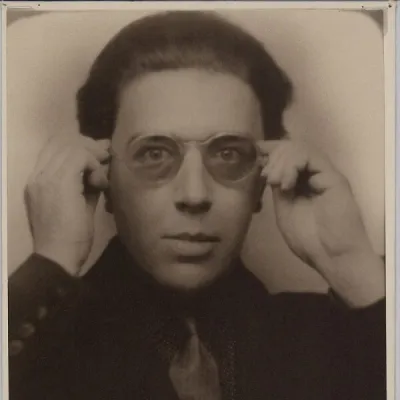
André Breton
Human Design Chart
Biography
Along with his role as leader of the surrealist movement he is the author of celebrated books such as Nadja and L'Amour fou. Those activities, combined with his critical and theoretical work on writing and the plastic arts, made André Breton a major figure in 20th-century French art and literature.
André Breton as a Manifesting Generator 1/3 in Human Design
Manifesting Generator 1/3 — Design at a Glance
André Breton's design shows a tendency towards hybrid dynamics: He combines the constant energy source of Generators with the ability to skip steps and quickly draw results into his life. As an Manifesting Generator, he had a defined Sacral Center that provided him with continuous strength. However, this dictated a specific strategy: Not to initiate himself but to react to external impulses. Only when this reaction was answered by an inner clear 'yes', the action would be fruitful.
His nature tended to pursue multiple projects in parallel and move forward quickly. This speed could, however, hide two pitfalls: Sometimes he skipped necessary intermediate steps, which later led to backtracking work and frustration - a classic sign of the non-self theme of this type. Additionally, through multitasking, he risked losing his inner consent if he did not regularly check whether his authority still stood behind the started paths.
If André Breton learned to respond to his impulses and engage in a playful mode where variety was welcome, he drew deep satisfaction from his work. The demand to always complete only one thing at a time contradicted his architecture; instead, his creativity flourished through parallel activities as long as they were carried by inner resonance. His path consisted of using his own speed without losing sight of the fundamental strategy of reacting.
Emotional Authority
André Breton's design shows a tendency towards emotional wave movements that shaped his perception of the world significantly. As a carrier of Emotional Authority, he was subject to constant ups and downs of his feelings; his view was always colored by the current mood. What appeared inspiring in one moment could seem negative in the next. These fluctuations did not mean that the first impression represented the truth. Quick, spontaneous decisions based on transient emotions often turned out disadvantageous for his life path.
The mechanics of his inner authority required patience and time. Since the defined Solar Plexus Center carried this authority, it always had priority over other defined centers in his chart, regardless of their number or type. The strategy was not to make decisions immediately but to take time so that intense feelings could subside. Only through multiple reconsiderations of a question did André Breton gain emotional distance. In this process, clarity and calm gradually set in. This path of delay was essential for long-term decisions that had a significant impact on his life course. Only when he went through this maturation process could he use his deeper, more comprehensive insight instead of being guided by momentary moods.
The 1/3 Profile — Investigator / Martyr
André Breton's design shows a tendency towards a dual approach: He was both a theoretical researcher and a practical experimenter. His Profile 1/3, that of the 'Researcher and Experimenter', marked him as someone who not only gathered knowledge but also tested it through personal action. Line 1 drove him to learning and planning, while Line 3 fueled his urge for trial and error. Often this led to an internal tension: The desire for complete theoretical preparation could delay implementation because he felt he did not know enough yet. But only through actual experimentation and learning from mistakes did his insight gain substance.
This process was supported by specific energetic configurations. Gate 55 in Line 1 emphasized the necessity of cooperation with stronger forces for mental growth; without this alliance, there was a risk of slipping into ineffective patterns. Simultaneously, Gate 34 in Line 3 addressed dealing with power through trial and error. This mechanism served to unlock higher levels of self-efficacy and authenticity development. For André Breton, therefore, self-earned insights were of central importance: If he considered something valid, it had passed both theoretical scrutiny and practical testing. His judgment was thus based on a solid synthesis of studied theory and lived experience.
Triple Split Definition — Defined & Open Centers
André Breton was someone who constantly felt mental pressure to ask questions and understand connections. This tendency stemmed from his definition between Head Center and Ajna Center: a constant stream of inspiration, but without direct energy for implementation. Instead of acting himself, he inspired others to think; his mind was always active, generating concepts and shaping the mental field around him.
His willpower and material orientation were given by his defined Heart Center. He liked to determine his life himself, keep promises, and seek recognition for his contribution. However, this ego strength stood in tension with his open G Center. Without a fixed identity or inner direction, he tended to be influenced by the environment and search for a borrowed identity. The constant question of who he really was and where love could be found could confuse him when he tried to fill this gap through the mind.
As a Generator, André Breton had a defined Sacral Center, an enormous source of vital energy. His strategy was not to initiate but to wait for life and then react. Only in this way could he unleash his full power; mental initiatives without sacral confirmation led to resistance and exhaustion. Additionally, his defined Solar Plexus Center: emotions were his inner authority. He had to wait for the emotional wave to gain clarity instead of impulsively reacting to highs or lows.
His open Root Center made him vulnerable to external stress. He absorbed the adrenalized pressure of his environment, which could lead to restlessness if he did not recognize this foreign impulse and let himself be carried away by it. His defined Spleen Center, on the other hand, offered intuitive safety in the present moment; his body instinct watched over health and well-being, independent of rational considerations. The Throat was his channel of manifestation through which these complex inner processes - mental, emotional, sacral - were translated into the world.
Channels for clarity, powerful intuition and communal connection.
André Breton's design tended towards impulsive, charismatic expressive strength. Channel Charisma 34-20 connected the raw physiological energy of the Sacral Center with the Now Gate in Throat Center. This configuration generated a drive for immediate manifestation that was often faster than conscious reaction. Breton showed himself as someone who had difficulty sitting still; his generative power sought constant discharge into the world. Without inner guidance, this energy could appear possessed or misdirected.
At the same time, Channel Flash of Insight 57-20 gave him sharp intuitive self-awareness. Here, knowledge flowed directly from Spleen to communication in the Now. This allowed André Breton to set spontaneous verbal outbursts that hit the core of a matter - not through logical thought but through acoustic intuition. He often knew intuitively what needed to be done and spoke this truth before others could grasp it rationally. His ability for mutative insight in the moment shaped his way of dealing with his environment.
In the mental realm, Channel Awareness 61-24 worked. It connected the inspiration of Head Center with rationalizing in Ajna Center. This created a thinker who did not work through discovery but sudden insight (Satori). André Breton's mind was designed to break old patterns and spontaneously generate new insights when mental silence allowed it. He did not control his thinking; knowledge happened at its own pace.
The basis of his vitality was Channel Power 34-57. It connected sacral energy with the intuitive vigilance of Spleen. This kept André Breton physically fit and acoustically alert to dangers or opportunities in his environment. His survival intelligence reacted immediately, free from mental delay.
Additionally, Gates like 59 (Mating Strategy) and 56 (Pictorial Storytelling) contributed to complexity while Channel Community 37-40 emphasized the need for emotional clarity in relationships. André Breton's design was a mix of impulsive action, intuitive truth, and mutative thinking.
Individual Circuitry — Circuit Signature
André Breton's design tended towards impulsive, innovative mental attitudes that discharged into concrete actions. This structure resulted from the Triple Definition: three separate energetic islands existed in parallel without direct flow to each other.
In the Knowledge Circuit, two isolated segments connected his thinking and action. Head Center and Ajna Center generated spontaneous flashes of insight (Channel 20-57), while Throat Center and Spleen Center filtered new insights acoustically or intuitively through Awareness (Channel 24-61). These channels promoted deviations from the known, which gave André Breton a stance of mutation and creative transformation.
Parallel to this, the Ego Circuit worked as an independent force. Here, Channel 37-40 (Community) connected Heart Center with Solar Plexus Center. This created a rhythm of giving and taking based on mutual support within a group. Without connection to Sacral Center, this dynamic required regular rest pauses for resource regeneration, which appeared conservative and traditional.
The third island formed the Integration Circuit. Here, Channel 20-34 (Charisma) and Channel 34-57 (Power) connected Throat, Sacral, and Spleen Centers into a continuous flow. This configuration allowed him to draw power from reacting to life, guide it through intuitive knowledge, and make it effective in the Now.
Together, these three separate systems created a complex profile: André Breton lived with a drive for individual knowledge creation, needed cooperative structures for resource security at the same time, and had direct access to intuitive self-empowerment in the present moment.
Right Angle Cross of the Sleeping Phoenix 1
André Bretons Human Design legte eine Tendenz zu einer tiefgreifenden, oft unbewussten Verbindung zwischen dem materiellen und dem spirituellen Bereich fest. Diese Konfiguration, bekannt als das rechte Kreuz des schlafenden Phönix, beschrieb eine Lebensaufgabe, die darin bestand, verborgene Wahrheiten aus der Tiefe des Unbewussten an die Oberfläche zu bringen. Es ging nicht um oberflächliche Erkenntnis, sondern um eine transformative Kraft, die aus dem Schlaf oder der Ruhe hervorgeht und plötzlich wirksam wird. André Breton zeigte sich als jemand, der diese energetische Brücke nutzte, um das Unsichtbare sichtbar zu machen. Die Mechanik dieses Kreuzes implizierte einen Prozess der Wiedergeburt durch die Konfrontation mit dem Verborgenen. Es war keine aktive Suche im herkömmlichen Sinne, sondern eine Empfänglichkeit für Impulse, die aus einer anderen Ebene kamen. Diese Energie prägte seine Art, die Welt zu sehen und zu gestalten, indem sie ihm erlaubte, Muster zu erkennen, die anderen verborgen blieben. Die Verbindung zwischen dem Schlafenden Phönix und der rechten Seite des Kreuzes betonte dabei die Integration dieser tiefen Erkenntnisse in das alltägliche Leben, ohne dass dies immer bewusst gesteuert werden konnte. Es war eine kraftvolle Strömung, die ihn trieb, das Gewöhnliche zu hinterfragen und nach einer höheren, oft surrealen Realität zu streben, die aus der Stille und dem Nicht-Wissen entsprang.
Saturn Return · Uranus Opposition · Chiron Return · 2nd Saturn Return — Life Cycles
André Bretons Human Design legte eine Tendenz zu radikalen Neuanfängen fest, die sich oft durch plötzliche, unerwartete Wendungen im persönlichen Leben zeigten. Diese Dynamik wurde 1924, im Alter von 28 Jahren, sichtbar: Die Veröffentlichung des Manifestes des Surrealismus markierte den ersten Saturn-Return. In diesem Zyklus verdichteten sich jahrelange Vorarbeiten zu einem tragfähigen Ergebnis, das seine innere Struktur nach außen trug und seinen Weg festigte.
Zehn Jahre später, 1934 im Alter von 38 Jahren, trat die Uranus-Opposition ein. Dieser Aspekt bringt oft eine Phase der Loslösung vom Bekannten mit sich, gepaart mit dem Verlangen nach Freiheit und neuen Perspektiven. Für André Breton mündete diese energetische Verschiebung in eine konkrete Lebensentscheidung: Die Heirat mit der Malerin Jacqueline Lamba. Es war ein Moment, in dem sich die Notwendigkeit des Wandels in einer festen Bindung manifestierte – nicht als Ende der Suche, sondern als neue Grundlage für künftige Entwicklungen.
Der Chiron-Return um das 49. Lebensjahr herum ist ein Erfüllungszyklus, in dem sich das eigene Inkarnationskreuz entfaltet und Sinn erfahrbar wird. 1945 heiratete André Breton Elisa Claro-Bindhoff. Dieses Ereignis unterstreicht die im Design angelegte Fähigkeit, auch in späteren Phasen noch tiefgreifende Verbindungen einzugehen, die als Bestätigung des gelebten Weges wirken. Die Beziehung war kein bloßer Zufall, sondern Teil einer sich vollziehenden inneren Reife und Ausrichtung auf den persönlichen Zweck.
Manifesting Generator · Emotional Authority — Synthesis
André Breton lebte ein Leben, das von einem ständigen Wechselspiel zwischen dem Drang zur schnellen Umsetzung und der Notwendigkeit emotionaler Reifung geprägt war. Als Manifestierender Generator besaß er eine konstante sakrale Energie (sakraler Zentrum), die ihn zu unmittelbarer Reaktion trieb – ein Impuls, der durch die Verbindung zum Throat-Zentrum verstärkt wurde und ihm ermöglichte, Ideen zügig in Bewegung zu setzen (Channel Charisma). Gleichzeitig erforderte seine emotionale Autorität eine Zeit der inneren Klärung, um Entscheidungen nicht vorschnell zu treffen und deren Konsequenzen vollständig zu erfassen. Diese Kombination aus schneller Reaktion und emotionaler Welle prägte seinen Ansatz, indem er sowohl innovative Wege beschritt als auch die Bedeutung gründlicher Prüfung erkannte (Profile Forscher/Experimentierer).
Ein zentrales Paradox in seinem Design lag in der Spannung zwischen dem Wunsch nach individueller Entdeckung im Wissens-Schaltkreis und der Notwendigkeit, diese Erkenntnisse durch emotionale Prozesse zu filtern. Das definierte Head-Zentrum schuf einen stetigen mentalen Druck, Fragen zu stellen und neue Perspektiven zu entwickeln, während die emotionale Autorität verlangte, dass diese Inspirationen erst nach einer Phase der emotionalen Auseinandersetzung geäußert wurden. Dies führte zu einem dynamischen Prozess des Suchens, Experimentierens und anschließenden Verfeinerns, wie etwa bei der Formulierung neuer Ideen im Jahr 1924 (Saturn-Return), oder auch in Beziehungen, die durch Phasen intensiver Erfahrung und emotionaler Verarbeitung gekennzeichnet waren (Uranus-Opposition, Chiron-Return).
5 Defined Channels
Incarnation Cross - Right Angle Cross of the Sleeping Phoenix 1
Solar Return
The Solar Return shows the moment when the sun returns to its exact birth position - your personal solar year.
Life Cycles
Discover the life cycles with a detailed triple view (birth chart, cycle chart, composite).
Human Design Profile
- Strategy
- To respond - wait for something to respond to
- Authority
- Emotional Authority
- Profile
- 1/3 - Investigator / Martyr
- Definition
- Triple Split
- Incarnation Cross
- Right Angle Cross of the Sleeping Phoenix 1
- Date of Birth
- 19.02.1896 22:00
- Place of Birth
- Tinchebray, France
Frequently Asked Questions
What was André Breton's Human Design type?
What Profile did André Breton have in Human Design?
Which Authority guided André Breton's decisions?
What incarnation cross did André Breton have?
When was André Breton born?
Discover your own Human Design
Are you also a Manifesting Generator? Find out in a personal reading how to unfold your multi-talents and direct your energy wisely.
More Personalities
Back to overviewAlain-Fournier

Aldair

Alizée

Angeli

Arletty

Artus