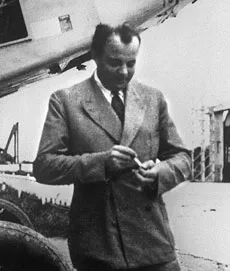
Antoine de Saint-Exupéry
Human Design Chart
Biography
During WW II, he flew reconnaissance missions during the Nazi invasion of France. Antoine disappeared mysteriously on his seventh mission on 31 July 1944 over the Mediterranean Alps in his P-38 Lightning. He was presumed dead by authorities either by crashing, being shot down or committing suicide. No trace of his body or plane had been found.
Saint-Exupéry grew up in an impoverished noble family. His father, Jean de Saint-Exupéry, worked for an insurance company. His mother, Marie, indulged her son and her other four children. He was brought up in two chateaux owned by his great aunt and his maternal grandparents. His father died when he was four years old. He displayed unruly behavior and was extremely willful to the nannies who tried to raise the boy and his siblings.
At 12, Saint-Exupéry tried to build an airborne bike. He was an avid reader who read Jules Verne and Hans Christian Anderson. Failing as a naval candidate at the Ecole Bossuet in Paris, he borrowed money from his mother and enrolled at the Beaux-Arts school to try his hand at architecture. He used his noble background to be invited to the best houses and enjoyed the lavish dinners and milieu of fellow aristocrats.
In 1921, he went to the Strasbourg military base and was awarded his pilot's license the following year. He went to work for a commercial airline company as an international air mail pilot and by 1926 was flying mail from Casablanca to Dakar. He wrote in his personal journal in cafes in Paris and when he traveled.
In 1929, Saint-Exupéry wrote his first novel, "Southern Mail.
Antoine de Saint-Exupéry as a Manifesting Generator 4/6 in Human Design
Manifesting Generator 4/6 — Design at a Glance
Antoine de Saint-Exupéry revealed himself as a Hybrid being: He possessed the constant, profound energy of a Manifesting Generator, yet also had the potential to skip steps and quickly draw results into his life. This combination of Manifesting Generator fundamentally shaped his approach to work.
His design required a specific strategy: Instead of taking initiative on his own, Antoine needed to respond to external impulses. Only when his sacral center – the source of his power – clearly signaled "yes" was it sensible to take action. This set him apart from pure initiators; his strength lay in responding rather than pushing forward.
However, this speed carried risks. If Antoine acted too quickly or skipped important intermediate steps, he often had to backtrack and do remedial work. Such situations easily led to frustration, the specific suffering path of this type. Additionally, he tended to pursue multiple projects simultaneously, driven by various impulses. Without constant confirmation from his inner authority, this versatility quickly tipped into overwhelm and dissatisfaction.
However, Antoine achieved deepest satisfaction and maximum creative power in "play mode." When he responded to impulses that found approval within him, parallel working was not a problem but rather a source of joy and variety. Thus, his design did not foster linear, single-track discipline but instead promoted a dynamic, playful approach where inner resonance determined whether an undertaking would be pursued further or not.
Emotional Authority
Antoine de Saint-Exupéry revealed himself as someone who did not leave his decisions to the first impulse but rather let them rest consciously. His design indicated a tendency to question spontaneous judgments and seek clarity only after emotional waves had subsided. This attitude stemmed from his emotional authority, carried by the defined Solar Plexus Center. In Human Design mechanics, this authority always takes precedence over all other defined centers, regardless of further configurations in the chart.
This center was subject to constant emotional fluctuations. Antoine de Saint-Exupéry saw the world colored by his current mood: at one moment he could be totally enthusiastic, and in the next, he might negatively evaluate the same situation. His immediate feeling was merely a snapshot, not necessarily his deeper truth. Quick, spontaneous decisions based on this emotion therefore risked negative consequences.
Instead, he gained insight by taking time. The requirement was to practice patience and "sleep over" decisions multiple times. Through this process, his feelings settled, creating emotional distance. Only then did calmness and true clarity set in. This mechanism was particularly relevant for long-term decisions that significantly influenced the course of his life. The necessity of this pause served to distinguish between momentary mood and deeper truth.
The 4/6 Profile — Opportunist / Role Model
Antoine de Saint-Exupéry was marked by his Profile 4/6, characterized by a tension field between social engagement and detached reflection. In the first three decades of his life, he experimented intensively, with Line 6 still acting like a Line 3. This manifested in various relationship and friendship dynamics driven by the curiosity of the networker.
With Saturn's return, Line 6 was fully activated. From this point on, his internal conflict between the deep desire for community belonging (Line 4) and the need to withdraw to think about the meaning of life (Line 6) intensified. This struggle of heart against head shaped his further development.
Line 4 provided him with self-discipline and concentration but remained cautious of false bonds to avoid injury. Simultaneously, Line 6 developed into a "Bodhisattva" stance: he expressed his opinion or leadership only upon request. In his later years, it was expected that he would act as a wise role model through cooperation and collective succession. His doubts served not for uncertainty but were beneficial to the collective when shared. This structure led to mutations in collective processes being initiated by his detached yet sought-after wisdom.
Single Definition — Defined & Open Centers
Antoine de Saint-Exupéry exhibited a persistent mental structure and clear emotional waves while lacking the energy for voluntary assertiveness. His defined Ajna Center ensured continuous conceptual thinking; he processed data in specific ways, independent of external influences. This mental constancy flowed into his defined Throat Center, allowing him to communicate his thoughts and concepts reliably. His identity and direction came from the defined G Center, which gave him a secure self-worth without needing to force others to follow his path.
His energy base was formed by his defined Sacral Center: He had vital power that only became active in response to requests. Initiatives from the mind led to frustration; waiting and reacting activated his generative energy. Simultaneously, his defined Solar Plexus acted as an emotional authority. He needed time for the emotional wave to subside before gaining clarity. Impulsive decisions made during emotional highs or lows were avoided through patience; only at the end of the cycle did he make correct judgments. His defined Spleen Center provided spontaneous intuitive warnings in the present moment, while his defined Root Center supplied a constant pressure to maintain life force.
In contrast, his Heart Center was open. Antoine de Saint-Exupéry lacked consistent willpower and tended to prove himself through promises or competitions to demonstrate value, often leading into cycles of overextension and self-doubt as he could not sustain such commitments. His open Head Center made him susceptible to mental pressure and doubt. He tended to engage with others' questions or seek inspiration to resolve confusion rather than relying on his inner authority. The combination of strong mental and emotional definition without consistent willpower characterized his actions: energy was regulated through reaction and emotional clarity, not ego-driven compulsion.
Channels & Gates
Antoine de Saint-Exupéry exhibited a fundamental disposition of permanent internal stillness. His design was marked by the defined Concentration Channel 52-9, which generated calm tension to maintain focus on details and facts. This format energy drove logic to perfect patterns by keeping distractions at bay. In the background, personality channels were active: The Awakening Channel 10-20 promoted authentic expression through self-love and individual guidance in the present moment. The Exploration Channel 34-10 supported inner strength to hold personal convictions while the Charisma Channel 34-20 offered potential for charismatic manifestation with proper sacral reaction. This combination created a tension field between the urge for silent concentration and the impulse for external, individual expression.
Circuit Signature
Antoine de Saint-Exupéry's design tended towards inner stability and strong self-worth. This internal stability came from the Centering Circuit, which in him connected the Sacral Center with the Identity Center. This created a stable personality with clear convictions that were often hard to verbalize due to no connection to the Throat Center.
Parallel to this, the Understanding Circuit was active. It linked two separate areas: On one hand Ajna and Throat Center, which translated logical thinking into words; on the other hand Sacral, Root, and Spleen Centers, linking strategic intuition with survival energy. This configuration promoted sharing rational insights for the future free from emotional influence.
The Meaning Circuit connected Throat and Solar Plexus in Antoine de Saint-Exupéry. It focused on past experiences and emotions. Feelings were processed cyclically and then shared to learn from the past. Unlike the cool logic of the Understanding Circuit, this involved emotional wave movements.
Finally, Integration acted as a connecting element. It linked Throat, Sacral, and Identity Centers directly together. This allowed Antoine de Saint-Exupéry to draw strength from reactions to life through intuitive knowledge and act effectively in the present moment. This connection strengthened his highest individuality and enabled direct implementation of inner impulses into external action and expression, partially integrating previously described separate energies.
Right Angle Cross of Service 2
Antoine de Saint-Exupéry's Human Design configuration pointed towards a tendency for service-oriented action. His identity and life path were defined by the principle that his existence was justified through acts of giving and helping, focusing on contributions to community or other people.
This orientation stemmed from the configuration 'The Right Cross of Service 2'. It described an inner alignment with service as a central motivational principle. For Antoine de Saint-Exupéry, it wasn't just an option for action but the fundamental structure of his personal definition. His sense of purpose arose from benefiting others and engaging in this way.
The mechanics of this cross emphasized that well-being and clarity about one's path were directly linked to the ability to serve effectively. It was not about readiness to sacrifice in a negative sense, but rather a natural alignment where helping became the source of energy. Antoine de Saint-Exupéry showed himself as someone whose inner balance depended on finding his place within a larger whole and actively being there for others. His design challenged him to take up this role to fulfill his own destiny. Without this service, he lacked connection to his center; with it, a deep bond with life itself emerged.
Saturn Return · Uranus Opposition · Chiron Return · 2nd Saturn Return — Life Cycles
Antoine de Saint-Exupéry's Human Design configuration pointed towards creative maturation and inner condensation. This structure shaped his development by not immediately releasing impulses outward but first condensing them internally until they became actionable.
In 1929, at the age of 29, he experienced his first Saturn Return. This cycle often marks a transition from experimentation to stable structuring. Indeed, Saint-Exupéry then completed advanced training in navigation with the Marine Flyers in Brest and subsequently went to Argentina to establish air mail and cargo lines. This event illustrated the mechanics of the Saturn Return: years of groundwork condensed into a concrete, stable life purpose and professional focus. The energy shifted from exploratory to defining; he laid the foundation for his later effectiveness.
Later, in 1940 at age 40, the Uranus Opposition occurred. This cycle often demands breaking free from old structures in favor of new perspectives or deeper inner work. Saint-Exupéry wrote on a book he had started in 1936: 'Citadelle' ('The City in the Desert'). Here, the Uranus dynamics did not manifest as external rebellion but as intense internal condensation and intellectual deepening. Thus, his design promoted a development line where external successes (Saturn) and inner transformations (Uranus) alternately took focus, always towards a clear personal expression form.
Manifesting Generator · Emotional Authority — Synthesis
Antoine de Saint-Exupéry was a Manifesting Generator whose life was marked by a profound dynamic between inner perception and the urge to shape the world. His defined Sacral Center provided a constant energy source, yet this was subject to emotional authority (Ajna Center) - quick impulses were not immediately acted upon but filtered through waves of feeling. This combination of sacral reaction and emotional weighing led to a life driven by focused attention on details (Channel 52-9) and the desire to contribute through precise work.
A central paradox in his design lay in the tension between individual focus and the need for connection. The profile as Networker/Role Model points towards a longing for community (Line 4), while Line 6 signals an inner drive toward reflection and wisdom. This led to a lifestyle where he both acted through cooperation with others - evidenced by professional steps (Saturn Return in 1929) - and sought phases of intense creative work (Uranus Opposition in 1940). This interplay between the desire for belonging and the necessity to withdraw shaped his character.
7 Defined Channels
Incarnation Cross - Right Angle Cross of Service 2
Solar Return
The Solar Return shows the moment when the sun returns to its exact birth position - your personal solar year.
Life Cycles
Discover the life cycles with a detailed triple view (birth chart, cycle chart, composite).
Human Design Profile
- Strategy
- To respond - wait for something to respond to
- Authority
- Emotional Authority
- Profile
- 4/6 - Opportunist / Role Model
- Definition
- Single Definition
- Incarnation Cross
- Right Angle Cross of Service 2
- Date of Birth
- 29.06.1900 09:15
- Place of Birth
- Lyon, France
Frequently Asked Questions
What is Antoine de Saint-Exupéry's Human Design type?
What profile did Antoine de Saint-Exupéry have?
Which authority guided Antoine de Saint-Exupéry?
What incarnation cross did Antoine de Saint-Exupéry have?
When was Antoine de Saint-Exupéry born?
Discover your own Human Design
Are you also a Manifesting Generator? Find out in a personal reading how to unfold your multi-talents and direct your energy wisely.
More Personalities
Back to overviewAlain-Fournier

Aldair

Alizée

Angeli

Arletty

Artus