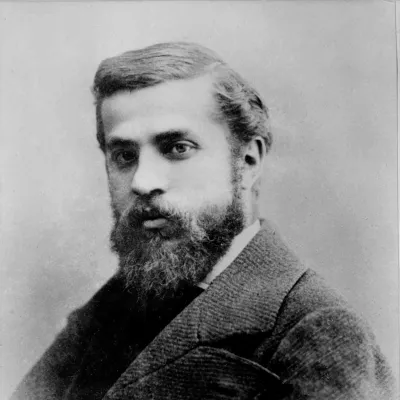
Antoni Gaudi
Human Design Chart
Biography
Gaudi was excessively pious, especially as he grew older. He used to shuffle around the streets of his city nibbling on crusts of bread and seeking alms for the building of the Sagrada Familia. He hated liberalism and was devoted to the most penitential and reactionary in Spanish Catholicism. Gloomy, short-fused and arrogant, he was untroubled by the Christian concept of humility. A misogynist, he never married and probably died a virgin.
He died 10 June 1926, Barcelona, Spain after being hit by a train. He had lived such a private life, that when his body was picked up, authorities assumed that he was just another homeless vagrant.
In 1992, a movement began to stir in Barcelona among the city's Catholic hierarchy to push for the beatification and eventual canonization of Gaudi. Virtuous and pious he may have been, but sainthood requires strong evidence of miracles, and though Gaudi has left breathtaking beauty behind, he has no track record of providing divine intervention.
What does Manifestor 1/3 mean for Antoni Gaudi?
Manifestor 1/3 — Design at a Glance
Antoni Gaudis design established a foundational stance as a pioneer and visionary, geared towards steering the world into new directions. His character bore traits of a Roman emperor: he possessed grand plans for an empire but did not wage wars himself; instead, he sent others to conquer foreign lands on his behalf. This structure brought with it a specific conflict. As he often thought further ahead than his surroundings, Antoni Gaudi was misunderstood and polarized strongly. His vast visions were loved by those who followed him, yet hated or rejected by others precisely because of their magnitude.
To navigate this dynamic, the mechanism of informing played a central role. Only through timely and precise communication of his intentions could he find the right followership. When Antoni Gaudi adhered to this strategy, he was rewarded with an inner sense of peace. However, if he lived against his design and failed to inform, it resulted in persistent, deep anger. Thus, his Human-Design not only described a leadership role but also a clear path for transforming misunderstandings into peaceful guidance through the consistent application of the informing strategy.
Emotional Authority
Antoni Gaudis inner authority lay in his defined Solar Plexus Center, fundamentally shaping his decision-making process. He was someone who did not achieve clarity through immediate intuition but rather by consciously navigating emotional waves. His feelings were subject to constant ups and downs; the world appeared colored by his current mood. What excited him deeply at one moment could appear negative in the next. These fleeting impulses were unreliable truths, merely initial impressions that often proved misleading upon quick reaction.
The mechanics of his emotional authority required patience and time. Rather than acting spontaneously, Gaudi let decisions mature. He practiced sleeping on questions multiple times to allow the initial emotional noise to subside. Over time, intense feelings subsided, allowing for an emotional distance. Only in this phase of calm did true clarity emerge. This process was essential for long-term course corrections that significantly influenced his life path. By waiting, he gained the depth and breadth of insight necessary, rather than being led by transient moods.
The 1/3 Profile — Investigator / Martyr
Antoni Gaudis design pointed towards a profound judgmental ability shaped through experience. He demonstrated someone who did not view theoretical knowledge in isolation but insisted on validating it practically. His Profile 1/3, that of the researcher and experimenter, defined this life task as a cyclical process of thorough learning followed by practical experimentation.
Line 1 of his design emphasized the necessity of pausing and concentrated deliberation before action. Here, there was pressure to commit energy for the concentration process to achieve stillness and calm of energy. Simultaneously, this aspect required that Antoni Gaudi face the consequences of his actions; an early release of energy would have led to time loss.
However, this theoretical impulse stood in tension with Line 3, which demanded trial and error as a central learning method. This line included understanding and adaptability, as well as conscious engagement and relinquishment of connections. For Antoni Gaudi, the best path was through detailed work and experiments. Experiences at the end of the journey were necessary, as shortcuts would have limited the value of his opinion and crucial details could have been missed.
The authenticity of his convictions only emerged from this combination: thorough preparation on one side and willingness to learn from mistakes on the other. When Antoni Gaudi made a decision or formed an opinion, he had previously examined it both theoretically and practically in depth. His design thus described someone whose confidence in their own insights grew through navigating this dual process – research and experimentation.
Split Definition — Defined & Open Centers
Antoni Gaudí's design established a tendency towards clear, strong-willed expression characterized by emotional depth and intuitive sharpness. His defined Throat Center ensured reliable communication, while the Heart Center provided willpower and self-determination. He was someone who waited to feel his emotions – his Solar Plexus was authority – before acting, supported by the spontaneous intuition of the Spleen Center and the persistent pressure of the Root Center to handle stress.
This firm structure in expression and emotion contrasted with his situational openness. With open Head and Ajna Centers, he was receptive to mental inspiration but tended to identify with foreign questions or concepts rather than seeking his own answers. His open G Center meant no fixed identity; he often sought direction through the environment and relationships instead of knowing it from within himself. Additionally, lacking a constant generative energy in his open Sacral Center, he was prone to identifying with others' work effort or overworking beyond his limits, which could lead to exhaustion as he did not always know when enough was enough.
The mechanics show: Gaudí had clear channels for expression, willpower, and emotional clarity but needed to learn to accept mental confusion and identity-seeking through external influences, rather than fighting against them. His strength lay in authentically speaking his inner truth; his challenge was not being overwhelmed by borrowed mental or sacral energy.
Channels for intuition, logic and interpersonal dynamics.
Antoni Gaudí's design established a tendency towards synthesizing intuitive depth with technical perfection. He showed himself as someone who transformed raw skill through years of repetitive practice into masterful talent. This process required not only engagement but also the recognition and resources to continue refining.
This attitude stemmed from the Channel of Wavelength 48-16. It connected Gate 48, which links with his inner intelligence beyond intellectual grasp, with Gate 16, which experimentally tests new possibilities and perfects skills. Through this connection, a gradual change towards precision became effective. The available depth of Gate 48 was only accessible to others when Gaudí tuned into the natural instincts of his body. By deeply identifying with a skill and practicing it, he communicated his talent or achieved the perfection of a pattern. On a cellular level, the body needed seven years to master a technique; exploring its depth took a lifetime.
This process was supported by the Channel of Judgment 58-18. It connected Gate 58 with his insatiable drive for
Collective Circuitry — Circuit Signature
Antoni Gaudí's design presented two energetically separate, parallel operating systems: on one hand, cool, future-oriented logic and on the other hand, traditional tribal logic. This separation formed the foundation of his inner dynamics.
The Understanding Circuit in him connected Throat, Spleen, and Root Centers. Here, the 'emotionless ratio' operated: logical structuring and strategic focus on future improvements. Without Solar Plexus influence, this insight remained free from emotional coloring, purely rational and visually oriented. It was about sharing clear, unconditioned insights regarding societal structure.
Completely isolated from this, the Ego Circuit acted, connecting Heart and Solar Plexus Centers. This area belonged to tribal logic, not individual ego. Without format energy, it was timeless and conservative in nature. Channel 37-40 regulated here the balance of giving and taking – mutual support within the collective. As there was no connection to the Sacral Center, rest periods were essential for regenerating resources for the tribe.
Between the futuristic, logical intelligence of the Understanding Circuit and the traditional, resource-oriented cooperation of the Ego Circuit, there was no direct bridge. Antoni Gaudí thus lived with a clear mechanical distance between his strategic future planning and his conservative handling of collective resource relationships.
Right Angle Cross of Service 2
Antoni Gaudis design emphasized a tendency towards deep devotion and service to others. His internal drive did not lie in the pursuit of selfish achievements but rather in making a meaningful contribution to the community or a greater whole. This fundamental attitude stemmed from the right Service Cross 2, a configuration that defines selflessness as a central life path.
This design pattern highlighted his willingness to put himself aside to meet the needs of others. It was not an imposed duty but rather a motivation from inner conviction: Antoni Gaudi found his own way through service. The mechanics of this cross show that true fulfillment for him lay in placing his identity at the service of a higher purpose.
The emphasis on devotion shaped his orientation sustainably. It was about creating value for others, with less focus on individual fame and more on the impact for the collective. Through this configuration, his actions were guided by a quiet but powerful motivation aimed at fostering lasting benefit through self-forgetfulness. His design thus described a life task where the 'I' was subordinated to the 'We', thereby fulfilling his deepest destiny.
Saturn Return · Uranus Opposition · Chiron Return · 2nd Saturn Return — Life Cycles
Antoni Gaudis design featured a structure in which external crises and maturation processes acted as catalysts for professional consolidation. His path showed a pattern of gradual solidification closely linked with planetary cycles.
In 1878, at age 26, Antoni Gaudi received his degree from the School of Architecture. This marked his first Saturn Return. During this cycle, years of groundwork coalesced into a viable result; it was a phase of structuring and professional foundation that allowed him to pour his skills into a clear format.
His Chiron Return followed in 1900 with the start of designing Park Güell. At age 48, Antoni Gaudi entered a fulfillment cycle. If he had lived according to his strategy, here his incarnation cross increasingly unfolded. It was not a time for repair but a bloom phase where meaning and purpose were experienced and his creative vision reached its full extent.
In 1906, at age 54, Antoni Gaudi experienced the death of his father Francesc Gaudí i Serra during his second Saturn Return. This cycle often brings profound upheavals and confrontation with final limits. For Antoni Gaudi, this loss acted as another catalyst for internal consolidation, profoundly shaping and reinforcing his creative orientation.
Manifestor · Emotional Authority — Synthesis
Antoni Gaudi was a Manifestor whose life was marked by a deep-rooted drive towards innovation and the expression of unique visions. His emotional authority (and the need to let decisions mature) combined with the ability to transform something in the world through communication and action (Throat Center), always trusting his inner instinctive intelligence (Channel of Wavelength). This interplay between inner maturity and the desire to express one's truth formed a red thread throughout his entire work. He was an explorer and experimenter (Profile 1/3) who delved deeply into themes before bringing his insights to the world – always striving to perfect skills and find solutions.
Gaudis design also showed itself as a tension field between the need for recognition of his visions (Manifestor) and the inner depth that fueled his creative process. The connection between logical understanding (Understanding Circuit) and a strong focus on the future worked alongside a deeply rooted ability to judge and name what did not work – an ongoing balance between the new and the proven. Experienced crises (such as his father's death) and career highlights revealed this internal conflict between the desire for progress and engagement with existing structures.
3 Defined Channels
Incarnation Cross - Right Angle Cross of Service 2
Solar Return
The Solar Return shows the moment when the sun returns to its exact birth position - your personal solar year.
Life Cycles
Discover the life cycles with a detailed triple view (birth chart, cycle chart, composite).
Human Design Profile
- Type
- Manifestor
- Strategy
- To inform others before acting
- Authority
- Emotional Authority
- Profile
- 1/3 - Investigator / Martyr
- Definition
- Split Definition
- Incarnation Cross
- Right Angle Cross of Service 2
- Date of Birth
- 25.06.1852 09:30
- Place of Birth
- Reus, Spain
Frequently Asked Questions
What was Antoni Gaudi's Human Design type?
Which Profile did Antoni Gaudi have in Human Design?
What Authority did Antoni Gaudi have?
Which incarnation cross was active for Antoni Gaudí?
When was Antoni Gaudí born?
Discover your own Human Design
Are you also a Manifestor? Find out in a personal reading how to use your initiation power peacefully and dissolve resistance.
More Personalities
Back to overviewChristian-Jaque
Kesha

Lucebert
Masaccio
Papus
Petrarch