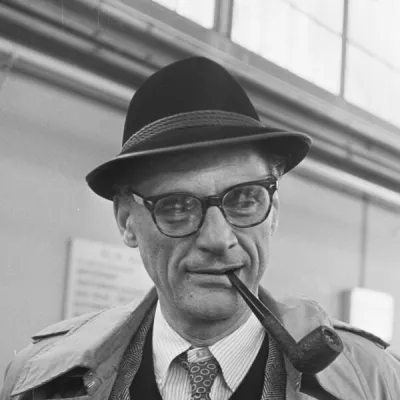
Arthur Miller
Human Design Chart
Biography
Miller was often in the public eye, particularly during the late 1940s, 1950s and early 1960s. During this time, he received a Pulitzer Prize for Drama, testified before the House Un-American Activities Committee, and married Marilyn Monroe. In 1980, he received the St. Louis Literary Award from the Saint Louis University Library Associates. He received the Praemium Imperiale prize in 2001, the Prince of Asturias Award in 2002, and the Jerusalem Prize in 2003, and the Dorothy and Lillian Gish Prize in 1999.
What does Generator 3/5 mean for Arthur Miller?
Generator 3/5 — Design at a Glance
Arthur Miller revealed himself as someone with immense endurance and strength, comparable to a workhorse ready to carry heavy loads. His Human Design type was the Generator, characterized by abundant energy in the sacral center. This configuration endowed him with the ability to manifest things sustainably into reality, provided he acted in harmony with his inner compass.
The central mechanism for him involved not initiating himself but responding to impulses from the outside world. When a signal came and his gut feeling gave a clear 'yes', he could effectively utilize this energy. If he adhered faithfully to this strategy, it led to a profound sense of fulfillment.
At the same time, he carried specific risks within him. One danger lay in permanently taking on tasks that did not bring him joy and only wasted his strength; this threatened to slow him down over the long term. The other stumbling block appeared when he was prevented from continuing work on his heart project despite still being full of energy for it. If, however, he tried to fight against nature and constantly initiate himself instead of waiting and responding, sooner or later he encountered frustration and a lack of life energy. His path to effectiveness therefore always lay in reacting to life rather than forcing self-actualization through sheer will.
Sacral Authority
Arthur's decision-making was characterized by direct physical resonance. As a Generator, he possessed sacral authority that also formed his strategy and simplified his process. This inner guidance did not manifest in the head but as an immediate reaction to external stimuli: a surge of energy in the gut or spontaneous vocalization like grunting signaled agreement. When he felt this impulse, he became vital and acted with inexhaustible energy and great enthusiasm. His design suggested that he was born to perform tasks joyfully without always assessing them against an external purpose.
This mechanism worked reliably because his emotional center was open; it did not obstruct the sacral response but allowed it to come through clearly. Additionally, his activated spleen center acted as a supportive instance. Through its connection to the sacral center, this enabled quick, spontaneous reactions and direct access to instinctive perception. Arthur could thus rely on being guided by his physical well-being. This configuration described a way of life in which he could fully immerse himself in his tasks, driven by the inner confirmation of the moment rather than through lengthy cognitive deliberations or emotional delays. His energy was therefore directly linked to his ability to respond here and now and experience satisfaction.
The 3/5 Profile — Martyr / Heretic
Arthur Miller's design was marked by the tension between experimental freedom and a heroic commitment to reliability. As a 3/5 profile ("Explorer/Hero"), he initially learned through personal experimentation without adopting preconceived beliefs. This line of the adventurer led him to gain knowledge primarily through practical action, often also in failures, which he then offered as solutions to others.
This dynamic was shaped by specific lines configurations: The third line at Gate 32 brought a tendency towards indecision and a lack of continuity with it. During times of transformation, he often lacked a clear instinct, leading to delayed changes or the loss of earlier achievements. At the same time, the fifth line at Gate 62 acted as an opposing force: It demanded metamorphosis and practical perfection in crisis situations. Here his drive to penetrate details to absolute clarity before presenting them to the public was evident.
Miller's appeal to others arose precisely from this combination: He offered the rich treasure of his practical experiences, earning him the role of helper and storyteller. This heroic role flattered his design but became painful when his public experiments failed in plain sight. His life thus became a continuous process of experimentation, internal detail work, and external presentation, navigating between the lightness of an experimenter and the weight of expected perfection.
Split Definition — Defined & Open Centers
Arthur Miller's design inclined towards clear, identity-based communication. His defined throat connected directly to the G Center, meaning he spoke not from momentary emotions or intellectual concepts but from a firm inner direction and a deep sense of his own self. This configuration gave his voice a consistent quality: He articulated his truth honestly and without hesitation as the source of his utterances – the G Center – was reliable.
As a Generator with defined Sacral and Spleen Centers, Arthur Miller had an enormous vital energy base that could only be activated through reaction. His design required him to wait for impulses before acting; his Sacral Center then responded with a clear yes or no, signaling the availability of his power. Simultaneously, his defined Spleen worked in pure present moment, delivering spontaneous intuitive judgments about health and safety. This combination of sacral endurance and spleen-based intuition allowed him to persistently focus on tasks that were intuitively felt as correct, while his defined Root Center provided the necessary pressure to carry these processes through to completion.
At the same time, his chart revealed specific vulnerabilities through several undefined centers. His open Head and Ajna Centers made him susceptible to mental confusion; he tended to engage with questions not of his own making or tried to find answers where no consistent inspiration was present. This could lead to an internal monologue seeking validation rather than trusting his inner authority. His open Heart Center led to frequent proving himself; he risked making promises or getting entangled in competitive situations to prove his worth, though he couldn't consistently generate this energy. Additionally, his open Solar Plexus absorbed the emotions of his surroundings strongly, leading him to personalize foreign moods and recoil from emotional confrontations to maintain peace. These open areas required him to always distinguish between his own truth and impulses taken on from the world.
Channels for maturation, logical leadership and intuitive precision.
Arthur Miller's design inclined towards collective leadership based on logical scrutiny and gaining trust. He was someone who did not rule through absolute authority but by understanding patterns and inviting others to follow him. This attitude was shaped by the Alpha Channel 7-31: Gate 7 provided the logical role of "the power behind the throne,", while Gate 31 spoke as a collective leader. His voice had influence because it articulated tested, valid patterns that one could safely follow. Success occurred when he was chosen by the majority to represent them; he showed the way but did not take it away from others.
Parallel to this, there was an urge in him to transform intuitive depth into mastery through repeated experimentation. The Wave Channel 48-16 connected the inner intelligence of Gate 48 with the skillfulness of Gate 16. Here it was about step-by-step perfection of a skill – whether in logical process or artistic expression – until technical mastery became a unique talent. This talent flourished when rewarded by recognition and resources, feeding the cycle of master and apprentice.
Another aspect was his cyclical approach to experience. The Maturity Channel 42-53 drove him to start new cycles, complete them fully, and then reflect to gain wisdom. Each experience had to have a satisfying conclusion before the next chapter began; premature endings led to repeating the cycle.
Additionally, prioritized gates contributed: Gate 32 sought continuity and material success for the tribe, while Gate 62 with patience checked details and logically ordered patterns. Gate 61 aimed at inner truth and silence amidst mental noise, and Gate 28 demanded decisions in the here and now by listening to his own authority. Gate 19 connected him with resources and territory, Gate 52 required a concentrated pause for pattern correction, and Gate 39 used provocation for analytical re-evaluation. Gate 25 brought mystical innocence, Gate 56 allowed abstraction of mental processes into stories, Gate 13 collected experiences for collective memory, and Gate 15 organized according to natural rhythms of collective behavior.
Collective Circuitry — Circuit Signature
Arthur Miller's design inclined towards rational structuring moving through separate energetic poles. As a person with Split Definition, he had no continuous connection between these areas; they existed as parallel, independent forces in his system.
The Understanding Circuit connected his Throat, Identity, and Spleen Centers into a coherent flow. This allowed an "emotionless ratio" sharing logical insights free from conditioning. The energy was future-oriented, focused on strategy and improving society through visual understanding and clear formats.
Completely separate from this worked the Meaning-Finding Circuit. It exclusively connected the Sacral and Root Centers. Here it wasn't about cool logic but cyclical emotional waves from the past. This energy reflected past events to find their meaning and imparted learned insights emotionally with the collective.
Arthur Miller thus showed himself as someone who, on one hand, looked into the future through clear rational visions, while on the other hand was marked by deep, wave-like emotions of the past. Since these circuits were not connected, he had to process these two different information types – the cool strategy and the hot emotional reflection – as separate experiences without them automatically merging into a single truth.
Right Angle Cross of Maya 3
Arthur Miller's Human Design profile carried the signature of the right cross of the Maya. This configuration shaped a fundamental disposition characterized by deep empathy and a strong desire for emotional connection. In Human-Design terms, this pattern describes an energetic structure that guides people to experience relationships not just as exchanges of information but as profound emotional resonance. Arthur Miller often appeared as someone who exerted a calming, stabilizing influence in his environment without needing to be at the center.
The mechanics of this cross promote the ability to feel and convey the emotions of others while maintaining inner calmness. It is not about active leadership or dominant presence but rather creating a safe space where others can open up. Arthur Miller's chart suggested that he often resolved conflicts through gentle de-escalation and understanding, rather than direct confrontation. This energy acted like an invisible adhesive, holding groups or couples together by absorbing emotional tensions and transforming them into stable forms. His way of being was marked by a quiet aura that fostered trust without demanding it.
Saturn Return · Uranus Opposition · Chiron Return · 2nd Saturn Return — Life Cycles
Arthur Miller's Human Design profile indicated a tendency towards structural condensation, often manifesting in early years as a search for solid foundations. This attitude aligns with the mechanics of the first Saturn Return, a cycle that begins around age 29 and compresses years of groundwork into a stable outcome. For Arthur Miller, this process became effective in 1944: he received the Theatre Guild Award. This success was not coincidental but marked the crystallization of his inner authority into external recognition – a typical moment when the design finds its first major confirmation and lays the foundation for future developments.
Later, Arthur Miller showed deep transformations when internal tensions demanded resolution. This corresponds to the dynamics of the Uranus Opposition, which occurs around age 41 and challenges old structures to enable new freedoms. For Arthur Miller, this turning point came in 1956: he married Marilyn Monroe. This relationship was not just a change but the manifestation of a necessary break from the known towards something unconventional. The mechanics of this cycle often require radical breaks for full potential realization; with Arthur Miller, it showed in a partnership that opened new dimensions both personally and publicly, fundamentally changing his life direction.
Generator · Sacral Authority — Synthesis
Arthur Miller was a Generator whose life was marked by a deep-rooted drive to work and the need to keep energy moving (sacral authority). His profile as an experimenter/hero and rescuer suggests he learned through personal experiences and used this knowledge to help others. This combination of sacral motivation and willingness to face new challenges led him to continually explore new paths and invest his energy in projects close to his heart – provided he was not hindered by external forces. The definition in the Communication and Manifestation Center (Throat Center) amplified this tendency towards expressive power and influence on his surroundings.
A central paradox in his design lay in the connection between the Understanding Circuit, which emphasizes logical structures and future perspectives (Channel of the Alpha Animal), and the Meaning Seeking Circuit, which searches for significance and inner truth. Miller seemed to strive to understand the world through rational analysis while simultaneously having a deep need to ask deeper questions and authentically represent human experiences. This led to a tension between the desire for control and order versus acceptance of uncertainty and complexity – dynamics that reflected in his works.
3 Defined Channels
Incarnation Cross - Right Angle Cross of Maya 3
Solar Return
The Solar Return shows the moment when the sun returns to its exact birth position - your personal solar year.
Life Cycles
Discover the life cycles with a detailed triple view (birth chart, cycle chart, composite).
Human Design Profile
- Type
- Generator
- Strategy
- To respond - wait for something to respond to
- Authority
- Sacral Authority
- Profile
- 3/5 - Martyr / Heretic
- Definition
- Split Definition
- Incarnation Cross
- Right Angle Cross of Maya 3
- Date of Birth
- 17.10.1915 05:12
- Place of Birth
- New York, United States
Frequently Asked Questions
What was Arthur Miller's Human Design type?
What Profile did Arthur Miller have in Human Design?
What Authority guided Arthur Miller's decisions?
What incarnation cross was assigned to Arthur Miller?
When was Arthur Miller born?
Discover your own Human Design
Are you also a Generator? Find out in a personal reading how to use your sacral energy correctly and discover deep satisfaction.
More Personalities
Back to overviewAaliyah

Alain-Fournier

Alexia

Angèle

Angeli

Anne-Marie