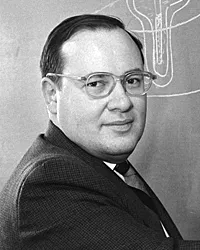
Arthur Schawlow
Human Design Chart
Biography
Arthur Schawlow had one marriage with three children. He died of leukaemia on 28 April 1999 at age 77 in Palo Alto, California.
Human Design Analysis: Arthur Schawlow as Manifestor 2/4
Manifestor 2/4 — Design at a Glance
Arthur Schawlow's design marked him as a pioneer, whose nature lay in steering the world in a new direction. Similar to an emperor pursuing visions of a great empire without leading battles himself, he had a tendency to mobilize others to achieve his goals. This configuration often led to him being misunderstood; his thoughts frequently lay beyond the conventional, which inspired admiration in some and disdain or even hatred in others. This polarization was a central aspect of his experiential world. To find the right followers who could support his visions, it was essential for him to inform others timely and precisely about his intentions. This strategy of informing served to minimize resistance and generate resonance. Living according to this strategy rewarded him with a sense of inner peace. Failing to adhere to this path, however, led to a persistent, deep-seated anger within him. His design thus established that clear communication was the key to exercising his leadership role while simultaneously avoiding the emotional turbulence that arose from misunderstandings. Arthur Schawlow moved within this tension between the need to be seen and understood and the inherent challenge of often appearing isolated as a visionary until he reached the right people.
Emotional Authority
Arthur Schawlow's design inclined towards emotional depth and wave-like experience. As a person with defined Emotional Authority, he was subject to an internal dynamic that manifested in a constant up and down of emotions. The world appeared to him always colored by his current mood; what was exciting in one moment could appear negative in the next. However, this emotional wave did not mean that the first impression was the truth. Quick, spontaneous decisions based on fleeting emotions often proved detrimental, as they ignored the unresolved situation.
Central to this configuration was the rule that the defined Emotional Center always carried the inner authority, regardless of which other centers were also defined. This priority required patience. Arthur Schawlow was someone who did not make decisions immediately but let them mature. Sleeping on important questions and hesitation served to let intense feelings subside. Only with this distance did clarity and calmness set in. This process of emotional condensation was particularly crucial for long-term, life-defining decisions, as it ensured that the choice was based on deeper insight rather than transient mood.
The 2/4 Profile — Hermit / Opportunist
Arthur Schawlow, through the Profile 2/4, oscillated between a deep need for withdrawal and a desire for close connection. This configuration created an inner tension: Line 2, the 'Hermit' principle, demanded time alone to gain clarity and penetrate internal processes. Simultaneously, Line 4, the 'Community' principle, drew him into the circle of his trusted people. For him, it was essential to establish a safe environment where he could clearly communicate when he sought company and when he wanted to be undisturbed.
During his alone time, he immersed himself in his natural talents. The second line described a natural ability to find the right direction without consciously steering it. Crucial was that he was correctly 'called', rather than intervening in processes that were not his. A defined ego supported this realization better than an open one.
At the same time, he carried the burden of Line 4. This zone tended towards exhaustion, as it struggled to fend off when others told their stories. He absorbed much emotional energy, which weighed on him. After phases of renewal and listening, exhaustion often followed, pushing him back into silence to reflect. Only when the need for peace was satisfied did he return to his network to evaluate the knowledge gathered there and develop new insights. This rhythm of exchange and withdrawal shaped his work style.
Split Definition — Defined & Open Centers
Arthur Schawlow's design indicated a tendency towards constant mental pressure and deep conceptual work. His defined Head and Ajna Centers created a permanent inner drive to question and understand connections. However, this process was purely mental; without a direct energy source for implementation, the challenge was to practice patience and inspire others with implementing power, rather than falling into frustration over unresolved thoughts. His defined Throat Center allowed him to articulate these concepts clearly, while his defined G Center provided a stable identity and inner direction. The defined Heart and Solar Plexus Centers added willpower and emotional depth, requiring him to make decisions only after waiting for the emotional wave to gain clarity.
In contrast, his open Centers acted as mirrors for external influences. His open Sacral Center made him susceptible to absorbing foreign vital energy, which could lead to overload if he did not listen to his own limits. His open Spleen Center brought a fundamental fear of survival, causing him to cling to insecure structures to gain a false sense of security. Additionally, his open Root Center absorbed external stress, leading to a cycle of avoidable tension and attempts to unload this non-native pressure through excessive activity. Arthur Schawlow's path involved using the stability of his defined Centers to navigate these open fields through inner authority rather than conditioning.
Channels for inspiration, community, reflection, clarity and pioneering.
Arthur Schawlow was someone who had to influence through authentic role modeling and gain deep insights. His design indicated a tendency towards individual inspiration, combined with the ability to reflect experiences and use mystical intuition.
The Channel of Inspiration 1-8 connected his G Center with the Throat Center. Through the Gate of Self-Expression (1) and the Gate of Contribution (8), he was designed to inspire others through his unique life and creative existence, rather than just explaining. He lived his individual direction and thereby attracted attention, opening a mutative perspective for others.
Parallel to this, the Channel of the Lost Son 13-33 was active. It also connected G and Throat Centers, this time through the Gate of the Listener (13) and the Gate of Retreat (33). This helped him to be patient in collecting information and secrets, withdrawing to process them, and only then, when the truth was ripe, to share his insights.
Mentally, the Channel of Awareness 61-24 shaped his thinking. Between Head and Ajna Centers, carried by the Gate of Secrets (61) and the Gate of Rationalization (24), he experienced sudden moments of knowledge (Satori). His mind sought silence to accept these mutative insights, which had to be accepted rather than controlled.
Emotionally and energetically, the Channel of Initiation 51-25 formed his attitude. It connected the Heart Center through the Gate of Shock (51) and the Gate of the Spirit of Self (25). This gave him natural competitiveness and the ability to reach individual awareness through initiation shocks and to encourage others in this process.
Additionally, the Channel of Community 37-40 between Solar Plexus and Heart Centers was active. Through the Gate of Friendship (37) and the Gate of Solitude (40), he sought his place in groups based on mutual respect and clear emotional agreements.
Individual Gates like Gate 2 (Receptivity), Gate 7 (Leadership), Gate 55 (Emotional Awareness), Gate 36 (Crisis), Gate 6 (Friction), and Gate 47 (Understanding) rounded out this profile by supporting receptivity to new directions, leadership potential, emotional depth, and the processing of collective past.
Individual Circuitry — Circuit Signature
Arthur Schawlow's design was a configuration of separate, parallel functioning energetic blocks, as he had a split definition. This meant that his inner forces did not flow in a single continuous stream but acted in two independent clusters: a block consisting of Identity, Heart, Solar Plexus, and Throat, and a separate block consisting of Ajna and Head.
Within this structure, four specific circuits were active. The Knowledge Circuit in him consisted of two isolated parts: a connection between Head and Ajna (Inspiration) and one between Throat and Identity Center (Awareness). These separated the mental inspiration from the identity-forming expression. Parallel to this, the Centering Circuit connected the Identity with the Heart Center through the Channel of Initiation, fostering inner stability and strong conviction, but without a direct expression channel to the Throat.
The Meaning Circuit linked Throat and Identity Center through the Channel of the Lost Son. This directed energy towards the emotional reflection of past experiences and their sharing, driven by the wave-like dynamics of the Solar Plexus. Finally, the Ego Circuit operated through the Channel of Community, which connected Heart and Solar Plexus Centers. This created a dynamic of mutual giving and taking as well as cooperation, but required regular rest periods due to the missing Sacral connection for resource renewal. Overall, these separate but internally coherent systems shaped a personality that navigated between inner conviction, emotional reflection, and cooperative interaction without these areas directly overlapping.
Right Angle Cross of the Sphinx 2
Arthur Schawlow's design showed a tendency towards deep, often painful self-reflection. This configuration, the right cross of the Sphinx, established a fundamental attitude that did not seek superficial validation but rather a radical, sometimes brutal honesty with his own soul. It was an internal process of purification, where old, no longer useful identities or beliefs were shed to make room for a more authentic existence.
This mechanism did not manifest as external actions but as intense inner work. Arthur Schawlow was called to confront the darker, often unconscious aspects of his nature. It was not about self-pity but about a transformative power that arose through the confrontation with his own suffering or shadows. The goal of this inner dynamic was the liberation from illusions and the return to an unclouded, though often solitary, truth.
This energy shaped his inner disposition through a constant drive towards purification. It challenged him not to lose himself in social roles or external successes but always to look inward. The resulting clarity was the outcome of a continuous, often arduous process of letting go and starting anew on a soul level. Arthur Schawlow's path was thus marked by this profound inner transformation aimed at authenticity and spiritual integrity, independent of external circumstances or recognition.
Saturn Return · Uranus Opposition · Chiron Return · 2nd Saturn Return — Life Cycles
Arthur Schawlow's design showed a clear tendency towards structural anchoring in relationships and career, confirmed through recurring planetary cycles. His first Saturn return was in 1951, at the age of 30, marking his marriage to Aurelia Townes. This cycle symbolizes the formation of stable life structures; here, his private foundation solidified through a committed partnership.
Ten years later, in 1961, the Uranus opposition hit his design. At 40, he was appointed Professor of Physics at Stanford University. This configuration often demands a radical reorientation or expansion of identity. Arthur Schawlow used this impulse to fundamentally expand his professional role and establish himself in a new academic environment.
His second Saturn return in 1978, when he was 57, crowned this development. His appointment as J. G. Jackson and C. J. Woods Professor confirmed the structures he had built. This cycle requires the integration of long-term experiences into a stable, recognized position. Arthur Schawlow lived this mechanism by reinforcing his scientific authority through a prestigious professorship. His life stations followed the rhythmic dictates of his chart exactly: private commitment, professional expansion, and finally institutional affirmation.
Manifestor · Emotional Authority — Synthesis
Arthur Schawlow was a Manifestor whose life was marked by an internal tension between the drive to forge new paths and the need to gather in periods of retreat. His emotional authority (emotional center) required time to mature decisions, while his defined Head Center (Head-Ajna) continuously pressed for inspiration and understanding. This combination led to a deep engagement with complex ideas, which he then expressed through the channel of inspiration (Gate 1/8) – a creative contribution that often drew attention.
A central paradox in his design lay in the interaction between the need for solitude (Line 2) and the desire for community (Line 4). He oscillated between retreating into internal processes to gain clarity and the need to share his insights and connect with others. This was evident in key moments when professional recognition (1961, 1978) coincided with personal commitments (1951), indicating a lifestyle shaped by both independent thinking and connection with others.
5 Defined Channels
Incarnation Cross - Right Angle Cross of the Sphinx 2
Solar Return
The Solar Return shows the moment when the sun returns to its exact birth position - your personal solar year.
Life Cycles
Discover the life cycles with a detailed triple view (birth chart, cycle chart, composite).
Human Design Profile
- Type
- Manifestor
- Strategy
- To inform others before acting
- Authority
- Emotional Authority
- Profile
- 2/4 - Hermit / Opportunist
- Definition
- Split Definition
- Incarnation Cross
- Right Angle Cross of the Sphinx 2
- Date of Birth
- 05.05.1921 11:00
- Place of Birth
- Mount Vernon (Westchester County), NY, United States
Frequently Asked Questions
What was Arthur Schawlow's Human Design type?
What Profile did Arthur Schawlow have in Human Design?
What Authority guided Arthur Schawlow in making decisions?
What incarnation cross was Arthur Schawlow assigned to?
When was Arthur Schawlow born?
Discover your own Human Design
Are you also a Manifestor? Find out in a personal reading how to use your initiation power peacefully and dissolve resistance.
More Personalities
Back to overviewChristian-Jaque
Kesha

Lucebert
Masaccio
Nadar
Papus