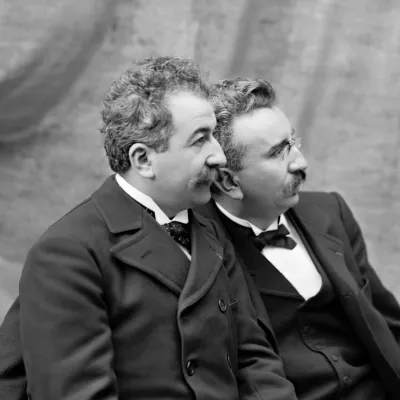
Auguste Lumière
Human Design Chart
Biography
Auguste unwittingly became one of the first film stars by appearing as a subject in many of the films shot by Louis. However, according to Louis, Auguste lost interest in the cinematographer as soon as construction had been completed, and thereafter showed no further interest in the film medium. An active biologist, he spent much of his later life working in a physiological lab clinic which he founded.
Lumiere died on 10 April 1954 Lyon, France.
What does Projector 6/2 mean for Auguste Lumière?
Projector 6/2 — Design at a Glance
Auguste Lumière exhibited an intense and focused presence that distinguished him as someone who quickly identified weaknesses in other people's systems. As a Projector, he did not have a constant internal energy source like a motor but rather acted more like a bright flashlight: His light shone directly on areas around him that were still dark or malfunctioning. This ability to immediately identify errors was powerful yet risky. If he projected this insight unfiltered and directly into others' faces, it often came across as challenging and met with resistance.
The more effective strategy for Auguste Lumière involved not actively pushing but rather setting a harmonious example himself. By walking his own path and shining brightly, he naturally attracted those who then sought his guidance. His design required him to wait for an honest, appreciative invitation from others before offering his knowledge or leadership. Without this invitation, he risked feeling overwhelmed because his undefined Sacral Center alternated between phases of high activity and necessary rest periods to prevent burnout. Living by the principle of patiently waiting for invitations to lead brought him success; ignoring this dynamic and instead trying to impose his viewpoint led to the typical feeling of not being oneself, characterized by bitterness. His influence was thus never a matter of brute force but rather of attractive clarity and the right timing of his interventions.
Splenic Authority
Auguste Lumière acted according to an inner authority rooted in the Spleen Center. This design required a high level of vigilance towards the first spontaneous impulse as a reliable indicator of health and well-being. With the Emotional and Sacral Centers open, this survival intelligence could operate; it did not manifest as a long-term strategy but rather as immediate knowledge at the moment of decision.
This subtle Spleen impulse came only once and had to be recognized immediately before being drowned out by other influences. Auguste Lumière used this intuition rigorously to distance himself from harmful environments or societies, protecting himself in the process. Plans were subject to constant short-term changes since what was right became clear only at each moment. Long-term commitments hindered this process; instead, he sought much freedom and flexibility. A temporary withdrawal supported decision-making when the spontaneous impulse was not immediately clear. This configuration shaped a lifestyle based on the protection of one's own resources and distinguished itself through adaptability to current circumstances without unnecessary binding.
The 6/2 Profile — Role Model / Hermit
Auguste Lumière revealed himself in his youth as an experimental natural talent who learned through trial and error. His design configuration as Profile 6/2 – 'Role Model/Natural Talent' – dictated that before the age of thirty, the energy of Line 3 dominated. This meant a phase of intense experimentation where setbacks and feelings of failure were not seen as final destinations but rather as necessary steps towards self-awareness. The accompanying fear of material failure, characteristic of Line 6 in Gate 32, drove him to accept changes and preserve himself through transformation.
After the age of thirty, this dynamic fundamentally shifted. The wisdom of Line 6 became effective, prompting Auguste Lumière to reflect more deeply on his earlier experiments. Instead of continuing to act impulsively, he metaphorically withdrew to look at the accumulated experiences with distance. This process of healing and introspection allowed him to emerge from the isolation of the 'genius' – a feature of Gate 56 in Line 2 – to become a role model whose insights were now accessible to others. The initial inability to respond appropriately to stimuli gave way to stable wisdom, enabling others to learn from his deep self-reflection and equanimity towards impermanence.
Split Definition — Defined & Open Centers
Auguste Lumière's Human Design profile indicated a tendency towards consequent and willful implementation of his intentions. His defined Heart Center endowed him with consistent determination and the drive to take control of his life, fulfilling promises made. This energy flowed into his defined Throat Center, enabling clear communication and manifestation of his goals. Supported by his defined Ajna Center, he maintained a reliable, independent mental structure; concepts were processed stably without being easily influenced from outside. His defined Spleen Center added an intuitive, momentary perception that oriented him towards health and well-being in the present.
At the same time, Auguste Lumière was strongly exposed to his environment through several open centers. The open Head Center made him vulnerable to mental pressure and the need to find answers not coming from himself; he tended to identify with others' questions. His open G Center meant a lack of fixed identity, leading him to take directions and love from the surroundings, often reflecting in relationships rather than standing independently. An open Sacral Center led to unstable energy; he amplified the vitality of others but risked overloading and exhaustion through borrowed strength. Additionally, his open Solar Plexus absorbed foreign emotions, making him emotionally vulnerable and prompting him to avoid confrontation to maintain stability. Finally, his open Root Center took on external stress, leading him into cycles of adrenalized pressure and attempts to escape it. This combination shaped him as someone with strong inner command in thinking and willing but constantly interacting with the energetic, emotional, and stress-induced waves of his environment.
Channels for instinctive devotion and curious seeking.
Auguste Lumière's energy was directed towards transforming abstract ideas into captivating stories that engaged the audience. This tendency stemmed from Channel 11-56 (Curiosity), linking Ajna Center to Throat Center. Through Gate 11 (Ideas) and Gate 56 (Inspiration), he constantly sought new perspectives, not to find definitive truths but to tell parables that encouraged others to reconsider their lives anew. His creativity lay in preparing information to stimulate imagination and emotion – he was a storyteller teaching what it means to be human.
Parallel to this, an entrepreneurial instinctiveness emerged within him. Channel 44-26 (Devotion) connected Spleen Center with Heart Center. Here, the intuitive intelligence of Gate 44 combined with the willpower of Gate 26 (Ego), giving him the ability to intuitively recognize what a market or community needed before they knew it themselves. He could convincingly sell products or ideas by using his inner confidence to win others over for improvements – a blend of fine intuition and strategic persuasion.
Additionally, individual gates contributed to the structure of his experience: Gate 32 ensured continuity and evaluated material values; Gate 42 required completing processes before taking on new commitments. Gate 60 accepted limitations as a path to transcendence while Gate 40 linked work with the claim for rest. Personality Gates like 48 (Pattern Recognition) and 47 (Collective Understanding from Past) promoted pattern recognition and understanding of collective connections from history. Design Gates such as 12 (Hesitation) and 23 (Understanding) supported a transformative, explanatory communication style. Higher Gates like 45 (Tribe Level), 17 (Logical Teaching), and 24 (Mental Renewal) rounded out his profile by bundling energy, organizing future visions, and seeking inner peace.
Tribal Circuitry — Circuit Signature
Auguste Lumière was someone who visually and emotionally prepared insights from the past to share with others. This tendency resulted from the Meaning Circuit, specifically Channel 11-56 (Curiosity). It linked Ajna Center (Focus/Intuition) directly to Throat Center (Communication/Expression). The focus wasn't on cold logic but on wave-like emotions and reflecting on past events. These insights served to learn collectively from experience and make it visible in the collective.
Parallelly, a second separate energetic structure existed: the Ego Circuit over Channel 26-44 (Devotion). This linked Heart Center (Will/Contract) with Spleen Center (Health/Discrimination). Cooperation and joint creation of resources were at the forefront here. As there was no connection to Sacral Center, there was a lack of constant life flow; instead, rest periods were necessary to regenerate energy for the community. It was a traditional give-and-take supported by touch and smell senses.
Due to Shared Definition, these two systems – communicative-emotional sharing of past and resource-oriented cooperation – existed as parallel forces alongside each other. They weren't directly connected but worked as independent parts in Auguste Lumière's design.
Left Angle Cross of Limitation 2
Auguste Lumières Human-Design legte eine Tendenz zur... fest. Seine innere Struktur war von einer tiefen, oft unbewussten Suche nach den Grenzen des Möglichen geprägt. Dies geschah nicht als oberflächliche Neugier, sondern als ein fundamentales Bedürfnis, die Schranken der eigenen Existenz und der materiellen Welt auszuloten.
Diese Haltung entsprang dem Einfluss des linken Kreuzes der Begrenzung 2. In der Human-Design-Mechanik steht diese Konfiguration für eine spezifische Art der Interaktion mit dem Unbekannten. Sie beschreibt keine passive Hinnahme von Grenzen, sondern einen aktiven, fast schon instinktiven Drang, diese zu testen und zu definieren. Es ging darum, durch das Erfahren von Widerstand und Begrenzung Klarheit über die eigene Substanz und Reichweite zu gewinnen.
Für Auguste Lumière bedeutete dies, dass sein Leben von einem fortwährenden Prozess des Absteckens geprägt war. Er lernte seine Möglichkeiten nicht durch theoretische Überlegungen kennen, sondern indem er sich an den Rändern seines Handelns bewegte. Jede Begrenzung, auf die er traf, diente ihm als Spiegel, der ihm zeigte, wo sein Einfluss endete und wo er beginnen konnte. Diese Dynamik schuf eine Lebensweise, die stets im Spannungsfeld zwischen dem Bekannten und dem noch nicht Erschlossenen stand. Durch das ständige Prüfen dieser Schranken entwickelte sich ein tiefes Verständnis dafür, was innerhalb seiner Reichweite lag und was jenseits derselben verblieb. Dies war kein Kampf gegen die Welt, sondern eine präzise Kartierung der eigenen Position darin.
Saturn Return · Uranus Opposition · Chiron Return · 2nd Saturn Return — Life Cycles
Auguste Lumière durchlief sein Leben in klar strukturierten Phasen, die von den großen planetaren Zyklen geprägt waren. Sein Design sah eine Entwicklung vor, die sich nicht linear, sondern in wiederkehrenden Wellen der Reifung und des Wandels vollzog. Der erste Saturn-Return markierte dabei einen entscheidenden Punkt: Hier verdichtete sich frühe Erfahrung zu einer tragfähigen Lebensstruktur. Es war ein Moment der Konsolidation, in dem Auguste Lumière die Grundlagen für seine weitere Existenz festigte.
Später trat die Uranus-Opposition auf, eine Phase tiefgreifender Veränderung. Dieser Zyklus brach alte Muster und forderte Anpassungsfähigkeit. Für Auguste Lumière bedeutete dies einen notwendigen Bruch mit Gewohntem, um neuen Entwicklungen Raum zu geben. Die Spannung dieser Zeit diente nicht der Zerstörung, sondern der Befreiung von veralteten Strukturen.
Mit dem Chiron-Return erreichte sein Leben eine besondere Blüte. Dieser Erfüllungszyklus zeigte sich als Zeit, in der sich sein individueller Sinn zunehmend konkretisierte. Sofern er seiner inneren Strategie folgte, wurde sein Inkarnationszweck erfahrbar und wirkmächtig. Es war keine Phase der Heilung alter Wunden, sondern eine des vollen Ausdrucks seines Wesens.
Der zweite Saturn-Return krönte diesen Prozess mit einer letzten großen Reifung. Hier fand Auguste Lumière zur endgültigen Form seiner Lebensaufgabe. Die Zyklen arbeiteten zusammen: Struktur, Wandel und Erfüllung bildeten einen geschlossenen Bogen, der seine Existenz formte. Sein Weg war geprägt von dieser rhythmischen Abfolge von Stabilisierung und Transformation.
Projector · Splenic Authority — Synthesis
Auguste Lumière lebte primär durch die Wahrnehmung und das Teilen von Erkenntnissen. Sein definierter mentaler Kern (Ajna Center) in Verbindung mit dem Kanal der Neugier (Gate 11/56) deutet auf eine fortwährende Suche nach Verständnis und die Bereitschaft, dieses Wissen weiterzugeben. Diese Tendenz wurde durch die Autorität in der Spleen verstärkt – ein instinktives Erfassen von Gesundheit und passenden Umgebungen, das ihm erlaubte, intuitiv zu erkennen, was für ihn stimmte und dies dann mit anderen zu teilen. Die 6/2 Profile-Line unterstrich diesen Prozess: eine Phase intensiver persönlicher Erfahrung gefolgt von einer Zeit der Reflexion und schließlich der Weitergabe von Weisheit an andere.
Ein zentrales Paradox lag in der Art und Weise, wie er seine Beobachtungen kommunizierte. Als Projektor besaß er die Fähigkeit, Fehler im System zu erkennen (Gate 11), doch das Spleen-Zentrum forderte ihn gleichzeitig zur Abgrenzung auf. Diese Spannung zwischen dem Drang, Licht ins Dunkle zu bringen, und der Notwendigkeit, sich selbst zu schützen, prägte seinen Umgang mit der Welt – ein Wechselspiel zwischen direkter Wahrnehmung und zyklischem Rückzug, um die gewonnenen Erkenntnisse zu verarbeiten und in geeigneter Form weiterzugeben.
2 Defined Channels
Incarnation Cross - Left Angle Cross of Limitation 2
Solar Return
The Solar Return shows the moment when the sun returns to its exact birth position - your personal solar year.
Life Cycles
Discover the life cycles with a detailed triple view (birth chart, cycle chart, composite).
Human Design Profile
- Type
- Projector
- Strategy
- Wait for the respectful invitation
- Authority
- Splenic Authority
- Profile
- 6/2 - Role Model / Hermit
- Definition
- Split Definition
- Incarnation Cross
- Left Angle Cross of Limitation 2
- Date of Birth
- 19.10.1862 15:30
- Place of Birth
- Besançon, France
Frequently Asked Questions
What is Auguste Lumiere's Human Design type?
Which Profile did Auguste Lumiere have?
What Authority did Auguste Lumiere have?
What incarnation cross did Auguste Lumiere have?
When was Auguste Lumiere born?
Discover your own Human Design
Are you also a Projector? Find out in a personal reading how to unfold your leadership qualities and recognize the right invitations.
More Personalities
Back to overviewSissy Spacek

Alain-Fournier

Anémone

Ann-Margret

Bourvil
Hergé