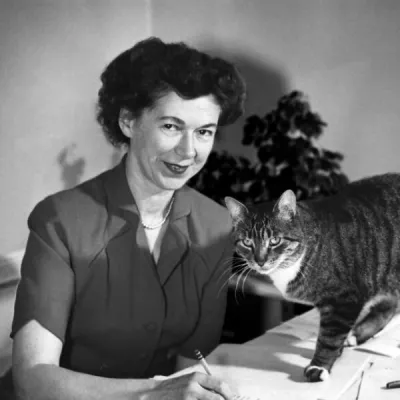
Photo: Wikimedia Commons
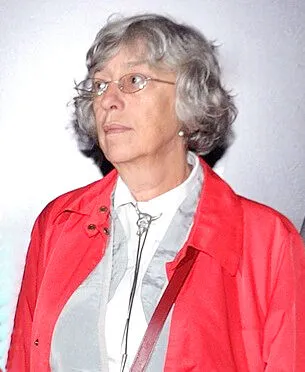
Beverly Cleary
Human Design Chart
Biography
The majority of Cleary's books are set in the Grant Park neighborhood of northeast Portland, Oregon, where she was raised, and she has been credited as one of the first authors of children's literature to figure emotional realism in the narratives of her characters, often children in middle-class families. Her first children's book, Henry Huggins, was written in response to a question from a kid when Cleary was a librarian.
Cleary won the 1981 National Book Award for Ramona and Her Mother and the 1984 Newbery Medal for Dear Mr. Henshaw. For her lifetime contributions to American literature, she received the National Medal of Arts, recognition as a Library of Congress Living Legend, and the Laura Ingalls Wilder Medal from the Association for Library Service to Children. The Beverly Cleary School, a public school in Portland, was named after her, and several statues of her most famous characters were erected in Grant Park in 1995.
She married Clarence Cleary in 1940. In 1955, Cleary gave birth to their twins, Malcolm and Marianne. Clarence died in 2004. Beverly Cleary died on 25 March 2021 at the age of 104 in Carmel-by-the-Sea, California.
Beverly Cleary — Projector with Profile 3/5
Projector 3/5 — Design at a Glance
Beverly Cleary's design tends towards focused perception: She had the ability to immediately recognize systemic weaknesses in her environment. As a projector, her aura acted like a bright flashlight, directing light to areas that were still in the dark for others. This intense projection could be perceived as unpleasant by her surroundings if she addressed these flaws directly, which could quickly provoke resistance, similar to light shining directly into someone's eyes.
The more elegant strategy was simply to shine pleasantly. By embodying harmony herself, she naturally attracted others who then asked for her insider tips. Therefore, her best life strategy was to wait for a genuine and respectful invitation from others before offering her knowledge or leadership.
Since her Sacral Center was undefined, Beverly Cleary did not have a constant, intrinsic source of life energy. Instead, she experienced phases of high energy and rapid productivity, which inevitably had to be followed by necessary rest phases to prevent burnout. The conventional school system and most work structures often did not accommodate this need for rhythm. Living according to this design rewarded her with success; deviating from it sooner or later led to her non-self theme of bitterness.
Emotional Authority
Beverly Cleary's inner compass was shaped by her defined Emotional Center, significantly influencing her decision-making. She was subject to a natural emotional wave, manifesting in constant ups and downs of her feelings. The world appeared to her colored by her current mood: She could be enthusiastic about something one moment and negatively evaluate the same thing the next. Her immediate feeling was merely a snapshot, a first impression, not necessarily reflecting her deeper truth. Therefore, quick, spontaneous decisions made directly from an intense emotion often led to negative consequences.
The mechanics of her emotional authority demanded patience. The more time she took to let a decision mature, the deeper and more comprehensive she could understand the situation. This required consciously sleeping on decisions and allowing herself to be asked multiple times. Over time, the intense feelings subsided, she gained emotional distance, and clarity and calmness set in. Only then was the process complete. This approach was especially important for long-term decisions that could significantly impact her life course. Her inner authority took precedence over other defined areas, regardless of further configurations in her design.
The 3/5 Profile — Martyr / Heretic
Beverly Cleary's design tends towards heroic experimentation, paired with the role of a storyteller who draws lessons from personal experiences. As a 3/5 type, she learned primarily through trial and error; she initially believed nothing on faith but had to test everything herself. This third-line process accepted errors as a natural part of growth, which she transformed into advantages through her assertiveness. Excessive caution would have hindered this learning potential; instead, she used her practical life experiences to solve others' problems.
The fifth line, the Hero Line, shaped how she was perceived from the outside: Others projected more knowledge onto her than she actually possessed. This Factor 61 described her influence, which was particularly noticeable with strangers, not in close circles. She appeared attractive because she presented her experience, which naturally flattered her. Yet, this role could be painful when experiments failed in public. Her wisdom and inspiration often arose from crises, as the fifth line offered solutions under the condition that they provided an advantage. Beverly Cleary lived this dynamic by using her self-learned insights to inspire others while embodying the projected authority of an enlightened father figure who shaped a generation. Her design revealed her as someone who learned from mistakes and made this knowledge accessible to others as a hero.
Split Definition — Defined & Open Centers
Beverly Cleary's Human Design profile revealed a reliable inner identity and direction, paired with a clear, characteristic way of communication. Her defined G Center provided her with a stable self-image and a sense of her own mission, while the defined Throat Center ensured that her messages emanated from this inner source with honesty and clarity. This combination created a presence that touched others with her consistency, without her needing to control or change her own direction.
At the same time, she lived in an emotional rhythm that required patience. Her defined Solar Plexus was her inner authority; truth revealed itself to her not in the moment but after navigating the emotional wave. She tended to make decisions when emotional clarity was achieved, rather than impulsively reacting to highs or lows. The defined Root pressure propelled her forward, but this stress was shaped by the emotional filtering of the Solar Plexus, necessitating a deep, though time-intensive, handling of challenges.
In contrast, her design revealed a high vulnerability to mental and social conditioning. Her open Head Center made her susceptible to the mental pressure of others, leading her to wonder if she had to find inspiring answers that were not truly her own. The open Ajna Center made her receptive to foreign concepts, putting her at risk of adopting the opinions of others as her own truth. The open Heart Center led her to not need to prove herself through promises or competition, but to learn that her value did not depend on fulfilling external expectations. Additionally, her open Sacral Center was vulnerable to 'borrowed' energy, leading her to overextend herself rather than trust her own, fluctuating energy source. The open Spleen Center made her sensitive to the well-being in her environment, requiring her to learn to distinguish between her own health needs and absorbed fears.
Channels for retreat, principles and emotional clarity.
Beverly Cleary's Human Design profile showed a tendency towards deep reflection and emotional intensity. She was someone who gathered experiences to process them later with care and inner truth.
The Lost Son Channel 13-33 connected her G Center with her Throat Center. Through the Listener Gate (13), she stored information and secrets, while the Withdrawal Gate (33) prompted her to withdraw to reflect on these experiences. This created a cyclical process of maturation: she listened, collected memories, and waited patiently for deeper truths to reveal themselves before communicating them. This channel helped her observe the sequence of events and derive lessons for others.
Simultaneously, the Synthesis Channel 19-49, connecting her Root Center with her Solar Plexus Center, was at work. The Claims Gate (19) urged her towards connection and belonging, while the Principles Gate (49) made her reject anything incompatible with her highest ideals. This created a sensitive awareness of her position in the whole and a desire to be needed. She sought balance between feasibility and fairness within her community.
The Recognition Channel 30-41 also connected Root and Solar Plexus. The Limitations Gate (41) generated restlessness and a desire for new experiences, fueled by the emotions of the Feelings Recognition Gate (30). This led to an intense need to deeply feel life and make new experiences, learning to give the emotional wave time to gain clarity.
Additionally, Gates like 61 (inner truth, silence) and 62 (logic, details) shaped her way of processing knowledge and recognizing patterns. Gate 42 emphasized the importance of closing processes for new commitments, while Gate 32 had continuity and material success in mind. These configurations formed her ability to understand complex emotional and social dynamics and bring them into structured, truthful forms.
Collective Circuitry — Circuit Signature
Beverly Cleary's Human Design profile showed a tendency towards emotional reflection, paired with a strong focus on collaborative creation. Her energy was divided into two separate, non-directly connected streams.
The Manifesting circuit formed two isolated segments. One stream connected the Throat with the Identity Center. This created the ability to articulate and share inner values and emotional waves from the past in words. The second, independent stream connected the Solar Plexus with the Root Center. Here, a cyclical, often inexplicable emotional tension operated in waves – with a beginning, middle, and end. These two groups were energetically separate; the emotional wave did not flow directly into the verbal expression form.
Parallel to this, the Ego circuit was active. In Beverly Cleary, it was through the channel between Solar Plexus and Root Center. This emphasized cooperation, mutual support, and the joint creation of resources within a group. Since this circuit did not connect to the Sacral Center, regular rest was necessary to maintain these social and material forces. The energy was timeless and tradition-oriented, focused on giving and taking in relationships.
Overall, a design was revealed that reflected and verbally formed emotional patterns from the past, while simultaneously being mindful of exchange and mutual aid in social structures. The shared definition meant that these areas worked as separate, coexisting forces, not as a continuous flow.
Right Angle Cross of Maya 1
Beverly Cleary's design carried the signature of the right Maya 1 Cross. This configuration established a foundational stance characterized by a deep, often quiet connection to one's inner truth. It was not an outwardly directed, loud self-presentation, but rather an inwardly directed integrity. Beverly Cleary lived in a world where the authenticity of one's being was the central measure.
The right Maya 1 Cross describes an energetic structure aimed at preserving one's essence. People with this expression tended to distance themselves from external expectations to avoid diluting their inner clarity. It was less about achieving societal goals and more about staying true to their core. Beverly Cleary demonstrated this inner stability, even if it appeared unremarkable from the outside.
This mechanism promoted a lifestyle based on authenticity. Beverly Cleary did not seek validation from the masses but oriented herself to an inner compass. The energy of this cross supported her in navigating a complex world on her own path, without being swayed by external currents. It was a stance of quiet constancy that shaped her actions and decisions. Beverly Cleary relied on this inner source, which granted her a certain independence from external judgments.
Saturn Return · Uranus Opposition · Chiron Return · 2nd Saturn Return — Life Cycles
Beverly Cleary's life followed a rhythmic pattern of structural condensation and necessary change. Her design foresaw that her inner alignment would recalibrate in fixed, recurring cycles, alternating between stability and change.
The first Saturn Return marked her transition from youth to adult responsibility. In this phase, her previous life's work condensed into a solid foundation. It was a time when she defined her identity and place in the world more clearly, supported by the gravity of her own decisions.
Following the Uranus Opposition, a phase of internal tension and the urge for freedom ensued. This cycle challenged her to question old structures and take new paths, often accompanied by a sense of unease that was necessary for growth.
The Chiron Return, around the age of 50, brought the bloom of her incarnation purpose. If she had followed her strategy, her life's meaning became experiential and increasingly fulfilled. It was not a time of healing in a pathological sense, but of full realization of what she was there for.
The second Saturn Return rounded off this process. It brought a deeper refinement of the already established structures and a confirmation of the lived path. Beverly Cleary's design thus showed a clear path: building, challenge, fulfillment, and confirmation.
Projector · Emotional Authority — Synthesis
She was a projector, distinguished by the ability to recognize patterns and unresolved issues in others (Gate 13/33). This gift was accompanied by an emotional authority that characterized a deep, though wave-like experience of the world. She needed time to let decisions mature and to grasp the complexity of her feelings – a process that was strengthened by the connection to the sense-making circuitry, which emphasized reflecting on past experiences and their significance for the collective. Through experimenting and trying out (Line 3), she gathered life experiences that she then made available to others (Line 5), always mindful of understanding the underlying causes.
Her design revealed a central paradox: the necessity to connect and project to fulfill her destiny stood in tension with a deep need for withdrawal and reflection. Recognizing problems in others was indeed a strength, but direct confrontation could elicit resistance. Instead, she lived the role of the observer, gaining valuable insights from a distance, to share these, at the right moment, with others and thus contribute to deeper understanding.
3 Defined Channels
Incarnation Cross - Right Angle Cross of Maya 1
Solar Return
The Solar Return shows the moment when the sun returns to its exact birth position - your personal solar year.
Life Cycles
Discover the life cycles with a detailed triple view (birth chart, cycle chart, composite).
Human Design Profile
- Type
- Projector
- Strategy
- Wait for the respectful invitation
- Authority
- Emotional Authority
- Profile
- 3/5 - Martyr / Heretic
- Definition
- Split Definition
- Incarnation Cross
- Right Angle Cross of Maya 1
- Date of Birth
- 12.04.1916 19:00
- Place of Birth
- McMinnville, OR, United States
Frequently Asked Questions
What was Beverly Cleary's Human Design type?
What Profiles did Beverly Cleary have?
What Authority did Beverly Cleary have?
What incarnation cross did Beverly Cleary have?
When was Beverly Cleary born?
Discover your own Human Design
Are you also a Projector? Find out in a personal reading how to unfold your leadership qualities and recognize the right invitations.
More Personalities
Back to overviewSissy Spacek
Alain-Fournier
Anémone
Angeli
Ann-Margret

Bourvil