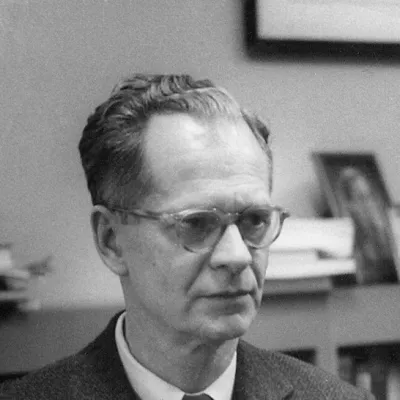
B.F. Skinner
Human Design Chart
Biography
Born Burrhus Frederic Skinner, Fred to his friends, he was the oldest son of Grace, an amateur musician, and William, a lawyer. His boyhood was warm and stable, with no punishment ever by his father and only once by his mother who, when he used a bad word, washed his mouth out with soap. As a boy he was intrigued by mechanics and gadgets and built everything from steerable sleds and rafts to a stem cannon. During high school he held a variety of jobs from collecting telephone bills and selling shoes to playing saxophone in a jazz band. He wrote for the local newspaper, composing a few ads and reminiscences of the town and occasionally covered a meeting or concert..
Skinner majored in English at Hamilton College in Clinton, NY and decided he wanted to be a writer. He sent some short stories to the poet Robert Frost, who wrote back; "You are worth twice anyone else I have seen in prose this year." Skinner went to Manhattan's Greenwich Village to work on his craft, but after a year, found that he had nothing to say. He went on to graduate study in psychology after being attracted to the work of John B. Watson, the founder of behaviorism.
B.F. Skinner as a Projector 2/4 in Human Design
Projector 2/4 — Design at a Glance
B.F. Skinner's design inclined towards precise system analysis. As a projector, he did not have a constant, intrinsic source of life energy but rather acted like a focused flashlight, directing its beam to structural weaknesses in his environment. This mechanism allowed him to identify errors in complex contexts immediately. A direct, unbridled intervention would often be perceived as disruptive, as the bright light of the projector exposed the problems of others. His most effective strategy was to wait for an honest invitation from his surroundings. Through this passive surrender, he avoided conflicts and allowed others to come to him seeking advice. His undefined Sacral Center also meant that he had to alternate phases of high productivity with necessary rest periods to prevent exhaustion. Living by this principle rewarded him with success; ignoring the necessity of invitation or rest led to the non-self-experience of bitterness. His energy was thus not a continuous flow but a targeted signal that only fully unfolded when requested from the outside. This shaped his interaction with the world: not through dominant action, but through attractive clarity and patient waiting for the right moment to contribute his knowledge.
Ego Authority
B.F. Skinner's design established a rare inner orientation: the authority in the ego. This configuration required that his emotional, sacral, and spleen-related centers remain open while the ego center was defined. His truth did not lie in thorough analysis but in his will, which spontaneously manifested in speech. He had to learn to listen to himself while speaking to distinguish when the mind – often influenced by the openness of the centers – spoke and when his true ego center. What came out unfiltered and directly from him was his truth.
If something truly mattered to him, he had the willpower to achieve goals and keep promises. This consistent following of his own will could appear selfish to others, but it was essential for him to stand by himself. For B.F. Skinner, it was always about his actions being rewarding for himself. This not only concerned material success but also the will to be first, to face special challenges, and to leave conventional paths. This could lead others into new directions. A central mechanism of his design was the necessity of a pause after goal achievement. Continuous work without interruption led to this configuration not to desired results but to unhealthy exhaustion and illness. His path was marked by this balance between strong will and necessary regeneration.
The 2/4 Profile — Hermit / Opportunist
B.F. Skinner's design inclined towards a pendulum rhythm between intense isolation and selective community. As a 2/4 profile, he constantly swung between the need of line 2 to withdraw as a hermit and the desire of line 4 to spend time with his closest circle. This configuration required the creation of a safe environment where he could clearly communicate when he sought company and when he wanted to be undisturbed.
In his solitary time, he immersed himself in internal processes to gain clarity. Only after this need for retreat was satisfied did he emerge from his 'cave' to connect with his favorite people. Line 2 promoted existential dedication to the here and now, free from intention, while line 4 brought opportunism and the waiting for favorable opportunities for transformation. Through this structure, Skinner could reflect and evaluate the knowledge of his network in solitude and develop brilliant ideas. The tension between these two poles shaped his way of connecting with the world: not through constant availability, but through targeted, reflective interaction after sufficient inner condensation.
Single Definition — Defined & Open Centers
B.F. Skinner's Design established a tendency towards clear self-determination and inner direction. His defined G Center gave him a reliable identity and the feeling of being lovable without relying on others. He had a sense of his own mission and could naturally give others orientation as long as he did not try to direct them uninvited. His defined Heart Center complemented this with firm willpower and the desire to control his own resources and work rhythms. He preferred to follow his own inner mechanism, keep promises, and be recognized for his contribution rather than being guided by external expectations.
These stable inner poles contrasted strongly with his open centers, which made him receptive to external conditioning. His open Head Center had no constant source of mental inspiration; he tended to identify with others' doubts or questions rather than remaining an unattached observer. The open Ajna Center meant that he could not hold concepts and theories as personal truth but had to use the mind as a flexible classroom to take in ideas from the environment without clinging to them.
His open Throat Center naturally drew attention when he waited rather than actively seeking approval. His open Sacral Center lacked a steady energy flow; he was prone to amplify others' energy and overexert himself if he did not listen to his inner authority to set boundaries. His open Solar Plexus Center absorbed the emotions of the environment, which could lead him to personalize others' moods rather than recognizing them as temporary. Finally, his open Root Center took on external stress, which he could not carry indefinitely without withdrawing to relieve the pressure.
Channels for pioneering spirit and universal love.
B.F. Skinner's Design established a tendency towards competitive progress that not only propelled the individual but also the entire collective forward. This attitude was rooted in the Initiation Channel 51-25, which cuts through the Heart Center. It connected the ego-driven energy of Gate 51, which always wants to be first, with the universal love and spiritual vision of Gate 25. For Skinner, initiation was an art: he recognized the potential for individuation in others and, when invited, provided the necessary "shock" to trigger this initiation. This channel propelled the material world forward through natural competitiveness and linked mastering the self with mastering the world. Each triumph in this process led to a high and a new awareness of one's uniqueness, which in turn served as a bold example for others.
In addition to this driving force, other configurations were at play. Gate 46 emphasized dedication to the physical process and the care of the body as a temple, where success was achieved through full participation and engagement. Gate 10 in the G Center steered the integration process through genetically programmed behavioral rules that secured survival through correct action at the right time. Gate 15 provided logical order and adaptation to natural rhythms in collective behavior, while Gate 13 maintained collective memory and continuity through reflection of the past. Finally, Gate 1 brought in the creative mutation, which created new things in the here and now without limitations. This combination shaped Skinner as someone who transcended encounters through authentic living and the right timing, thereby reinforcing the collective to mutate. His strategy was not to seek initiation but to surrender to it when it found him.
Individual Circuitry — Circuit Signature
B.F. Skinner's Design established a tendency towards more stable and courageous individuality. His chart was marked by the Centering Circuit, which specifically affected the Initiation Channel in his case. This channel connected the Identity Center directly with the Heart Center. As a result, the energy of self-worth and inner convictions flowed directly into his own identity. This connection fostered a strong, internally peaceful personality that clearly perceived and defended its individuality. The energy of this configuration was pulsating and grounded in the present, which lent a certain melancholy or creative depth. However, since this circuit did not connect to the Throat Center, these firm inner convictions often remained difficult to articulate verbally. The strength lay less in external articulation and more in internal affirmation and reinforcement of one's existence. B.F. Skinner lived with this simple definition, where only the G Center and the Heart Center were energetically connected. This isolated yet powerful connection between identity and willpower shaped his essence as someone who clearly felt his own direction without necessarily having to loudly proclaim it to the world. The energy remained centered, individualistic, and focused on affirming his own being.
Right Angle Cross of the Vessel of Love 1
B.F. Skinner's design carried the imprint of the right cross of the Love Vessel. This specific configuration set a profound orientation that did not exhaust itself in superficial relationships but led to an intense, often painful commitment to life itself. It was an energetic impulse that tended to intertwine one's own identity with the larger whole of human experience, often at the cost of personal boundaries. In Human Design, this cross marks a particular quality of love that is less romantic and more existential. It demands a complete surrender that dissolves the boundaries between self and other. For B.F. Skinner, this meant that his drive did not come from cool detachment but from a near passionate connection with the processes of life. This energy is intense and can be overwhelming, as it knows no half measures. It drives one to give oneself entirely, which holds both immense creative power and the risk of exhaustion. The structure of his chart thus showed a person whose actions and insights were marked by this deep, almost mystical bond with the matter and beings that surrounded him. It was a dynamic that sought totality and often transcended personal boundaries to touch a greater truth.
Saturn Return · Uranus Opposition · Chiron Return · 2nd Saturn Return — Life Cycles
B.F. Skinner's design showed a tendency towards structural condensation followed by broader resonance. His life path was marked by phases where inner work ripened into visible results. In 1931, at the age of 27, he was awarded his doctorate from Harvard University. This marked his first Saturn Return, a cycle where years of groundwork often condensed into a solid, institutionally recognized outcome. The energy of this time promoted the consolidation of knowledge and the transition into an established role.
Another pattern emerged in 1953 when Skinner was 49 years old and published 'Science and Human Behavior'. This fell during his Chiron Return, a fulfillment cycle in which one's incarnation cross unfolds. If the person had lived according to their strategy and authority up to that point, meaning and purpose became experiential. The work stood for the flowering of his specific life task, not for the healing of old wounds, but for the realization of his design.
The second Saturn Return around 1960, at the age of 56, brought another level of stabilization. His novel 'Walden Two' developed into a cult phenomenon and sold millions of copies. This success underscores the mechanics of the second Saturn cycle: it cements one's reputation and long-term impact in the public sphere. Skinner's design used these cycles to translate theoretical foundations into sustainable, far-reaching structures that transcended individual achievement.
Projector · Ego Authority — Synthesis
He was a projector who, through his defined G Center, possessed a clear direction and identity. This inner security, combined with the ability to recognize flaws in the system (Channel 51-25), shaped his observations and his quest for understanding human behavior. His profile as a natural talent and networker points to a dynamic between the need for withdrawal into internal processes and the desire to connect with others. This dynamic was reflected in his work, as he withdrew into phases of intense research before making his insights accessible to a broader audience – a process that is evidenced by his Saturn Return in 1960 and the success of 'Walden Two'.
A central paradox in his design lay in the tension between the bright light of his judgment and the need to use it gently. The Initiation Channel energy (51-25) drove him to recognize the potential in others and give impulses, yet the projector strategy required finesse to avoid resistance. This inner tension was evident in his work, which both offered innovative approaches to behavior change and showed a certain detachment from the consequences of his theories. He thus lived in a constant balancing act between the urge to initiate and the need to heed the readiness of others.
1 Defined Channel
Incarnation Cross - Right Angle Cross of the Vessel of Love 1
Solar Return
The Solar Return shows the moment when the sun returns to its exact birth position - your personal solar year.
Life Cycles
Discover the life cycles with a detailed triple view (birth chart, cycle chart, composite).
Human Design Profile
- Type
- Projector
- Strategy
- Wait for the respectful invitation
- Authority
- Ego Authority
- Profile
- 2/4 - Hermit / Opportunist
- Definition
- Single Definition
- Incarnation Cross
- Right Angle Cross of the Vessel of Love 1
- Date of Birth
- 20.03.1904 03:15
- Place of Birth
- Susquehanna, PA, United States
Frequently Asked Questions
What was B.F. Skinner's Human Design type?
What Profile did B.F. Skinner have in Human Design?
Which Authority guided B.F. Skinner?
What incarnation cross did B.F. Skinner have?
When was B.F. Skinner born?
Discover your own Human Design
Are you also a Projector? Find out in a personal reading how to unfold your leadership qualities and recognize the right invitations.
More Personalities
Back to overviewSissy Spacek

Alain-Fournier

Anémone

Angeli

Ann-Margret

Bourvil