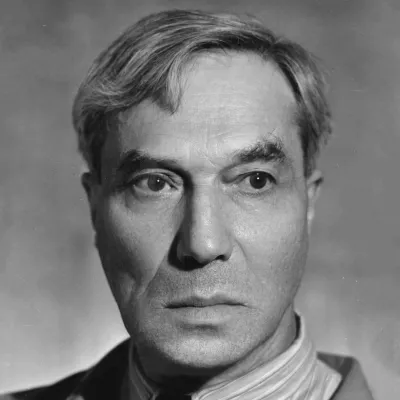
Boris Pasternak
Human Design Chart
Biography
In 1922 Pasternak married Evgeniya Lurye, a student at the Art Institute. The following year their son Yevgenii was born. In 1932 Pasternak fell in love with Zinaida Neuhaus, the wife of the Russian pianist Heinrich Neuhaus. They both got divorces and married two years later.
Boris Pasternak died of lung cancer in his dacha in Peredelkino on the evening of 30 May 1960 at age 70. In 1989, Pasternak's son Yevgeny finally accepted the Nobel award on his father's behalf. Doctor Zhivago has been part of the main Russian school curriculum since 2003.
Boris Pasternak as a Generator 3/5 in Human Design
Generator 3/5 — Design at a Glance
Boris Pasternak revealed himself as someone with immense inner endurance and productivity. His Generator design endowed him with a great sacral energy source, making him a powerful „workhorse“ – strong and steady, provided he received the right impulses. This energy was not available to him through sheer will alone but ignited in response to signals from his environment. Therefore, his motto was: Not initiate, but react.
His path led through waiting for inner confirmation. When his sacral center gave a clear „yes“, he responded with active action. This mechanism was the key to his deepest satisfaction and sense of true fulfillment. Conversely, two specific dangers threatened him: Either he spent his energy on things that did not bring him joy, leading to exhaustion, or he was prevented from continuing work on his heart projects even though he still had plenty of energy.
If he initiated action out of his own drive without this inner resonance, sooner or later he encountered frustration and a lack of vitality. Only in harmony with this strategy – by reacting to life rather than forcing it – could no one stop him. His strength did not lie in pre-empting actions but in the powerful gut reaction when the opportunity arose.
Emotional Authority
Boris Pasternak showed an inner decision-making structure that did not clarify itself at the moment of first enthusiasm or rejection. His design carried Emotional Authority, meaning his defined emotional center was the sole authority for his life decisions – regardless of which other centers were defined in his chart. This priority rule is central: The emotional wave always took precedence over all other internal impulses.
His perception of the world was marked by this constant fluctuation of feelings. What appeared as a profound truth in one moment could look completely different in the next due to a shifted mood. This emotional wave generated an ongoing up and down, often clouding quick, spontaneous judgments. The immediate reaction was merely a snapshot, not yet the final clarity.
Therefore, his inner logic required patience and time distance. A decision matured only when intense feelings subsided and emotional distance was gained. Only then did calmness set in and the true core of a situation became apparent. This process of „sleeping on it“ was no sign of hesitation but the necessary strategy to reach deep insight beyond the noise of emotions. Only through this delay could he find his truth, beyond the often misleading first impressions.
The 3/5 Profile — Martyr / Heretic
Boris Pasternak revealed himself as someone who gained knowledge not from dogma but through personal experimentation. His Profile 3/5 – the experimenter and hero – set a foundational stance: He had to experience things firsthand to understand them. The line of the adventurer drove him to practically test everything, even if this brought errors with it. This accumulated experiential knowledge then served the Line 5, the rescuer, which aims to support others through his own solutions. This combination created natural attraction; his practical knowledge worked on those around him attractively as people wanted to learn from his lived experiences. However, this role also carried danger: Failing in public could be painful for him since the hero role was marked by an expectation of competence. Additionally, specific Gates shaped his actions. Gate 19 brought a need for resources and vigilance in relationships, where productivity and mutual dependence in dealing with others were crucial. Parallel to this, Gate 44 aimed at clan security. Here it was about integrating forces through pattern recognition and maintaining a functioning hierarchy to secure material success. Boris Pasternak thus lived in a tension field between individual experimentation and the responsibility for protecting and structuring his community.
Triple Split Definition — Defined & Open Centers
Boris Pasternak revealed himself as someone who was constantly under mental pressure to ask questions and understand connections. This inclination stemmed from his defined configuration between the Head Center and Ajna Center. He had a firm way of thinking and was continuously inspired, yet this inspiration did not provide direct energy for implementation. Instead of acting hastily, his mind served to inspire others to think deeply. His mental activity was unstoppable; he processed data and creativity continuously, which gave him a trustworthy, specific cognitive function.
Parallel to this, Boris Pasternak had a clear sense of self-identity and direction in life, shaped by his defined G Center. He knew who he was without relying on others. This inner security allowed him to pursue his own paths even if others did not follow. His communication was also structured: His defined Throat Center served as a pivot point that translated the information from his mind into language and action. He spoke what his conceptual thinking conceptualized, giving his statements a reliable but limited form.
Despite these inner clarities, Boris Pasternak was vulnerable to external influences in certain areas. His open Heart Center made him sensitive to the pressure of proving his worth through willpower or promises. He tended to undervalue himself and felt compelled to do more to gain recognition, though he did not have the consistent energy for it. Additionally, his open Root Center absorbed stress from the environment. The pressure exerted by others could lead to a feeling of overload since he did not generate this adrenalized impulse but merely reflected it. This openness required distinguishing between self and external pressures to avoid burnout.
Channels for intimacy, intuitive action and clear insight.
Boris Pasternak's design showed a tendency towards deep intimacy, paired with a strong ability to articulate spontaneous truths in the present moment. Channel of Union 59-6 connected sacral sexuality with emotional waves; this required patience to nurture relationships from friendship to fertility and avoid misunderstandings through the emotional oscillation of Gate 6. Simultaneously, his design spoke for itself: Channel of Awakening 10-20 expressed the awareness “I am,” where Gate 10 in the G Center linked behavior with Gate 20 in the Throat Center to ensure individual clarity and survival through self-love.
This intuitive foundation flowed into Channel of Perfect Form 57-10, connecting spleen intuition (Gate 57) with the G Center (Gate 10). This allowed for behavior guided by inner wisdom that released unfounded future anxieties and perfected survival in the moment. Additionally, Channel of Lightning Stroke 57-20 gave this intuition a clear voice: The insight from the spleen (Gate 57) was directly channeled to the Throat Center (Gate 20) to communicate existential knowledge spontaneously and truthfully.
Mentally, his mind was shaped by Channel of Awareness 61-24. Here, Ajna Center (Gate 24) transformed the inspiration from the Head Center (Gate 61) into rational answers, where knowledge was not sought but expected as Satori. Additional gates like Gate 19 (Resources/Spirituality), Gate 33 (Reflection/Withdrawal), and Gate 44 (Transformation/Acceptance) in the cross emphasized the need for a safe environment for mystical paths and cellular learning processes. In his design, Gates such as Gate 25 (Innocence/Mysticism), Gate 32 (Continuity/Stability), and Gate 16 (Experimentation/Expertise) were present. His personality showed gates like Gate 15 (Collective Rhythm/Humility), Gate 1 (Uniqueness/Creativity), and Gate 50 (Reflex/Self-Value), indicating adaptation to natural flows and protection of individual values.
Individual Circuitry — Circuit Signature
Boris Pasternak's design laid a tendency towards impulsive, creative flashes of insight, paired with a deep instinct for the essential. This configuration did not appear as a continuous flow of all energies but rather as three separate, parallel operating energy fields – typical for his triple definition.
The Knowledge Circuit connected two independent segments in him: Head and Ajna Center on one side, Throat and Spleen Center on the other. This generated innovative ideas (Channel 20-57) as well as conscious expressiveness (Channel 24-61), which did not directly merge but existed alongside each other.
Parallel to this, the Archer Circuit worked through Channel of Union (59-6). It connected the Sacral Center with the Solar Plexus and provided a primal, instinctive life force aimed at protection and emotional connection.
The third field formed the Integration Circuit. Here, Throat, Identity, and Spleen Centers were directly linked (Channels 20-10 and 10-57). This connection allowed filtering intuitive insights from the spleen through identity and expressing them in the “now” via the Throat Center. It was a structure for self-reinforcement that drew strength from reacting to life and formed it into concrete action or statement.
These three separate groups – creative intuition, instinctive protection, and integrative expression – shaped his experiential world as isolated but equal energy sources that did not merge but set their own focal points.
Right Angle Cross of the Four Ways 4
Boris Pasternak's Human Design configuration indicated a tendency towards inner conflict and the pursuit of wholeness. This setup, known as the right cross of the four paths, described someone who constantly oscillated between opposing poles: action versus reflection, desire for control versus need for surrender. It was not about finding a stable middle ground but rather engaging in a dynamic tension that pushed him to integrate various life areas without ever fully merging into one.
This mechanism worked as an ongoing internal challenge. Boris Pasternak emerged as someone who did not define his identity through a single role, but rather through the synthesis of contradictory forces. The right cross of the four paths linked parts of his design that would normally operate separately – such as the Personality Center and Essence Center, or logical thinking with emotional intuition. This resulted in a deep rooting in the present moment coupled with a strong drive to grasp the larger meaning behind events.
The energy of this configuration was not linear but circular. It demanded that Boris Pasternak see himself as part of a greater pattern where opposites were necessary to complete the whole. There was no simple solution or fixed point of rest; instead, he was marked by constant interactions between these four paths. His life task involved enduring and creatively utilizing these tensions rather than seeking final reconciliation. This created a unique perspective that was both deeply personal and universally valid.
Saturn Return · Uranus Opposition · Chiron Return · 2nd Saturn Return — Life Cycles
In 1932, at the age of 42, Boris Pasternak showed himself through an intense infatuation with Zinaida Neuhaus. For his Human Design chart, this moment marked the Uranus Return, a cycle of radical restructuring and sudden change. This aspect often triggered profound emotional upheavals that dissolved old binding structures and paved new, unexpected paths. The infatuation was not just a private feeling but an expression of a necessary inner liberation from past patterns. The Uranus Return acted as a catalyst for this transformation by breaking established habits and pushing the person into a phase of reorientation. During this time, there was a strong tendency to break free from conventional expectations, which manifested in his relationship with Zinaida Neuhaus. This connection symbolized the desire for authenticity and freedom beyond societal norms. The cycle promoted readiness to take risks and embrace the unknown. Through this experience, Boris Pasternak's path towards an authentic life design accelerated, with Uranus ensuring that this change was deep and lasting. The emotional intensity of this year thus served as a motor for a personal revolution that significantly shaped his future development.
Generator · Emotional Authority — Synthesis
He was a Generator whose life was marked by profound sacral energy. This power, combined with the emotional authority and Profile of an Explorer/Hero, created a character distinguished by constant experimentation and sharing practical experiences. The defined Head Center generated a permanent mental pressure to question things and understand them – an inspiration that influenced others (Head Center). The connection between Sacral Center and Solar Plexus through the Channel of Union pointed towards an intense, creative essence that required emotional clarity.
A central paradox in his design lay in the interplay between the drive for constant renewal (Knowledge Circuit) and the need to let decisions mature through emotional waves. While he sought new experiences and transformed knowledge, his authority demanded patience and reflection on things. This led to a tension between the impulsive seeker of knowledge and the thoughtful observer, which was evident in an event – infatuation followed by a period of emotional confrontation (Uranus Opposition at age 42).
5 Defined Channels
Incarnation Cross - Right Angle Cross of the Four Ways 4
Solar Return
The Solar Return shows the moment when the sun returns to its exact birth position - your personal solar year.
Life Cycles
Discover the life cycles with a detailed triple view (birth chart, cycle chart, composite).
Human Design Profile
- Type
- Generator
- Strategy
- To respond - wait for something to respond to
- Authority
- Emotional Authority
- Profile
- 3/5 - Martyr / Heretic
- Definition
- Triple Split
- Incarnation Cross
- Right Angle Cross of the Four Ways 4
- Date of Birth
- 29.01.1890 23:59
- Place of Birth
- Moscow, Russia
Frequently Asked Questions
What was Boris Pasternak's Human Design type?
What profile did Boris Pasternak have?
What authority did Boris Pasternak possess?
What incarnation cross did Boris Pasternak have?
When was Boris Pasternak born?
Discover your own Human Design
Are you also a Generator? Find out in a personal reading how to use your sacral energy correctly and discover deep satisfaction.
More Personalities
Back to overviewAaliyah
Alain-Fournier

Alexia
Angèle

Angeli
Anne-Marie