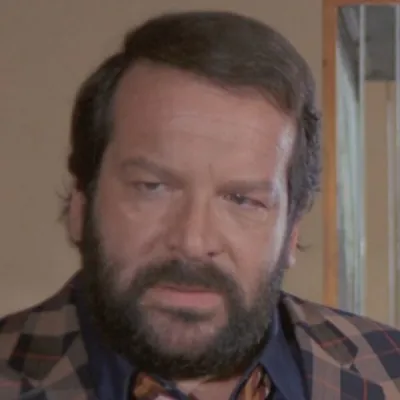
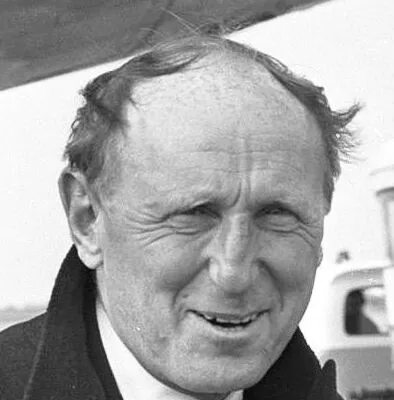
Bud Spencer
Human Design Chart
Biography
In his youth, Bud Spencer was a successful athlete and swimmer for Gruppo Sportivo Fiamme Oro. and for Società Sportiva Lazio Nuoto. He represented Italy twice at the Summer Olympics. He obtained a law degree and registered several patents. Spencer also became a certified commercial airline and helicopter pilot, and supported and funded many children's charities, including the Spencer Scholarship Fund.
What does Projector 6/2 mean for Bud Spencer?
Projector 6/2 — Design at a Glance
Bud Spencer revealed himself as someone who brought immediate structure and clarity to his surroundings through his presence. As a Projector in Human-Design, he had a dense, focused aura, which he used like a bright flashlight to pinpoint weaknesses in systems or in other people. He had the ability to recognize flaws in the processes or logic of others instantly.
However, this direct perception could be confrontational when he addressed the problems in his environment immediately. Similar to a light beam shining directly into someone's face, this immediacy was often uncomfortable or felt like criticism for his counterpart. The more elegant expression of his design was to simply be harmonious and radiant himself. By setting an example, he became attractive, so that other people came to him voluntarily to seek advice.
His strategy lay in waiting for appreciative, honest invitations. Instead of initiating himself, he allowed his knowledge and leadership to be sought after. Since Projectors do not have a constant, intrinsic source of life energy, he was subject to phases of high activity followed by necessary rest phases for regeneration. Continuous, uninterrupted work would have quickly burned him out. If he paid attention to this dynamic and waited for invitations, he was rewarded with success. Ignoring this principle and acting against his natural rhythm led to a feeling of bitterness, his Non-Self theme.
Splenic Authority
Bud Spencer revealed himself as someone who made decisions not through prolonged deliberation but through an immediate, physical impulse. His design indicated a tendency towards spontaneous action capability, which directly stemmed from his inner authority in the Spleen. This configuration means that the Spleen Center functions as a health and alarm system, providing a fine but precise survival intelligence: a spontaneous inner knowledge about whether a situation, place, or person was healthy and right for him.
Since his Emotional and Sacral Centers were open, he could use this authority. The first, intuitive impulse was the most reliable indicator of his well-being. Bud Spencer reacted by rigorously distancing himself from harmful influences and taking care of himself. However, this impulse was only available in the moment; it came once and quickly faded. Therefore, it required high vigilance not to miss this fine signal or have it drowned out by external influences. A short retreat sometimes helped him to hear the Spleen voice clearly.
Long-term plans fit little with this mechanism, as the right decision only revealed itself in the moment. Bud Spencer therefore needed a lot of freedom and flexibility. He avoided unnecessary commitments and preferred to decide spontaneously. This structure allowed him to adapt to changing circumstances and always choose what best promoted his physical and emotional health in the moment.
The 6/2 Profile — Role Model / Hermit
Bud Spencer revealed himself as someone who, in his youth, learned through intense experimentation and the principle of trial and error. Before the age of thirty, his energy was focused on gathering diverse experiences, with setbacks often forcing a necessary retreat for reflection. This phase served to orient himself in a world he actively and sometimes riskily explored.
With the entry into the third decade of life, triggered by the return of Saturn, this dynamic fundamentally changed. The sixth line of his design became active, marking a profound turn towards introspection. Instead of pushing outward further, Bud Spencer metaphorically retreated into a 'cave' to look back at the past years with great distance. This time of isolation was not a weakness but a process of healing and deep self-awareness.
The mechanics of Line 6/2 describe this transition exactly: From the early, often chaotic search for identity through risk and profit-seeking – marked by the will to win at all costs – to mature wisdom. Reflection became the central instrument to process experiences and build inner strength. Only after completing this phase of inner clarification did Bud Spencer re-emerge. He no longer appeared as the searching experimenter but as a wise person, whose life experiences had matured into a clear, shared insight. Others could recognize this gained wisdom and learn from his ability for deep self-reflection.
Single Definition — Defined & Open Centers
Bud Spencer revealed through his defined Throat Center as someone whose expression and actions always stemmed from a reliable, consistent source. His communication and manifestation were not arbitrary but followed a clear inner structure. At the same time, his defined Spleen Center marked a deep connection with bodily awareness and the 'now.' He possessed the ability to make spontaneous, intuitive judgments based on a healthy instinct for well-being and survival. This configuration allowed him to live in the moment and trust the subtle warning signals of his body without having to rationalize them.
In contrast, his design revealed several areas of receptivity. His open Head Center made him vulnerable to mental pressure and the inspiration of others, leading him to get entangled in questions that were not his own. Similarly, his open Ajna Center meant that his conceptual thinking was flexible but lacked a firm truth; he adopted ideas without solidifying them as his own identity. Particularly defining was his open G Center: Bud Spencer had no fixed identity or direction but adapted to his environment. He tended to question who he was or where to find love and often sought confirmation from others rather than following a fixed, unchanging path.
Additionally, his open Heart Center and open Sacral Center were influential. He was not designed to consistently produce willpower or generative energy. Instead, he absorbed the pressure and vitality of his surroundings, making him vulnerable to exhaustion if he did not listen to his inner authority. His open Solar Plexus and open Root Center completed this picture: he took on the emotions and adrenalin-stressed conditions of others, amplified them, but lacked his own stable source for them. This openness allowed him to be a mirror for the emotional and energetic climate, but it challenged him not to identify with these foreign energies to maintain his own clarity.
Channels for deep knowledge and perfect execution.
Bud Spencer revealed himself as someone who combined intuitive depth with technical mastery. His design inclined him to perfect skills through repeated experimentation until they became natural talents. This occurred through the Channel of Wave 48-16. Gate 48 sought vital information, while Gate 16 experimented and refined new possibilities. This connection transformed raw skill into talent that flourished with recognition and resources. It was a process that required patience and engagement to find one's own wave length.
Additionally, Gate 28 shaped his stance in the present moment. It was about consciously taking or avoiding risks based on listening in the current situation. This gate stood for the decision whether one's life was worth living and demanded tenacity in listening. Risks could lead to abrupt changes if handled according to the strategy.
Gate 27 brought a genetic role of care. It improved all activities through altruistic warmth and cared for self-preservation and the tribe. This magical effect ensured continuity and protection.
Gate 33 allowed reflection and withdrawal. Through calm and memory, he strengthened his position before new cycles. Without this pause, experiences would have been mere repetitions.
Gate 19 connected him to resources and territory. It sought safety in the community and spirituality, often through partnership approaches.
Gate 44 was watchful and accommodating. It transformed itself through proper interaction and stored these experiences in cellular memory.
Gate 57 offered intuitive clarity. As a complex spleen gate, it promoted awareness of survival and individual self-determination.
Gate 32 aimed at material continuity and tribal connection. It assessed situations for value and led to radical changes when necessary.
Gate 35 sought change through interaction. True satisfaction came later, through the meaning of the experiences made.
Gate 12 in the Cone Center showed restraint. It linked emotional mood with creative expression and individual mutation.
Collective Circuitry — Circuit Signature
Bud Spencer revealed through his design as someone who prioritized logical clarity and strategic structure. His chart threw the energy of the Mind Circuit, whose core theme was sharing rational insights – ideally free from conditioned emotions. This specifically concerned the connection between Throat Center and Spleen Center via the Channel 'The Wave Length.' This configuration linked the ability for verbal articulation with the intuitive perception of what was relevant or useful. It was an 'emotionless ratio,' as the Solar Plexus Center was not involved. The energy flowed directly from the intuitive selection of the Spleen to the verbal expression form of the Throat. Since Bud Spencer had a Simple Definition, these two centers formed a coherent, stable unit. This structure shaped his way of processing and conveying information: focused, visual, and aimed at improving things or guiding them towards a better future. The mechanics described a tendency to formulate logical strategies based on a deep, intuitive resonance, without being driven by emotional waves.
Left Angle Cross of Alignment 2
Bud Spencer was marked by the left cross of alignment 2, a configuration that emphasized a deep connection to physical reality and his own body. This design inclined him to find security and orientation primarily through the familiar, the tangible, and the material. It was not an abstract search for meaning but a concrete anchoring in the here and now. The mechanics of this cross described a life task of strengthening his own existence through direct experience and tactile perception. Bud Spencer lived this orientation by focusing on what was tangible and provided him with stability. His focus was on preserving the familiar and creating stability in a frequently chaotic world. This meant that he directed his energy towards where he could feel control and constancy. The left cross of alignment 2 challenged him to respect his boundaries and not lose himself in foreign spheres, but rather to carry the power of the inner self outward. His way of encountering the world was characterized by this grounded approach, which accepted the visible and tangible as the highest truth. Through this orientation, he found his path by concentrating on what truly belonged to him and gave him a sense of home and security.
Saturn Return · Uranus Opposition · Chiron Return · 2nd Saturn Return — Life Cycles
Bud Spencer showed a development line where structural consolidation and expansive life events alternated. His design inclined him to establish new identity structures in certain age phases that would shape his self-image sustainably.
In 1956, at the age of 27, he participated in the Olympic Games in Melbourne and reached 11th place in the 100-meter freestyle. This fell in the first Saturn return, a phase in which years of hard work and inner discipline often condense into a tangible, visible result. For his design, this was a moment of confirmation, in which his physical performance and his will to a concrete position condensed.
Later, in 1970 at the age of 41, his second daughter Diamante was born. This happened during the Uranus opposition, a configuration that often triggers unexpected changes in the private sphere or family structure. The birth marked a turning point here, which recalibrated his role as a father and the dynamics of his relationships, driven by the energy of Uranus, which often stands for sudden but profound personal expansions.
In 1977, at the age of 48, Bud Spencer received his pilot's license. This fell in the Chiron return, a fulfillment cycle in which the individual incarnation cross unfolds and meaning becomes tangible. If he had lived according to his strategy up to this point, this was a bloom of his life task: the attainment of new freedom and competencies that carried his inner direction outward and made his life purpose concrete.
Projector · Splenic Authority — Synthesis
He was a projector, who through the defined connection of the Spleen Center and Throat Center (Channel of the Wavelength) possessed a special gift: the recognition of errors and potentials in his environment. This ability, paired with the authority of the Spleen, points to a person who instinctively and immediately recognized what was right or wrong – not through rational analysis, but through bodily sensation. The profile as a role model and natural talent, initially shaped by experimentation and later wisdom, reinforces the impression of a deep observer who taught from personal experience and subtly guided others towards improvement. This combination of perception, instinct, and lived experience formed the red thread of his work.
At the same time, a tension field between the projector type and the ability to communicate information through the Throat Center was revealed. While he intuitively recognized what was not working (Gate 48), the Spleen authority required spontaneous, unconsidered action. The tendency to address errors thus collided with the need to heed the inner impulse and convey the message indirectly. This paradox between the urge to correct and the wisdom to wait shaped his interactions and created a dynamic of direct perception and subtle influence.
1 Defined Channel
Incarnation Cross - Left Angle Cross of Alignment 2
Solar Return
The Solar Return shows the moment when the sun returns to its exact birth position - your personal solar year.
Life Cycles
Discover the life cycles with a detailed triple view (birth chart, cycle chart, composite).
Human Design Profile
- Type
- Projector
- Strategy
- Wait for the respectful invitation
- Authority
- Splenic Authority
- Profile
- 6/2 - Role Model / Hermit
- Definition
- Single Definition
- Incarnation Cross
- Left Angle Cross of Alignment 2
- Date of Birth
- 31.10.1929 03:20
- Place of Birth
- Naples, Italy
Frequently Asked Questions
What was Bud Spencer's Human Design type?
What Profile did Bud Spencer have in Human Design?
What Authority did Bud Spencer have?
What incarnation cross did Bud Spencer have?
When was Bud Spencer born?
Discover your own Human Design
Are you also a Projector? Find out in a personal reading how to unfold your leadership qualities and recognize the right invitations.
More Personalities
Back to overviewSissy Spacek
Alain-Fournier

Anémone

Ann-Margret
Bourvil
Christian-Jaque