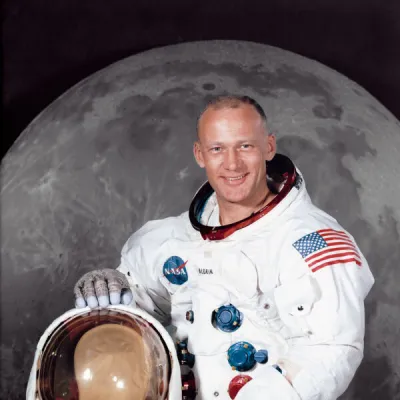
Buzz Aldrin
Human Design Chart
Biography
Aldrin graduated third in his class at the U.S. Military Academy at West Point, NY in 1951, earning his wings the following year. In 1959, he was a Korean War fighter pilot and Air Force major with eight years of service; he took an uncanny risk. Lacking any test pilot experience, he went to MIT for his doctorate in astronautics, specializing in the delicate science of spacecraft rendezvous. He dedicated his 1963 thesis on the subject, "To the men in the astronaut program. Oh, that I were one of them!"
Troubled by depression after his lunar excursion, he spent a year doing public relations work for NASA. Aldrin was too famous for a middling job and too inexperienced for one at the top. Then he returned to active duty in the air Force and was assigned as commandant of the services test-pilot school. In October 1971 he was hospitalized for depression. In 1978, he faced up to another problem, alcoholism. He said he has not had a drink since then.
By 1987, Aldrin was a space technology consultant in Laguna Beach. He married in the fall to his third wife, Lois Cannon, with whom he scubas and skis. His kids, Mike, born in 1963, a flight attendant, and Andy, born in 1965, a Ph.D. at UCLA, are frequent visitors. A self-proclaimed futurist, he gives interviews and is prized on the lecture circuit.
He wrote two autobiographies, " Return To Earth" and "Men From Earth." In August 1996, Aldrin published his first novel, an adventure drama written with sci-fi novelist John Barnes.
Buzz Aldrin — Manifestor with Profile 4/1
Manifestor 4/1 — Design at a Glance
Buzz Aldrin's design points towards a tendency to take on a leading role where he doesn't fight every battle himself but mobilizes others to realize his visions. As a Manifestor, he acted like a strategic leader whose plans often extended beyond the immediate understanding of his surroundings. This unconventional perspective inevitably led to polarization: while some were drawn in by his grand goals and followed him, the same determination met misunderstanding or even rejection from others. This tug-of-war between admiration and criticism is a characteristic pain point for this type, arising because one's own perspective is often perceived as superior or foreign.
To resolve this inner conflict and avoid anger, the strategy of informing was crucial. By clearly communicating his intentions, Buzz Aldrin attracted the right supporters – those willing to support him in achieving his goals. This approach not only facilitated external coordination but also created the conditions for internal peace. When a Manifestor lives by this strategy, he is rewarded with calmness; ignoring it leads instead to persistent frustration. His design thus shows a clear dynamic: great visions lead only to harmonious effect if they are communicated proactively and transparently before action.
Splenic Authority
Buzz Aldrin's design points towards an immediate, intuitive decision-making tendency directly linked to his physical well-being. As someone who had to rely on this inner voice, he showed himself as a person whose first impulse was crucial for health and survival. This stems from his authority in the Spleen Center. For the Spleen Center to function as such an authority, both the Emotional and Sacral Centers must be open; hence only Projectors or Manifestors have this specific configuration.
The Spleen Center functions here as a health and alarm system. It offers excellent survival intelligence that manifests as spontaneous inner knowledge: whether an environment, situation, or society is right is immediately recognized through instinct and physical well-being. Decisions must be made in the moment since the first impulse is correct and provides immediate protection from harmful influences. This ability allows for rigorous self-protection and good care of oneself.
However, this Spleen impulse is very subtle and comes only once at a moment. It can easily be ignored or drowned out by other influences, requiring high vigilance. Since the right thing is always known in the now, plans may change short-term. Long-term commitments are therefore difficult; instead, much space and flexibility are needed to do justice to this spontaneous intelligence. A retreat for decision-making can be helpful since signal quality depends on immediacy.
The 4/1 Profile — Opportunist / Investigator
Buzz Aldrin's design points towards a tendency of deep inner firmness coupled with a cautious handling of external pressure. As a 4/1 Profile (Networker/Researcher), his essence is fixed; it cannot change nor does it want to. This large heart closes quickly at impulses for change that do not accept its nature. Externally, this can be perceived as stubbornness or inability to take criticism, yet in the core, it serves to protect integrity.
The fourth line (Gate 60) focuses on mutation and boundaries. Buzz Aldrin did not use limitations as obstacles but as frameworks to enhance his potential and create opportunities for change. Without this correct alignment, depression threatened; with it, he became a stable 'rock in the storm', ideal for disseminating knowledge.
The first line (Gate 28) complemented this through careful risk assessment and detail work. Here intuition played a decisive role in evaluating plans before decisions were made. This prevented aesthetic visions from turning into unrealistic expectations. The combination of unchangeable core substance and precise, intuitive planning created unique stability: a person who accepted himself to serve others as a reliable mentor while mutating and growing within clear boundaries.
Single Definition — Defined & Open Centers
Buzz Aldrin's design shows a tendency towards constant mental activity and reliable intuitive perception. His defined Head and Ajna centers created a continuous pressure to question things and form concepts – a firm way of thinking that, however, did not provide energy for direct implementation. Instead, this mental infrastructure served to inspire or put others under pressure. The connection to the defined Throat Center allowed him to clearly express these thoughts. This was complemented by the defined Spleen Center, which provided a reliable instinct in the present moment, as well as the defined Root Center, which offered a fixed way of dealing with stress and physical pressure.
In contrast, his G-, Heart-, Sacral-, and Solar Plexus centers were open. This meant that identity, direction, and love did not come from within him but were initiated by the environment. He tended to question who he really was or whether he was in the right place when the surroundings didn't feel right. Without constant willpower in his open Heart Center, he risked wanting to prove his worth through promises rather than trusting inner authority. His open Sacral Center lacked generative life energy; he could absorb and amplify others' energy, leading to exhaustion if he did not pause. Additionally, his open Solar Plexus Center picked up on the emotions of the environment, which could lead to identifying with foreign moods. Therefore, his strength lay in a stable mental and physical infrastructure while he relied on external initiation for direction, willpower, and emotional clarity.
Channels for curiosity, intuition, logic and awareness.
Buzz Aldrin's design shows a tendency towards analytical perfectionism and inspired knowledge. He was someone who combined intuitive depth with technical precision, driven by an inner urge to correct things and sudden flashes of insight. This configuration described his life task: questioning patterns, mastering skills, and processing innovative knowledge.
The Awareness Channel 61-24 connects the Head Center with the Ajna Center through the Gate of Secrets (61) and the Gate of Rationalizing (24). This created the individual thinker who transformed inspiration into rational answers. It was not about discovery but rather how the acoustic mind processed inspiration until a mutation or satori occurred – sudden knowledge that broke old cycles. Buzz Aldrin was designed to inspire others with this unique knowledge without having to control his thinking; the knowledge happened in his own time.
The Wavelength Channel 48-16 connects the Spleen Center with the Throat Center through the Gate of Depth (48) and the Gate of Skillfulness (16). Here, inner intelligence sought life-critical information while new possibilities were experimentally tested. Through repeated practice and identification with a skill, gradual change developed towards precision and excellence. Buzz Aldrin's design promoted the combination of intuitive depth with technical mastery, turning skill into talent through engagement and repetition to achieve mastery and perfect patterns.
The Judgment Channel 58-18 connects the Root Center with the Spleen Center through the Gate of Liveliness (58) and the Gate of Correcting (18). This nourished the art of control through an insatiable urge to question and correct patterns. Gate 58 drove the desire for 'better and more,' while Gate 18 judged what was out of balance. Buzz Aldrin had a sense of what needed correction to find satisfaction in perfect patterns; his judgment served to make life cheerful for the collective by challenging and naming what did not work.
The Curiosity Channel 19 connects the Ajna Center with the Throat Center through the Gate of Ideas (11) and the Gate of Stimulating (56). This made him a storyteller who constantly sought stimulation to explore new perspectives. His creativity showed magically when he linked ideas into stories that taught or entertained an audience. Buzz Aldrin was less interested in pure facts than in how his stories illustrated something; they served to engage others and stimulate their imagination.
Collective Circuitry — Circuit Signature
Buzz Aldrin's design shows a clear distinction between rational future planning and emotional past reflection, flanked by impulsive creative ideas. Since he is simply defined, these forces worked as a continuous flow, not separate islands.
The Understanding Circuit connected his Throat-, Spleen-, and Root Centers. This created an 'emotionless ratio' focusing on logical strategies to improve the future. Through Channel 16-48 ('Wavelength'), he shared these rational insights precisely, while Channel 18-58 ('Judgment') provided structural focus.
Parallel to this, the Meaning Circuit worked through Ajna and Throat Centers (Channel 11-56 'Curiosity'). Here it was about wave-like learning from the past. Emotional cycles were reflected upon to understand the meaning of past events together with others – a contrast to the cool logic of the Understanding Circuit.
Additionally active was the Knowledge Circuit in his Head and Ajna Centers (Channel 24-61 'Awareness'). This promoted innovative flashes of insight and the urge to go new ways. The connection of all centers allowed Buzz Aldrin to express these different energies – rational strategy, emotional meaning-making, and individual creativity – in an integrated way without contradiction.
Juxtaposition Cross of Limitation
Buzz Aldrin's design established an archetypal tension: the inner drive for expansion confronted with the compelling necessity of boundaries. This configuration, the Juxtaposition Cross of limitation, shapes his fundamental attitude as someone who experiences growth not as an unbridled flow but always in awareness of what defines and circumscribes him. The mechanics of this design show that growth for Buzz Aldrin is inseparable from acknowledging limitations. It's not about ignoring obstacles but finding the structure within which energy can unfold effectively. This tension between wanting more space and the reality of being limited forms the core of his experiential world. It forces clarity on where personal freedom ends and external constraints begin. For his design, this means that every expansion is only stable when it rests on a solid foundation of self-imposed limitation. The energy of this cross does not act as a blocking force but as a formative factor. It ensures that impulses towards expansion do not end in chaos but are channeled into defined paths. Buzz Aldrin thus shows himself to be marked by the ability to endure the tension field between expansion and restriction and develop from it a viable structure. The boundary here is no enemy, but the prerequisite for meaningful expansion.
Saturn Return · Uranus Opposition · Chiron Return · 2nd Saturn Return — Life Cycles
Buzz Aldrin's design established a tendency towards radical realignments followed by phases of deep integration. The Uranus opposition marks in Human Design a cycle of breaking with the old and searching for new freedom or identity. In 1969, at age 39, this dynamic manifested concretely: His call to duty as pilot of the lunar module on Apollo 11 was not a gradual ascent but a sudden, disruptive turning point that fundamentally changed his life path.
Following this came the Chiron Return, a fulfillment cycle between ages 49 and 51 (here starting at age 48), in which one's incarnation cross unfolds and purpose becomes experiential – provided one lives according to strategy and authority. This is not about mythological healing but the blossoming of individual purpose. In 1978, at age 48, this mechanism was demonstrated through overcoming his alcohol dependency. This event was no mere detoxification but an active step into his own center and confirmation of his essence. The configuration describes a path that forces new directions through external upheavals (Uranus) to reach inner wholeness and fulfillment of personal purpose in the Chiron Return. Buzz Aldrin thus moved from disruptive realignment towards stable anchoring in his own nature.
Manifestor · Splenic Authority — Synthesis
The central red thread in this design is the dynamic interaction between inner clarity and the necessity to share it with the world. The defined mental authority (Head Center and Ajna Center) generates a constant drive for understanding and inspiration, which is strengthened through channels like curiosity (Gate 11/56) and awareness (Gate 61/24). This internal world seeks expression through the defined Throat Center, hinting at a natural talent for communication and conveying insights – yet always filtered by the spontaneous intuition of the defined Spleen Center. The combination of mental sharpness and instinctive perception creates a person who reflects deeply while also being able to convey complex ideas in accessible ways.
The central paradox lies in the tension field between the need for inner withdrawal and the ability to inspire others. The open G Center points towards an undefined identity that is strongly oriented towards the environment, while the defined Root Center generates constant pressure to move forward and manifest something. This leads to internal tension between a desire for autonomy and a natural inclination to draw others in and influence them – a give-and-take that can both unleash creative energy as well as lead to feelings of alienation.
4 Defined Channels
Incarnation Cross - Juxtaposition Cross of Limitation
Solar Return
The Solar Return shows the moment when the sun returns to its exact birth position - your personal solar year.
Life Cycles
Discover the life cycles with a detailed triple view (birth chart, cycle chart, composite).
Human Design Profile
- Type
- Manifestor
- Strategy
- To inform others before acting
- Authority
- Splenic Authority
- Profile
- 4/1 - Opportunist / Investigator
- Definition
- Single Definition
- Incarnation Cross
- Juxtaposition Cross of Limitation
- Date of Birth
- 20.01.1930 14:17
- Place of Birth
- Glen Ridge, NJ, United States
Frequently Asked Questions
What is Buzz Aldrin's Human Design type?
What Profile does Buzz Aldrin have in Human Design?
Which Authority guides Buzz Aldrin's decisions?
Which incarnation cross is assigned to Buzz Aldrin?
When was Buzz Aldrin born?
Discover your own Human Design
Are you also a Manifestor? Find out in a personal reading how to use your initiation power peacefully and dissolve resistance.
More Personalities
Back to overviewChristian-Jaque

Kesha

Lucebert
Marilyn

Masaccio

Papus