
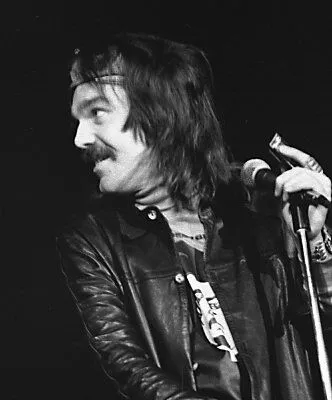
Captain Beefheart
Human Design Chart
Biography
Vliet, his birth surname, had cut a record in 1959 with Frank Zappa. In 1964 he formed the Magic Band. Some of their hits included "Safe as Milk" (1967), "Mirror Man" and Strictly Personal (1968). "Trout Mask Replica" has been defined as somewhere "between blues, jazz, rock and classical music."
Vliet was considered an eccentric and he did not conform well to the requirements of the music industry. In 1982 he released his last album "Ice Cream for Crow."
Since about 1984 he has lived somewhere in the California desert. He was diagnosed with multiple sclerois in the early 1990s.
He died in California on December 17, 2010 of complications of multiple sclerosis.
Captain Beefheart — Manifesting Generator with Profile 6/2
Manifesting Generator 6/2 — Design at a Glance
Captain Beefheart had a hybrid energy configuration: constant sacral power paired with the ability to act swiftly. His design required responding to inner impulses to avoid frustration. As an Manifestor Generator, he could skip steps and quickly pull things into his life. However, this speed carried risks: He tended to miss important stages or get distracted by parallel projects. Without strategy and inner authority, his creative drive would quickly turn to frustration. Deep satisfaction came only in the "play mode," characterized by variety and fun. Then it was no problem to pursue several things at once; the compulsion to finish one thing before starting another felt more like a hindrance. His energy worked optimally when he responded to life impulses and his sacral center gave a clear “yes.” Only then did his speed remain helpful rather than destructive. Captain Beefheart showed himself as someone who sought this balance between impulsive reaction and playful variety to fully realize his potential without falling into the trap of rushing or distraction.
Sacral Authority
Captain Beefheart demonstrated a decision-making approach that did not originate in the Head Center but rather responded from the body. His design lacked any cognitive pre-planning; instead, his inner authority was the Sacral Authority, which exists only for Generators and whose strategy is identical to the Decision Strategy. This fundamentally simplified his process: he didn’t need to think things through but simply waited for external stimuli and then reacted.
This reaction manifested as physical signals—a “gut feeling,” grunting, humming, or a noticeable surge of energy. Captain Beefheart learned to read these bodily sounds like "Mhm" or "Hm-hm." When his sacral motor responded to a stimulus, he entered a state of inexhaustible energy and great vitality. He then tackled his tasks with great enthusiasm and immersed himself in them without the need for any sense of obligation. His life’s task was to move through life with joy, driven by this spontaneous resonance.
The open Emotional Center was the prerequisite for this mechanism. Since no priority rule was mentioned between other defined centers in the raw content, the Sacral Authority stood as the sole primary instance in focus. Captain Beefheart lived from his immediate bodily perception, not from intellectual planning.
The 6/2 Profile — Role Model / Hermit
Captain Beefheart showed a clear two-phase life path determined by his Profile 6/2. In his youth, the experimental Line 3 dominated: He learned through trial and error, withdrew after mistakes, and accumulated numerous personal experiences. This early period laid the groundwork for later insights, even though values were not yet firmly established.
After turning 30, the mutative Line 6 activated. Captain Beefheart metaphorically retreated into a "cave" to reflect on his earlier experiments from a distance. This phase was characterized by intense reflection, healing, and deep self-awareness. Line 6 reviewed the practicality of his previous solutions and decided which insights should be transferred to collective consciousness.
Line 2 brought determination and intelligence but often encountered resistance because his projected ideas had not yet gained widespread acceptance. Rather than confronting this head-on, Captain Beefheart used strategic retreats or allies to overcome such resistance.
The result of this process was acquired wisdom. Captain Beefheart eventually emerged as a role model that attracted others. People sought him out to partake in his life lessons and learn the ability for deep introspection. His development from an experimenting youth into a wise teacher illustrates the mechanics of his design: through personal experience and later distancing, he gained authority that resonated with the collective.
Split Definition — Defined & Open Centers
Captain Beefheart revealed himself through a massive inner substance and action-oriented energy. His design was marked by seven defined centers, creating constant presence in the areas of mental inspiration, willpower, and stress management. The connection between Head Center and Ajna Center created a persistent mental pressure to question things and understand them; this inspiration was available to others but could also lead to inner concern if the pressure was not accepted.
This mental impulse flowed into a defined Throat Center, serving as a pivot point to transform messages from the entire system into communication and action. This was supported by the powerful combination of Heart, Sacral, and Root Centers. The defined Heart Center provided willpower and the desire for control over resources, while the Sacral Center supplied an immense source of vital energy waiting for reactions. Additionally, the Root Center generated a constant adrenalized pressure to move forward in the world and manage stress. This intensity was complemented by a defined Spleen Center, which cared for spontaneous intuition, health, and existential awareness in the here and now.
In contrast, the G Center (Identity/Direction) and Solar Plexus Center (Emotions) remained open. Captain Beefheart did not have a fixed, continuous identity or emotional stability but rather took these situationally from his environment. The open G Center tended to merge with others or seek a "borrowed" identity and direction, often leading to the question of who one actually was or where love could be found. Simultaneously, the open Solar Plexus Center absorbed the emotions of the surroundings instead of generating stable feelings itself. This made him vulnerable to personalizing foreign moods and sentiments, which could lead to emotional confusion if he did not distance himself from these conditioning influences.
Channels for logical acceptance, change, value, structure, insight and care.
Captain Beefheart revealed himself as a mutative thinker, whose knowledge did not arise through logical planning but rather as spontaneous, atmospheric inspiration. This energy was primarily driven by the Channel of Awareness 61-24: Gate 61 provided the "white noise" of inspiration from the Head Center, while Gate 24 in the Ajna Center attempted to transform these acoustic disturbances into rational answers. The result was an individual mind that waited for sudden Satori moments – knowledge that simply appeared when it arrived.
This inspired impulse flowed directly into the Channel of Structuring 43-24. Here, Gate 43 processed insights as spontaneous breakthroughs and translated them through Gate 23 in the Throat Center into metaphorical language. Captain Beefheart expressed his innovative thinking, which often seemed light-years ahead. His challenge was to wait for the right timing; without an invitation, his unique perspective could easily be dismissed or misunderstood.
At the same time, the Channel of Mutation 60-3 acted as a deeper, unpredictable force. It connected the Root Center with the Sacral Center and brought a pulsing on/off rhythm with it. Gate 60 accepted the limitation of the moment, while Gate 3 tried to create order out of the confusion of a new beginning. This channel generated inner tension and melancholy in the pauses between creative pulses. Captain Beefheart had to learn not to resist this mechanical moodiness but rather patiently wait for mutation to reveal itself.
In contrast stood the Channel of Accepting 17-62 in his personality. It organized details logically and sought structural clarity, which worked against the chaotic flow of mutation. Additionally, the Human Design channel of the Line of Money 21-45 brought a will towards material control. Captain Beefheart aspired to independence to determine his own rhythm and had to learn to take responsibility without being drained by the necessity of control. His mechanics were a constant tension between inspired chaos and the need for logical and material order.
Individual Circuitry — Circuit Signature
Captain Beefheart's Design showed a division into two parallel, not directly connected energy fields. The Split Definition separated instinctual survival energies (Sacral, Root, Spleen) from mental-creative expression streams (Head, Ajna, Throat, Heart). This created an inner distance between pure instinct and the shaping of mental form.
The Knowledge Circuit shaped his individual identity. Here he linked Head, Ajna, and Throat Centers into a stream of pulsing, acoustic creativity. The Awareness Channel (24-61) promoted innovative flashes of insight in the Ajna Center while the Definition (23-43) brought these insights into form. The Mutation (3-60) pushed deviations from the known forward. This energy aimed to transform new knowledge and express it through the Throat Center. The stream of Knowledge Awareness in the Ajna underscored a focus on mental clarity as a means for change.
Parallel to this, the Understanding Circuit worked. The Acceptance Channel (17-62) reconnected Ajna and Throat Centers, this time with focused visual energy. This served to share logical insights free from emotional coloring to strategically improve society.
In the realm of resources stood the Ego Circuit. The Money Line (21-45) connected Throat and Heart Centers. This involved the joint creation of material well-being through cooperation and exchange of giving and taking, always interrupted by necessary pauses without direct Sacral energy.
Finally, the Protector Circuit secured the foundation. The Preservation Channel (27-50) linked Sacral and Spleen Centers. This ancient energy cared for the protection of genetics, nurturing and preserving the family unit through instinctive care.
Left Angle Cross of Obscuration 2
Captain Beefheart carried the left Veil 2 Cross. This configuration suggested a fundamental stance where hiding or veiling aspects of oneself played a central role. The design indicated that openness was not always the natural path; instead, there was a tendency to protect or disguise certain truths or intentions from the outside world.
In Human Design mechanics, this cross describes a specific dynamic of making things invisible. It is less about malicious deception and more about a protective mechanism or strategic reserve. The energy of this cross fostered an environment where not everything was immediately apparent at first glance. Captain Beefheart lived with a structure that required him to partially hide himself in order to preserve his integrity or creative space.
The 'left' element of this configuration also pointed towards a specific orientation of this veiling energy, although the exact nuances remained general. Important for his design was the awareness that hiding was an integral part of his experiential world. It was an embedded strategy of the chart: not everything had to be immediately transparent. Through this veiling, Captain Beefheart could set boundaries and decide who had access to which parts of his personality or creative work. This mechanism shaped his way of interacting with the world – often indirectly, sometimes enigmatically, but always driven by the necessity to protect the essential from unwanted exposure.
Saturn Return · Uranus Opposition · Chiron Return · 2nd Saturn Return — Life Cycles
Captain Beefhearts design indicated a tendency towards structural life changes that were framed architecturally by planetary cycles as fundamental identity shifts. This configuration did not describe arbitrary breaks, but rather ordered phase transitions where inner development unfolded outwardly.
In 1969, at the age of 28, his first Saturn return occurred. This cycle often marked the moment when years of groundwork condensed into a sustainable result. For Captain Beefheart, this was concretely shown with the release of the album *Trout Mask Replica*. It was not a sudden coincidence but the structural crowning of a long phase of form-finding and expression.
Later, in 1982 at the age of 41, his Uranus opposition took effect. This cycle often demands a detachment from established structures to find new authenticity. Captain Beefheart then left the music world and began his journey as a visual artist. This shift was not an abandonment out of exhaustion but a necessary realignment of expression according to the inner pressure of the cycle. Both events illustrated how his design organized life phases not as linear progress, but as architecturally guided transformations where each step built structurally on or consciously dissolved the previous one.
Manifesting Generator · Sacral Authority — Synthesis
The red thread running through the design is a dynamic tension between the need for independent expression and the ability to forge deep connections. The defined sacral authority and manifestor component of his design imply a strong impulse to react to the world, yet with an inherent speed that can occasionally lead to overstepping boundaries. This drive is amplified by the open G Center – a constant search for identity and direction influenced by the environment but also offering the ability to adapt to new contexts. The numerous defined centers (Head, Ajna, Throat, Heart, Sacral, Root) generate a strong inner drive, yet through the open Solar Plexus and Spleen Centers, it brings high sensitivity to the energies of other people.
The central paradox lies in the combination of the urge towards individuality (Knowledge Circuit, Mutations) and the deep capacity to experience community and share resources (Ego Circuit). The design is geared towards generating and implementing knowledge but simultaneously requires confirmation and exchange with others. This tension manifests as a tendency toward experimentation and self-discovery (Profile 6/2), followed by phases of intense reflection and wisdom transmission. Thus, the energy of the design is an ongoing oscillation between creating new patterns and anchoring these patterns in collective consciousness.
6 Defined Channels
Incarnation Cross - Left Angle Cross of Obscuration 2
Solar Return
The Solar Return shows the moment when the sun returns to its exact birth position - your personal solar year.
Life Cycles
Discover the life cycles with a detailed triple view (birth chart, cycle chart, composite).
Human Design Profile
- Strategy
- To respond - wait for something to respond to
- Authority
- Sacral Authority
- Profile
- 6/2 - Role Model / Hermit
- Definition
- Split Definition
- Incarnation Cross
- Left Angle Cross of Obscuration 2
- Date of Birth
- 15.01.1941 16:25
- Place of Birth
- Los Angeles, CA, United States
Frequently Asked Questions
What was Captain Beefheart's Human Design type?
What profile did Captain Beefheart have in Human Design?
Which authority guided Captain Beefheart?
What incarnation cross did Captain Beefheart have?
When was Captain Beefheart born?
Discover your own Human Design
Are you also a Manifesting Generator? Find out in a personal reading how to unfold your multi-talents and direct your energy wisely.
More Personalities
Back to overviewAaliyah

Aldair

Alexia

Alizée

Angèle

Angeli
