
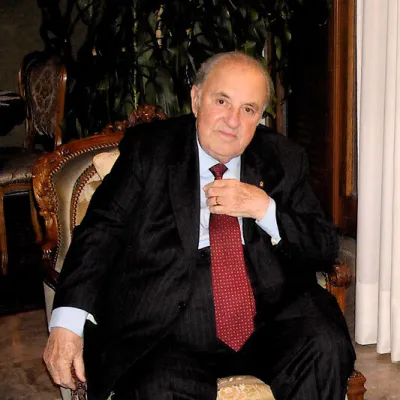
Carlo Bergonzi
Human Design Chart
Biography
Nevertheless, handsome and romantic looking, he has demonstrated luminous performances on occasion, with plush and resonate sound.
His repertory has consisted of 68 operas, mainly performed abroad, with appearances in London and at the Met. Bergonzi became a director of his own school, "Accademia di Canto" and president of a contest for singers in the Verdi operas.
After a lifetime in the theater, acclaimed for his beautiful voice and professionalism, he sang at the Met on 27 April 1996 at age 71, stepping in at the last minute as a replacement for Pavarotti, who had the flu.
The Human Design of Carlo Bergonzi: Projector 1/3
Projector 1/3 — Design at a Glance
Carlo Bergonzi's design had a tendency towards a focusing, flashlight-like radiance. As a projector, he did not have a constant, intrinsic energy source from the undefined Sacral Center but rather worked through a dense aura that immediately revealed systemic flaws in others. This ability to 'shed light into darkness' and illuminate paths could be unpleasant when he addressed these flaws directly – comparable to shining a bright beam of light straight into someone's face.
Therefore, his design required patience: Carlo Bergonzi had to wait for an honest, appreciative invitation to exercise his leadership role. Only then was his radiance perceived as attractive and helpful rather than confrontational. His life followed a rhythm of intense activity and necessary rest phases since his system did not generate continuous life energy. Without these recovery periods, he risked burning out. Living by the principle of invitation and pausing rewarded him with success; ignoring this design led to bitterness as an expression of his non-self sooner or later. Thus, his strength lay not in constant action but in precise, invited guidance of others.
Emotional Authority
Carlo Bergonzi showed a decision-making strategy that required time and emotional distance. His design carried Emotional Authority, meaning his defined Emotional Center held inner leadership – regardless of which other centers were also defined. This configuration was subject to a permanent wave of ups and downs; his perception was always colored by the current mood state. What appeared inspiring in one moment could be negative in the next. Therefore, his immediate feeling only captured a snapshot, not necessarily the truth. Spontaneous, emotion-driven decisions often proved misleading for him and could have negative consequences.
Instead, his mechanism worked such that he took time to let decisions mature. Revisiting important questions multiple times was a central process step. Over time, intense feelings subsided, and he gained emotional distance. Only then did clarity and calm set in – the sign that he had completed the inner process. This patience was especially crucial for long-term decisions as they could significantly impact his life course. Carlo Bergonzi thus learned not to react to first impressions but to wait until the emotional wave calmed, allowing a deeper, more comprehensive understanding.
The 1/3 Profile — Investigator / Martyr
Carlo Bergonzi's design leaned towards a synthesis of theoretical detail work and practical experimentation. He was someone who did not just passively collect knowledge but actively tested it through experimenting – comparable to a scientist who is also an adventurer. This configuration stemmed from his Profile 1/3, the Researcher and Experimenter.
Line 1 in this design emphasized detailed work, routine, and caution as the foundation for lifelong rituals. It demanded careful examination before action was taken. Simultaneously, Line 3 drove the impulse to experiment and required accepting mistakes as a natural learning method. For Carlo Bergonzi, this created an internal conflict: The fear of Line 1 that he did not know enough could block the experimental impulse of Line 3.
The strength of his design lay in overcoming this paralyzing caution. When he deemed something good, he had thoroughly examined it both theoretically and practically. For him, mistakes were not pyres but data points for further development. Through this process of trial and error, he transformed uncertainty into reliable knowledge. His judgment was trustworthy because it was based on self-earned and tested experiences that transcended logic through imagination and knew careful examination over hasty experimentation.
Split Definition — Defined & Open Centers
Carlo Bergonzi was characterized by an intense internal dynamics consisting of a constant mental pressure and deep emotional waves. His design featured defined Head, Ajna, and Solar Plexus centers along with a defined Root Center, creating a permanent inner process of questioning, connecting concepts, and feeling emotions driven by a stable survival urge. Since the Head and Ajna centers lacked direct energy for implementation, attempting to enforce ideas immediately often led to frustration; instead, he served as an inspirational source for others while his internal authority was emotional. Decisions required time until the emotional wave provided clarity, supported by the focus of the Root Center to endure this process.
At the same time, his chart revealed specific vulnerabilities in open centers. The open Throat Center indicated a lack of firm identity; Carlo Bergonzi tended to blend with his environment and sought direction through external initiations rather than asserting it himself. His open Heart Center lacked consistent willpower, making him susceptible to pressure to prove his worth through promises or competition – a cycle that often led to self-doubt in case of failure. Additionally, his Sacral Center was open, meaning he did not have constant generative energy and could easily be conditioned by the work ethic of others, potentially leading to exhaustion if boundaries were not set. The open Spleen Center made him sensitive to well-being or illness in his environment; spontaneous decisions here were risky as they often relied on absorbed fears rather than genuine intuition. Finally, his open Throat Center attracted attention without him actively seeking it; attempting to speak up to be heard often led to unpredictable or ineffective statements, while waiting for the right invitation to communicate conserved energy and promoted authenticity.
Channels for mental clarity and emotional waves.
Carlo Bergonzi was characterized by a specific tension between mental passivity and emotional provocation. His design suggested that he did not act through logical planning but waited for spontaneous inner truth, while simultaneously challenging others with authentic moods.
The Awareness Channel 61-24 connected the Head Center to the Ajna Center via Gate of Secrets (61) and Gate of Rationalizing (24). This mechanism generated no logical conclusions but rather 'acoustic inspiration'. Carlo Bergonzi did not need to actively think; his mind was constantly engaged with the 'white noise' of Gate 61. Knowledge for him appeared as sudden mutations or satori – a moment where the gap in thought process closed and he simply knew. He clearly distinguished between knowable and unknowable knowledge. His thinking served not to discover through analysis but to surrender to the pace of this inner truth, which revealed itself at its own speed. This created a thinker who inspired others with unique transcendent insights without being able to control them.
Simultaneously, the Channel of Emotional Release 39-55 connected the Root Center to the Solar Plexus (Gate of Provocation 39 and Gate of Spirit 55). This generated a pulsating emotional wave between joy and melancholy. Carlo Bergonzi was designed to provoke 'spirit' in others to find correctness and spiritual passion. His moodiness was not a weakness but a creative force for mutation. Authenticity towards his own moods was crucial; only when he fully embraced his emotional wave – without compensating it through eating or sex – could he inspire others and make correct connections. His impact depended on whether he was in the right mood to tease out desired qualities from others.
Overall, this configuration shaped a person who neither logically rationalized nor emotionally manipulated but acted by waiting for inspiration and authentically living his moods.
Individual Circuitry — Circuit Signature
Carlo Bergonzi was characterized by a pulsating acoustic energy rooted in the present moment, seeking the innate path of transformation. His design featured Shared Definition, where two separate energetic streams existed parallel without directly flowing into each other.
The Knowledge Circuit strongly shaped this dynamics. On one hand, it connected the Head to the Ajna Center. This section promoted innovative flashes and creative impulses (Channel 24-61) serving as awareness to form new identities and allow deviations from the old. It was about the mental spark of mutation.
Independently, a second stream flowed between the Solar Plexus and Root Centers (Channel 55-39). This area stood for releasing emotions. It linked the emotional wave with physical endurance to make change not only thinkable but effective through expression in the Throat Center. The melancholy and creativity of this circuit helped new knowledge emerge.
Since these two groups – Head/Ajna on one side and Solar Plexus/Root on the other – were not directly connected for Carlo Bergonzi, he experienced these forces as coexisting poles: the mental impulse towards innovation and emotional power towards implementation. This configuration supported him in developing his unique individuality through creative flashes and initiating transformations by turning emotions into expression.
Right Angle Cross of Maya 2
Carlo Bergonzi's Human Design profile carried the signature of the right cross of Maya 2. This aspect described a deeply rooted tendency to anchor oneself in a chaotic world through clear structure and disciplined order. It was not about rigid control but rather the need for a stable foundation on which genuine growth could take place. For Carlo Bergonzi, this meant seeking inner clarity by creating or accepting external frameworks. This configuration promoted an attitude of patience and systematic approach; quick, impulsive solutions were less emphasized in favor of sustainable development of projects and relationships over time.
The right cross of Maya 2 symbolically represents the process of gaining security from the unknown through methodical action. It was about experiencing life not as a random sequence of events but as a shapeable space where one gradually took responsibility step by step. Carlo Bergonzi often appeared as someone who valued reliability and directed his energy to where it could have concrete impact. This mechanical orientation helped him reduce uncertainties by focusing on what he could immediately influence and organize. The strength of this design lay in its ability to reduce complexity and generate action without ignoring intuition, but rather making it usable through structure.
Saturn Return · Uranus Opposition · Chiron Return · 2nd Saturn Return — Life Cycles
Carlo Bergonzi moved through his life according to a clear rhythm of establishment followed by later confirmation. His profile was characterized by phases where inner structuring met external recognition – a process oriented towards the astronomical cycles of Saturn and Chiron.
The first Saturn return marked for him the transition from potential to concrete professional anchoring. In this phase, years of preparation condensed into a solid foundation. This became evident in 1951 when Carlo Bergonzi, at age 27, made his debut as a tenor in Bari. This moment was no coincidence but rather the typical point where Saturn return discipline became visible externally and established a stable career base.
Later came the Chiron return, a cycle of fulfillment and bloom. Here it wasn't about healing old wounds but rather that his specific life purpose – if he had followed his strategy up to this point – could fully unfold. Meaning and purpose were experienced; his unique quality found its highest confirmation. This was reflected in 1972 when Carlo Bergonzi, at age 48, received the Verdi d'oro award. This recognition stood for the mature fruits of his development: acknowledgment came precisely when his design had reached full maturity and he stood in the bloom of his work. Both cycles shaped his path as clear stages from building to successful realization.
Projector · Emotional Authority — Synthesis
Carlo Bergonzi lived a life marked by deep inner search and a drive towards authenticity. His profile as a projector, combined with emotional authority and the Profile of Researcher/Experimenter (1/3), points to someone who explored the world through an observational lens, trying to uncover hidden patterns. The connection between Head Center and Ajna Center strengthened this mental drive while his open Sacral, Heart, and G Centers made him receptive to environmental energies – a constant intake and processing of influences without having a constant internal source. This constellation led to a capacity for profound insights that he could only clearly articulate once the emotional wave subsided.
A central paradox in Carlo Bergonzi's design lies in the tension between his natural ability to recognize errors and imbalances (Gate 62) and the lack of inner drive to independently implement these insights. He was dependent on waiting for invitations before offering inspiration – a process further slowed by emotional authority. At the same time, the open Heart Center points to vulnerability to conditioning, making it difficult for him to recognize his own worth and free himself from others' expectations. This interplay of sharp perception and emotional dependence shaped his life and work.
2 Defined Channels
Incarnation Cross - Right Angle Cross of Maya 2
Solar Return
The Solar Return shows the moment when the sun returns to its exact birth position - your personal solar year.
Life Cycles
Discover the life cycles with a detailed triple view (birth chart, cycle chart, composite).
Human Design Profile
- Type
- Projector
- Strategy
- Wait for the respectful invitation
- Authority
- Emotional Authority
- Profile
- 1/3 - Investigator / Martyr
- Definition
- Split Definition
- Incarnation Cross
- Right Angle Cross of Maya 2
- Date of Birth
- 13.07.1924 13:30
- Place of Birth
- Polesine Parmense, Italy
Frequently Asked Questions
What was Carlo Bergonzi's Human Design type?
What Profiles did Carlo Bergonzi have?
What Authority did Carlo Bergonzi have?
What incarnation cross did Carlo Bergonzi have?
When was Carlo Bergonzi born?
Discover your own Human Design
Are you also a Projector? Find out in a personal reading how to unfold your leadership qualities and recognize the right invitations.
More Personalities
Back to overviewSissy Spacek

Aaliyah

Alain-Fournier

Alexia

Alizée

Anémone
