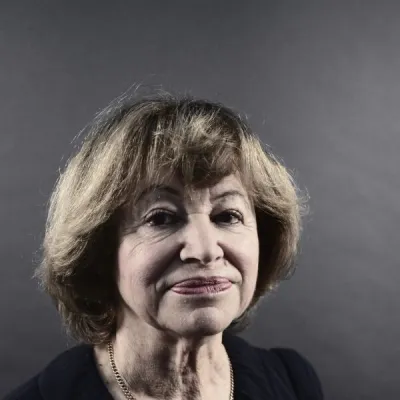
Catherine Cesarsky
Human Design Chart
Biography
She graduated with a PhD in Astronomy in 1971 from Harvard University (Cambridge, Mass., USA), and for several years worked at the California Institute of Technology.
In 1974, she moved to France, becoming a staff member of the Service d'Astrophysique (SAp), Direction des Sciences de la Matière (DSM), Commissariat à l'Energie Atomique (CEA). She then established her career in France. From 1985 to 1993, she was the Head of SAp. Later, as Director of DSM (1994 - 1999), she led a team of about 3000 scientists, engineers and technicians active within a broad spectrum of basic research programmes in physics, chemistry, astrophysics and earth sciences. From 1999 to 2007, she was the Director General of the European Southern Observatory; she was thus responssible for the end of construction of the VLT and its instruments and for the operations, for the conclusion of the agreements and the first part of the construction of ALMA, and she launched the studies for the European Extremely Large Telescope (ELT). At present, she is the High Commissioner for Atomic Energy in France, advisor to the French government for science and energy issues. She chairs the Science Program Committee of the French space agency, CNES (Centre National d’Etudes Spatiales), and the Consultative CommitteeEURATOM - Fusion (CCE-FU).
Catherine Cesarsky — Generator with Profile 6/2
Generator 6/2 — Design at a Glance
Catherine Cesarsky's design established a foundation of endurance and productive power. As a Generator, she possessed a high level of sacral energy that made her extremely resilient, like a workhorse – provided this strength was used for appropriate tasks. Her life force did not unfold through self-initiative but rather by reacting to impulses from the environment. The motto of her design was clear: Do not initiate, but wait until life sends a signal and then respond with action.
This mechanism brought deep satisfaction into her life when she followed her inner "yes" impulses. Conversely, frustration and energy loss threatened if she acted against this rhythm or allowed herself to be deterred from her heart project. Two main risks shaped her dynamics: Either she wasted her strength on things without internal resonance, leading to exhaustion, or external forces stopped her work while her inner self was still full of power. Her success depended on reacting intuitively and directing this enormous endurance purposefully rather than misguiding it. Thus, her energy became effective by responding to life signals instead of taking the first step herself.
Sacral Authority
Catherine Cesarsky's design points to a tendency towards intuitive, body-based decision-making. As a Generator, her strategy aligned perfectly with her inner authority: the sacral authority. This configuration greatly simplified her process as she did not need to distinguish between strategic action and internal compass. The prerequisite for this was an open Emotional Center, meaning that emotional clarity required time while the sacral response was immediately available.
This authority manifested as a direct physical reaction to external stimuli – a gut feeling or surge of energy. Catherine Cesarsky learned to pay attention to these "body noises": grunts, hums, or simple sounds like "mm-hm" signaling agreement. Once her sacral motor engaged, she had vital energy and inexhaustible enthusiasm. She was born to perform tasks with joy without the need for an external purpose.
Additionally, a supportive Spleen Center authority came into play. This grants the ability for quick, spontaneous reactions and immediate access to instinctive perception. Therefore, Catherine Cesarsky could guide herself both through the sustained energy of the Sacral Center as well as the lightning-fast intuition of the Spleen Center, enabling high reaction speed while maintaining deep bodily reliability.
The 6/2 Profile — Role Model / Hermit
Catherine Cesarsky's Human Design profile is characterized by a clear developmental line: initially marked by experimentation and learning through trial and error, later moving towards deep introspection and wise detachment. In the early years of her life, the 3-line of her configuration was prominent. This fostered a pragmatic approach to the world where material security and individual survival strategies were prioritized. The focus was on meeting one's own needs and establishing independence from others, which could often be misunderstood as selfish or materialistic, but in fact laid the necessary foundation for later spiritual development.
With Saturn's return cycle, typically around age 30, this dynamic shifted fundamentally. The 6-line became active and invited Catherine Cesarsky to withdraw from immediate busyness. This phase served intensive reflection on previously gathered experiences. It was no longer about quick action or external success but rather healing and understanding deeper connections. From this distance, she could integrate her earlier mistakes as valuable lessons.
At the same time, her design brought an innate ability for problem-solving that was recognized by those around her. However, this competence unfolds best through collaboration and detailed analysis. The transition from individual concern with survival to a broader perspective allowed her to use her analytical skills not only for herself but also as a resource for others. She developed into a role model whose wisdom is based on having lived through and processed the tough lessons of life.
Single Definition — Defined & Open Centers
Catherine Cesarsky's design established a firm, reliable identity connected with a clear sense of her life direction. Her defined G Center gave her the ability to love herself and lead others without dependency by showing them new perspectives. This was complemented by a defined Sacral Center that provided an enormous source of vital energy. However, this power required not initiating but responding to questions; only in this way did the necessary endurance for sustained work become available without leading to frustration or exhaustion.
At the same time, Catherine Cesarsky was strongly exposed to her environment through several open centers. Her open Head Center made her vulnerable to mental pressure and the temptation to solve other people's problems as if they were her own. Instead of steady inspiration, she tended to get caught in intellectual whirlpools when not trusting her inner authority. Similarly, her open Ajna Center allowed a flexible mind for new concepts but carried the trap of adopting others' ideas as her truth or pretending uncertainty to be accepted.
Her open Heart Center lacked consistent willpower; here there was the danger of wanting to prove herself through promises and getting caught in a cycle of self-doubt because she wasn't designed to sustain long-term competitive pressure. Additionally, her open Solar Plexus absorbed emotions from the environment, leading to experiencing others' moods as personal instability and avoiding confrontation out of fear of rejection. Finally, her open Root Center took on external stress, causing her to easily fall into a cycle of hyperactivity to release this pressure rather than using or ignoring it consciously. These opennesses required a conscious distancing from foreign energies and thoughts to not exceed her own strength.
Channels for persistent determination and inner confirmation.
Catherine Cesarsky's design established a tendency towards persistent, deep experience where she let go of expectations to be in the right place at the right time. This attitude was shaped by Channel Discovery 29-46 connecting the Sacral Center with the G Center. Gate 29, 'Depth within Depth', offered access to the wellspring of endurance only through positive reactions to questions. Gate 46 connected her with her life direction and allowed her to fully commit to an experience even if it took years and initially made no sense. Through this commitment, she could make discoveries that changed collective understanding by learning from the past and sharing results rather than making logical assumptions.
Additionally, individual gates influenced her life energy. Gate 55 at the Solar Plexus brought extreme mood swings and a role in genetic mutation; it required eating only when truly hungry. In the Sacral Center, Gate 59 supported the genetic strategy of pairing and bonding regardless of personal preferences while Gate 9 promoted detailed work and perfection through repeated experimentation – without correct energy fulfillment, frustration threatened here. Gate 16 allowed the expression of skills through persistent experimenting on verbal levels. On a personality level, Gate 25 stood for spiritual innocence and individualization, allowing her to test unconditional love over a mystical channel. This configuration described someone who found their own path through patience, attention to detail, and emotional authenticity without forcing control but by trusting the process.
Collective Circuitry — Circuit Signature
Catherine Cesarsky's design established a tendency towards emotional processing of the past. It showed as someone whose inner world was marked by wave-like feeling currents – with clear beginnings, middles, and ends – serving to find meaning behind past events. This energy is less focused on cool logic or future-oriented planning but rather focuses on what has already been experienced.
This character trait stems from the Simple Definition of her chart. For Catherine Cesarsky, the Sacral Center and Identity Center are directly connected. This connection forms the core of the Sense-Making Circuit (also known as Perception Circuit). Through Channel 'Discovery' (Gates 46 and 29), energy flows between these two centers. This means that her emotional truth from the Solar Plexus Center – even though this is not directly in the channel, the circuit is emotionally marked – merges with her identity. The felt insights are not only private but carry an inherent quality of sharing. There's a drive to connect these past-gained insights with the collective to learn together from them. As it's a Simple Definition, there are no separate, unconnected energy islands; power flows continuously between identity and sacral center. This shaped her way of processing experiences not in isolation but placing them into a larger shared context. The cyclical nature of these emotions meant that clarity often only emerged after going through an emotional wave, making her process of meaning-making rhythmic and experience-based.
Left Angle Cross of Spirit 1
Catherine Cesarsky's Human Design profile suggests a tendency towards a deep spiritual orientation that is less based on dogmatic structures and more on inner experience. This configuration, known as the left cross of Spirit 1, describes a path of personal transformation through direct encounters with the transcendent. It is not an intellectual debate about religion but rather a living experience of meaning and connection that often arises in moments of silence or intense internal reflection.
For Catherine Cesarsky, this meant that her authority and compass were always inwardly directed. She was someone who was willing to question established truths to follow a deeper, personal truth. This impulse fostered an attitude of humility towards the unknown while simultaneously cultivating strong trust in her inner voice. The mechanics of this cross support processes where external circumstances serve as catalysts for internal growth rather than being perceived as obstacles.
It wasn't about finding final answers but about the ongoing process of recognizing and letting go. Catherine Cesarsky was guided by this configuration to actively live and shape her spirituality, free from external constraints. This created a foundation for authentic action that always aligned with her deepest values, even if it made her path less predictable.
Saturn Return · Uranus Opposition · Chiron Return · 2nd Saturn Return — Life Cycles
Catherine Cesarsky's Human Design profile is characterized by a clear, step-by-step densification of her role. In 1971, she earned her Ph.D. in Astronomy from Harvard University. This first Saturn Return often marks the point where years of groundwork solidifies into a stable foundation – here, her academic qualification as the basis for her later career.
At age 42 in 1985, she became Chairwoman of SAp. This coincided with the Uranus Opposition, a phase when internal maturity often breaks outwards into changed responsibility or structure. The mechanics show the transition from learning to leading within her field here.
In 1994, she reached her Chiron Return and was appointed Director of DSM. During this fulfillment cycle between ages 49 and 51, her own incarnation cross increasingly unfolds in life. Those who live according to their strategy experience meaning and purpose as tangible reality – for Cesarsky, the assumption of a central leadership role.
Finally, the second Saturn Return came in 1999 with her appointment as General Director of the European Southern Observatory. The second Saturn cycle deepens and anchors the structure created in the first cycle on a higher level. Cesarsky's path shows how cyclical pressure points structured her career: from academic foundation through leadership roles to institutional responsibility, each in rhythm with her astrologically specific development steps.
Generator · Sacral Authority — Synthesis
A central red thread in Catherine Cesarsky's Human Design profile is the deep connection to her own sacral energy (Generator Type, Sacral Authority, Discovery Channel). This energy source allows her to work on tasks joyfully and persistently as long as she pays attention to her inner reaction. The defined G-Center strengthens this aspect by hinting at a clear sense of direction and a natural ability to lead others – an inner knowledge that manifests through the division of experiences from the Perception Circuit. Profile Line 6 indicates that this process is marked by intense personal experience, followed by phases of withdrawal and reflection to gain wisdom and later share it.
Simultaneously, a central paradox reveals itself between the need for deep immersion in her own sacral reaction (Discovery Channel) and the cyclical experiences highlighted by the left cross of Spirit 1. The documented events – Ph.D. completion, leadership roles – show a career shaped by external demands and expectations while the design points to deep trust in inner impulses and natural rhythms. This tension between embracing external obligations and the necessity to withdraw and reflect (6/2 Profile) forms the core of her individual challenge.
1 Defined Channel
Incarnation Cross - Left Angle Cross of Spirit 1
Solar Return
The Solar Return shows the moment when the sun returns to its exact birth position - your personal solar year.
Life Cycles
Discover the life cycles with a detailed triple view (birth chart, cycle chart, composite).
Human Design Profile
- Type
- Generator
- Strategy
- To respond - wait for something to respond to
- Authority
- Sacral Authority
- Profile
- 6/2 - Role Model / Hermit
- Definition
- Single Definition
- Incarnation Cross
- Left Angle Cross of Spirit 1
- Date of Birth
- 24.02.1943 12:30
- Place of Birth
- Ambazac, France
Frequently Asked Questions
What is Catherine Cesarsky's Human Design type?
What Profile does Catherine Cesarsky have?
What authority does Catherine Cesarsky possess?
What incarnation cross is assigned to Catherine Cesarsky?
When was Catherine Cesarsky born?
Discover your own Human Design
Are you also a Generator? Find out in a personal reading how to use your sacral energy correctly and discover deep satisfaction.
More Personalities
Back to overviewAaliyah

Alexia

Angèle

Anne-Marie

Arcángel

Arno