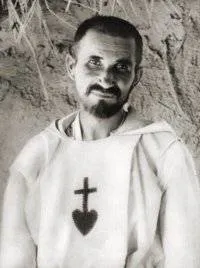
Charles De Foucauld
Human Design Chart
Biography
As a youth, he had been known as a wastrel, dissolute, greedy and lazy. He became a cavalry officer in the French Army, then an explorer and geographer, and finally a Catholic priest, a hermit who lived among the Tuareg in the Sahara in Algeria. His inspiration and writings led to the founding of the Little Brothers of Jesus among other religious congregations. He was shot to death by tribesmen on 1 December 1916 and is considered by the Church to be a martyr.
De Foucauld was beatified by Pope Benedict XVI on 13 November 2005. On 27 May 2020, Pope Francis cleared the way for his canonization at a future date. He was canonized on 15 May 2022.
What does Manifestor 6/3 mean for Charles De Foucauld?
Manifestor 6/3 — Design at a Glance
Charles de Foucauld's design pointed towards exemplary leadership and visionary thinking. As a Manifestor, he was geared to steer the world into new directions, much like an emperor in ancient Rome who had visions but did not lead every battle himself; instead, he acted through others. This role, however, came with a specific pain point: The risk of being misunderstood or polarized. His great dreams were loved and followed by some, rejected or even hated by others because they often thought beyond their surroundings.
To minimize these tensions and find the right followership, his strategy was crucial: He had to inform others about his intentions at the right time and precisely. This communication served not only transparency but also the key for people to follow him without feeling surprised or overwhelmed.
Living according to this strategy and his inner authority rewarded him with a deep sense of inner peace. Conversely, living against this pattern often led to persistent, profound anger. His chart-based path thus consisted in reducing resistance through clear information and creating space for visionary leadership, thereby receiving the necessary support to pursue his goals without remaining in constant conflict.
Emotional Authority
Charles de Foucauld showed an internal decision-making structure that did not rely on immediate clarity but rather on navigating emotional waves. His design carried emotional authority, meaning the Solar Plexus Center was defined and thus became the primary source for his inner answers. Regardless of other defined centers in his chart, this emotional component always took precedence in decision-making.
His perception of the world was marked by a permanent fluctuation of feelings. In one moment he could feel inspired by an idea or person, in the next view the same situation negatively. This intensity was not an ultimate truth but merely a temporary mood state. Quick, spontaneous decisions made directly from this emotional heat often proved problematic as they did not align with deep insight.
For Charles de Foucauld, patience was the crucial tool. He had to learn to sleep on decisions and give time for intense feelings to subside. Only when an emotional distance was gained and calmness set in, true clarity emerged. This process was particularly important for long-term life decisions as it ensured that choices came from a stable inner truth rather than a transient emotional coloring.
The 6/3 Profile — Role Model / Martyr
Charles de Foucauld revealed himself as someone who shaped his life through constant experimentation and deep self-reflection. His design as Profile 6/3 ("Role Model / Experimenter") determined that he primarily acted as a pure experimenter in the first thirty years of his life. This phase was characterized by numerous self-experiments, as Line 3 of the Explorer Channel dictated action through trial and error. He did not seek ordinary perfection but aimed for an extraordinary life far from any standards. Internally, he often felt restless, driven by a search for the right thing that seemed never fully found.
This inclination towards self-analysis was reinforced by Gate 12 Line 3. Here, the process of social experimentation took center stage. Since Line 3 cannot yet clearly see the other side, this led to uncertainty and feelings of inadequacy in interpersonal contacts. Mistakes were often interpreted as personal failure, which could lead to inner criticism.
Simultaneously, Gate 47 Line 6 influenced him. This position grants the ability to oversee an entire process cycle from a bird's-eye view and distinguish sense from nonsense. However, this height also brought the risk of despair or complaining if no clear direction was apparent. After his first Saturn Return around age thirty, his attitude changed. The earlier experiments did not end the search but became the foundation for wisdom and humor. He used his unusual experiences to become a far-sighted role model who took responsibility without losing the experimental nature of his being.
Single Definition — Defined & Open Centers
Charles de Foucauld lived under a constant, internal mental pressure. His design connected the Head Center and Ajna Center, creating a permanent source of questions, doubts, and inspiration. This state was not a temporary phase but his constant mental reality: he always thought, processed data, and sought concepts. However, since these centers did not have their own energy for implementation, attempting to immediately convert this pressure into action often led to frustration or hasty decisions. His task was to accept the pressure without avoiding it and wait for others to adopt his ideas.
This mental intensity was complemented by a defined Heart Center, which gave him willpower and the desire for control over his resources. He wanted to determine when he worked and how he presented himself. At the same time, he had an emotional authority in the Solar Plexus Center. His feelings were not fleeting moods but a complex wave cycle that needed time to clarify. Impulsive decisions made during emotional highs or lows often led him to chaos; true insight only emerged after going through the entire wave.
His open G Center meant he did not have a fixed, unchanging identity. He tended to blend with his environment and often sought direction or love through external validation. This could lead him to ask: “Who am I?” or try to adopt titles and roles to gain a sense of self-worth. Without this conditioned search, however, he was open to initiations by others who showed him where his true place was.
His open Sacral Center made him vulnerable to burnout. He absorbed the vital energy from his surroundings and amplified it but lacked his own constant energy reserve. This led him to often overwork himself because he did not know when enough was enough, leading to burnout cycles if he tried to work like someone with a defined Sacral. His open Root Center also absorbed external stress and adrenaline from the environment. He felt a constant pressure to achieve or hurry up, even though this pressure did not come from him. This mechanism drove him into a cycle of hyperactivity to get rid of foreign stress, which over time endangered his health. His intuition in the defined Spleen Center was his only reliable compass for the “now,” protecting him from physical dangers if he did not follow mental noise.
Channels for devotion, community, curiosity, openness and abstraction.
Charles de Foucauld showed himself as someone whose mind was constantly and insatiably searching for new perspectives. This fundamental attitude was shaped by the Channel of Curiosity 11-56: He gathered experiences not to find an ultimate truth but to process them into stories and pass them on. His communication, however, did not follow a rational plan but the waves of his mood. The Channel of Openness 22-12 determined his social presence; he was only truly approachable and open when his emotional wave allowed it. In moments of emotional lows, he could appear harsh or withdraw as he waited for inner resonance before interacting with others.
Deep in his instinct worked the Channel of Devotion 26-44. He had a fine sense of what his environment or “tribe” needed and used his willpower to offer fitting solutions or ideologies – often before others themselves knew they were seeking them. This stood in tension with his need for community, described by the Channel of Community 37-40. He sought a place within a group based on mutual commitment and emotional clarity, not spontaneous impulses. His bonds formed slowly, strengthened over time and the feeling of being part of something larger.
Mentally, he was driven by the Channel of Abstraction 47-64. His mind constantly foraged through mental images and possibilities to construct a story from life’s chaos. This inner restlessness was fueled by Gate 63 (Doubt), which urged him to resolve uncertainties and recognize patterns, supported by the logical precision of Gate 62. While he withdrew into the reflection of Gate 33 to condense experiences, he sought the authentic now (Gate 20) and processed crises (Gate 36) as a cyclical movement towards development. His design was a complex mix of instinctive devotion, mood-driven openness, and an unceasingly abstracting mind.
Tribal Circuitry — Circuit Signature
Charles de Foucauld’s design inclined toward emotional openness and abstract meaning-making. He showed himself to be someone who carried inner feelings directly outward, connected with the need to translate past experiences into abstract contexts. This configuration consisted of two separate energetic blocks within a simple definition.
The Knowledge Circuit linked his Throat Center and Solar Plexus Center. This created a direct flow between emotional wave and expression. Charles de Foucauld could articulate his emotions immediately, generating a pulsing, acoustic energy. It was about expressing individuality through emotional authenticity.
Parallel to this worked the Meaning-Making Circuit. It connected Head, Ajna, and Throat Centers. Here visual abstraction took center stage: impulses from the Head Center were processed in Ajna and articulated as abstract concepts or curious questions. This flow sought meaning behind past events to share insights with others. The energy was cyclical and aimed at collective learning from the past.
The Ego Circuit completed the connection by linking Heart, Solar Plexus, and Spleen Centers. This promoted cooperation and mutual support within the tribe. Through the Channel of Devotion (Heart) and Community (Spleen/Solarplexus), a dynamic of giving and taking emerged. Since there was no connection to the Sacral Center, rest periods were necessary to regenerate resources for these social bonds. Overall, these three circuits shaped a life oscillating between emotional directness, intellectual meaning-making, and tribal solidarity.
Left Angle Cross of Informing 2
Charles de Foucauld's design inclined towards a profound, often unspoken connection with others. This configuration, the left cross of sharing, described less his ability to speak loudly and clearly than his need to create a sense of belonging through silent presence and shared experience. It was an energy of integration where words were often secondary to the feeling of being part of something greater.
This mechanism did not work through active persuasion or rhetorical power but created spaces in which others felt understood and included without this needing to be explicitly addressed. The connection arose on an emotional and intuitive level that went beyond mere information exchange. It was a kind of co-existence based on resonance: Charles de Foucauld showed himself as someone who, through his presence and attention, built bridges that mitigated isolation and made community palpable. This quiet way of communicating shaped his interactions sustainably by fostering a sense of belonging that did not rest on intellectual agreement but on the shared experience of human closeness and trust in the deeper layers of interpersonal relationships.
Saturn Return · Uranus Opposition · Chiron Return · 2nd Saturn Return — Life Cycles
Charles de Foucauld's life path followed a structure where inner transformation and outer positioning were closely intertwined. His design showed a tendency to experience profound spiritual or worldview shifts not in isolation, but in conjunction with concrete geographical or social realignments. This became visible in 1886: At the age of 28, he underwent the transition to Catholic faith. For his chart, this first Saturn return marked a point of crystallization; years-long inner processes solidified here into a clear and binding stance.
Ten years later, in 1896 at the age of 38, the opposition to Uranus became active. This cycle often demands a loosening from established structures in favor of new degrees of freedom or perspectives. In Charles de Foucauld's case, this manifested as his relocation to Algeria. It was not mere flight but a conscious reorientation of living space that supported his inner development and steered his path into new directions.
The second Saturn return in 1916, when he was 58 years old, concluded this arc. His murder during World War I marked the end of a phase where his life mission had fully unfolded. His design suggested that his influence and presence held until the very end; death here was not an abrupt cessation but the conclusion of a cycle shaped by earlier decisions and transformations. The mechanics show a consistent line from inner clarification through spatial reordering to the final culmination of his work.
Manifestor · Emotional Authority — Synthesis
He was a pioneer who, through his defined emotional authority and profile as role model and experimenter, developed an inner drive for profound self-experience. Constant questioning and seeking (Channel of Curiosity) in the mental center created an unceasing inspiration that moved him to explore new perspectives and transform knowledge – a process amplified by the pulsating energy of the Knowledge Circuit. This combination of inner wisdom and the need for constant renewal shaped his path and led to a search for extraordinary life designs beyond conventional norms.
A central paradox lay in the tension between his manifesting nature as an initiator and the emotional wave that required maturing decision-making. While he was destined to tread new paths and inspire others, he needed time to process his feelings and gain clarity. This resulted in an inner dynamic where visions met careful deliberation, a give-and-take that played out over the course of his life and was emphasized by limited cycles.
5 Defined Channels
Incarnation Cross - Left Angle Cross of Informing 2
Solar Return
The Solar Return shows the moment when the sun returns to its exact birth position - your personal solar year.
Life Cycles
Discover the life cycles with a detailed triple view (birth chart, cycle chart, composite).
Human Design Profile
- Type
- Manifestor
- Strategy
- To inform others before acting
- Authority
- Emotional Authority
- Profile
- 6/3 - Role Model / Martyr
- Definition
- Single Definition
- Incarnation Cross
- Left Angle Cross of Informing 2
- Date of Birth
- 15.09.1858 17:00
- Place of Birth
- Strasbourg, France
Frequently Asked Questions
What Human Design type was Charles De Foucauld?
What Profiles did Charles De Foucauld have?
What Authority did Charles De Foucauld have?
What incarnation cross did Charles de Foucauld have?
When was Charles De Foucauld born?
Discover your own Human Design
Are you also a Manifestor? Find out in a personal reading how to use your initiation power peacefully and dissolve resistance.
More Personalities
Back to overviewChristian-Jaque
Kesha

Lucebert
Masaccio
Nadar
Papus