
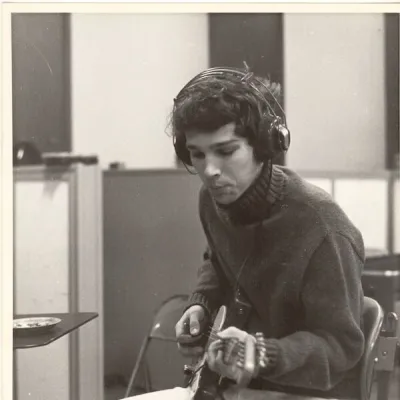
Chris (1951) Bell
Human Design Chart
Biography
Bell died on 27 December 1978, when he lost control of his Triumph TR7 sports car, sometime after 1:00 AM in Memphis. He was on his way home from a band rehearsal. The car struck a wooden light pole on the side of the road. The pole fell and killed him instantly. He was 27.
Bell's catalogue of proto-alternative rock has inspired the likes of Beck, R.E.M., Teenage Fanclub, Pixies, Primal Scream, Afghan Whigs, Pete Yorn, Wilco, The Posies, and The Replacements, all of whom have covered his music or expressed their admiration for Big Star in the press.
His life was documented in the acclaimed documentary Big Star: Nothing Can Hurt Me, released in 2013 by Magnolia Pictures. Bell's life, and the career of Big Star, was also documented in the 2018 book There Was a Light: The Cosmic History of Chris Bell and the Rise of Big Star. The 400-page oral-history style bio contains rare interviews with Bell, his bandmates, friends, family and notable fans.
What does Projector 1/4 mean for Chris (1951) Bell?
Projector 1/4 — Design at a Glance
Chris (1951) Bell's design pointed towards a tendency for focused perception. He was someone who immediately recognized system errors – comparable to a flashlight that shines directly on dark spots. This dense aura could be perceived as unpleasant by the environment, especially when errors were addressed directly. Instead of critical pointing, his design worked more effectively through passive shining: by setting harmonious examples himself, he attracted others who then sought advice from him. The central strategy was to wait for an honest invitation before engaging. This protected him from resistance and utilized his natural charisma.
Physiologically, Chris (1951) Bell did not have a constant life energy center; his Sacral Center was undefined. This shaped a cycle of phases with high efficiency and necessary rest periods to avoid burnout. The traditional work model that demands continuous performance ignored this need for recovery. Living according to this design – by waiting for invitations and respecting his energy cycles – he was rewarded with success. Ignoring these mechanics and pushing instead led sooner or later to bitterness as an expression of his non-self. His path was not constant action, but targeted shining at the right time.
Emotional Authority
Chris (1951) Bell's design pointed towards a specific decision-making strategy: consciously postponing judgments until the emotional wave subsides. He showed himself as someone who did not find his inner truth in the first moment of excitement or rejection, but only after a process of 'sleeping on it.' This attitude results from his Emotional Authority, carried by the defined Solar Plexus Center. This center is subject to a natural rhythm of ups and downs; current mood colors perception like a lens. Immediate action based solely on this initial impression would be risky as it only represents a snapshot, not the deeper reality.
The mechanics here require time and sleep. By letting Chris (1951) Bell decisions rest and allowing repeated questioning, he gained necessary emotional distance. Only when intense feelings subsided did clarity emerge. This process is of highest priority: Emotional Authority always takes precedence over other defined centers or logical considerations. Through this patience and waiting until calmness was achieved, he could make decisions that truly aligned with his inner truth rather than falling into the trap of momentary impressions. This shaped his way to design long-term life paths thoughtfully, not impulsively.
The 1/4 Profile — Investigator / Opportunist
Chris (1951) Bell's design was marked by a paradoxical tension: an intense drive for isolated knowledge acquisition on one hand and a deep need for familiar community on the other. As a 1/4, the Researcher/Networker, he showed a fundamental approach to thoroughly researching things before sharing them with others. Line 1 brought pressure to uncover occult or hidden knowledge, often accompanied by an ascetic retreat and isolation. This knowledge appeared pulsating and mysterious but required mutation to become publicly effective.
At the same time, Line 4 created a need for a network of familiar people. However, there was a central challenge: fear of exposure if one's own knowledge was still insufficient. A lack of security in matter could cause great heartache among loved ones. Therefore, a loving environment with deep trust was crucial. Only within this protected framework could Chris (1951) Bell unfold his potential. By combining profound expertise and networking ability, he developed into an authority in his heart topics. The flexibility to adapt principles as long as it was safe supported this development towards a stable position within his community.
Single Definition — Defined & Open Centers
Chris (1951) Bell revealed himself through a fixed inner identity and direction rooted in the defined G Center. This gave him a deep sense of security in self-love as well as a clear compass for his life mission, without being dependent on others. Parallel to this, the defined Solar Plexus Center acted as an emotional authority: truth did not reveal itself immediately but only after waiting out the emotional wave. This patience allowed for deep insights and careful decisions rather than impulsive reactions.
Supporting this stability was the defined Spleen Center, which offered a sharp intuitive survival sense in the here-and-now. Spontaneous warning signals were reliably perceived, promoting health and well-being. Additionally, the defined Root Center generated a constant inner pressure towards action capability and correction, propelling him forward in the material world.
In contrast stood the open centers, requiring vigilance. The open Head Center tended to situational mental confusion; Chris (1951) Bell could easily be distracted by doubts or questions from others rather than trusting his inner authority. Similarly, the open Ajna Center allowed flexible conceptual thinking but carried the risk of adopting other people's ideas as one's own truth or compensating for uncertainty with false certainty.
The open Heart Center did not imply a constant will; there was the temptation to make promises to prove worth, often ending in cycles of disappointment. Instead, it was wise not to feel compelled to prove oneself. The open Sacral Center led to variable energy; he easily absorbed environmental energy, which could lead to overexertion if boundaries were ignored and he relied on 'borrowed' energy. Finally, the open Throat Center attracted attention only upon invitation; attempting to force attention created stress, while patient waiting brought about the right moments for speaking.
Channels for intuitive elegance, emotional urgency and persistent ambition.
Chris (1951) Bell's design shows a fundamental disposition characterized by intuitive self-assurance and deep emotional curiosity. This configuration creates a person who not only secures their own survival through spontaneous adaptation but actively seeks new experiences and aims to improve their position within the social fabric.
This dynamic stems from Channel of Perfect Form 57-10, connecting the Spleen Center with the G Center. Through Gate 57, intuitive insight, and Gate 10, self-behavior, a capacity arises to rely on one's physical reality moment by moment. This is not an intellectual calculation but an acoustic sensitivity to the environment that resolves unfounded future anxieties and creates an aesthetic presence that exemplifies living fully in the here and now.
Parallel to this, Channel of Recognition 30-41 connects Root Center with Solar Plexus. Gate 41 brings the original drive for new experiences while Gate 30 emotionally charges this longing. The result is restlessness not quelled by rational planning but through diving into life itself. Here, waiting out the emotional wave leads to clarity before following the next impulse.
The third pillar is formed by Channel of Transformation 32-54 between Root and Spleen. Gate 54 brings ambition to rise through talent and hard work driven by concern for the survival of one's tribe (Gate 32). This ambition is less egoistic but rather a dedication to the community; Chris (1951) Bell works hard to prove worth and gain support. The synthesis of intuitive aesthetics, emotional curiosity, and ambitious transformation shapes a life that constantly evolves, with these channels' energy persisting regardless of the Personality Sun in Gate 61.
Individual Circuitry — Circuit Signature
Chris (1951) Bell's design inclined towards emotional reflection. He showed himself as someone who did not simply forget past experiences but sought meaning within them and shared felt insights with others. This attitude results from active Meaning-Finding Circuit. Contrary to the cool logic of other configurations, this energy is inexplicable and wave-like: each emotional cycle has a clear beginning, middle, and end.
Channel 'Recognition' (30-41) connected Chris (1951) Bell's Solar Plexus Center with his Root Center. This created a direct link between emotional perception and fundamental survival energy. Emotions were not fleeting moods but drove reflection. As this is a Simple Definition, these centers together with the G Center and Spleen Center formed one coherent energetic flow.
Additionally, Ego Circuit was active through Channel 'Transformation' (32-54). This connected the Spleen Center with the Root Center. Here it was not about individual ego but tribe and cooperation. The energy supported communal resource creation and required pauses as there was no direct connection to Sacral Center.
The Integration Circuit completed the picture through Channel 'Perfect Form' (10-57). This connected Identity Center with Spleen Center. It allowed Chris (1951) Bell to draw strength from reacting to life and guide it through intuitive knowledge in the present moment. The combination of these circuits shaped a being that united emotional depth, tribal support, and intuitive presence into one cohesive experience.
Right Angle Cross of Maya 4
Chris (1951) Bell's design carried the structural principle of the right cross of the Maya 4. This configuration acts as an overarching order characteristic that holds together the entire energy architecture and suggests a specific life direction. In Human Design, such a cross marks a deeply rooted inner logic that cannot be easily changed by external circumstances but serves as a constant reference.
Since the raw content does not provide further mechanical details about this cross—neither specific behaviors nor characteristic challenges—the description is limited to the mere presence of this principle. It functions here as a structural framework without deriving concrete patterns of action or psychological tendencies from it. The design thus shows a clear affiliation with this category, which stands in the context of the four Maya crosses but lacks additional differentiation through channels or centers in this section.
This classification highlights that Chris (1951) Bell possessed a defined energetic structure serving as a backdrop for all other processes. Without further specific data on how this cross affected daily experience or decision-making, it remains a neutral statement of the architectural conditions in the chart. The mechanics themselves remain abstract in this chapter and serve only to identify the underlying system.
Saturn Return · Uranus Opposition · Chiron Return · 2nd Saturn Return — Life Cycles
Chris (1951) Bell's design was characterized by an intense but short cyclic structure marked by two prominent transition points. He died at age 27 on his way home from a band rehearsal in 1978, falling into the first Saturn return, a period often regarded in Human Design as a concluding phase of a life stage where long-term structures condense or—as here—abruptly end. His death thus marked the end of this first major cycle.
The dynamics of his design continued posthumously. In 1992, at age 41 (based on his birth date), the album 'I Am the Cosmos' was released. This corresponds to the Uranus opposition, a point where sudden liberation or unexpected redefinitions often occur. In Chris's case, this mechanical constellation led to his artistic legacy gaining new expansive qualities after his death. The combination of an early end through the Saturn cycle and later surprising publication due to Uranus activation shows a life whose influence did not end with physical death but unfolded in a second, unexpected phase. This sequence underscores the specific way his design stored and ultimately released energy—first in the stillness of death, then in posthumous resonance of his work.
Projector · Emotional Authority — Synthesis
A central red thread in Chris (1951) Bell's design is the dynamic interaction between inner perception and the need to carry this outward. The combination of a defined G-Center, emotional authority, and the profile of researcher/networker points towards deep self-knowledge that unfolds fully only through exchange with others. Open Throat, Sacral, and Heart Centers reinforce this tendency toward adaptation to environmental energy, while defined centers like Root and Solar Plexus provide an inner drive and emotional depth forming a foundation for authentic connections. The ability to recognize patterns (Gate 62) and transform knowledge (Channel 54-32) seems closely linked with the search for meaning in exchange with others.
A central paradox in Chris (1951) Bell's design lies between the need for inner clarity, conditioned by emotional authority, and the open nature of many centers making him receptive to external influences. While he possesses deep inner truth (Gate 61), he is simultaneously dependent on validating and shaping this through interaction with others. This tension between self-observation and social engagement shapes his way of communicating and expressing himself, influenced both intuitively and by the energies of his environment.
3 Defined Channels
Incarnation Cross - Right Angle Cross of Maya 4
Solar Return
The Solar Return shows the moment when the sun returns to its exact birth position - your personal solar year.
Life Cycles
Discover the life cycles with a detailed triple view (birth chart, cycle chart, composite).
Human Design Profile
- Type
- Projector
- Strategy
- Wait for the respectful invitation
- Authority
- Emotional Authority
- Profile
- 1/4 - Investigator / Opportunist
- Definition
- Single Definition
- Incarnation Cross
- Right Angle Cross of Maya 4
- Date of Birth
- 12.01.1951 10:11
- Place of Birth
- Memphis, TN, United States
Frequently Asked Questions
What is Chris Bell's Human Design type?
What is Chris Bell's Profile?
What is Chris Bell's Authority?
Which incarnation cross is assigned to Chris Bell?
When was Chris (1951) Bell born?
Discover your own Human Design
Are you also a Projector? Find out in a personal reading how to unfold your leadership qualities and recognize the right invitations.
More Personalities
Back to overviewSissy Spacek

Aaliyah

Alain-Fournier

Alexia

Alizée

Anémone
