
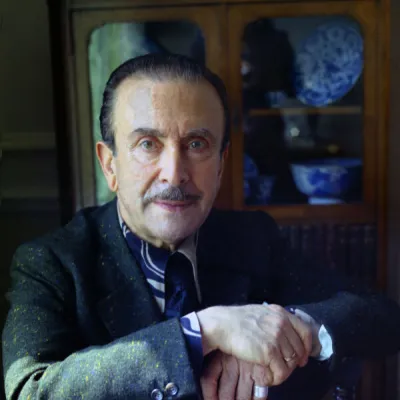
Claudio Arrau
Human Design Chart
Biography
He showed his musical abilities early. His dad, Carlos Arrau, died before he was a year old and his mom supported the family by giving music lessons. When he was four, he startled his mom by playing from memory some of the pieces her students were learning. A child prodigy, he gave his first concert at five and began international tours at nine, in 1912. He made his Berlin debut in 1914 and toured Europe in 1918. In 1927, he won the Grand Prix Internationale des Pianistes, in Geneva.
He moved to the U.S. in 1941, performing in the U.S. and abroad, winning many international awards. He later resided in Germany, which claimed his mind and his intellect , though his heart always remained loyal to Chile.
Arrau had stopped performing in June 1989 after the death of his wife, Ruth Schneider, a German-born mezzo-soprano whom he married in 1937. He was visiting Austria for a rare appearance, a private recital to open a museum when he was stricken with stomach problems. He died on 9 June 1991 of complications from emergency intestinal surgery in Muerzzuschlag, Austria.
Claudio Arrau as a Projector 5/1 in Human Design
Projector 5/1 — Design at a Glance
Claudio Arrau revealed himself as someone with a dense, focused aura that metaphorically acted like a bright flashlight. His design allowed him to immediately recognize errors in other people's systems and shed light on them. However, directly addressing these deficiencies would have generated resistance; instead, his elegant strategy was to passively shine by example through a harmonious presence. This radiance was strongly attractive and invited others to seek out his insights.
As a Projector, Claudio Arrau did not have a defined Sacral Center, meaning he lacked constant intrinsic life energy. His rhythm consisted of phases of high activity followed by necessary rest periods to avoid burnout. The central rule of his design was to wait for a respectful and honest invitation rather than initiate himself. When he followed this strategy, he was rewarded with success. If he ignored it and tried to push his energy against the resistance of his environment, sooner or later his non-self theme of bitterness would emerge. His path involved using the attractive power of his aura and acknowledging the necessity of rest instead of exhausting himself in a foreign system's constant run.
Emotional Authority
Claudio Arrau's Human Design profile indicated a tendency towards delayed decision-making; spontaneous impulses proved misleading. His inner authority was located in the Defined Emotional Center, meaning he experienced constant fluctuations of his feelings. The world appeared to him colored by his current mood: one moment totally excited, the next feeling negative. However, this feeling was only a snapshot and not necessarily his truth. Quick, spontaneous decisions based on emotion could therefore have negative consequences.
The mechanics required patience and time. The longer Claudio Arrau let a decision mature, the deeper he could see. This meant literally delaying decisions, asking himself multiple times, and "sleeping on" choices. Over time, intense feelings subsided; emotional distance was established. Only then did true clarity and calmness emerge. This process was essential for long-term decisions with significant influence on life's trajectory. Emotional authority always took precedence over other defined centers, regardless of additional configurations in the chart. It was only through going through this emotional cycle that Claudio Arrau reached his inner truth rather than being led by fleeting moods.
The 5/1 Profile — Heretic / Investigator
Claudio Arrau revealed himself as someone who oscillated between the magnetic urge to offer solutions to others and the necessity of deep, patient research. His design indicated a tendency to be perceived as a hero while internally undergoing the process of careful learning. This aligned with the dynamics of his 5/1 Profile: Line 5 gave him almost magnetic qualities so that people desperately wanted to know what knowledge he had to offer. They often sought solutions for their problems from him.
However, this constellation harboured the risk of exhaustion through societal projections into the "saviour" role. Like a sage in science who answers questions for hours and is drained by evening, Claudio Arrau could quickly become overwhelmed if clear boundaries were not set. Line 1, on the other hand, emphasised patience as a crucial factor for introspection and absorbing new insights. Without this depth, there was the danger of being perceived superficially.
The challenge lay in balancing: On one hand, he stood available to others (Line 5), while on the other, he needed time for his private research (Line 1). The risk of overload through constant "saying no" was real. However, when Claudio Arrau learned to set boundaries, he could maintain a beneficial balance between problem-solving for others and his own work of gaining insight. Thus, he optimally utilised his gifts by not just reacting but acting from a deep knowledge base supported by inner security.
Split Definition — Defined & Open Centers
Claudio Arrau had a persistent, specific mental structure and a constant inner pressure that shaped his actions. His defined Ajna Center guaranteed permanent cognitive activity; he thought continuously and created concepts in an unchanging way, unaffected by external opinions. This mental energy flowed into his defined Throat Center, which served as a reliable channel to communicate or manifest these thoughts as well as other internal processes clearly and authentically.
However, his decision-making was determined by the defined Solar Plexus Center. As an emotional authority, this required patience: he had to wait out the waves of his feelings until clarity set in before acting. This fostered a deep spiritual sensitivity and prevented impulsive reactions to passing moods. Parallel to this, the defined Root Center provided a constant, adrenalized survival pressure that propelled him forward. Without guidance from his emotional authority, this pressure could have led to obsessive stress; instead, it served as a steady energy foundation for his existence.
This firm infrastructure contrasted with his open centers, which conditioned situational vulnerabilities. His open G Center meant that identity and life direction were not set but had to be gained through initiation from the environment; he tended to find himself in various roles rather than possessing a rigid "I" structure. The open Heart Center made him vulnerable to the pressure of proving his worth through promises or competition – a pattern he needed to avoid to prevent self-doubt. Additionally, his Sacral Center was open, meaning that generative energy was not consistently available. He risked exhaustion if he took on foreign energies or ignored when rest was necessary. His open Spleen Center required caution with spontaneous decisions, as intuitive safety could only be perceived in healthy environments, and his open Head Center made him vulnerable to mental confusion when seeking answers that were not his own.
Channels for focused drive, intuitive insight and expression.
Claudio Arrau revealed himself as someone whose thinking often seemed light-years ahead of its time. His design contained innovative insights that he could not simply spill out; they needed time to be understood. This tension between the mutative knowledge of his design and the restless longing of his personality fundamentally shaped his inner dynamics.
At the core, Channel 43-23 was at work in him. This channel connects the Ajna Center with the Throat Center through Gate Insight (43) and Gate Assimilation (23). Inspired knowledge was received here as spontaneous breakthroughs that then had to be processed and clearly expressed. What made this connection special was its mutative quality: it formed a unique perspective that was efficient but only accepted when communicated at the right time. Without patience and strategy, these innovative thoughts seemed foreign or were rejected. Arrau had to learn to explain his genius simply so that it could be embraced by the collective rather than being perceived as an outsider.
At the same time, Channel 41-30 drove him in his personality. This channel connects the Root Center with the Solar Plexus through Gate Limitation (41) and Gate Feeling Recognition (30). The pressure from the root created restlessness and a strong desire for new experiences, while emotions intensified this need. Here lay the challenge of timing: as design knowledge had to wait, personality energy impatiently pushed for fulfillment. Success only came when he learned to trust the emotional wave and waited for clarity before jumping into new experiences.
Additionally, Gates like 13 (Continuity), 7 (Leadership), and 16 (Experimenting) played a role in fostering his ability to reflect and master through sustained experimentation. Gate 55 also brought emotional instability and genetic mutation signals. Arrau's path involved integrating these forces: patient communication of innovative insights paired with trust in his emotional authority.
Collective Circuitry — Circuit Signature
Claudio Arrau was marked by a split definition that created two parallel but not directly connected energetic poles within him. On one side, the Knowledge Circuit linked his Ajna Center to his Throat Center through the Channel of Structuring (Gates 43 and 23). This configuration promoted a pulsating, acoustic form of expression where cognitive clarity was immediately translated into structured communication. It was about conveying knowledge through clear articulation.
At the same time, there existed an entirely separate current in the Sense Finder Circuit. Here, the Channel of Recognition (Gates 30 and 41) connected his Solar Plexus Center to his Root Center. This connection generated a cyclical, visual processing of emotional waves from the past. Unlike the immediate cognitive structuring, this area required time for reflection and understanding of past experiences before they could be shared.
Since both circuits were not connected in Claudio Arrau, these forces existed as internal polarisation side by side: on one hand, direct structured knowledge transmission, on the other hand, wave-like emotional sense finding. His life task was to integrate these two separate areas – cognitive present and emotional past – without energetically mixing them.
Left Angle Cross of Masks 1
Claudio Arrau's Human Design profile indicated a tendency towards social adaptability that was expressed through strategic role-playing. He demonstrated the ability to adopt different facets of his personality according to the situation, without compromising his core identity. This flexibility served as a tool for navigating complex social structures.
This dynamic stemmed from what is known as the 'left cross of masks' configuration. The idea behind this setup is that identity is not rigid but fluid and context-dependent. The ability to wear different 'masks' did not mean deception or loss of self for Claudio Arrau, but rather a conscious adaptation strategy. It was about effectively acting in changing environments by anticipating and responding to the expectations and demands of his surroundings.
The emphasis here was on the strategic use of these role changes. By adapting, he could overcome social barriers and shape relationships without compromising his inner integrity. This configuration described a life task that combined social intelligence with internal stability. Claudio Arrau lived this mechanism by presenting himself differently in various contexts while always acting from a firm center. Thus, flexibility was not a sign of weakness or dishonesty but a powerful resource for dealing with the social world.
Saturn Return · Uranus Opposition · Chiron Return · 2nd Saturn Return — Life Cycles
Claudio Arrau's Human Design profile indicated a tendency towards sudden, necessary separations that acted as catalytic moments for realignment. This mechanism arose from his Uranus opposition in his chart, a configuration that generated abrupt breaks in life rhythms to break stagnant patterns and enforce new directions. It was not random unrest but a structural necessity to dissolve old bonds so that his potential could continue to develop.
This dynamic became concrete in 1941: Claudio Arrau moved to the USA at age 38. This step marked a decisive turning point in his career, illustrating the Uranus opposition as an instrument of radical change. The move was not a gradual transition but a sharp break from his previous life reality, allowing him to adapt to a new environment and continue his artistic career under changed conditions. The opposition functioned here as a driving force that challenged him out of his comfort zone and enforced a fundamental realignment of his professional path. Through this sudden shift, Claudio Arrau could open up new perspectives that might not have been accessible without this disruptive impulse. Thus, the mechanism showed itself to be an essential factor in his development by forcing him to remain flexible and continuously adapt to changing circumstances.
Projector · Emotional Authority — Synthesis
Claudio Arrau lived deeply rooted in the perception of patterns and recognizing potentials. His profile as a Projector, coupled with emotional authority and the Hero/Researcher Profile (5/1), indicates a natural ability to recognize hidden aspects in others and offer solutions – but only when he himself could patiently wait out his emotional wave. The connection between defined Head and Throat Centers allowed him to clearly structure and express knowledge while the open Root and Sacral Centers made him receptive to the energies of his environment, which could be both inspiring and exhausting. He was an observer who guided others through his inner clarity and deep understanding.
A central paradox in Claudio Arrau's design lies in the tension between his need for recognition and his ability for independent insight. The open Heart Center points towards a search for validation, while the defined Ajna Center provided him with strong internal knowledge. This combination led to a dynamic where he offered solutions but was also dependent on being 'invited' by others to fully realize his potential and share his wisdom. He navigated between the desire for recognition and the necessity of relying on his own inner authority.
2 Defined Channels
Incarnation Cross - Left Angle Cross of Masks 1
Solar Return
The Solar Return shows the moment when the sun returns to its exact birth position - your personal solar year.
Life Cycles
Discover the life cycles with a detailed triple view (birth chart, cycle chart, composite).
Human Design Profile
- Type
- Projector
- Strategy
- Wait for the respectful invitation
- Authority
- Emotional Authority
- Profile
- 5/1 - Heretic / Investigator
- Definition
- Split Definition
- Incarnation Cross
- Left Angle Cross of Masks 1
- Date of Birth
- 06.02.1903 23:59
- Place of Birth
- Chillán, Chile
Frequently Asked Questions
What was Claudio Arrau's Human Design type?
What Profile did Claudio Arrau have?
What Authority did Claudio Arrau have?
What incarnation cross did Claudio Arrau have?
When was Claudio Arrau born?
Discover your own Human Design
Are you also a Projector? Find out in a personal reading how to unfold your leadership qualities and recognize the right invitations.
More Personalities
Back to overviewSissy Spacek

Aaliyah

Alain-Fournier

Alexia

Alizée

Anémone
