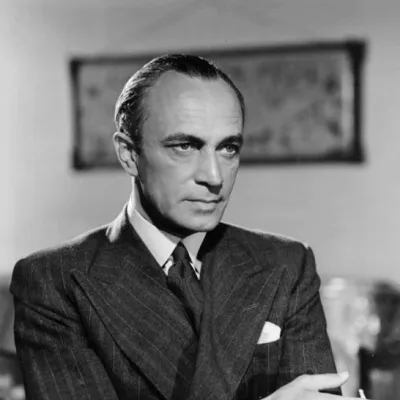
Conrad Veidt
Human Design Chart
Biography
Conrad Veidt married three times: he first married Augusta Holl, a cabaret entertainer known as "Gussy", on 18 June 1918. They divorced four years later. Gussy later married German actor Emil Jannings. Veidt's second wife Felicitas Radke was from an aristocratic German family; they married in 1923. Their daughter, Vera Viola Maria, called Viola, was born on 10 August 1925. He last married Ilona Prager, a Hungarian Jew called Lily, in 1933; they were together until his death.
Conrad Veidt died on 3 April 1943, aged 50, of a massive heart attack while playing golf at the Riviera Country Club in Los Angeles with singer Arthur Fields and his personal physician, Dr. Bergman, who pronounced him dead on the scene.
Human Design Analysis: Conrad Veidt as Manifestor 1/3
Manifestor 1/3 — Design at a Glance
Conrad Veidt revealed himself as a person with a clear pioneer role: He was a Manifestor. This design set him up as a leader and visionary, someone destined to lead the world in a new direction. Similar to an emperor in ancient Rome, he had great plans but did not wage the necessary wars himself; instead, he sent others out to conquer lands for him. This structure brought with it a specific pain point: He was often misunderstood and polarized his environment. Because his thinking reached further than that of many others, he found admirers who followed him while others disliked or even hated him because of these grand visions. To find the right followers, it was crucial for his design to inform others about his intentions in a timely and precise manner. This strategy of informing was key to aligning with his essence. If he followed this strategy, he was rewarded with a feeling of inner peace. However, if he lived against this design, he felt instead a persistent, deep anger within himself. His character trait as a polarizing leadership figure thus directly derived from the mechanics of his Manifestor type and significantly determined his interaction with the world.
Splenic Authority
Conrad Veidt's design tended towards immediate, instinctive orientation. His inner authority lay in the defined Spleen Center – his health and alarm system. Since both the Emotional and Sacral Centers were open, this specific survival intelligence could operate; only Projectors or Manifestors carry this configuration.
This center functioned as a reliable indicator of physical well-being and intuition. Veidt had spontaneous inner knowledge that signaled to him in each moment whether a situation, environment, or society was right for him. Decisions therefore had to be made on the spot; the first impulse served his health directly and allowed him to rigorously distance himself from harmful influences.
This Spleen voice, however, was a very fine impulse that only came once and could easily be drowned out or ignored by other influences. This required high vigilance; occasionally, a retreat helped to hear the decision clearly. Since what was right became apparent only in the moment, plans could change short-term. Long-term commitments were difficult; instead, Veidt needed much freedom and flexibility to act spontaneously without unnecessarily binding himself.
The 1/3 Profile — Investigator / Martyr
Conrad Veidt revealed himself as a person whose life revolved around the principle of trial and error. His design marked him as both an explorer and experimenter – a configuration that links theoretical knowledge with practical application. Often, the energy of Line 1 took control; then he hesitated before implementation because he felt he did not know enough yet. This stood in tension to Line 3, which urged him to try things out and learn from mistakes. Self-earned insights were crucial for him: If he deemed something good, he had previously examined it both theoretically and practically intensively.
This dynamic is reflected in the specific energies. The first line of Gate 41 called for an inner reflection and investigation of the right feelings to limit oneself. It was important to look deeply into fantasies and focus on a feeling to make meaningful experiences. At the same time, Mercury in Fall showed a tendency towards overexertion and the urge to evoke many emotions simultaneously. On the other hand, the third line of Gate 28 included an adventurous spirit and the willingness to take risks without reason to achieve personal life goals. Saturn enhanced this through cautious adventure-seeking and the readiness to weigh important decisions rationally. Over time, he learned to be more selective in dealing with risks and recognize the value of personal goals. His judgment was trustworthy as it rested on this double test.
Split Definition — Defined & Open Centers
Conrad Veidt's Design set a tendency towards constant mental activity and conceptual processing. His defined Head Center and Ajna Center generated a persistent internal pressure to ask questions and form concepts. This energy flowed through his defined Throat Center, translating thoughts directly into communication. Additionally, the defined Spleen Center provided spontaneous intuitive judgments in the present moment, while the defined Root Center supplied the necessary adrenaline-driven pressure to move forward and master existential challenges.
This complex interplay stood in contrast to his open centers. The open G Center meant that Veidt did not have a fixed identity; he tended to blend with his environment and sought direction through external initiations. The missing Heart Center lacked consistent willpower, making him vulnerable to the pressure of proving his worth through promises or performance – a pattern often ending in self-doubt when expectations were not met.
Especially defining was his open Sacral Center. Without his own generative energy source, he absorbed the life force of others and amplified it. This led to being easily overwhelmed if he did not adhere to his inner authority, as he had no natural limits for workload or sexual availability. He tended to ignore exhaustion by using "borrowed" energy rather than waiting for true resonance.
The open Solar Plexus Center completed this picture of sensitivity: Veidt absorbed and amplified the emotions of his surroundings. He relied on not identifying these emotional waves as his own to maintain clarity. In quiet moments alone, he could detach from this conditioning burden and use his barometric sense of the emotional climate without being immersed in it. His strength lay in the ability to clearly articulate mental concepts and intuitively act while learning to accept his open centers as mirrors for the world around him rather than needing to fill them.
Channels for intuition, logical scrutiny and inner clarity.
Conrad Veidt revealed himself as someone who combined intuitive depth with technical mastery. His design indicated a tendency to perfect a skill through repeated experimentation and engagement, transforming it into genuine talent. This attitude stemmed from the Channel 48-16. Here, Gate 48 sought out vital information while Gate 16 experimented with new possibilities and perfected skills. Veidt needed recognition and resources to continue this process of refinement; his talent flourished when energized.
Parallel to this, he had a sharp sense for what needed correction. The Channel of Judgment 58-18 drove him to question and improve patterns. Gate 58 provided an insatiable drive for "better and more," while Gate 18 acted as a sentry to recognize imbalances. Veidt found joy in being asked to find solutions to problems or identify what was not working. His logic served to keep society moving forward and promote satisfaction through perfect patterns.
Mentally, Veidt's mind was geared towards processing sudden insights. The Channel of Awareness 61-24 connected the inspiration from Gate 61 with the rationalization from Gate 24. His thinking did not seek discovery in a conventional sense but waited for the moment of mutation when knowledge simply entered. He could not control his thoughts; they happened at their own pace, often accompanied by a need for silence to filter out the "white noise" of inspiration and hear the inner truth.
Collective Circuitry — Circuit Signature
Conrad Veidts Design shows a tendency towards analytical clarity paired with an impulse for innovative awakening. He appeared as someone who used rational structures to face the future while simultaneously creative insights emerged – two separate yet coexisting forces of his divided definition.
In the Understanding Circuit, he connected Throat, Spleen, and Root Centers directly. This connection allowed him to share logical insights free from emotional coloring (Channel 16-48) and apply strategic judgment (Channel 18-58). This shaped an attitude of focused transmission of rational insights.
At the same time, his Head and Ajna Centers formed a separate stream of the Knowing Circuit. Here, the Channel of Awareness (24-61), which generates innovative ideas and new perspectives, was active. Since these centers were not connected to the first circuit block, these creative impulses existed as a separate energy source.
The mechanics show that Conrad Veidt possessed the ability to articulate complex connections clearly and strategically organize them. Simultaneously, new insights and individual viewpoints emerged in his mind. These two systems – rational sharing and creative discovery – operated as independent streams without directly flowing into each other. This created a dynamic where analytical precision and innovative awareness functioned as separate yet coexisting aspects of his personality.
Right Angle Cross of the Unexpected 4
Conrad Veidt was characterized by a fundamental attitude that embraced the unpredictable as a driving force. His design featured the right cross of Unexpected Four, suggesting a life dynamic where spontaneous turns and sudden insights were central. This configuration did not describe linear planning but rather an ability to respond with specific intuition to unexpected opportunities or crises. Instead of orienting himself around rigid routines, his inner compass was attuned to transforming the chaos of the moment into tangible experience. The right cross four often linked areas of identity and external perception in a way that personal authenticity sharpened through confrontation with the unpredictable. It wasn't random action but a deeper resonance with situations outside the realm of control. Conrad Veidt lived in a reality where the surprising was not seen as disruption, but essential information. This structure demanded constant adaptability and readiness to embrace new circumstances without prior certainty. The energy of this cross acted like a catalyst for moments when old patterns broke down, making space for something new. It was a dynamic of trust in the flow of events, even if that flow was unpredictable.
Saturn Return · Uranus Opposition · Chiron Return — Life Cycles
Conrad Veidt's design laid out a tendency towards intense, often fateful turning points that clearly structured his life path. His first Saturn Return around age 27 marked the transition from pre-established presence to established presence. This became evident in 1920: That year he gained fame through his role as Cesare in the film 'The Cabinet of Dr. Caligari.' This success condensed years of artistic development into a sustainable, public result and solidified his reputation permanently.
The Uranus Opposition around age 40 brought a phase of necessary adaptation to new external circumstances. Here it was not just about change but integrating altered conditions into one's identity. In 1933 he played in the film operetta 'The Congress Dances.' This career development reflected the mechanical necessity of flexibly adapting to changed societal or professional structures and recalibrating his own form of expression.
The Chiron Return around age 50 is a fulfillment cycle where the inner purpose of the design often fully unfolds or concludes. For Conrad Veidt, however, this cycle ended abruptly: He died in 1943 at the age of 50 from a severe heart attack. This death fell exactly into the phase when his incarnation cross would have shown its full effect, linking the conclusion of his life journey with the peak of his inner development.
Manifestor · Splenic Authority — Synthesis
Conrad Veidt lived a path of relentless research and experimentation, driven by a deep, instinctive perception (Spleen Center) and an ongoing urge to understand and explore new possibilities (defined Head Center). This process led him repeatedly into uncharted territory where he made judgments through trial and error – a pattern evident in professional successes based on careful preparation and practical experience. The ability to grasp hidden information (Gate 48) and apply it skillfully (Gate 16) created unique depth and competence that inspired or challenged others.
At the same time, Veidt was a man of contrasts: As a Manifestor with inner Spleen authority, he acted impulsively and independently, yet his defined Head Center connection created constant mental pressure to question and analyze everything. This combination of spontaneous intuition and unceasing inspiration led to creative energy that was transformative but also made him vulnerable to internal conflicts – a tension between the desire for free expression and the necessity to think things through in detail.
3 Defined Channels
Incarnation Cross - Right Angle Cross of the Unexpected 4
Solar Return
The Solar Return shows the moment when the sun returns to its exact birth position - your personal solar year.
Life Cycles
Discover the life cycles with a detailed triple view (birth chart, cycle chart, composite).
Human Design Profile
- Type
- Manifestor
- Strategy
- To inform others before acting
- Authority
- Splenic Authority
- Profile
- 1/3 - Investigator / Martyr
- Definition
- Split Definition
- Incarnation Cross
- Right Angle Cross of the Unexpected 4
- Date of Birth
- 22.01.1893 14:00
- Place of Birth
- Berlin, GER
Frequently Asked Questions
What was Conrad Veidt's Human Design type?
Which Profile did Conrad Veidt have?
What Authority guided Conrad Veidt?
What incarnation cross did Conrad Veidt have?
When was Conrad Veidt born?
Discover your own Human Design
Are you also a Manifestor? Find out in a personal reading how to use your initiation power peacefully and dissolve resistance.
More Personalities
Back to overviewSissy Spacek

Anémone

Ann-Margret

Arletty
Arno

Artus