
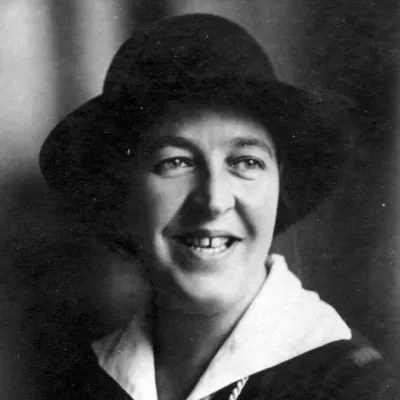
Corrie ten Boom
Human Design Chart
Biography
Corrie was the daughter of the Protestant Dutch Reformed watchmaker Casper ten Boom (18 May 1859, Haarlem -10 March 1944, Loosduinen) and Cornelia "Cor" Johanna Arnolda Luitingh (19 May 1858, Amsterdam - 17 October 1921, Haarlem), who married on 16 October 1884 in Benthuizen.
They got five children: Elisabeth "Betsie" ten Boom, (19 Augustus 1885, A'dam - 16 December 1944, Ravensbrück concentration camp), Willem ten Boom (21 November 1886, A'dam - 13 December 1946, Hilversum), a theologian, Hendrick Jan ten Boom (12 September 1888 - 6 March 1889), Arnolda Johanna "Nollie" ten Boom (1890 - 22 October 1953) and Cornelia Arnolda Johanna "Corrie" ten Boom (1892 - 1983).
Caspar ten Boom was the son of Willem ten Boom, who had a watch shop at the prominent Barteljorisstraat 19, Haarlem, Netherlands, also called "Beje" and now a Holocaust museum. He took over his fathers business and the family lived at the two floors above the shop. Willem studied in Leiden theology and Nollie married and thus got away, but his two daughters Betsie and Corrie stayed with their old father. Corrie became the first licensed Dutch female watch maker after a study in Switzerland.
At the end of WW1 (1918) the family adopted foster children for several years. In 1921 Casper's wife died from a stroke. During the second world war, Casper ten Boom and his daughters Betsie en Corrie sheltered Jewish people, who were trying to escape from the Nazi Holocaust at their home. Some thirty eight Jewish people were saved, but only Corrie survived the Holocaust. All three were honoured by Yad Vashem.
When the Dutch Jews had to wear a seemingly toxic yellowish Jew star, Caspar ten Boom, meaning: Treasurer of the Tree, demonstratively wore an in his eyes Golden David Star. He honestly believed that all people were equal before God.
Corrie ten Boom as a Generator 6/2 in Human Design
Generator 6/2 — Design at a Glance
Corrie ten Boom had a remarkable endurance and a high level of sacral energy, which marked her as a Generator type. Her design indicated that her strength was most effectively utilized not through constant initiation of projects but by responding to external impulses. She worked like a workhorse: strong and steady as long as she had the energy for her task.
The central mechanics of her design were the strategy of waiting and reacting. Instead of taking the first step herself, she should wait for signals from life and then act when her sacral center gave a clear "yes." This process allowed her to use her energy efficiently and make things in her life happen effectively.
When she followed this strategy and pursued her heart's work, it rewarded her with a sense of deep fulfillment. Conversely, ignoring this inner signal or forcing initiations often led to frustration and energy depletion. Two main pitfalls shaped her potential: either wasting her power on things without internal resonance, leading to burnout, or being held back from her true passion despite still having plenty of power. Her success therefore depended largely on whether she reacted from the gut and protected herself against forced pauses or false initiations to maintain her inner satisfaction.
Sacral Authority
Corrie ten Boom oriented her decisions around sacral authority. As a Generator, she was the only type whose strategy also formed her inner authority, simplifying her decision-making process. Her leadership did not come from the Head Center but as a physical reaction to external stimuli: a gut feeling or a noticeable surge of energy. She learned to pay attention to specific bodily sounds like grunts, hums, or loud "mmms." These signals marked the right path.
When her sacral motor kicked in, she felt vital and alive. An almost inexhaustible level of energy was available, making work happen with great enthusiasm. She was born to walk through life joyfully and immerse herself completely in activities without needing an abstract purpose behind them. The action itself was enough.
Additionally, the Spleen Center acted as a supporting authority. This allowed for particularly quick, spontaneous reactions. She had immediate access to her physical well-being and instinctive perception. This instinct was reliable; it guided her safely through complex situations by promoting instant gut reactions rather than waiting for long deliberations.
The 6/2 Profile — Role Model / Hermit
Corrie ten Boom's Design established a clear two-phase developmental path. In the first three decades of her life, an experimental phase dominated: She gathered diverse experiences through trial and error, with each failure prompting brief retreats to realign herself. This early period primarily served for pure action and learning from personal experience without yet recognizing any overarching structure.
Around her 30th year, her fundamental approach fundamentally changed. The activation of the sixth line in her Profile prompted her to withdraw – metaphorically into a "cave on the mountain." There she viewed the previously gathered life events with great distance. This withdrawal was not isolation for its own sake but rather a necessary process of reflection and healing. She abstracted general patterns from her personal successes and failures, thus developing profound self-awareness.
The result of this phase was maturity in a wise stance. Corrie ten Boom eventually re-emerged into exchange with others, now no longer as an experimenting novice, but as a role model. Her task was to selectively impart the wisdom she had gained. The second line of her Profile ensured that she shared her insights only with those who were ready to participate in the growth process and learn from her ability for introspection. This enabled others to follow their own path of transformation.
Triple Split Definition — Defined & Open Centers
Corrie ten Boom revealed herself as a person with a stable inner authority. Her design featured defined centers in Ajna, Throat, G Center, Sacral, Spleen, and Root. This endowed her with constant mental clarity in conceptual thinking and reliable communication methods. She possessed a firm self-identity and a clear sense of life direction, coupled with deep intuition for well-being in the present moment. Her vital energy from the Sacral Center was available to her for reactive decisions, while the defined Root Center provided consistent pressure to manage stress and move forward.
In contrast, Head, Heart, and Solar Plexus centers were open. These open areas acted like mirrors reflecting their environment. The open Head Center received inspirations or doubts from the surroundings without identifying them as personal mental truth. Corrie ten Boom tended to be distracted by external questions when she did not trust her inner authority. The open Heart Center lacked consistent willpower; it was vulnerable to pressure to prove itself through promises or competitive thinking. Instead, she could learn to not need to prove her worth. The open Solar Plexus Center absorbed the emotions of others. It served as a barometer for emotional climate but required detachment to avoid personalizing other people's moods or fears and free herself from emotional conditioning. This configuration allowed her to remain in her own stable identity and intuition despite external emotional waves.
Channels for ambition, rhythm and clear structure.
Corrie ten Boom revealed herself through a deep connection of generative life force and inner direction. Her design featured the Beat channel 14-2, linking Sacral Center with G Center. Gate 14 focused on making material resources available for mutation, while Gate 2 served as driver for identity and higher understanding. This configuration made her a custodian of essential keys to translate mutative impulses into material reality. She did not need to know the path ahead; through trust in her sacral reaction – inner yes or no – she initiated new perspectives for herself and her environment. Her mere presence was strengthening, as she authentically followed her destiny.
Alongside this powerful foundation, Corrie ten Boom had the channel of Structuring 43-23. It connected Ajna Center with Throat Center. Gate 43 received spontaneous insights and breakthroughs that were assimilated and clearly expressed through Gate 23. This allowed her to communicate unique perspectives in ways that promoted efficiency and changed others' thinking. Her challenge was to let go of control and allow her mind to process knowledge at its own pace. When her utterances came at the right time, her innovative ideas were recognized; otherwise, she felt like an outsider.
Additionally, gates such as 42 (Experience and Completion) and 60 (Acceptance of Limitations), which foster growth through ending old processes, played a role. Gate 56 supported the narration of mental processes, while Gate 1 stood for creative mutation in the here and now. These elements shaped a person who learned from experience to accept limits and forge new paths without losing sight of her own identity.
Individual Circuitry — Circuit Signature
Corrie ten Boom revealed herself as someone who brought new insights into the world through structured expression and rhythmic life force. Her design presented three separate energetic streams, as she had a Triple Definition; these remained parallel alongside each other without directly flowing into one another.
In the Knowledge Circuit, two independent segments were at work. The first connected Ajna Center (Mind) with Throat Center (Expression). This enabled her to translate inner visions and mental clarity into concrete words or actions, making change tangible for others. The second segment of this circuit linked Identity Center with Sacral Center (Life Force). Here a pulsing energy arose that affirmed and transformed her unique individuality through continuous impulses from within.
Another independent stream flowed in the Ego Circuit between Spleen Center (Intuition/Survival) and Root Center (Movement/Security). This transformation channel helped her break old patterns and intuitively find new ways in uncertain situations. Since this area was not connected to Sacral Center, Corrie ten Boom needed quiet pauses here to recharge her resources for the root.
The combination of mental expression, sacral identity power, and intuitive transformation shaped her unique path. She used these separate forces not only to gain new knowledge but also to make it effective through emotional resonance and structured communication.
Left Angle Cross of Limitation 1
Corrie ten Booms Human-Design legte eine grundlegende Ausrichtung auf das Erkennen und Respektieren von Grenzen fest. Sie zeigte sich durch die archetypische Struktur des linken Kreuzes der Begrenzung 1 geprägt, was nicht als willkürliche Beschränkung zu verstehen war. Stattdessen ging es um die intuitive Wahrnehmung dessen, was tatsächlich möglich ist und wo natürliche Limitationen liegen.
Dieses Kreuz verlieh ihr eine tiefe, oft unbewusste Intuition für Kapazitäten und Schranken – sowohl in sich selbst als auch in anderen Menschen. Es unterstützte ein Verhalten, das auf Realismus und dem Verständnis von Reichweite basierte, anstatt auf grenzenloser Expansion. Für Corrie ten Boom bedeutete dies, dass ihre Handlungen und Entscheidungen stark davon beeinflusst wurden, wie gut sie die tatsächlichen Grenzen einer Situation einschätzen konnte. Sie orientierte sich weniger an theoretischen Möglichkeiten als an der konkreten Realität dessen, was tragbar und durchführbar war. Diese innere Kompassfunktion half ihr, Energie dorthin zu lenken, wo sie wirklich wirken konnte, und verhinderte Überforderung durch unrealistische Erwartungen. Die Mechanik dieses Designs förderte somit eine klare, bodenständige Perspektive auf Lebensumstände und menschliche Fähigkeiten.
Saturn Return · Uranus Opposition · Chiron Return · 2nd Saturn Return — Life Cycles
Corrie ten Booms Human-Design legte eine Tendenz an, Lebensphasen durch klare Strukturierungsmomente zu definieren, in denen innere Überzeugungen nach außen traten. Dies zeigte sich konkret im ersten Saturn-Return: 1920 lernte sie den Beruf der Uhrmacherin in Basel. Dieser Zyklus markierte oft die berufliche Festigung und den Aufbau eines tragfähigen Fundaments für das weitere Leben.
Ein weiteres prägendes Element war der Chiron-Return, ein Erfüllungszyklus, in dem sich der eigene Lebenszweck zunehmend entfaltet und erfahrbar wird – sofern man gemäß seiner Strategie gelebt hat. Für Corrie ten Boom trat dieser Moment 1941 ein, im Alter von 49 Jahren. Ein jüdisches Ehepaar bat sie um Hilfe; sie fand für sie ein sicheres Versteck. Dieses Ereignis veranschaulichte die Mechanik des Chiron-Returns: Es handelte nicht primär um das Heilen alter Wunden, sondern um die konkrete Ausübung der eigenen Bestimmung im Dienst anderer. Die Unterstützung in dieser Notlage war der Ausdruck ihrer Inkarnationsaufgabe, die in dieser Lebensphase an Klarheit und Wirksamkeit gewann. Beide Zyklen – die frühe berufliche Verankerung und die spätere Entfaltung des Dienstes – strukturierten ihr Leben durch konkrete Handlungen, die aus ihrem Design heraus wuchsen.
Generator · Sacral Authority — Synthesis
Corrie ten Booms Human-Design offenbart eine zentrale Kontinuität in der dynamischen Balance zwischen innerer Kraft und dem Dienst am Kollektiv. Die definierte sakrale Energie (Generator-Typ) bildete die Grundlage für Ausdauer und tiefes Engagement, insbesondere wenn sie durch äußere Impulse aktiviert wurde – ein wiederkehrendes Muster, das sich in ihrer Bereitschaft zeigte, auf Lebensumstände zu reagieren. Diese Reaktionsfähigkeit wurde durch eine starke Verbindung zwischen G-Zentrum und Sakral verstärkt, was einen natürlichen Drang zur Unterstützung anderer und zum Aufbau von Beziehungen impliziert. Das definierte Ajna- und Kehlzentrum deuteten zudem auf eine klare innere Stimme und die Fähigkeit hin, diese authentisch auszudrücken, solange sie im Einklang mit der sakralen Autorität stand.
Ein zentrales Paradox in ihrem Design liegt in der Spannung zwischen dem Bedürfnis nach individueller Bestätigung (Gate 1) und der offenen Emotionalität (undefiniertes Solarplexus-Zentrum). Während das definierte G-Zentrum eine starke, innere Richtung vorgab, absorbierte sie gleichzeitig die Emotionen ihrer Umgebung. Dies führte zu einer inneren Dynamik, in der die eigene Identität und Richtung durch äußere Einflüsse verstärkt oder verzerrt werden konnten. Die Herausforderung bestand darin, die eigene Wahrheit zu bewahren und authentisch auszudrücken, ohne von den emotionalen Strömungen anderer überwältigt zu werden – ein Balanceakt zwischen Selbstbehauptung und Empathie.
3 Defined Channels
Incarnation Cross - Left Angle Cross of Limitation 1
Solar Return
The Solar Return shows the moment when the sun returns to its exact birth position - your personal solar year.
Life Cycles
Discover the life cycles with a detailed triple view (birth chart, cycle chart, composite).
Human Design Profile
- Type
- Generator
- Strategy
- To respond - wait for something to respond to
- Authority
- Sacral Authority
- Profile
- 6/2 - Role Model / Hermit
- Definition
- Triple Split
- Incarnation Cross
- Left Angle Cross of Limitation 1
- Date of Birth
- 15.04.1892 15:00
- Place of Birth
- Amsterdam, Netherlands
Frequently Asked Questions
What was Corrie ten Boom's Human Design type?
What Profile did Corrie ten Boom have in Human Design?
Which Authority guided Corrie ten Boom?
What incarnation cross was assigned to Corrie ten Boom?
When was Corrie ten Boom born?
Discover your own Human Design
Are you also a Generator? Find out in a personal reading how to use your sacral energy correctly and discover deep satisfaction.
More Personalities
Back to overviewAaliyah

Alain-Fournier

Alexia

Angèle

Angeli
Anne-Marie
