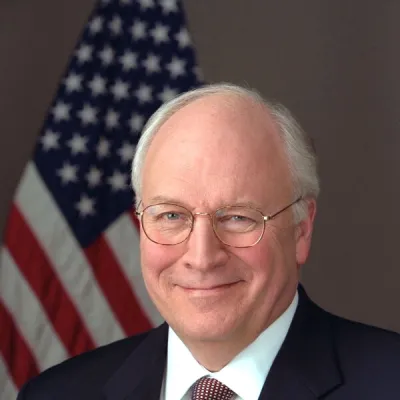
Dick Cheney
Human Design Chart
Biography
A rock-solid conservative, Cheney opposed abortion rights, gun-control, the Clean Water Act and Endangered Species Act. He voted against Environmental Cleanups and supported Oil Drilling in Alaska's wilderness. He was a staunch supporter of Defense, and the production of chemical weapons. He supported the death penalty. He favored raising the Social Security retirement age from 65 to 67 and opposed coverage of long-term care for the chronically ill. He opposed the Equal Rights Amendment and supported prayer in public schools.
Cheney attended Yale University on a scholarship but dropped out after three semesters. He took a job with the Utilities Company working as a lineman for two years before resuming his education at the University of Wyoming, his future wife’s home. Lynne Ann Vincent was born on 14 August 1941 in Casper, Wyoming. At school, Dick played football and was senior class president, and Lynne was homecoming queen. They married on 29 August 1964 and had two daughters, Elizabeth "Liz" and Mary.
After a B.A. in 1965 and an M.A. in 1966 in Political Science, Cheney left school in 1968 without completing his Ph.D. dissertation. The family moved to the Washington, DC area in 1969 when Cheney took a Congressional internship.
Dick Cheney — Projector with Profile 4/6
Projector 4/6 — Design at a Glance
Dick Cheney revealed himself as someone with an intense, focused aura that directly influenced his surroundings. As a Projector, he did not have the constant intrinsic energy source of other types' defined Sacral Center. Instead, he worked in phases of high intensity followed by necessary rest periods to avoid burnout. His design predisposed him to immediately recognize systemic errors and weaknesses – similar to a bright flashlight shining directly into darkness.
This ability to identify problems within a system was effective only when he did not confront them aggressively. Direct criticism would often be perceived as unpleasant or overbearing. Instead, his energy worked most effectively through an attractive presence: When he radiated harmony and clarity himself, others actively sought out his advice. His strategy involved waiting for honest invitations from the outside before offering his knowledge or leadership.
If he lived by this principle of waiting for invitations, he was rewarded with success. Ignoring this dynamic and attempting to lead or correct without invitation led sooner or later to his Non-Self theme: Bitterness. Therefore, his influence did not rest on constant action power but rather on targeted, invited guidance of others through his sharp perception and focused presence.
Emotional Authority
Dick Cheney was subject to an emotional wave that significantly shaped his judgment. His inner authority resided in the defined Emotional Center. This mechanism means: Every type except Reflectors can carry this authority, yet it is always prioritized regardless of other defined centers in the chart. Cheney saw the world permanently colored by his current mood. In one moment he could be completely enthusiastic about something, only to view the same situation negatively a short while later. This up-and-down of emotions was not a weakness but structurally given. However, his feeling at any moment represented merely a snapshot – a first impression that did not necessarily reflect his truth yet. Quick, spontaneous decisions based on such emotion often had negative consequences. The mechanism required patience: the more time he took to let a decision mature, the deeper and broader his understanding became. This involved consciously delaying, repeatedly reviewing questions, and being willing to be asked again. Over time, intense feelings subsided, emotional distance was gained. Only then did clarity and calm set in. This process was particularly important for long-term decisions that could have a significant impact on his life path. Through waiting, he reached the point where he had gone through the emotional process and acted.
The 4/6 Profile — Opportunist / Role Model
Dick Cheney showed a clear developmental line: In his first thirty years, he intensely experimented with relationships and friendships. This early behavior aligned with the dynamics of Profile Line 4, which fosters mutual dependence and cooperation. He sought close contact but expected others to keep up quickly to create a functioning team dynamic.
With Saturn's return, this attitude fundamentally changed. Line 6 became active and brought an internal conflict between the desire for community (Heart) and the need for detached reflection on the meaning of things (Head). Cheney increasingly withdrew, showed reserve, and sought a new direction as old processes came to an end.
In his later years, he appeared as a role model. He was expected to act wisely and cooperatively. At the same time, his heart remained cautious; it opened only to those who met his high standards. Line 6 gave him a certain detachment from the usual and could appear intolerant when something did not meet its criteria. It also helped him recognize a spiritual ego that had blindly surrendered itself to processes. His design thus marks him as someone who moved from an intimate team spirit to a detached, critical authority stance.
Triple Split Definition — Defined & Open Centers
Dick Cheney's design points to a tendency for constant mental activity and strong willpower. He appeared as someone who was under continuous pressure to ask questions and find answers, driven by his defined Head Center and Ajna Center. This configuration created a continual process of conceptual thinking, where inspiration often came with confusion or doubt since there was no direct energy available to implement the thoughts. Instead, his mind served to create concepts and inspire others to think.
Parallel to this, he had firm willpower through his defined Heart Center. This marked him as someone who enjoyed taking charge, controlling resources, and keeping promises. His ego strength was healthy so long as it wasn't used to impose unrealistic expectations on others. Supporting this structure was his defined Spleen Center, which gave him spontaneous intuition for health and well-being, along with the defined Root Center, providing a constant pressure to move forward in the world and cope with stress.
In contrast, he was open in other areas and thus susceptible to conditioning. His open Throat Center meant that he could not speak with constancy; he tended to feel pressured to demand attention through words rather than waiting for the natural invitation to speak. His open G Center left him acting without a fixed identity or direction; he relied on his environment to initiate action, often adapting himself to those around him instead of radiating a stable personality. Finally, lacking the constant vital energy of a defined Sacral Center, he was vulnerable to overloading with others' work energy and easily exhausted if he did not listen to his inner authority to set boundaries and rest.
Channels for synthesis, awareness and devotion.
Dick Cheney is marked by a design characterized by deep tribal loyalty and instinctive strategic evaluation. His essence was significantly shaped by the Synthesis Channel 19-49, which connects the Root Center with the Solar Plexus. This connection created an emotional "glue" based on the pressure to belong and the strict demarcation of what contradicted common ideals. Loyalty and the protection of one's territory were not abstract values but emotional necessities for the survival of the group.
Parallel to this, the Channel of Devotion 26-44 worked, creating a direct bridge between the Spleen and Heart Centers. This gave him the ability to instinctively recognize what the "tribe" needed—whether it was a product or an ideology—and to convey this with entrepreneurial energy. He selectively used historical memories to persuade his target audience, often acting as a promoter on the front line generating resources to supply the team.
Mentally supported by the Channel of Awareness 61-24, which translates inspiration from the Head Center into rational answers in the Ajna Center, he was able to experience sudden insights ("Satori"), arising not through logical deduction but through an inner mutation of knowledge. His mind sought silence to capture these mutative moments rather than constantly planning.
Additionally, prioritized Gates shaped his Profile: Gate 33 promoted reflection and withdrawal for strengthening before new cycles, while Gate 36 harnessed the energy of crises as a driving force. Gate 48 allowed him to recognize deeper patterns, even if this could lead to frustration, and Gate 21 aimed at controlling material resources in service to the community. Gate 18 emphasized correcting collective processes with an emphasis on fundamental rights, and Gate 57 offered intuitive clarity in the present moment.
Tribal Circuitry — Circuit Signature
Dick Cheney emerged as someone who created new perspectives through targeted impulses and relied on cooperative structures for resource building. His design was characterized by a Triple Definition, meaning three separate, parallel operating energy blocks: the Head Center and Ajna Center formed one block, Heart Center and Spleen Center another, and Solar Plexus Center and Root Center a third. These blocks were not directly connected to each other but existed as independent force fields alongside one another.
In the Knowledge Circuit, Dick Cheney activated the Channel of Awareness (24-61), which linked the Head Center with the Ajna Center. This promoted innovative flashes of insight and the ability to transform new knowledge. It was about expressing a unique identity through creative impulses that were immediate and auditory.
The Ego Circuit provided two additional connection lines. On one hand, the Channel of Devotion (26-44) connected the Heart Center with the Spleen Center. This supported the mediation of ideas and the joint creation of resources within a tribe or group based on traditional knowledge and tactile sense. On the other hand, the Channel of Synthesis (19-49) linked the Solar Plexus Center with the Root Center. This generated an emotional dynamic aimed at mutual support. Since this circuit did not have a connection to the Sacral Center, such cooperation and resource accumulation necessarily required periods of rest for regeneration. Dick Cheney thus operated through impulsive thinking, strategic cooperation, and emotional synchronization in separate steps.
Right Angle Cross of the Four Ways 4
Dick Cheney was shaped by a structure that pushed him into the role of a strategic mediator between different centers of power. His design did not follow a simple linear path; instead, it revealed a pattern of connection and balance. This configuration, known as the right cross of the four paths, described a life task of synthesis. It connected seemingly contradictory forces into a functional unit. Cheney did not live in isolated decision-making autonomy but rather in an ongoing process of integration. His energy was directed towards building bridges and stabilizing complex systems through mutual influence. This was a mechanism of relationship formation where he always acted as a mediator. The four paths symbolized the various directions of influence that he had to coordinate. His actions were characterized by the need to balance these streams, rather than dominate or suppress them. This resulted in a specific kind of authority based on coordination and an understanding of connections, not just direct command alone. He was part of a larger framework that could only exist through his mediating function. His presence served to stabilize this network of relationships and interests.
Saturn Return · Uranus Opposition · Chiron Return · 2nd Saturn Return — Life Cycles
Dick Cheney emerged as someone whose professional ascent was closely tied to structural milestones. His design suggested a tendency towards strategic positioning and institutional anchoring, which became evident in 1971 when he became the US Representative for Wyoming at age 30 – a classic first Saturn Return moment where years of groundwork often condense into a solid result and initial public responsibility is taken on.
His path was marked by clear phases of affirmation. In 1978, at 37 years old, he was elected the only Republican representative for Wyoming in the US House of Representatives. This corresponded with the Uranus Opposition cycle, often bringing unexpected turns or establishment within new structures.
The deepest unfolding of his design occurred during his Chiron Return. In 1989, at age 48, Cheney was appointed Secretary of Defense under George Bush. This fulfillment cycle does not mark healing of old wounds but a blooming period: the incarnation cross unfolds increasingly, and meaning and purpose become experiential. Here, the full extent of his inner alignment manifested in one of the highest political functions.
The consolidation of this role followed in 1997 with his second Saturn Return. At age 56, he co-founded the conservative think tank Project for the New American Century alongside Donald Rumsfeld. This cycle often solidifies long-term identity and influence built over previous decades, anchoring achievements sustainably in the public sphere.
Projector · Emotional Authority — Synthesis
He was a projector whose life was marked by a profound ability to recognize patterns and point out what remained unresolved in other areas (defined Head Center). However, this gift went hand in hand with an emotional ups and downs (emotional authority) that forced him to let decisions mature over longer periods. The profile as networker/role model indicates that he increasingly felt the need to demonstrate wisdom and cooperation throughout his life – a trait reflected in repeated career shifts (Saturn Returns, Uranus Opposition, Chiron Return). The Channel of Synthesis (Gate 19/49) underscores this tendency to seek connections while upholding ideals.
A central paradox lay in the tension between the desire for belonging (Line 4 in the profile) and the need for independent reflection (Line 6). He sought community, yet his deep analytical ability led him repeatedly to question existing structures. This inner conflict shaped his path, marked by a constant oscillation between integration and detachment – a pattern reflected in the documented career events.
3 Defined Channels
Incarnation Cross - Right Angle Cross of the Four Ways 4
Solar Return
The Solar Return shows the moment when the sun returns to its exact birth position - your personal solar year.
Life Cycles
Discover the life cycles with a detailed triple view (birth chart, cycle chart, composite).
Human Design Profile
- Type
- Projector
- Strategy
- Wait for the respectful invitation
- Authority
- Emotional Authority
- Profile
- 4/6 - Opportunist / Role Model
- Definition
- Triple Split
- Incarnation Cross
- Right Angle Cross of the Four Ways 4
- Date of Birth
- 30.01.1941 19:30
- Place of Birth
- Lincoln, NE, United States
Frequently Asked Questions
What was Dick Cheney's Human Design type?
What Profile did Dick Cheney have in Human Design?
What authority did Dick Cheney possess?
What incarnation cross did Dick Cheney have?
When was Dick Cheney born?
Discover your own Human Design
Are you also a Projector? Find out in a personal reading how to unfold your leadership qualities and recognize the right invitations.
More Personalities
Back to overviewSissy Spacek

Alain-Fournier

Anémone

Ann-Margret

Bourvil
Hergé