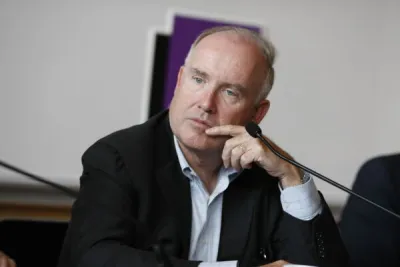
Dominique Bussereau
Human Design Chart
Biography
The Human Design of Dominique Bussereau: Generator 1/3
Generator 1/3 — Design at a Glance
Dominique Bussereau's design pointed towards great endurance and inner power potential. As a Generator, he had plenty of sacral energy that allowed him to pursue tasks with remarkable consistency – comparable to an workhorse that unfolds its strength as long as it burns for the task. However, this configuration also described a clear condition for his well-being: His energy was effective when he reacted to impulses from his environment rather than initiating independently. The strategy 'react' was key; only if the sacral center signaled a clear 'yes', could he optimally use his strength and experience deep satisfaction.
Two stumbling blocks shaped his energetic profile. First, frustration or energy loss threatened when he tackled tasks that did not give him inner resonance – wasting his resources on assignments without personal enthusiasm. Second, conflict potential arose if he was prevented from pursuing his heart project despite having full power available. Living in harmony with this design meant for Dominique Bussereau not to anticipate or force but to wait until life posed a question that his gut feeling could answer. In these moments of reaction, his true performance capacity and the sense of deep fulfillment were revealed, while constant initiating without inner confirmation sooner or later led to persistent frustration.
Sacral Authority
Dominique Bussereau's design pointed towards intuitive, body-based decision-making. As a Generator, Dominique had sacral authority – the only internal guidance that is both strategy and authority at once. This simplified the process: Instead of planning, he reacted to external stimuli with an immediate 'gut feeling'. This showed as a burst of energy or vocal confirmation like an affirming 'mm-hm', signaling vitality and inexhaustible energy. Such impulses drove him to perform tasks with great enthusiasm and without rigid purpose; he was born to lose himself in his work.
Additionally, an activated spleen center acted as supporting authority. In conjunction with the sacral center, this enabled quick, spontaneous reactions. Dominique had direct access to instinctive perception and physical well-being, stabilizing his decisions further. This configuration shaped a lifestyle based on resonance: When the sacral motor kicked in, tangible satisfaction followed; without an impulse, energy was retained. The mechanics did not require rational analysis before action but trusted these primary bodily signals as reliable guides through life.
The 1/3 Profile — Investigator / Martyr
Dominique Bussereau's design pointed towards a dual approach: combining meticulous theoretical preparation with the urge to validate insights through practical experimentation. As a Researcher and Experimenter (Profiles 1/3), Dominique Bussereau was someone who not only accumulated knowledge but actively tested it on his heart and guts.
The first line emphasized detail work, caution, and routine as the foundation for lifelong rituals. A solid base of facts was essential here, with creativity helping to transcend pure logic. The danger lay in getting stuck in planning out of fear of not knowing enough yet.
The third line complemented this through the principle of trial and error. Mistakes were accepted here not as failures but as a natural learning process. Assertiveness enabled Dominique Bussereau to turn these experiences into advantages. However, excessive caution could impair this learning potential by blocking the necessary step from theoretical to practical.
The result of this configuration was a judgment one could absolutely trust: If Dominique Bussereau deemed something good, it had passed both the theoretical scrutiny of Line 1 and the practical validation of Line 3. Thus, self-earned insights were the central theme shaping Dominique's approach.
Single Definition — Defined & Open Centers
Dominique Bussereau's Human Design profile indicated a tendency towards a clear, unwavering sense of self-identity and a deep understanding of his life direction. With the defined G Center, he had a reliable inner core that allowed him to love himself and show others new perspectives without being dependent on their approval. This internal stability was fueled by his also defined Sacral Center, a powerful source of vital energy. His strategy involved not initiating actions but responding to questions or invitations; only in this way could he sense whether his energy was truly available for a task. This protected him from exhaustion and frustration that would arise if mental decisions overlaid the sacral response.
In contrast, his profile revealed several areas of openness. The open Head Center made him vulnerable to mental pressure and confusion; he tended to get entangled in questions that were not his own rather than trusting his inner authority. Similarly, his open Ajna Center absorbed concepts and opinions from the environment, making him intellectually flexible but also prone to interpreting foreign ideas as personal truth or feeling uncertain when lacking an immediate answer.
The open Throat Center showed a tendency to demand attention through impulsive speaking or acting instead of waiting for an invitation to raise his voice. Additionally, his open Heart Center made him vulnerable to the pressure of proving his worth through willpower and promises – a cycle often ending in self-doubt due to the lack of constant energy. His open Solar Plexus Center also absorbed foreign emotions, leading him to feel emotionally unstable or avoid confrontation out of fear of rejection. Finally, his open Spleen Center reflected deep survival fears and the temptation to cling to unhealthy situations for a false sense of security, as well as his open Root Center, which amplified external stress and could drive him into cycles of chaos and burnout if he tried to actively reduce this foreign pressure.
Channels for the rhythm of material creation.
Dominique Bussereau exhibited a fundamental stance of mutative renewal, coupled with the impulse to make new directions tangible through concrete resources and logical structuring. This dynamic is rooted in Channel 14-2, connecting the Sacral Center and G Center. Gate 14 brings competence in handling material means to drive innovations forward, while Gate 2 acts as a conductor of movement through space and time. Together they enable leaving the status quo behind and establishing a new identity or orientation – not through coercion but through authentic responses to life.
This energetic foundation is refined by further influences. Gate 62 demands patience and exact pattern recognition to logically order facts and create frameworks, complemented by Gate 61 which describes inner truth as an acoustic process where noise is cleansed into the stillness of self-knowledge. In the realm of experience, Gate 42 plays a role: it emphasizes the need to complete processes before taking on new commitments and freeing up sacral power.
Gate 32 seeks continuity and material success for the tribe but critically assesses stability and can initiate radical changes if necessary. On the side of personality, Gate 7 acts as a leadership impulse that establishes hierarchies and projects future patterns. Within his design itself are Gate 29 with its persistence and saying 'yes' to life force, and Gate 25 which fosters mystical innocence and unconditional love. Finally, Gate 1 carries the energy of creative mutation in the here and now, enabling creativity without limitations. Dominique Bussereau's design thus links intuitive direction choice with analytical precision and the drive to materialize the new.
Individual Circuitry — Circuit Signature
Dominique Bussereau's Human Design profile indicated a tendency towards a deeply rooted, rhythmic expression style. His energy did not manifest as a diffuse idea but as a concrete 'beat' – a pulsing rhythm coming from within that sought immediate, acoustic or physical realization. This stance results from his Simple Definition: for him, the Identity Center (who I am) and the Sacral Center (my life energy) were directly connected.
This specific channel linked his personal identity with the constant, wave-like energy source of the sacral center. The result was an authentic way of being that relied less on intellectual analysis than on intuitive rhythm. Dominique Bussereau had this stable connection between Being and Doing, allowing him to continuously carry his individual signature into the world without interruption. Energy flowed evenly from the source in the Sacral Center directly to the expression form of identity, so actions naturally emerged from the core of his personality rather than being planned or constructed. This mechanism marked him as someone whose presence was characterized by a unique, steady and reliable rhythm.
Right Angle Cross of Maya 2
Dominique Bussereau's design points to a tendency towards deep, often painful transformation marked by the 'Right Cross of Maya'. This configuration describes a process where old structures and identities must be consciously dissolved to make room for a new self-understanding. It is not an easy change but rather a necessary breakdown of the known as a prerequisite for a more authentic existence.
The mechanics of this cross show that Dominique Bussereau was called upon to free himself from external expectations and internal constraints. This path often comes with uncertainty, as familiar support structures disappear. Yet it is precisely in this emptiness that the possibility arises to redefine oneself – not based on societal norms but from a deep inner truth. The challenge lies in accepting the pain of dissolution without clinging to the old. Only through this radical release can true freedom be achieved, beyond roles and masks. Dominique Bussereau thus showed himself as someone willing to take the uncomfortable path of transformation to discover his true nature.
Saturn Return · Uranus Opposition · Chiron Return · 2nd Saturn Return — Life Cycles
Dominique Bussereau's design points towards a tendency for structural anchoring and institutional responsibility. His life course was marked by phases where personal maturity corresponded with public offices – a pattern hinting at the cyclical densification of his inner authority through external structures.
In 2004, at age 52, he became French Minister of Agriculture. This period fell into the Chiron Return, a fulfillment cycle between ages 49 and 51 (here slightly delayed), during which one's incarnation cross unfolds. Those who have lived according to their strategy experience a bloom: meaning and purpose become tangible. Bussereau's appointment marked this phase of actualizing his design in societal reality.
Three years later, in 2007 at age 55, he was appointed Secretary of State for Transport in the Fillon I cabinet. This corresponded to the second Saturn Return, a cycle often leading to stabilization and deepening of already achieved positions. While the first return marks foundation, the second condenses years of work into a sustainable, lasting structure. Bussereau's career steps illustrate this mechanism: not as random ascents but as visible effects of inner maturation processes manifesting in concrete offices and responsibilities. His path shows how design cycles can shape political careers – through continuous integration of experience into tangible power structures.
Generator · Sacral Authority — Synthesis
Dominique Bussereau seems to be marked by a deep drive for authentic knowledge and its practical application. The sacral energy (Generator type) forms the driving force, which gains clear direction through the defined G Center – an inner compass feeling for love, identity, and one's path. This impulse is strengthened by the Profile of Researcher/Experimentator, who continuously learns and arrives at self-discovered insights through trial and error (Line 1/3). The Beat Channel connects this energy with a drive towards innovation and mutation, hinting at a natural talent for designing new paths. Repeated professional steps (2004, 2007) could be expressions of the need to turn knowledge into concrete changes.
At the same time, a tension field between the desire for independent exploration and potential melancholy associated with the knowledge circuit reveals itself. Intensive engagement with new ideas and possibilities carries the risk of getting caught in a cycle of constant search without fully arriving in the present moment. The defined G Center points to clear direction sense, yet the Researcher/Experimentator wants to test all options simultaneously, which can lead to internal conflicts – a play between the need for security and the drive for newness.
1 Defined Channel
Incarnation Cross - Right Angle Cross of Maya 2
Solar Return
The Solar Return shows the moment when the sun returns to its exact birth position - your personal solar year.
Life Cycles
Discover the life cycles with a detailed triple view (birth chart, cycle chart, composite).
Human Design Profile
- Type
- Generator
- Strategy
- To respond - wait for something to respond to
- Authority
- Sacral Authority
- Profile
- 1/3 - Investigator / Martyr
- Definition
- Single Definition
- Incarnation Cross
- Right Angle Cross of Maya 2
- Date of Birth
- 13.07.1952 11:00
- Place of Birth
- Tours, France
Frequently Asked Questions
What is Dominique Bussereau's Human Design type?
What Profiles does Dominique Bussereau have?
What authority does Dominique Bussereau have?
Which incarnation cross is active for Dominique Bussereau?
When was Dominique Bussereau born?
Discover your own Human Design
Are you also a Generator? Find out in a personal reading how to use your sacral energy correctly and discover deep satisfaction.
More Personalities
Back to overviewAaliyah

Alexia

Angèle

Anne-Marie

Arcángel
Arno