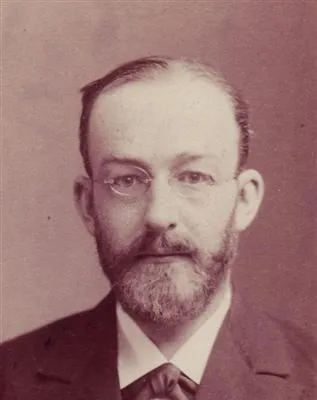
Eberhard Nestle
Human Design Chart
Biography
Eberhard Nestle married twice and had seven children. He died on 9 March 1913 in Stuttgart at age 61.
The Human Design of Eberhard Nestle: Manifesting Generator 3/5
Manifesting Generator 3/5 — Design at a Glance
Eberhard Nestle revealed himself as someone who possessed hybrid energy: the constant power of a Generator paired with the lightning-fast execution force of a Manifestor. His design indicated that he was capable of skipping steps and quickly pulling things into his life once he responded to an impulse. However, this speed was a double-edged sword; if he tended to juggle multiple projects or skip important stages, it led quickly to frustration – his specific Non-Self theme. To use this energy constructively, his strategy was the Reaction: He had to respond to life and wait until his Sacral Center gave a clear 'yes'. Only then could his creative power result in deep satisfaction. Once this inner resonance space was activated, he fell into a productive play mode where variety and parallel work did not serve as distractions but rather sources of his fulfillment. Without this alignment with inner authority, however, his natural dynamism risked running aimlessly or pushing him back through hasty action.
Sacral Authority
Eberhard Nestle revealed himself as someone who made decisions not in his head but from a direct physical reaction to the life around him. His design indicated a tendency to respond to external stimuli with an immediate inner signal – a kind of 'gut feeling' or surge of energy – that showed whether something was right or wrong. This mechanism is sacral authority, which exists only for Generator types and corresponds to their strategy of response. It greatly simplified his decision-making process: instead of weighing options, he waited for this internal confirmation, often expressed as a subtle grunting sound or feeling of vitality. Once this sacral motor kicked in, he had access to inexhaustible energy, allowing him to perform tasks with great enthusiasm and without obsessive purposefulness. Additionally, his activated Spleen Center served as a supportive instance. This gave him the ability to react especially quickly and spontaneously, as well as instinctively reach for his physical wellbeing. This combination allowed Eberhard Nestle to reliably guide himself from his immediate perception through life, fully immersed in his actions while experiencing joy and satisfaction.
The 3/5 Profile — Martyr / Heretic
Eberhard Nestle revealed himself as someone who did not acquire knowledge from books but through personal experimentation, often painful trial and error. His Profile 3/5 marked him as an experimental adventurer who initially questioned everything and had to test it himself before believing it. This line of the experimenter drove him to make mistakes in order to distill real life wisdom.
This practical experience became the foundation for his role as a hero and rescuer. The fifth profile line gave him the ability to present his accumulated insights to others, making him attractive to his environment. He functioned as a living example from which others could learn. Yet this status came with risks: If he failed in public experiments, it hit him particularly hard because his authority rested on visible success.
Additionally, the third line in Gate 24 enabled him to expose false knowers and gain attention through irrational use of focus. At the same time, he carried the potential of the fifth line in Gate 19: a deep need for readiness to sacrifice during crises. Yet this sacrifice was only authentic and sustainable if it did not stem from condescension or blind impulse but strictly followed his inner authority. Thus, his design connected the raw truth of experimentation with the responsibility to serve as an example to others.
Triple Split Definition — Defined & Open Centers
Eberhard Nestle revealed himself as a person with immense inner stability and a clear sense of his own identity. His defined G Center gave him a firm self-perception, while the also defined Heart Center provided him with the willpower to actively shape his life and keep promises. This combination of inner direction and assertiveness significantly shaped his character.
At the same time, he possessed constant mental activity. The definition between Head and Ajna Centers created a persistent pressure for him to question and form concepts continuously. He was constantly in the process of thinking, which could make him an inspiration source for others but also led him to get lost in unresolved thoughts when trying to immediately implement purely intellectual impulses into action. His defined Throat Center, however, allowed him to reliably express his mental processes as well as his willpower and identity.
As a Generator with a defined Sacral Center, Eberhard Nestle had a powerful source of vitality. His strategy was not to initiate but to react to life. Only through this reactive stance could he make his full energy available and avoid frustration. His defined Spleen Center supported this by providing a strong sense of intuition in the present moment, helping him make healthy decisions and protect his well-being.
In contrast, his Solar Plexus Center was open. This made him susceptible to absorbing and amplifying the emotions of those around him. He tended to interpret other people's feelings as his own or withdraw from emotional confrontations to avoid rejection. However, this openness also served as a barometer for the emotional climate; in calm moments, he could release these absorbed emotions and see more clearly. His defined Root Center provided a constant adrenergic pressure that propelled him forward and helped him deal with stress as long as he followed his inner authority.
Channel 20-57: The Brainwave — Channels & Gates
Eberhard Nestle revealed himself as someone whose internal rhythm was marked by sudden, profound transformation processes. This tendency resulted from the Mutation Channel 60-3, connecting Root and Sacral Centers. He carried potential for evolutionary change but had to learn to accept limitations and move beyond the confusion of new beginnings. His energy pulsed and could be melancholic; he needed time alone with his muse until the next impulse came.
At the same time, Eberhard Nestle possessed a rare clarity in dealing with himself and others. The Perfect Form Channel 57-10 connected Spleen and G Centers through intuitive insight and the Behavior Gate. This allowed him to guide his behavior from deep impulses, resolving unfounded future anxieties and promoting spontaneous, appropriate action. He lived out his uniqueness without seeking recognition and often left his environment healthier than he found it.
This intuition was expressed in the Brainwave Channel 57-20. Here, intuitive insight received a clear voice in the present moment. Eberhard Nestle could communicate profound self-awareness and encourage others to awaken their own inner survival intelligence. His spontaneous verbal outbursts often hit the core of an issue faster than reasoned argumentation.
In the mental realm, the Awareness Channel 61-24 between Head and Ajna Centers came into play. He experienced sudden moments of knowing, a Satori, breaking old thought cycles. His mind was not there to control everything but to receive inspiration and follow inner truth as it emerged in its own time.
For processing experiences, the Lost Son Channel 13-33 between G and Throat Centers served. As a natural listener, he gathered life stories and secrets, then withdrew to reflect before sharing them. This process of patience and remembering gave his communications depth and continuity.
The Initiation Channel 51-25 in the Heart Center connected competitive energy with universal love. Eberhard Nestle had the potential to reach deeper levels of consciousness through the 'shock' of individuation, encouraging others to live their uniqueness if invited.
Additionally, Gates like 44 (Awareness), 19 (Resources/Territory) and 56 (mental stimulation) shaped his design, while Gates 17, 42, 31, 41 and 32 added layers of logical organization, experiential building, and tribal continuity.
Individual Circuitry — Circuit Signature
Eberhard Nestle revealed himself as someone who combined deep inner centering with a strong individual expression. His design pointed to a Triple Definition: three separate energetic islands that did not flow directly into each other but existed parallel. One group connected the Sacral and Root Centers – another the Identity, Heart, Throat, and Spleen Centers; the third Head and Ajna Centers.
The Centering Circuit in him linked Identity and Heart through the Initiation Channel (25-51). This created solid, courageous convictions and a strong self-worth that remained without direct connection to the Throat Center within this circuit. Parallel to this, the Knowledge Circuit worked: Here Head and Ajna (Lightning Strike 20-57), Throat and Spleen (Awareness 24-61) as well as Sacral and Root (Mutation 3-60) were connected. These separate segments promoted innovative ideas, emotional transformation, and the expression of new paths.
The Meaning Circuit linked Throat and Identity through the Lost Son Channel (33-13). This allowed him to reflect on past experiences and share these insights emotionally with others to learn together from them. Finally, the Integration Circuit integrated Throat, Identity, and Spleen through the Awakening Channel (20-10) and Perfect Form Channel (10-57). Here he intuitively responded to life, channeled power through proper behavior and manifested this in the present moment. This combination shaped a personality that was both internally stable and called to bring new knowledge and emotional truths into the world – always from his unique identity.
Right Angle Cross of the Four Ways 1
Eberhard Nestle's design points to an inclination towards inner stability and trust in one's own path, independent of external circumstances. This attitude stems from the configuration of the right cross of the four pathways, a specific orientation in Human Design that aims to protect and nurture one's essence. People with this structure often showed a deep connection to themselves and their values, which helped them remain calm during turbulent times. They did not seek validation from outside but oriented themselves according to their inner voice. This ability to focus on the essential allowed Eberhard Nestle to make clear decisions that were in harmony with his nature. The right cross of the four pathways also fostered a respectful distance towards others, enabling him to protect his energy while remaining authentic. This characteristic shaped his entire life and helped him face challenges with composure. Through this inner alignment, he was able to live his own truth without being influenced by external expectations.
Saturn Return · Uranus Opposition · Chiron Return · 2nd Saturn Return — Life Cycles
Eberhard Nestle's design showed a tendency to experience personal bonds and professional positions as deeply intertwined with his life cycles. His first marriage to Klara Kommerell in 1880 at the age of 29 fell exactly within his first Saturn Return. This cycle marked for him a moment of condensation: years of internal structuring became visible and tangible in a stable relationship.
Ten years later, in 1890 when he was 39, the Uranus Opposition occurred. This phase often brings sudden changes or the need for new freedom to light. Nestle married Elisabeth Aichele that year. The design linked here the impulse to break free and repopulate directly with a fundamental relationship choice, indicating dynamic adaptability triggered by external circumstances.
The peak of this development was his Chiron Return in 1898. At age 47, Nestle became Professor at the Evangelical-Theological Seminar Maulbronn. In Human Design, this is not a healing process in a clinical sense but an achievement cycle: The inner calling and incarnation cross find their concrete, visible form in the outside world. His appointment to professorship was material confirmation of what his design defined as his true purpose – a blooming period where meaning and structure met.
Manifesting Generator · Sacral Authority — Synthesis
Eberhard Nestle lived a life marked by profound internal dynamics. His design as an Manifesting Generator (with defined Sacral Base) points to someone who constantly had energy available and could seize opportunities quickly, but was also bound to a certain instability due to the necessity of responding to sacral impulses. This combination of initiating power and reactive wisdom, reinforced by the defined Mental Center, created an indefatigable researcher who continuously asked questions and sought new insights – a pattern that showed in his recurring turning points (Saturn Return, Uranus Opposition) in relationships and career.
A central paradox in Nestle's chart lay in the interplay of experimental enthusiasm and the drive for solution competence. The profile as an Explorer/Hero suggests someone who learned through personal experimentation and then shared their knowledge. At the same time, the Channel of Mutation (3-60) implies inherent melancholy and acceptance of limitations even amidst constant striving for newness. This tension between unbound exploration and the necessity to confront the limits of reality shaped his path and led to a life full of transformation and knowledge acquisition.
7 Defined Channels
Incarnation Cross - Right Angle Cross of the Four Ways 1
Solar Return
The Solar Return shows the moment when the sun returns to its exact birth position - your personal solar year.
Life Cycles
Discover the life cycles with a detailed triple view (birth chart, cycle chart, composite).
Human Design Profile
- Strategy
- To respond - wait for something to respond to
- Authority
- Sacral Authority
- Profile
- 3/5 - Martyr / Heretic
- Definition
- Triple Split
- Incarnation Cross
- Right Angle Cross of the Four Ways 1
- Date of Birth
- 01.05.1851 07:15
- Place of Birth
- Stuttgart, GER
Frequently Asked Questions
What was Eberhard Nestle's Human Design type?
Which Profile did Eberhard Nestle have?
What Authority guided Eberhard Nestle?
What incarnation cross did Eberhard Nestle have?
When was Eberhard Nestle born?
Discover your own Human Design
Are you also a Manifesting Generator? Find out in a personal reading how to unfold your multi-talents and direct your energy wisely.
More Personalities
Back to overviewAldair

Alizée

Angeli

Arletty
Artus
Balthus