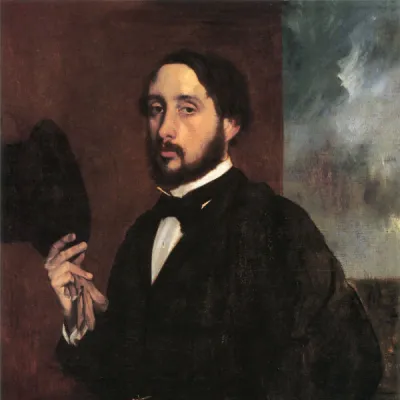
Edgar Degas
Human Design Chart
Biography
Degas also produced bronze sculptures, prints, and drawings. Degas is especially identified with the subject of dance; more than half of his works depict dancers. Although Degas is regarded as one of the founders of Impressionism, he rejected the term, preferring to be called a realist, and did not paint outdoors as many Impressionists did.
Degas was a superb draftsman, and particularly masterly in depicting movement, as can be seen in his rendition of dancers and bathing female nudes. In addition to ballet dancers and bathing women, Degas painted racehorses and racing jockeys, as well as portraits. His portraits are notable for their psychological complexity and their portrayal of human isolation.
At the beginning of his career, Degas wanted to be a history painter, a calling for which he was well prepared by his rigorous academic training and close study of classical Western art. In his early thirties he changed course, and by bringing the traditional methods of a history painter to bear on contemporary subject matter, he became a classical painter of modern life.
Edgar Degas — Generator with Profile 1/3
Generator 1/3 — Design at a Glance
Edgar Degas had enormous inner endurance and a high level of life energy. His design as a Generator suggested that he should work like a strong working horse: powerful and steady, provided he had the energy for his tasks. This power was not always immediately available to him; it ignited primarily when he responded to signals from his environment. The motto of his system was not to initiate independently but to wait until his Sacral Center – the motor of his motivation – gave a clear "yes."
This mechanism largely determined the quality of his life. When Degas listened to and acted on such inner impulses, he experienced deep satisfaction and a feeling of full fulfillment. Conversely, ignoring these signals or forcing actions without inner resonance led to frustration and energy loss. Two specific dangers lurked in this pattern: either he spent his energy on things that did not interest him, which exhausted him, or he was prevented from continuing work on his heart projects even though he still had plenty of drive left. His success therefore depended less on constant initiative than on the ability to react intuitively and use his energy where it flowed authentically.
Sacral Authority
Edgar Degas revealed himself as a Generator whose decision-making was marked by sacral authority. This inner voice did not operate in the Head Center but rather in his body: In response to external stimuli, he felt an immediate gut feeling or surge of energy. His design required him to recognize these physical signals—often audible as grunts, hums, or a simple "Mhm"—and trust them.
With his Emotional Center open, the sacral authority could establish itself clearly; it also formed his strategy. This simplified his process: Instead of thinking things through, he reacted to what energized him. When his sacral motor kicked in, he felt vital and alive. He then had an almost inexhaustible supply of energy and tackled his work with great enthusiasm. Degas was born to go through life with joy and satisfaction, fully immersed in his activities without being rigidly goal-oriented.
Additionally, his activated Spleen Center acted as a supporting authority. Directly connected to the Sacral Center, this allowed for particularly quick and spontaneous reactions. He had immediate access to his physical well-being and instinctive perception. Guided reliably by this deep, bodily intuition, it made his decisions in the moment precise and authentic.
The 1/3 Profile — Investigator / Martyr
Edgar Degas revealed himself as someone who did not merely collect knowledge theoretically but validated it through consistent practice and error checking. His design featured the Profile of a Researcher and Experimenter (1/3), defining his life task in terms of learning processes and the principle of trial and error. Often, Line 1 energy took control; then he felt that he did not know enough to act. This was in tension with Line 3, which urged him to try things out. Degas’ judgment rested on intellectually and practically examining objects or activities down to his heart and gut. Only after this double verification could he consider something truly valuable – a process that shaped his design.
This attitude was reinforced by specific energetic flows: Gate 56 emphasized the importance of quality in stimulation. For Degas, feedback was crucial for understanding whether his suggestions were effective and ideas could be naturally represented. Parallel to this, Gate 3 (Line 3), which stands for mutation and survival, pushed him to try extreme states to discern biological partner selection and fertility in a broader sense – that is, what works and what does not. This configuration linked the drive towards evolutionary change with the necessity of securing insights through personal experience. Degas’ design thus set a tendency to trust his judgment only when theory and practice aligned.
Split Definition — Defined & Open Centers
Edgar Degas was characterized by a constant, unchanging way of thinking and conceptualizing. His defined Ajna Center ensured that he was always in a mental process; his ideas were specific, trustworthy, and not easily influenced from the outside. This mental structure flowed directly into his defined Throat Center, allowing him to express or manifest what he thought. Thus, his communication was a direct expression of his conceptual world.
Additionally, Degas had a fixed sense of self-identity and direction, shaped by his defined G Center. He knew who he was and naturally showed others the way without being dependent on them. His actions were also driven by an enormous source of vital energy: his defined Sacral Center. As a Generator, he possessed a constant reserve of energy that became available only through reacting to external stimuli. Initiating actions without prior invitation led to frustration and exhaustion because the sacral power was then lacking.
In contrast, his Head Center was open. Degas had no consistent source for inspiration or mental clarity at the moment of decision-making. He tended to take on the mental pressure of others and deal with questions that were not his own. This could lead to confusion when he tried to solve these external problems. His open Heart Center also meant that he did not have a constant willpower. He was vulnerable to the urge to prove his worth through promises or competitions, which often ended in cycles of failure and self-doubt because he lacked the energy to maintain these commitments long-term.
His Solar Plexus Center was also open, causing him to absorb and amplify emotions from his environment. He tended to experience foreign moods as his own and avoid confrontation to prevent emotional storms. Finally, his Spleen Center being open brought a fundamental uncertainty about health and well-being with it. He unconsciously sought security from others but risked unhealthy dependencies or spontaneous decisions that were later regretted because they did not stem from his inner authority.
Channels for insatiable curiosity, change and clear action.
Edgar Degas showed himself to be someone who worked deep underground where new forms slowly developed before coming into the light. His design featured a tendency towards melancholic waiting periods, interrupted by sudden revolutionary impulses. This dynamic came from Channel of Mutation 60-3, connecting the Root Center with the Sacral Center. Gate 60 brought in evolutionary restriction energy while Gate 3 attempted to bring order to the chaos of a new beginning. Degas had to learn to accept this pulsing on/off energy and not argue against it but wait patiently for the right moment from his Sacral Center.
At the same time, he possessed a powerful ability to express himself in ways that awakened others. The Awakening Channel 10-20 connected his G Center with his Throat Center. Through Gate 10 (Appearance) and Gate 20 (Now), he spoke a clear message of self-love and awareness. His survival depended on accepting himself in every moment and proving this clarity through action, thereby unconsciously inspiring others to be themselves.
Additionally, an insatiable thirst for knowledge drove him forward. The Channel of Curiosity 11-56 connected his Ajna Center with his Throat Center. Gate 11 (Ideas) and Gate 56 (Inspiration) made him a storyteller who sought less after facts than illustrative parables. He picked up details, filled in gaps, and created magical stories that stimulated the imagination of others. This combination of mutative depth, awakened expression, and curious narration shaped his unique way of seeing and shaping the world.
Individual Circuitry — Circuit Signature
Edgar Degas showed himself to be someone who strengthened his unique identity through mutative deviations from existing norms. This tendency resulted from the Knowledge Circuit where specifically the mutation between Sacral and Root Centers was at work in him. This channel promoted gaining new knowledge and expressing a pulsing, acoustic creativity in the Now. Since he had a shared definition, these energies existed as separate streams. Another independent stream formed through the Meaning-Finding Circuit: Here curiosity connected Ajna with Throat Center. This channel channeled cyclical, visual emotions and experiences from the past into a collective sharing to learn from it. The third stream came from Integration, where the Awakening Channel linked Identity and Throat Centers. This allowed him to draw strength from reacting to life through correct behavior and intuitive knowledge and act effectively in the Now. These three separate groups – Mutation, Curiosity, and Awakening – shaped his design as parallel, not directly connected forces that each fulfilled their own tasks of transformation, reflection, and self-confirmation without forming a single continuous flow.
Right Angle Cross of Laws 2
Edgar Degas demonstrated a fundamental approach based on the search for hidden truths. His design indicated that he did not merely collect superficial impressions but aimed to understand deeper connections and principles. This inclination towards analyzing the invisible was a central driving force in his perception.
This orientation stemmed from the configuration 'The right cross of laws 2'. In Human Design mechanics, this pattern describes a specific life task: uncovering hidden structures and conveying these insights to others. It was not just about knowledge but a need to communicate complex connections in ways that were tangible for those around him. Degas' design thus promoted an attitude of decryption. He sought what lay beneath the surface and felt compelled to share his insights. The mechanics of this cross emphasized the connection between individual insight and collective understanding. For Degas, this meant that his deepest impulses were directed towards revealing hidden truths and shaping them into forms others could absorb. His path was marked by a dual focus: first, uncovering what is concealed and secondly making it comprehensible. This configuration created an inner compass that continually drove him to look beyond the facade of things and communicate his discoveries with his surroundings. It was a dynamic interaction between private understanding and public sharing of knowledge.
Saturn Return · Uranus Opposition · Chiron Return · 2nd Saturn Return — Life Cycles
Edgar Degas revealed himself as someone whose internal structure was geared towards sustainable condensation followed by disruptive breakthroughs. His design indicated a tendency for long-term formation before new structures became visible. In 1861, at the age of 27, he created paintings such as 'The Bellelli Family' and 'Medieval War Scene'. This corresponded to his first Saturn Return, a cycle where years of groundwork often condenses into solid results. Here, the foundation for his artistic base was laid, characterized by discipline and structuring.
Later, in 1874 at the age of 40, Degas organized the first group exhibition of Impressionists. This coincided with the Uranus Opposition, a period often heralding unexpected changes or breaks from established norms. Rather than clinging to old patterns, he acted as a catalyst for a new movement. This configuration describes a life path that initially works towards stability and mastery before later breaking through existing boundaries with innovative impulses. The mechanics of his design thus promoted both deep rooting in traditional forms and the ability to initiate radically new things when the time was ripe.
Generator · Sacral Authority — Synthesis
Edgar Degas' life was marked by a deeply rooted drive, through continuous experimentation and testing (Profile Researcher/Experimenter), to reach new insights. This investigative stance drew strength from his strong, sacral energy (Generator Type), driving him to continually explore new paths in artistic expression – as long as he felt the corresponding vitality internally (sacral authority). The Channel of Mutation (3-60) points towards a gift for evolutionary change, with accepting limits and transcending conventions being central elements of his creative process. This process was not linear but characterized by constant back-and-forth between theoretical exploration and practical experimentation.
Simultaneously, Degas lived in a tension field between the need for conceptual clarity (defined Ajna Center) and the unpredictable nature of his sacral energy. His mind was constantly active, concepts were continually reshaped, yet actual implementation depended on internal confirmation – a 'yes' from his body. This led to melancholy (Knowledge Circuit), as the creative process often involved letting go of old ideas and embracing the unknown. The documented events, such as the creation of certain paintings or organizing exhibitions, only became apparent after intense inner testing and experimental phases.
3 Defined Channels
Incarnation Cross - Right Angle Cross of Laws 2
Solar Return
The Solar Return shows the moment when the sun returns to its exact birth position - your personal solar year.
Life Cycles
Discover the life cycles with a detailed triple view (birth chart, cycle chart, composite).
Human Design Profile
- Type
- Generator
- Strategy
- To respond - wait for something to respond to
- Authority
- Sacral Authority
- Profile
- 1/3 - Investigator / Martyr
- Definition
- Split Definition
- Incarnation Cross
- Right Angle Cross of Laws 2
- Date of Birth
- 19.07.1834 20:30
- Place of Birth
- Paris, France
Frequently Asked Questions
What was Edgar Degas' Human Design type?
What Profile did Edgar Degas have in Human Design?
Which Authority guided Edgar Degas?
What incarnation cross did Edgar Degas have?
When was Edgar Degas born?
Discover your own Human Design
Are you also a Generator? Find out in a personal reading how to use your sacral energy correctly and discover deep satisfaction.
More Personalities
Back to overviewAaliyah

Alexia

Angèle

Anne-Marie

Arcángel

Arno