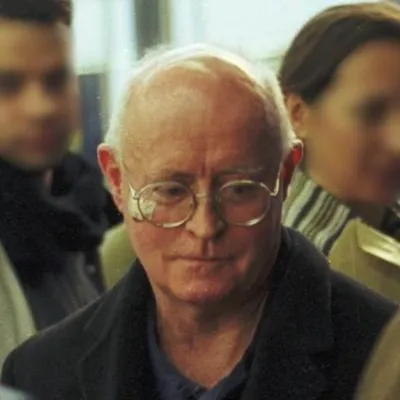
Edward Bond
Human Design Chart
Biography
He is the author of some fifty plays, among them Saved (1965), the production of which was instrumental in the abolition of theatre censorship in the UK. Bond is broadly considered one among the major living dramatists but he has always been and remains highly controversial because of the violence shown in his plays, the radicalism of his statements about modern theatre and society, and his theories on drama.
Bond was married to Elisabeth Pablé from 1971 until her death in 2017. They lived in Great Wilbraham, Cambridgeshire.
Edward Bond died in London on 3 March 2024 at the age of 89.
The Human Design of Edward Bond: Projector 6/2
Projector 6/2 — Design at a Glance
Edward Bond's design inclined towards precise system analysis: He was a Projector. His aura acted like a bright flashlight that immediately revealed areas in his surroundings still in darkness or not functioning properly. This ability to instantly recognize errors in other people's or organizations' structures characterized his way of perception.
However, the mechanics of his design presented a specific challenge: Addressing these deficiencies directly often triggered resistance, akin to shining light directly into someone's face. The effective strategy did not lie in immediate correction but in radiating his own harmony. By Edward Bond exemplifying a functioning role model himself, he attracted others who then sought his insights. His path led through waiting for a respectful invitation before sharing his knowledge.
Furthermore, he lacked a defined Sacral Center, meaning that no constant source of inner life energy was available to him. Instead, he experienced phases of high activity which necessarily had to be followed by rest periods to prevent burnout. This rhythmic energy management was essential for his well-being. Living according to this architecture – through patience in invitation and respectful pauses – rewarded Edward Bond with success. Deviations from this pattern tended towards bitterness, a feeling of disappointment over not being seen for his leadership ability.
Emotional Authority
Edward Bond's design inclined towards emotional wave movement, revealing spontaneous judgments as unreliable snapshots. His inner authority was the Emotional Authority carried by the defined Solar Plexus Center. This mechanism meant that his perception was always colored by current mood: A topic could appear inspiring in one moment and negative in another. However, this immediate feeling was not a final judgment but merely an initial impression. Quick decisions made from this emotional heat risked misjudgments.
The truth for Edward Bond only became clear after the emotions subsided. The process required patience and consciously sleeping on decisions. By allowing time for maturation, he let the emotional wave run its natural course. With increasing distance, intense impulses faded, leading to clarity and calmness. Only then was his inner process complete and a well-founded decision possible. This strategy applied regardless of other defined centers; the Solar Plexus Center took precedence here. Thus, Edward Bond showed himself as someone who did not seek deeper insights in the first emotional impact but gained them through enduring the emotional dynamics. Long-term orientation emerged from learning to ignore the moment's rush and trusting the quiet certainty after the wave.
The 6/2 Profile — Role Model / Hermit
Edward Bond's design inclined towards a clear shift in his life approach. In the first three decades, he appeared as someone who learned through experimentation and material detail work. This phase was characterized by trial and error; mistakes served not as failure but as necessary steps for experience collection. The Profile 6/2 (Role Model/Natural Talent) describes this early period through the energy of the third line: a focus on the concrete, material success, and enduring confusion without forcing immediate clarity.
After his thirtieth year, this dynamic fundamentally changed. The sixth line became active, leading Edward Bond into a phase of intense reflection. He metaphorically withdrew to observe previous experiences from a distance. This retreat served for healing and developing self-discipline. It was not isolation in the negative sense but a necessary process of integration. Through this inner work, he developed an authentic presence. The earlier immaturity transformed into wise distance. Edward Bond's design foresaw that he would only act as a role model after this period of self-examination. Others could recognize his clarity and learn from his ability for deep introspection. Thus, the path led from experimental freedom to stable, disciplined wisdom radiating through correct communication.
Split Definition — Defined & Open Centers
Edward Bond's Human Design profile established a constant, independent presence: He was mentally always active, spoke reliably from his inner sources, and had a firm self-love along with a clear sense of direction. His defined Ajna Center ensured continuous conceptual thinking; he processed data and creativity consistently without being easily influenced by the outside world. This mental stability flowed directly into his defined Throat, allowing him to express his concepts and opinions reliably – not as impulses but as dependable communication from mind and identity.
His actions were shaped by the defined Heart Center, which gave him the willpower to fulfill promises and control resources himself. He tended to actively determine his life and prove his own authority in the material world. Simultaneously, the defined G Center provided a stable identity; he knew who he was and showed others natural directions without needing their approval.
However, Edward Bond's emotional clarity wasn't an immediate product. His defined Solar Plexus Center made feelings into inner authority but these were subject to waves. He needed time to go through the ups and downs of his emotions before making decisions; spontaneous reactions at peaks or troughs often led to later regret. True insight only revealed itself at the end of the emotional cycle, once initial excitement had subsided.
At the same time, Head Center, Sacral Center, Spleen Center, and Root Center were open. Here he took inspiration, vital energy, intuition, and stress situationally from his environment. He tended to question whether he was inspired enough or if he needed to do more – thought patterns not of his own making but absorbed conditioning. Without a constant inner source in these areas, he was vulnerable to exhaustion through taken-on energy and confusion through foreign questions. His task was to not interpret external inputs as his truth but observe them as transient states while relying on his defined centers.
Channels for reflection, logical acceptance and community.
Edward Bond's design set a tendency towards logical organization of details coupled with the ability to reflect experiences and pass wisdom forward. Channel Accept 17-62 connected Ajna Center with Throat Center. Gate 17 visualized patterns, while Gate 62 translated them into language and named them. This created a permanent internal process: information was mentally sorted to establish logical coherence. Edward Bond showed himself as someone who constantly reviewed his worldview; only what he could integrate into this system was understood. The pressure in Throat Center demanded the communication of these structured opinions, with timing crucial to avoid resistance.
Simultaneously, Channel Lost Son 13-33 worked between G Center and Throat Center. Gate Listener (13) collected information, secrets, and memories while Gate Withdrawal (33) created space for reflection. This channel completed the cyclical process of maturation: Edward Bond withdrew to categorize gathered experiences before sharing them. It wasn't about prediction but proving that life retrospectively makes sense. The synthesis from Channel 17-62 and Channel 13-33 meant that Edward Bond translated detailed visual patterns into language, only after careful consideration. He functioned as a guardian of stories, extracting lessons from the past and passing them on at the right moment to foster continuity and stability. This configuration shaped an attitude of patient observation: information wasn't immediately expressed but communicated only when logical categorization was complete and timing favorable for listener receptivity.
Collective Circuitry — Circuit Signature
Edward Bond's design set a tendency towards clear, strategic communication. He showed himself as someone who not only internally processed intellectual insights but necessarily translated them into understandable strategies accepted by the environment. This ability to express accepted ideas was the absolute focus of his personality since Gate 62 represented his Sun and thus made up about seventy percent of his energy.
This trait originated from the Understanding Circuit, specifically through Channel 17-62 ("Accept"). It connected Ajna Center (Intellect) directly with Throat Center (Expression). This connection allowed a future-oriented, rational logic – often described as "emotionless ratio" – aimed at guiding society or leadership towards a better future. As Edward Bond had a Shared Definition, these energies existed parallel to other non-directly linked energy fields.
Another piece formed the Meaning Circuit through Channel 33-13 ("The Lost Son"). Here Throat Center and Identity Center were connected. This brought in a cyclical emotional component: sharing experiences from the past for collective learning. In contrast to the cool future vision of the Understanding Circuit, this involved wave-like emotions and reflection.
Additionally, the Ego Circuit with Channel 37-40 ("Community") acted. It linked Heart Center (Will) with Solar Plexus Center (Emotion). This promoted cooperation, mutual support, and resource exchange within a tribe or group. As there was no connection to Sacral Center, pauses for energy regeneration were necessary for these cooperative efforts. These three circuits shaped Edward Bond's essence as separate but simultaneous forces: strategic future shaping, emotional past reflection, and cooperative resource building.
Left Angle Cross of Obscuration 1
Edward Bonds Human-Design profile featured the left Veil 1 Cross. This configuration shaped a foundational stance where the visible often served as surface, beneath which deeper, hidden structures operated. The left Veil 1 Cross describes in Human Design a specific energetic focus: it's about the ability and drive to reveal or penetrate what is consciously or unconsciously concealed. Edward Bond was someone whose inner compass was aligned with this kind of unveiling. His design suggested that he wasn't interested in mere facts but rather how truths are constructed, hidden, or distorted. This mechanism means his energy was programmed to find gaps in the obvious reality and expose underlying motives or structures. It wasn't passive observation but an active process of illumination. Edward Bonds chart-based tendency involved piercing through the veil of surface to see what others overlooked or deliberately ignored. This configuration created internal tension between what was shown and what actually lay beneath. Edward Bond lived this dynamic by focusing on revealing the hidden, driven by the specific energy of this cross that aims at uncovering deception and viewing reality in its naked form, free from layers of concealment.
Saturn Return · Uranus Opposition · Chiron Return · 2nd Saturn Return — Life Cycles
Edward Bonds design indicated a tendency towards radical shifts, especially during phases of sudden change. This was concretely evident in 1973 when he was 39 years old with the publication and performance of "Bingo". For his system, this moment marked the Uranus Opposition, a cycle signaling breaking away from the familiar and freeing oneself from old structures.
During this period, an energy brought unexpected changes into rhythm. It wasn't about gradual adaptation but stepping back from established patterns in favor of new, often surprising expressions. The publication of "Bingo" exemplified this dynamic: a work challenging conventional expectations and thereby confirming his chart's capacity for disruptive innovation.
The Uranus Opposition acted here as a catalyst breaking existing boundaries. Edward Bond used this pressure not for stabilization but transformation. This event in 1973 was no isolated success, but the visible expression of profound inner shift. Old forms were shed to make way for an authentic yet unconventional voice. This process underscores how his design turned crises into sources of creative renewal rather than succumbing to inertia.
Projector · Emotional Authority — Synthesis
A central thread runs through the design: the ability to recognize patterns and translate them into understandable form (Channel 17-62), coupled with a deep connection to one's inner authority (emotional center) and G Center as compass for direction and identity. This combination enabled him to gain deep insights – both into human nature and societal structures – and convey these through his work (Channel 37-40). The open design of many centers points to high sensitivity to others' energies, enabling him to act as a mirror and reveal hidden dynamics.
A central paradox lies in the tension between the need for reflection and the drive towards communication. The defined Throat Center signals clear expressive power, but lacks a constant energy source due to the undefined Sacral Center. This led to an internal dynamic where the necessity of expression went hand-in-hand with phases of withdrawal and emotional maturation (Line 6). The ability to recognize and name patterns met inner uncertainty about his own energy availability, shaping a continuous process of adaptation and self-discovery.
3 Defined Channels
Incarnation Cross - Left Angle Cross of Obscuration 1
Solar Return
The Solar Return shows the moment when the sun returns to its exact birth position - your personal solar year.
Life Cycles
Discover the life cycles with a detailed triple view (birth chart, cycle chart, composite).
Human Design Profile
- Type
- Projector
- Strategy
- Wait for the respectful invitation
- Authority
- Emotional Authority
- Profile
- 6/2 - Role Model / Hermit
- Definition
- Split Definition
- Incarnation Cross
- Left Angle Cross of Obscuration 1
- Date of Birth
- 18.07.1934 20:30
- Place of Birth
- London, United Kingdom
Frequently Asked Questions
What was Edward Bond's Human Design type?
What Profiles did Edward Bond have in Human Design?
Which Authority guided Edward Bond's decisions?
What incarnation cross was assigned to Edward Bond?
When was Edward Bond born?
Discover your own Human Design
Are you also a Projector? Find out in a personal reading how to unfold your leadership qualities and recognize the right invitations.
More Personalities
Back to overviewSissy Spacek

Alain-Fournier

Anémone

Ann-Margret

Bourvil
Christian-Jaque