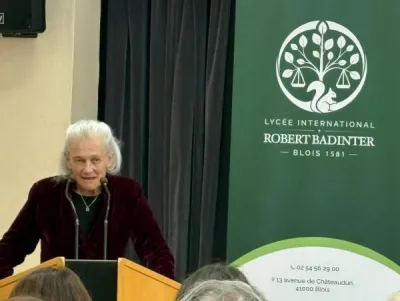
Elisabeth Badinter
Human Design Chart
Biography
She is the daughter of the late Marcel Bleustein-Blanchet, founder of the Publicis Groupe, and the wife of Robert Badinter, a famous French lawyer, law professor and previous French Minister of Justice. They have three children. According to Challenges, she is also one of the most wealthy French citizens (number 58) with a fortune of around 750 million euros in 2011.
While her interests and writings are diverse, a 2010 Marianne news magazine poll named Badinter France's most influential intellectual, primarily on the basis of her books on feminism and motherhood.
What does Manifesting Generator 4/6 mean for Elisabeth Badinter?
Manifesting Generator 4/6 — Design at a Glance
Elisabeth Badinter's design features a hybrid nature that combines the Manifestor speed with the constant energy of a Generator. This configuration allows her to skip steps and quickly draw things into her life, but it also carries the risk of missing important stages or overloading herself by starting too many parallel projects. Without inner consent, this rapid pace could easily lead to frustration, which is related to her type's theme of not being oneself.
The mechanics of a manifesting Generator therefore require reacting to impulses rather than initiating action. Satisfaction arises only in the 'play mode', alternating between creation and constant sacral confirmation. Elisabeth Badinter was someone whose creative power was marked by variety and fun; the compulsion to finish one thing before starting another would have slowed her energy more than it would have helped. Crucial for her was regularly checking whether her sacral center still affirmed her current path with a clear 'yes'. Only when strategy and inner authority were aligned did potential frustration from multitasking or moving too quickly transform into deep satisfaction. Her design challenged her to make her speed serve by reacting to life and only starting once her internal resonance matched – allowing her to pursue multiple projects simultaneously without getting distracted, as long as each step was carried by her energy.
Sacral Authority
Elisabeth Badinter's decision-making process relied on a direct physical resonance in response to external stimuli. Her design features sacral authority specific to the Generator type, whose strategy is identical to inner authority. This simplified her process: she didn't need to think but wait until an external stimulus triggered her internal response.
This reaction manifested as gut feeling or surge of energy – often audible through grunts, hums, or a clear 'mm-hm' for agreement versus 'hm-hm' for disagreement. A positive answer left her feeling vital and alive; an almost inexhaustible energy potential became available to perform tasks with great enthusiasm. She could fully immerse herself in her duties without external purpose being necessary; the joy of the activity itself was sufficient.
A 'no', however, led to a noticeable loss of energy. Therefore, it was central for her to perceive these physical signals and not ignore them. Only by listening to this inner voice could she activate authentic action joy and sustainably use her energy. The prerequisite for this was an open emotional center, meaning that emotional clarity came with delay while the sacral response happened immediately upon stimulus.
The 4/6 Profile — Opportunist / Role Model
Elisabeth Badinter's design sets a tendency towards deep internal tension that shaped her entire life. She oscillated between the urgent need for belonging and the call to isolated wisdom. This heart versus head conflict is at the core of Profile 4/6: While Line 4 opens the big heart and seeks connection, Line 6 calls for retreat to the mountain to ponder meaning.
In her first thirty years, she appeared more experimental and learning-oriented, similar to a Line 3. She tested relationships and friendships to find answers. Gate 63 in the fourth line emphasizes this through strong memory and externalization of doubts. She asked precise questions, relied on details and background knowledge to secure future safety. Once doubts were resolved, however, there was pressure to forget these details – dynamics that could cause problems later.
With the activation of Line 6, her role fundamentally changed. She became a cooperative authority and an expected role model. The sixth line brings unpredictability; it teaches flexibility towards universal flow and unexpected events. Elisabeth Badinter had to learn that these surprises strengthen development rather than working against productive logic. Her big heart remained cautious throughout to avoid opening up to false people and getting hurt. Maturity consisted in combining the wisdom of Line 6 with the cooperation of Line 4 without neglecting ego or desire for possession.
Split Definition — Defined & Open Centers
Elisabeth Badinter's design suggests a tendency towards constant mental pressure coupled with clear inner direction and a reliable voice. Her architecture is characterized by five defined centers: Head, Ajna, Throat, G Center, and Sacral. This creates an internal dynamic of inspiration (Head), conceptual processing (Ajna), and expression (Throat). The defined G Center provides stable identity, while the Sacral Center acts as a motor waiting for stimuli.
This configuration describes a 'Mental Generator'. Continuous mental activity contrasts with the ability to act, which strictly depends on sacral reactions. The focus is on distinguishing between an uninterrupted thought process and physical energy that only becomes available upon proper invitation.
At the same time, four open centers serve as windows for environmental energies: Heart, Solar Plexus, Spleen, and Root are not designed as internal sources of willpower, emotional stability, or spontaneous intuition. The open Heart Center tends to measure itself in competition with others or prove its worth, often ending in a cycle of promises and disappointment. The open Solar Plexus Center absorbs foreign emotions, which can lead to confusion when identified as one's own. The open Spleen Center is prone to conditioned fears about survival or unhealthy dependencies on security. The open Root Center amplifies external stress and adrenaline, leading to exhaustion if identified with this pressure. The mechanics show: true strength arises not from ignoring these opennesses but through trust in the defined sources of inspiration, concept, voice, identity, and sacral response.
Channels for logical doubt, presence, reflection and perseverance.
Elisabeth Badinter's design suggests a tendency towards permanent, questioning attitudes that filter patterns and seek consistent, verifiable evidence. This healthy skepticism rejected unfounded beliefs; every truth or idea had to be practically tested before being accepted as logical. Dogma gave way to empirical evidence.
This mechanism is driven by the Logic Channel 63-4, connecting Head Center with Ajna Center via Gate of Doubt (63) and Gate of Formulation (4). This questioning mind permanently filters patterns to test their consistency. If a pattern is inconsistent, pressure intensifies for questions demanding answers. The resulting skepticism must arise from logical experimentation leading to necessary proof. With little room for unfounded belief, an answer is only valid if it emerges from a consistent, reliable, and verifiable pattern.
Additionally, the Awakening Channel 10-20 between G Center and Throat Center via Gate of Appearance (10) and Gate of Now (20) expressed wisdom in behaving as a living expression of awakened self-love. The G Center spoke for itself; survival resulted from accepting oneself in every moment and living as one's true self.
The Lost Son Channel 13-33 between G Center and Throat Center via Gate of Listener (13) and Gate of Retreat (33) promoted reflection. One collected life stories, withdrew to categorize experiences, and later shared the lessons learned.
The Discovery Channel 29-46 between Sacral Center and G Center via Gate of Saying Yes (29) and Gate of Self-Determination (46) required letting go of expectations. Through persistence and positive reaction, one immersed in experience until its meaning was revealed at the end.
Prioritized Gates like 64 (Past Experiences), 5 (Rhythm), and 35 (Change through Interaction) complemented this profile while Gates like 31, 62, 45, 23, 16, and 12 added further nuances.
Collective Circuitry — Circuit Signature
Elisabeth Badinter's design suggests a tendency towards rational, strategic future planning that manifested in sharing logical insights for societal improvement. This energy, carried by the Understanding Circuit connecting Head and Ajna Centers via Logic Channel (Gates 63/4), was an 'emotionless ratio', free from conditioned emotional control, projecting visually structured concepts into the future.
Parallel to this existed a separate energetic block: The Meaning-Finding Circuit connected Throat, Identity, and Sacral centers. Here, processing past experiences as emotional waves occurred (Channels 33/13 and 46/29). This cyclical, often inexplicable reflection of the past contrasted with the cool logic of the mind. Both systems were not directly connected; they acted as parallel forces – on one side rational planning, on the other emotional learning from history.
A third aspect concerned survival: The Integration Circuit connected Throat and Identity centers via the Awakening Channel (Gates 20/10). This ensured individual self-empowerment in the present by guiding strength from reactions to life through proper behavior.
The tension lay between the dominant, future-oriented solar energy of logic and the wave-like processing of the past. While the rational side sought structural optimization, the emotional side demanded a cyclical meaning-making from experienced events. This divided definition created a profile that argued clearly on one hand but was marked by internal emotional cycles without both systems forming a common flow.
Right Angle Cross of Consciousness 1
Elisabeth Badinter's Human Design profile carries the archetypal imprint of the Right Cross of Consciousness. This configuration acts as a subtle but persistent undercurrent in her character, defining a deeper, often unconscious motivation and the fundamental life path. It represents a specific energetic signature that goes beyond individual gates and provides a collective or transpersonal background for her personality. The mechanics of this cross significantly shape how consciousness manifests in the world. Since there are no specific channel activations or center activations present, it remains an abstract energetic imprint without concrete behavioral expressions in everyday life. This underlying framework determines inner orientation without leading to direct patterns of action. Elisabeth Badinter is shown through this structure as someone whose essence was marked by this comprehensive consciousness dynamic, independent of situational reactions or conscious decisions. The Right Cross functions here as a constant reference point for her internal stance and the fundamental connection to her own existence.
Saturn Return · Uranus Opposition · Chiron Return · 2nd Saturn Return — Life Cycles
Elisabeth Badinter's design is characterized by a clear cyclical structure that combines inner consolidation with sudden public emergence. This dynamics manifests in three distinct phases. In 1973, at age 29, she obtained teaching qualifications for philosophy at higher schools. This was her first Saturn Return: a time when years of groundwork condenses into a solid foundation and responsibility is taken on.
A decade later, in 1986 at the age of 42, followed the Uranus Opposition cycle. Here, she published “L’un est l’autre” (German: I am You). This aspect often brings a break with the known and a new beginning that becomes public. The academic qualification transformed into a breakthrough in publishing.
The third phase began in 2000 at age 56 with her second Saturn Return. In this year, the end of patriarchy and the rise of gender equality were established, which is considered a great success. The second Saturn Return deepens the first integration; it confirms the long-term direction and anchors the achieved societal impact sustainably.
This sequence illustrates the typical rhythm of her design: First, the foundation is laid (Saturn), then follows an impulsive, transformative step into public life (Uranus), which finally leads to a stable, recognized position (second Saturn). The mechanics show how inner maturity and external change alternate to form a clear path from qualification to broad societal relevance.
Manifesting Generator · Sacral Authority — Synthesis
A central red thread runs through the chart: the dynamics between inner clarity and the need to share this with the outside world. Defined mental centers (Head & Ajna) generate a constant stream of questions and concepts (63/4), while the open Solar Plexus Center signals high sensitivity to collective emotions. This leads to a deep ability to recognize patterns and synthesize knowledge, coupled with the drive to express this understanding – a process that is reinforced by the Awakening Channel (10/20). The repeated emphasis on communication and the need to convey one's own truth (various Throat Channels) points towards a life task of filtering, processing, and passing on knowledge in a way that inspires or challenges others.
The central paradox lies in the interplay between defined self-identity (G Center) and open receptivity to external influences (open centers). While there is a strong inner foundation present, there is also a vulnerability to conditioning from the environment. This leads to an ongoing dance between one's own compass and the expectations of others, particularly in the realm of relationships and value systems. The ability to recognize patterns (64) combined with emotional openness creates a tension between the need for clarity and acceptance of life’s instability.
4 Defined Channels
Incarnation Cross - Right Angle Cross of Consciousness 1
Solar Return
The Solar Return shows the moment when the sun returns to its exact birth position - your personal solar year.
Life Cycles
Discover the life cycles with a detailed triple view (birth chart, cycle chart, composite).
Human Design Profile
- Strategy
- To respond - wait for something to respond to
- Authority
- Sacral Authority
- Profile
- 4/6 - Opportunist / Role Model
- Definition
- Split Definition
- Incarnation Cross
- Right Angle Cross of Consciousness 1
- Date of Birth
- 05.03.1944 12:00
- Place of Birth
- Boulogne Billancourt, France
Frequently Asked Questions
What is Elisabeth Badinter's Human Design type?
What Profile does Elisabeth Badinter have in Human Design?
What authority does Elisabeth Badinter possess?
What incarnation cross does Elisabeth Badinter have?
When was Elisabeth Badinter born?
Discover your own Human Design
Are you also a Manifesting Generator? Find out in a personal reading how to unfold your multi-talents and direct your energy wisely.
More Personalities
Back to overviewAlain-Fournier

Aldair

Alizée

Angeli
Arletty

Artus