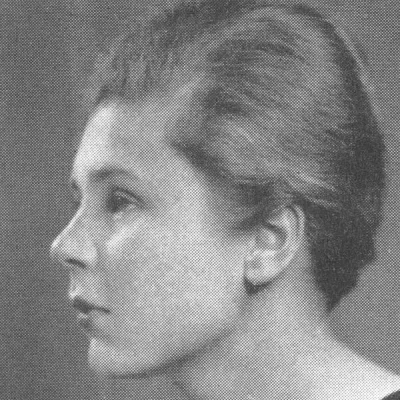
Elizabeth Bishop
Human Design Chart
Biography
Bishop spent many years writing a single poem, aiming for a spontaneous effect. With her "passion for accuracy" she wrote about the geographical locations she loved in her poems that only subtly reveal the themes of the alienation she felt as a woman, a lesbian, an orphan, a traveler without roots. The body of her work is small but considered brilliant. During her lifetime, she suffered from asthma, depression and alcoholism.
She had a sad childhood. Her father died before her first birthday, leaving her independently wealthy, and her mother, suffering from several nervous conditions, was committed to a mental hospital when Bishop was five. From the time she was three until she was six years old, Bishop lived in Nova Scotia with her mother’s parents and then moved to Worcester, where she lived with her father’s relatives.
Following graduation from Walnut Hill School, she attended Vassar, where she met the poet Marianne Moore, who became a mentor to the young woman. Bishop, who earned her bachelor’s in English in 1934, helped establish the Vassar College magazine, which published several of her poems, and, with the encouragement of Moore, Bishop gave up any idea about a medical career and turned to poetry.
In 1935, Moore published several of the younger woman’s poems in an anthology. After a year in New York, Bishop lived intermittently in Europe for three years, until she bought a home in Key West, Florida in 1938. Her first volume of poetry, having been rejected several times, was published in 1946. In 1947, Randall Jarrell introduced her to Robert Lowell, another poet who became a lifelong friend. .
In 1951, she became ill on a trip to South America, and she was left behind in Brazil, a country which she made home for the next 18 years. She embarked on a committed lesbian relationship with Lota de Macedo Soares, who ultimately took her own life.
The Human Design of Elizabeth Bishop: Generator 6/3
Generator 6/3 — Design at a Glance
Elizabeth Bishop was characterized by immense and enduring strength that did not stem from her own initiative but rather was activated through external impulses. Her design indicated that her deepest satisfaction and sense of fulfillment could only arise when she consistently responded to internal confirmation signals. This energy source was enormous, comparable to that of a workhorse: strong and steady as long as it was applied to the right task.
As a Generator, Elizabeth Bishop possessed abundant sacral energy that primarily became free when she could respond to stimuli from her environment. The motto of her nature was not proactive initiative but rather reacting 'from the gut'. If she followed this strategy and acted upon clear internal signals, nothing could stop her.
If she ignored these signals or tried to force initiatives, she encountered two major stumbling blocks. Either she wasted her energy on tasks without inner resonance, leading quickly to burnout, or she was held back from her heart project despite the presence of energy. If she did not live by this pattern of waiting and reacting, sooner or later she would encounter a feeling of persistent frustration and a lack of energy. The tension between the urge for action and the necessity of waiting for the right impulse shaped her experiential world significantly.
Sacral Authority
Elizabeth Bishop's design indicated a tendency towards sacral authority. This was the only inner authority for her Generator type, simplifying her decision-making process: strategy and authority were one. Her internal compass needle lay in the defined Sacral Center, which served as the primary instance.
The mechanics of this configuration require waiting for an external stimulus. Elizabeth Bishop showed herself through physical signals in response to these stimuli. A grunt, hum or a clear 'Hmm' from her abdominal area signaled confirmation; a negative sound or silence meant rejection. This physical response was her reliable guide.
When her sacral motor engaged with something, a palpable vitality entered. She then had inexhaustible energy and completed tasks with great enthusiasm. The design promoted a lifestyle of joy and contentment, fully immersed in activities without compulsive purposefulness.
Additionally, the active Spleen Center acted as supporting authority. Likely directly connected to the Sacral Center, this allowed for quick, spontaneous reactions. Elizabeth Bishop had immediate access to her physical well-being and instinctive perception. She could reliably guide herself from this deep, bodily instinct, complementing sacral confirmation with intuitive speed.
The 6/3 Profile — Role Model / Martyr
Elizabeth Bishop's design indicated a tendency towards intensive learning through self-experimentation in the first three decades of her life. As a 6/3 Profile (Role Model / Experimenter), she lived this phase similarly to a 3/3: marked by many attempts and mistakes. This early restlessness served the search for extraordinary perfection, far from ordinary standards.
The mechanics of her profile show a developmental line. After Saturn's return, around age thirty, pure experimentation slows down but never ends entirely as Line 3 is permanently anchored in the design. Elizabeth Bishop used these unusual experiences to mature into a wise and humorous role model.
This wisdom was shaped by two central forces. Line 6 (Gate 13) gave her unwavering hope for better relationships and union. She learned to accept interactions as necessary steps towards greater unity rather than falling into pessimism. Simultaneously, Line 3 (Gate 43) brought adaptability and tolerance of criticism. The drive for renewal stood in a dilemma with the knowledge of her own wisdom. Elizabeth Bishop thus united experimental courage for change with optimistic confidence that a better world is possible – a synthesis that only after maturation fully unfolded as far-sighted guidance.
Split Definition — Defined & Open Centers
Elizabeth Bishop displayed a consistent internal energy architecture: Her defined Ajna Center ensured continuous mental processing, while the connection to her Throat Center allowed for reliable expression. Her vital force came from her Sacral Center, which responded to stimuli rather than initiating them, and her Root Center provided a specific way of dealing with stress and pressure. These four defined centers formed a stable foundation.
In contrast, her open G Center lacked a fixed identity or internal direction. Elizabeth Bishop tended to orient herself in her environment; she did not actively seek out a firm 'I', but rather let herself be guided by external initiation. She understood that love and the right path would come to her when she was at the right place.
Additionally, her Head, Heart, Solar Plexus, and Spleen Centers were open. The open Head Center made her receptive to external inspiration without generating constant mental questions herself. Her open Heart Center led to not feeling the pressure to prove her worth through willpower or promises; she avoided engaging in competitions just for recognition. The open Solar Plexus Center absorbed the emotions of her environment, which required distinguishing between foreign feelings and her own state to avoid being overwhelmed by emotional waves from others. Finally, her open Spleen Center made her vulnerable to survival fears; she learned to avoid spontaneous decisions as these often stemmed from conditioned fear rather than wisdom. Through trusting in her defined centers and accepting her opennesses, Elizabeth Bishop found a balance between inner stability and situational adaptation.
Channels for change, logical order and intuitive structure.
Elizabeth Bishop exhibited a tension between an impulsive drive for change and the need to logically organize details. The Channel of Mutation 60-3 connected her Root Center with her Sacral Center. It brought an unpredictable, melancholic pulse of evolutionary change. Gate 60 accepted limitation while Gate 3 went beyond the confusion of a new beginning. This energy worked like music: suddenly and unexpectedly. During calm periods, internal tension arose, felt as melancholy. The key was not to argue but patiently wait for the next pulse that would bring innovation into her life.
At the same time, her mind permanently organized details in its mental system. The Channel of Acceptance 17-62 connected Ajna and Throat Centers. Gate 17 visualized patterns which Gate 62 translated and named through words. Everything had to be logically integrated to be understood. This created a foundation for teaching or presenting information as formulas or theories. Timing was crucial: waiting on an invitation to speak ensured clarity and reduced resistance.
Innovative insights also required patience in waiting. The Channel of Structuring 23-43 connected Ajna with Throat Centers too. Gate 43 received spontaneous breakthroughs which Gate 23 assimilated and expressed. This innovative thinking could increase efficiency, but only if communicated at the right time. Without strategy and inner authority, her unique knowledge often remained misunderstood or rejected. Elizabeth Bishop had to learn to let go of control and allow her mind to process its knowledge in its own pace. Her challenge was to explain these insights simply and clearly so others could recognize her gift. The individual knowledge felt like an outsider waiting for an invitation to offer its perspective. Through patience and correct timing, however, this knowledge could find recognition and enter the collective.
Individual Circuitry — Circuit Signature
Elizabeth Bishop's design indicated a tendency towards two parallel, unconnected energetic areas. The Split Definition meant that these forces existed side by side without forming an integrated flow.
The Knowledge Circuit connected her Ajna with Throat Centers as well as Sacral with Root Centers. This created a pulsating emotional wave for the expression of her unique identity. The Channel of Mutation (3-60) promoted deviations from the known and new paths, while Structuring (43-23) helped to articulate these impulses in words. It was about the original path, announcing new insights through emotional transformation.
Completely separate from this, the Understanding Circuit also connected her Ajna with Throat Centers. Here emotionless logic dominated: Logic, strategy, and focus served to share rational insights free of conditioning. This energy aimed at a better future, visually and focused structured.
The tension lay in the coexistence of these separated systems: on one hand, the melancholic, acoustically pulsating expression of individual creativity and mutations; on the other, the clear, forward-looking logic of sharing. Elizabeth Bishop showed through this configuration as someone whose inner process oscillated between emotional transformation and rational strategy without both sides directly transitioning into each other.
Left Angle Cross of Masks 1
Elizabeth Bishop's Human Design reveals a foundational tendency towards reflecting on social roles. She was someone who consciously perceived the wearing of facades in interpersonal contexts and reflected on the dynamics of adapting to expectations. This stems from the configuration known as the 'left cross of masks.' This structure does not imply rigid behavioral patterns through specific gates or channels but describes an abstract, pervasive tension between one's essence and the social roles one adopts.
For Elizabeth Bishop, this did not necessarily mean deception but a sharp awareness of how identity is constructed in the mirror of others. The mechanics of this cross focus on the question of which facial expressions one shows to the world and which remain hidden. Since there are no concrete energetic connections, its impact on personality remains intangible, working as a subtle background process. It's about the constant, often unconscious weighing between authenticity and social acceptance. Elizabeth Bishop wore these masks not out of lack of substance but as part of a complex interaction with her environment. The tendency towards adaptation was not a deficit but an instrument for navigating social spaces. Her design challenged her to confront who she is when no one is watching and who she becomes once the audience arrives. This duality shaped her inner approach to dealing with other people.
Saturn Return · Uranus Opposition · Chiron Return · 2nd Saturn Return — Life Cycles
Elizabeth Bishop's Human Design points toward sudden, profound turning points where external circumstances force internal change. This was evident in 1951: At age 40, after falling ill on a trip to South America, she remained in Brazil. This crisis marked the peak of her Uranus opposition cycle.
In Human Design mechanics, this configuration describes a phase of breaking free from old structures. The opposition acts as a catalyst: It destabilizes established patterns to make way for new realities. The external shock – here, illness and the resulting enforced stay in Brazil – served as an initiator that accelerated a necessary internal process.
It was not a random misfortune but a mechanically induced transformation. Uranus energy brings unexpected changes often felt as disruptive yet structurally necessary to break through stagnant life phases. For Elizabeth Bishop, this meant resolving old ties or life plans not by conscious decision in the traditional sense but under the pressure of circumstances that propelled her inner development.
This mechanism underscores how profound changes often emerge from seemingly chaotic events. The illness was an external manifestation of an internal maturation process requiring a break. Through this turning point, a new chapter became possible, marked by the consequences of this unexpected pause and the resulting shift in perspective.
Generator · Sacral Authority — Synthesis
A central thread runs through her design: navigating between inner drive and outer influences. Sacral authority (Sakral Center defined) demands a reaction to impulses while an open emotional center (Solar Plexus open) signals constant absorption and amplification of others' feelings. This interplay generates dynamics where distinguishing one's own resonance from conditioned behavior is crucial – a process amplified by the undefined G-Center, which constantly adapts in search of identity. The Root-Sacral channel adds another layer by generating a pulsing, unpredictable drive for change that also brings the necessity of pauses and acceptance.
The central paradox lies in the tension between the need for authentic reaction (sacral authority) and vulnerability to external conditioning (open centers). Her design seems to imply an ongoing search for inner clarity amidst a world full of stimuli. The ability not to be carried away by foreign emotions but instead trust one's own internal response presents a central challenge – a balancing act between adaptability and preserving one's integrity.
3 Defined Channels
Incarnation Cross - Left Angle Cross of Masks 1
Solar Return
The Solar Return shows the moment when the sun returns to its exact birth position - your personal solar year.
Life Cycles
Discover the life cycles with a detailed triple view (birth chart, cycle chart, composite).
Human Design Profile
- Type
- Generator
- Strategy
- To respond - wait for something to respond to
- Authority
- Sacral Authority
- Profile
- 6/3 - Role Model / Martyr
- Definition
- Split Definition
- Incarnation Cross
- Left Angle Cross of Masks 1
- Date of Birth
- 08.02.1911 10:45
- Place of Birth
- Worcester, MA, United States
Frequently Asked Questions
What is Elizabeth Bishop's Human Design type?
What Profiles does Elizabeth Bishop have?
Which Authority guides Elizabeth Bishop?
What is Elizabeth Bishop's incarnation cross?
When was Elizabeth Bishop born?
Discover your own Human Design
Are you also a Generator? Find out in a personal reading how to use your sacral energy correctly and discover deep satisfaction.
More Personalities
Back to overviewAaliyah

Alain-Fournier
Alexia

Angèle

Angeli

Anne-Marie