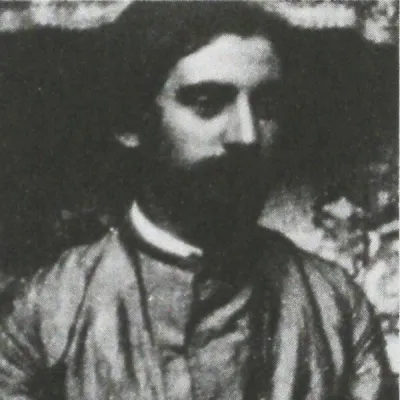
Émile Bernard
Human Design Chart
Biography
He died at 2 AM on 16 April 1941 in Paris.
The Human Design of Émile Bernard: Manifestor 1/3
Manifestor 1/3 — Design at a Glance
Émile Bernard's Human Design configuration marked him as a pioneer and visionary destined to lead the world into a new future. His setup resembled that of a Roman emperor: He possessed the grand vision of an empire but did not wage the necessary wars himself; instead, he delegated their execution to others to conquer foreign territories on his behalf. This superior perspective brought with it a central conflict. Émile Bernard was often misunderstood because his thinking transcended conventional norms. This led to strong polarization: Some were inspired by his great dreams and followed him, while others rejected or even hated him precisely because of these visions.
To ease this friction and find the right followers, it was crucial for Émile Bernard to inform his environment timely and accurately about his intentions. This strategy of information served as a filtering mechanism. If he adhered to this guideline and stayed true to his inner authority, he was rewarded with a deep sense of inner peace. Conversely, if he lived against his design, he felt instead a persistent, deep anger. His path therefore involved reducing misunderstandings through clear communication and achieving inner balance as the reward for correct action.
Emotional Authority
Émile Bernard's design established a specific decision-making structure: His inner authority carried the defined Emotional Center. This meant that he was subject to a constant emotional wave, which shaped his experience in a continuous up and down of feelings. The world appeared to him always colored by his current mood; the same thing could seem totally inspiring at one moment, yet completely negative the next.
This configuration required patience as a central tool. His immediate feeling was merely a snapshot, a first impression that did not necessarily reflect his deeper truth. Quick, spontaneous decisions made directly from such an emotion often proved unreliable and could have negative consequences. The mechanics of his design therefore demanded time to be given. By letting decisions mature – through the conscious "sleeping on it" – he gained emotional distance.
Over time, the stronger feelings subsided. What remained was a deeper clarity and calmness. This process of waiting was not a weakness but the necessary path to the truth of his authority. Especially for long-term decisions that significantly influenced the course of his life, this strategy proved crucial. Only by going through this emotional cycle could he move from transient mood to lasting insight and set his steps securely.
The 1/3 Profile — Investigator / Martyr
Émile Bernards design points to a tendency towards deep validation of knowledge. As a person with the Profile 1/3 (Researcher/Experimentor), he found himself in a constant tension between theoretical foundation and practical trial-and-error. Line 1 drove him to study everything and examine inspirations for their novelty and quality – an attitude of individuality that distinguished new thoughts from collective familiarity. At the same time, Line 3 demanded bold experimentation in the unknown, where mistakes served as necessary learning processes.
This dynamic created inner friction: The urge to know enough before acting often clashed with the necessity to simply jump into action. Émile Bernard learned, however, to integrate these poles. When he identified something as valuable or true, it was the result of a rigorous process of study and practical application. His judgment did not rest on superficial opinion but on self-earned expertise that connected abstract theory with applicable practice.
Moreover, the energy of Line 3 underscored the importance of resources and relationships. Awareness in handling his own territory and sensitivity for productive partnerships shaped his path. He sought connections that strengthened the tribe rather than shallow contacts. Through this combination of intellectual scrutiny and experience-based experimentation, Émile Bernard became a bridge between idea and reality – someone whose authenticity lay in sharing only what he had both intellectually examined and personally tested through success and failure.
Split Definition — Defined & Open Centers
Emile Bernard's Human Design foundation established a consistent internal structure through defined centers in the Throat, G Center, Heart, Solar Plexus, and Root. This configuration created a reliable base for identity, willpower, and emotional depth. The defined Throat acted as a pivot point that transmuted messages from connected motor centers - Heart and Solar Plexus - along with the G Center into speech and action. This gave him a clear voice speaking from his higher self (G Center), supported by willpower (Heart) and emotional resonance (Solar Plexus). The defined Root provided constant pressure for forward movement and stress management.
In contrast, Head, Ajna, Sacral, and Spleen were open centers. These open centers acted as mirrors to the environment, making Emile Bernard susceptible to conditioning. His open Head and Ajna Centers meant he lacked a consistent mental inspiration or conceptual truth; instead, he tended to engage with foreign questions or seek answers that did not stem from his own authority. He could easily fall into mental confusion when trying to solve problems that were not his.
His open Sacral Center lacked constant generative energy. Emile Bernard had to wait for external stimuli and avoid being overwhelmed by the overflowing energy of his environment, as he otherwise tended towards exhaustion. He did not have an internal source for consistent work power but needed to learn when it was right to act and when to rest.
The open Spleen Center revealed a vulnerability to survival fears and false feelings of security through others. He tended to cling to people or situations that gave him a deceptive sense of well-being, even if they were not healthy for him. Spontaneous decisions from the moment were risky as they often relied on conditioned fears rather than true intuition.
The tension between his strong, defined inner structure and the adaptability and vulnerability through open centers shaped his path. His defined Throat allowed him to clearly express his truth while he also had to learn to ignore mental pressure from the open Head and not be led by others' energy (open Sacral) or false security needs (open Spleen). Emotional authority in Solar Plexus required patience to gain clarity before acting, helping filter impulses of the open system.
Channels for breakthrough, reflection and emotional release.
Emile Bernard's design set a tendency for deep reflection while his personality appeared impulsive and initiatory. This duality shaped his inner workings: The Lost Son Channel 13-33 connected G Center with Throat Center through Gate 13 Listener and Gate 33 Withdrawal. Here he gathered experiences, listened, stored secrets, then withdrew to reflect patiently on the collected information until a deeper truth ripened that he could pass on as a lesson to others. This process required time and distance from surface events.
Simultaneously, his personality in Initiation Channel 51-25 drove him forward. This channel connected Heart Center through Gate 51 Shock with Gate 25 Self Spirit. Here a competing ego energy emerged wanting to be first and win. This force sought competition and prepared to initiate others through a 'shock' towards individuation, recognizing potential in people and mutatively advancing them, linked with the Higher Self's ability to see beauty in all things.
The challenge lay in timing these two mechanisms. The personality wanted immediate action, competitiveness, and initiation while the design needed time to digest experiences and find the right truth. Authenticity for Emile Bernard arose when he survived the shock of external initiation without speaking prematurely. Instead, he used the patient observation of the Lost Son to develop deep truths. Thus, he could accompany inner maturation cycles through external impulses without harming himself or others with premature action. Wisdom emerged only after reflection, not in the moment of shock.
Individual Circuitry — Circuit Signature
Emile Bernard's design set a tendency for internal firmness and individual identity strengthening, paired with wave-like processing of emotional past patterns. As someone with Split Definition, two separate energetic systems worked parallel: one system of central self-determination (identity, heart, G Center) and another of emotional impulses (solar plexus, root). This separation meant that inner convictions did not automatically translate into external expression.
The Authority Circuit connected Emile Bernard's Identity with Heart Center through Channel 25-51. This gave him a strong, individualistic stance and solidified internal beliefs about his self-worth. However, lacking connection to Throat Center, these firm inner truths often remained unspoken or hard to directly communicate; they shaped him quietly rather than loudly articulating them.
Parallel to this, the Knowledge Circuit worked through Channel 55-39 between Solar Plexus and Root Center. This was about releasing emotions to transform into new identity and initiate change. This energy pulsed and pushed for expression of individuality but remained anchored in the realm of emotional impulses.
The Meaning Circuit partially bridged this expression gap through Channel 33-13 between Throat and Identity Centers. This circuit focused on reflecting past experiences to find hidden meaning within them. Emile Bernard thus processed emotional waves from earlier experiences, gaining insights he could then connect with others - perhaps not as loud declarations of his innermost convictions (Authority), but shared experiences of the past (Meaning). The discrepancy between strong internal substance and needing to be expressed through emotional reflection shaped his way of interacting.
Right Angle Cross of the Four Ways 1
Émile Bernard's Human Design configuration carried the archetypal structure of the Right Cross of the Four Paths. This configuration set a specific, often internal life task that was not defined by external fame or conventional success but rather through a deep spiritual questing process. For Émile Bernard, this orientation was central: it shaped his energetic foundation as someone walking a path determined by four essential paths or aspects.
The Right Cross of the Four Paths describes in Human Design mechanics a framework where individual development often takes place behind closed doors. It's not about achieving visible milestones but rather about a transformation that usually only gains its full meaning after death or in the afterlife. Émile Bernard lived within this framework, which meant his true task was to walk and integrate these four paths without necessarily being understood or recognized by his time.
This structure created tension between inner knowledge of one's purpose and external reality, which often did not reflect it. For Émile Bernard, this was not a source of frustration in the everyday sense but a defining characteristic of his existence. His energy focused on navigating this archetypal challenge, giving his life a certain isolation or feeling of being different. The design thus showed a person whose value and significance were not measurable here and now but lay in fulfilling a higher, often solitary pattern.
Saturn Return · Uranus Opposition · Chiron Return · 2nd Saturn Return — Life Cycles
Émile Bernard's life followed a clear archetypal structure marked by the planetary cycles of Saturn and Uranus. These cycles signified phases of maturity as well as transformation. His first Saturn return around his 25th year fundamentally changed his living circumstances: in 1893, he settled down in Egypt and married there. This step reflected the saturnine dynamics where inner commitments become external structures and lay a stable foundation for further life. Later, the Uranus opposition, which typically appears around age 39 and often comes with a profound change or liberation from old patterns, was evident: in 1907, he published his memories of Paul Cézanne in Mercure de France. This event stood for a creative new beginning and public articulation of his personal history, driven by the pressing desire for authenticity and change associated with this Uranus cycle. Both phases – establishing a relationship and home in youth as well as literary self-assertion in middle age – underscored how cosmic influences shaped concrete biographical turning points.
Manifestor · Emotional Authority — Synthesis
Émile Bernard lived a life marked by a deep inner search for authenticity and the desire to express his individuality. This manifested in constant engagement with new ideas (Gate 24 Line 1) and readiness to learn through experience (Line 3), making him a researcher and experimenter. His defined emotional authority required time to gain clarity, while his defined G Center gave him a firm identity that he did not prematurely reveal (Channel 13-33). The connection of emotional awareness and strong self-definition points to someone deeply engaged with their inner processes and carrying insights creatively outward.
A central tension lay in the combination of his ability for deep emotional experience (Solar Plexus Center) and need for withdrawal and reflection (Gate 33). This dynamic led to a cyclical movement between engagement and distance, between the desire to express oneself and the necessity to first internally process gained insights. The connection of Heart Center and G Center strengthened this pull towards individuality, while his open Sacral Center made him receptive to external influences and required constant adaptation.
3 Defined Channels
Incarnation Cross - Right Angle Cross of the Four Ways 1
Solar Return
The Solar Return shows the moment when the sun returns to its exact birth position - your personal solar year.
Life Cycles
Discover the life cycles with a detailed triple view (birth chart, cycle chart, composite).
Human Design Profile
- Type
- Manifestor
- Strategy
- To inform others before acting
- Authority
- Emotional Authority
- Profile
- 1/3 - Investigator / Martyr
- Definition
- Split Definition
- Incarnation Cross
- Right Angle Cross of the Four Ways 1
- Date of Birth
- 28.04.1868 03:30
- Place of Birth
- Lille, France
Frequently Asked Questions
What is Émile Bernard's Human Design type?
What profile did Émile Bernard have?
What authority did Émile Bernard possess?
What incarnation cross did Émile Bernard have?
When was Émile Bernard born?
Discover your own Human Design
Are you also a Manifestor? Find out in a personal reading how to use your initiation power peacefully and dissolve resistance.
More Personalities
Back to overviewAlain-Fournier

Angeli

Christian-Jaque

Juninho

Kesha

Lucebert