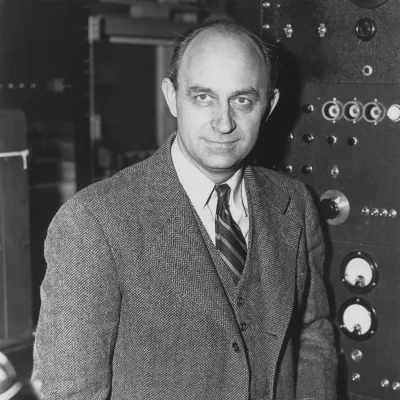
Enrico Fermi
Human Design Chart
Biography
Born in Rome, he was the son of the chief inspector of Italy's railways. He was a child prodigy in mathematics and physics Receiving his doctorate at age 21, he studied physics at the University of Göttingen in Germany, taught math at the University of Florence and became professor of theoretical physics at the University of Rome in 1926.
He developed statistics to explain the behavior of electrons and a theory of beta decay. In 1938 he was awarded the Nobel Prize in physics for his work on the production of artificial radioactivity and was allowed to receive the prize by Mussolini at the award ceremony in Sweden.
Fearing for the safety of his family, instead of returning to Italy, Fermi went to the U.S. with his wife and children and settled in Leonia, New Jersey. He taught at Columbia University until 1942 when he moved to the University of Chicago to became a key scientist in the Manhattan Project. At the University of Chicago, Fermi created the first controlled nuclear fission chain reaction. The remainder of the war years he worked on the atomic bomb. He later opposed the development of the hydrogen bomb on ethical grounds.
He married Laura Capon, daughter of a Jewish captain in the Italian navy. They had a daughter, Nella, and a son, Giulio. Laura died in 1977.
Fermi died of cancer on 28 November 1954 in Chicago, IL.
Enrico Fermi — Generator with Profile 3/5
Generator 3/5 — Design at a Glance
Enrico Fermi had a design that marked him as a Generator – a configuration with significant sacral energy. This structure gave him great endurance and the ability to translate things sustainably into reality, comparable to a strong workhorse. However, his energetic potential did not unfold through self-initiated attacks on problems but rather through reactions to external impulses.
The mechanics of his design required waiting for signals from life and then acting only when the Sacral Center gave clear confirmation. This inner response, often described as gut feeling, was the key to efficient energy use. When Enrico Fermi acted in harmony with this strategy – that is, by reacting rather than initiating – it led to deep satisfaction and a sense of fulfillment.
On the other hand, his design carried two specific risks. One danger lay in expending energy on tasks that did not resonate internally; this quickly led to frustration and burnout as the powerful sacral source dried up without appropriate stimulation. The other stumbling block was interrupting his work on topics supported by his design while he still had plenty of energy left. Such external stops hindered the natural flow of his productivity. Enrico Fermi's path to effectiveness thus lay in listening to life impulses and responding with action as soon as his inner self agreed.
Sacral Authority
Enrico Fermi was someone whose decision-making was deeply rooted in the body. His inner authority lay in a defined Sacral Center, making him a Generator type. For Enrico Fermi, this meant that he did not find his direction through active planning or initiatives but by reacting to external stimuli. This reactive strategy greatly simplified his process as it aligned strategy and authority.
A correct path became evident for him through physical confirmation. When an issue resonated with his nature, he felt an immediate surge of vitality or heard internal vocalizations like a reinforcing "mhm." This enthusiasm was the indispensable signal that he was on the right track. In these moments, Enrico Fermi had seemingly inexhaustible energy and could immerse himself fully in his tasks, driven by joy rather than compulsion.
Additionally, his active Spleen Center acted as a supportive instance. It gave him the ability for quick, spontaneous reactions and direct access to instinctive perception. Enrico Fermi could reliably trust this physical intuition, which complemented his sacral confirmation through rapid intuitive assessments. Thus, he lived in harmony between reactive energy and instinctive clarity.
The 3/5 Profile — Martyr / Heretic
Enrico Fermi's design laid a tendency toward intense personal experimentation that served as the foundation for his later public role. As a person with Profile 3/5, the Experimenter and Hero, he learned through direct experience and analysis of his own mistakes. The Line 3 in his Sun drove an obsessive zeal to grasp things materially and break old structures to make practical corrections. This process was often chaotic and error-prone, yet precisely these experiential values formed the core of his knowledge.
This self-acquired knowledge was later integrated into his life through Line 5. The Hero Line conveyed a charismatic presence as others wanted to learn from his practical solutions. In moments of silence or crisis, he could hold back and then make precise, concise statements that were effective in the collective. The dynamics between private experimentation and public expectations of the savior shaped his identity. Failing before an audience was a possible point of pain, as experimenting often took center stage. His design described a path from individual testing to clear communication of insights, with material-oriented Line 3 driving these learning processes.
Triple Split Definition — Defined & Open Centers
Enrico Fermi revealed himself as a person of immense inner substance and constant energy. His design was characterized by six defined centers that formed a self-sustaining architecture: He possessed a consistently active mind (defined Ajna Center), generating concepts and theories without external influence. These thoughts flowed reliably into speech or action through his defined Throat Center. His actions stemmed from a clear identity and direction (defined G Center) as well as an inexhaustible, reactive vitality (defined Sacral Center). Additionally, he filtered decisions through spontaneous intuition (defined Spleen Center) and a specific handling of existential pressure (defined Root Center). As a Generator, he reacted to life rather than initiating it; his strength lay in the combination of logical thinking, authentic communication, and persistence.
At the same time, he was protected from over-identification by three open centers. His open Head Center allowed him to be open to inspiration without feeling compelled to solve other people's problems. The open Heart/Ego Center freed him from the pressure to prove his worth; he did not tend to lose himself in competitions or promises that he could not keep. Finally, his open Solar Plexus served as a barometer for the emotional environment: He absorbed others' feelings and amplified them without personalizing them. This enabled him an objective observation of the emotional climate without getting entangled in other people's moods or making emotional decisions. This configuration created a person who was mentally clear, energetically robust, and emotionally detached enough to consistently follow his own inner authority.
Channels for rhythm, logic, judgment and structure.
Enrico Fermi showed himself as someone whose actions were driven by a deep biological pulse. The Rhythm Channel 5-15 connected his Sacral Center with the G Center, giving him a magnetic presence. He followed firm habits (Gate 5) and drew others into his natural life flow without succumbing to emotional fluctuations. This connection created a universal rhythm that propelled him forward and helped others find their own timing.
At the same time, Enrico Fermi organized information with great precision. The Accepting Channel 17-62 connected his Ajna Center with the Throat Center. His mind visualized patterns (Gate 17) and translated them into detailed speech (Gate 62). This generated a constant pressure to clearly articulate opinions and understanding of connections. He sought logical order to integrate complex details into his worldview.
Another key aspect was his insatiable drive for perfection. The Judgment Channel 58-18 connected the Root Center with the Spleen Center. Driven by the energy of life (Gate 58) and an instinct to correct, he constantly questioned existing patterns. His goal was to find errors and optimize processes to promote satisfaction and efficiency in the collective. However, he exercised this criticism most effectively when it was explicitly requested.
Finally, Enrico Fermi possessed a gift for unique insights. The Structuring Channel 23-43 also connected Ajna and Throat. He received spontaneous breakthroughs (Gate 43) and processed them into innovative concepts (Gate 23). His thinking often seemed forward-thinking, yet the acceptance of these ideas depended strongly on the right timing. If he waited until the moment was ripe, his mutative perspectives could sustainably change others' understanding; otherwise, they remained uncomprehended. This combination of rhythm, logical structure, corrective judgment, and innovative insight shaped his specific way of working.
Collective Circuitry — Circuit Signature
Enrico Fermi's design tended towards strategic, rational analysis that appeared free from emotional coloring. This 'emotionless ratio' came from the Understanding Circuit, whose energy aimed to share logical insights for improving the future. In Enrico Fermi, this circuit consisted of three separate segments: The Ajna and Throat Center were connected, as well as Identity with Sacral Center, and Spleen and Root. Since these groups did not connect with each other, they existed as parallel forces. Channel 18-58 (Judgment) shaped the central expression through focused visual logic.
Parallel to this, the Knowledge Circuit also linked Ajna with Throat Center – here via Channel 23-43 (Structuring). This part emphasized structuring one's unique path and identity through innovation. Although both circuits touched on the same center pair, their energetic sources remained separate due to triple definition. Enrico Fermi thus carried strategic rationality (Understanding) and structural innovation (Knowledge) side by side without them merging into a single, cohesive flow. The Sun in Gate 18 underscored judgment as the primary drive for sharing these clear, conditioning-free insights with others.
Right Angle Cross of Service 3
Enrico Fermi's design indicated a tendency towards deep dedication that went beyond himself. His inner compass was shaped by the right cross of service, a configuration that defined service not as a burden but as a central life task. For Enrico Fermi, this meant his actions were often guided by the question of how he could benefit others or a greater cause. This orientation created a foundation of selflessness and engagement that significantly influenced his experience.
The right cross of service describes a specific energetic structure in Human Design. It connects will with the capacity for dedication. Those who carry this configuration frequently find their fulfillment in dedicating themselves to others. It is not about subordination in a negative sense, but rather a conscious decision to use one's resources for a goal larger than oneself. For Enrico Fermi, this was evident as a constant basic attitude: the readiness to contribute and take responsibility where needed. This mechanism worked as a strong driving force behind his design. It shaped his way of interacting with the world by helping him find his place in a greater whole. Enrico Fermi lived this energy by dedicating himself to tasks that had meaning beyond personal benefit. His design supported him in experiencing dedication as a source of strength and clarity, rather than seeing it as sacrifice.
Saturn Return · Uranus Opposition · Chiron Return — Life Cycles
Enrico Fermi's development was structured around three distinct planetary cycles. The first Saturn return at about 27 years old promoted stability and commitment. This was reflected in 1928 when Enrico Fermi married Laura Capon – a step that brought his inner order to the outside world. Later came the Uranus opposition at approximately age 41, a period favoring radical breaks and innovation. During this phase, the first controlled nuclear chain reaction occurred in 1942. This event symbolized the profound change and innovative power activated by this cycle in his design. The third significant stage was the Chiron return around age 50, an integration cycle where meaning and purpose increasingly unfolded in life. For Enrico Fermi, this phase culminated in 1953 when he became president of the American Physical Society. This recognition marked the point at which his long-term work and life path showed their full impact. The sequence of these cycles – from stabilizing commitment through innovative breakthrough to integrative affirmation – traced the characteristic line of his design. Each step built on the previous one without him acting against his inner rhythm. Instead, he followed the natural dynamics of these astrological influences within his Human Design configuration.
Generator · Sacral Authority — Synthesis
He was a Generator whose life was marked by a deeply rooted rhythm (Channel of Rhythm). Sacral energy fueled an unrelenting work ethic that was always bound to an internal reaction – a gut feeling (sacral authority). This interplay between endurance and selective tension led to the ability to dive into tasks that truly attracted him, while consciously avoiding others. The Experimenter/Hero approach (Profile 3/5) further strengthened this process: he tried many things himself before passing on what he learned and solving problems – a cycle of personal experience and the desire to serve others (right cross of service).
A central paradox lay in the combination of defined mental structure (defined Ajna Center) and the necessity to follow sacral reactions. While he could develop and think through concepts, his real strength was tied to the
4 Defined Channels
Incarnation Cross - Right Angle Cross of Service 3
Solar Return
The Solar Return shows the moment when the sun returns to its exact birth position - your personal solar year.
Life Cycles
Discover the life cycles with a detailed triple view (birth chart, cycle chart, composite).
Human Design Profile
- Type
- Generator
- Strategy
- To respond - wait for something to respond to
- Authority
- Sacral Authority
- Profile
- 3/5 - Martyr / Heretic
- Definition
- Triple Split
- Incarnation Cross
- Right Angle Cross of Service 3
- Date of Birth
- 29.09.1901 19:00
- Place of Birth
- Rome, Italy
Frequently Asked Questions
What was Enrico Fermi's Human Design type?
What Profile did Enrico Fermi have?
What Authority did Enrico Fermi have?
What incarnation cross did Enrico Fermi have?
When was Enrico Fermi born?
Discover your own Human Design
Are you also a Generator? Find out in a personal reading how to use your sacral energy correctly and discover deep satisfaction.
More Personalities
Back to overviewAaliyah

Alexia

Angèle

Anne-Marie

Arcángel

Arno