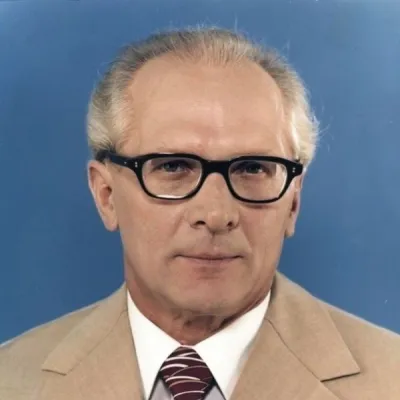
Erich Honecker
Human Design Chart
Biography
What does Manifesting Generator 3/5 mean for Erich Honecker?
Manifesting Generator 3/5 — Design at a Glance
Erich Honecker showed himself to be someone who worked with hybrid energy: the speed of a manifestor combined with the reactive power of a generator. His design indicated a tendency to skip steps and push projects forward simultaneously. This configuration described a mechanism that could quickly draw results into his life, yet it carried two specific risks.
Firstly, he tended to overlook important stages, which inevitably led him to return later to catch up on missing foundations. This created frustration, the central non-self theme of his type. Secondly, he reacted to numerous impulses at once and started various undertakings simultaneously. If strategy and inner authority were not aligned, his creative drive quickly turned into dissatisfaction.
To use this high speed productively, it was essential for him to react to life rather than initiate himself. He had to wait until his Sacral Center gave a clear "yes" – a sign of deep agreement. Only then could he enter a fruitful "play mode". In this state, working on multiple things at once was not a source of distraction but a source of deeper satisfaction. The advice to focus only on one thing did not suit his nature; rather, the variety and playful approach to tasks allowed him to sustainably and satisfyingly use his energy without falling into the trap of hasty action.
Emotional Authority
Erich Honecker displayed a decision-making stance that required time and emotional distance. His design featured Emotional Authority, meaning his defined Emotional Center formed the internal guiding structure – independent of other defined centers in his chart. This configuration was subject to constant wave dynamics of feelings: moods swung between enthusiasm and rejection, with the current emotional state always being just a snapshot, not the final truth. Therefore, spontaneous judgments based on intense emotions were misleading and risky.
The mechanics of his authority required patience. Honecker had to let decisions mature by reviewing them multiple times and sleeping on them. Only when the initial emotional wave subsided and clarity and calmness set in could he recognize his true direction. This process of "ripening" was not hesitation in a weak sense, but rather a necessary strategy to gain deeper insights. Especially for long-term, life-defining decisions, this distance was crucial. By waiting for emotional tranquility, Honecker arrived at a clear answer guided by his inner truth instead of being led astray by passing moods.
The 3/5 Profile — Martyr / Heretic
Erich Honecker's design inclined him to gain knowledge not through theory, but by experimenting and learning from failure. As a Line 3 experimenter, he initially believed little in prescribed dogma; instead, he learned from practical experiences. This process of "trial and error" was central for him, especially in the realm of relationships and intimacy, where experience led to self-assurance.
This self-acquired knowledge served as the foundation for his role as a Line 5 Hero. He presented his rich treasure trove of life experiences to others who saw him as a projection screen. The appeal of this Profile arose from the ability to solve problems with practical know-how. Yet, this public heroic role carried a risk: failing in front of others was deeply painful because it disappointed projected expectations.
Line 5 demanded realism and the recognition of the full spectrum of beauty and ugliness. Honecker helped others perceive this duality, which also brought him dissatisfaction with reality. The conflict lay in the tension between necessary private learning through mistakes and public pressure to always appear as a competent savior. His design thus played out in the interplay between personal experimentation and fulfilling external expectations of a heroic figure.
Single Definition — Defined & Open Centers
Erich Honecker's design was characterized by a stable, constant foundation of defined energy cores. His Sacral Center provided an enormous vital energy source that worked like a constant hum, guiding him towards reaction rather than initiation. This energy was only available for things he responded to with inner approval; initiatives without this confirmation led to frustration. Parallel to this, his defined G Center offered a reliable internal identity and a clear sense of direction, independent of external validation. He had a deep feeling of being part of something greater and could show others new perspectives without sacrificing himself.
His emotional authority lay in the defined Solar Plexus Center. Here, the rule was that truth wasn't revealed in the 'now', but over time. He relied on waiting for the emotional wave to gain clarity; impulsive decisions at the peaks or troughs of these waves often led to chaos and later regret. These inner states - vital energy, identity, and emotions - were transmuted outward through his defined Throat Center. It served as a pivot point for messages and allowed him to express his truth with ease and honesty if he trusted his strategy.
In contrast, Head, Ajna, Heart, Spleen, and Root were open. These centers represented no constant inner traits but reaction fields to external influences. His open Heart Center meant that willpower couldn't be used as a consistent internal authority; he tended to feel pressured to prove his worth or keep promises, which could lead him into spirals of self-disapproval if he failed. The open Spleen Center made him vulnerable to conditioned fears and the search for safety from others rather than trusting his own intuition. Mental inspiration (Head/Ajna) and stress pressure (Root) were taken in from the environment instead of generated internally. Thus, situational activity was driven by environmental pressure while his core energies remained constant.
Channels for intimacy, rhythm, powerful action and determination.
Erich Honecker appeared as someone who drew others to him through a deep inner rhythm, while interpersonal bonds were marked by intense emotionality. His design connected two dominant streams: Channel Rhythm 5-15 and Channel Union 59-6.
Channel Rhythm 5-15 linked the Sacral Center with the G Center. Through Gate 5, which represents firm habits, and Gate 15, which carries love to extreme human expressions, a universal life flow emerged. This channel gave him a magnetic monopoly in the G Center, drawing groups into his energy flow. He didn't move according to mental planning but followed a natural biological rhythm that unconsciously directed others towards him and set the course for communities.
Simultaneously, Channel Union 59-6, connecting the Sacral Center with the Solar Plexus, was at work. Gate 59 brought in sexual and creative essence while Gate 6 steered the emotional wave of pleasure and pain. This created a strong urge towards merging and intimacy. However, the emotional wave determined the timing of these connections; he had to wait for clarity through the wave cycle to experience true closeness. Without this patience, misunderstandings or chaotic interactions were risked.
The synthesis of these channels meant that his attraction to groups (Rhythm) and his ability for deep bonding (Union) required different time frames. While Rhythm constantly propelled forward, intimacy demanded waiting for emotional wave movements. This combination shaped a presence both collectively magnetic and personally intense, yet only impactful in the right emotional moment.
Collective Circuitry — Circuit Signature
Erich Honecker was marked by dominant, primordial energy aimed at protecting his family and ensuring the continuity of his genetics. This power came from the Guardian Circuit where his Gate 59 (Union) connected to the Solar Plexus Center. This linked instinctive drive with strong emotions, making themes like defense, nutrition, and preservation constantly present - a mix of maternal care and paternal protection.
Alongside this primary driving force, other separate energetic streams worked in parallel. The Understanding Circuit connected his Identity Center with the Sacral Center through the Rhythm Channel. This promoted sharing logical insights and structured future visions free from emotional conditioning. Parallel to this, the Meaning-Finding Circuit was also active between Identity and Sacrum (Discovery Channel). Here it was about emotionally reflecting on past experiences to derive collective learning processes - a wave-like movement in contrast to the cool ratio of Understanding.
Additionally, the Integration Circuit connected his Throat with the Sacral Center (Charisma Channel). This allowed him to draw strength from reacting to life and stabilize this in the here and now through authentic expression. As Erich Honecker had a simple definition, all these centers - Sacrum, Identity, Solar Plexus, and Throat - flowed in one continuous energetic stream. This created a coherent yet complex personality that united protective instincts, rational planning, emotional reflection, and direct expressive strength without the aspects appearing torn inside.
Right Angle Cross of the Sleeping Phoenix 3
Erich Honecker's Human Design profile was marked by the right cross of the sleeping Phoenix 3. This configuration pointed to a deeply rooted dynamic associated with the imagery of a sleeping phoenix, indicating latent energy that did not remain constantly active but rather resided in a state of rest until awakened by specific life circumstances.
Number 3 served as the central anchor point for this structure, marking where this potential power unfolded. The design suggested that Erich Honecker possessed an inner reserve that only became effective under certain conditions. It was not an obvious or constantly visible trait but rather a background factor subtly influencing his decisions and reactions.
The term 'sleeping phoenix' implied the ability to renew or transform from what appeared to be an inactive phase. For Erich Honecker, this meant that his life path could include moments where he transformed from a rest or retreat phase into an active form. This mechanism described not constant action but rather a cyclical nature of energy release. The right cross underscored the specific orientation of this dynamic within his overall design. It was a structural given that influenced his inner state and reactions to external events, without always being consciously controllable.
Saturn Return · Uranus Opposition · Chiron Return · 2nd Saturn Return — Life Cycles
Erich Honecker's Human Design profile was characterized by recurring cyclical crises and structural breakdowns that profoundly shaped his life. These patterns did not appear as random events but as deeply rooted dynamic forces that became particularly effective in certain phases of life.
The first Saturn return around the age of 25 often marked a turning point where earlier decisions and commitments came into full effect. For Honecker, this occurred in 1937 when he was sentenced to ten years' hard labor – a moment of deep crisis that fundamentally questioned his previous life structures.
The Uranus opposition around the age of 41 often brought unexpected changes and breaks, especially in personal relationships. In 1953, Honecker divorced Edith Baumann and began an affair with Margot Feist – a clear sign of the destabilizing power of this planetary configuration on his private ties.
The second Saturn return around the age of 58 again raised questions about responsibility and structure. In 1970, Honecker was suspended from his role as head of the Central Committee's secretariat – another serious crisis that shook his political position. These three events illustrate how cyclical planetary influences in his design generated recurring patterns of instability and new beginnings, significantly shaping his life.
Manifesting Generator · Emotional Authority — Synthesis
He lived a life marked by a strong drive for active creation. The combination of manifesting generator energy and emotional authority (Sacral Center, Throat Center) points to someone who could act quickly as well as feel deeply. This urge to act was reinforced by the Channel of Rhythm (Gates 5 & 15), a constant need to remain in motion and fill life with an inner, firm order. The profile as an experimenter/hero and rescuer suggests that he learned through personal experiences and wanted to make this knowledge available to others, focusing on experimenting and overcoming obstacles. Recurring crises (Saturn returns) and changes in relationships (Uranus oppositions) showed the need for constant redefinition and growth from experience.
A central paradox lay in the tension between the urge for quick action – typical of his manifesting aspect – and emotional authority that required time for decision maturation. He could initiate things swiftly but might skip important steps (Sacral Center), while simultaneously experiencing a deep emotional wave delaying clear judgments. This inner conflict between impulsivity and the need for emotional clarity shaped his path, leading to phases of action followed by periods of reflection, evident in recurring crises.
4 Defined Channels
Incarnation Cross - Right Angle Cross of the Sleeping Phoenix 3
Solar Return
The Solar Return shows the moment when the sun returns to its exact birth position - your personal solar year.
Life Cycles
Discover the life cycles with a detailed triple view (birth chart, cycle chart, composite).
Human Design Profile
- Strategy
- To respond - wait for something to respond to
- Authority
- Emotional Authority
- Profile
- 3/5 - Martyr / Heretic
- Definition
- Single Definition
- Incarnation Cross
- Right Angle Cross of the Sleeping Phoenix 3
- Date of Birth
- 25.08.1912 18:00
- Place of Birth
- Neunkirchen/Saar, Germany
Frequently Asked Questions
What was the Human Design type of Erich Honecker?
What Profile did Erich Honecker have in Human Design?
What Authority did Erich Honecker have?
What incarnation cross did Erich Honecker have?
When was Erich Honecker born?
Discover your own Human Design
Are you also a Manifesting Generator? Find out in a personal reading how to unfold your multi-talents and direct your energy wisely.
More Personalities
Back to overviewAldair

Alizée

Angeli

Arletty
Artus

Balthus