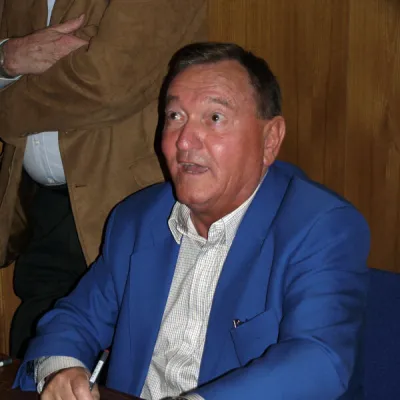
Erich von Däniken
Human Design Chart
Biography
The ideas put forth in his books are rejected by virtually all scientists and academics, who categorize his work as pseudohistory, pseudoarchaeology, and pseudoscience. Early in his career, he was convicted and served time for several counts of fraud or embezzlement, and wrote one of his books in prison.
Däniken was the co-founder of the Archaeology, Astronautics and SETI Research Association (AAS RA). He designed Mystery Park, a theme park located in Interlaken, Switzerland, that opened in May 2003.
Erich von Däniken as a Manifesting Generator 3/6 in Human Design
Manifesting Generator 3/6 — Design at a Glance
Erich von Däniken was revealed as someone with a hybrid energy configuration: He was a Manifesting Generator. This design combined the constant sacral power of a Generator with the ability to skip steps and quickly bring things into manifestation. Unlike pure Generators, he could take initiatives, but his strategy remained identical: react to impulses rather than initiate them. Only when the Sacral Center signaled a clear 'yes' should he act.
His speed was a double-edged sword. Often, he skipped important intermediate steps, leading him to have to return later and fill in gaps. This need for catch-up could quickly turn into frustration - the specific non-self theme of this type. Additionally, he tended to pursue multiple projects simultaneously, driven by various impulses. Without constant verification through his inner authority, this creative drive easily tipped into negativity.
However, when the strategy worked – that is, waiting for an internal impulse and regular confirmation from the Sacral Center – he drew deep satisfaction from his work. Then, variety was not a barrier but necessary. He needed a 'play mode' to keep his energy flowing. The advice to finish one thing before starting another did not suit his nature; rather, he flourished when active in various areas at once and found joy in diversity.
Emotional Authority
Erich von Däniken showed a decision-making stance that was not oriented towards immediate impulses but based on waiting for internal waves. His design carried emotional authority in the defined Emotional Center. In Human Design mechanics, this configuration is prioritized: regardless of other defined centers or strategies, he was subject to natural fluctuations in his feelings, coloring his perception at all times. What appeared as absolute enthusiasm in one moment could be felt as deepest disappointment in the next. These emotional states were merely fleeting snapshots and not necessarily the deeper truth of a situation. Quick, spontaneous reactions to such outbursts would often lead him astray. Instead, his system worked towards delaying decisions. By consciously drawing time – 'sleeping on important questions' – initial waves subsided. Only when this emotional density had dissipated and calmness set in did clarity emerge for him. This process of emotional condensation served to separate long-term life decisions from passing moods and ensure that actions were based on a stable, clear foundation rather than the failure of a fleeting feeling.
The 3/6 Profile — Martyr / Role Model
Erich von Däniken showed himself as someone who throughout his life oscillated between playful experimentation and later assuming the role of an observing role model. His Profile 3/6 shaped this development: In the first three decades, Line 3 dominated, driven by trial and error. Mistakes were for him not failure but necessary steps in the learning process, where his assertiveness helped turn setbacks into advantages. Only after his first Saturn Return, around thirty years of age, did Line 6 activate. It brought a withdrawal for reflection, connected earlier curiosity with an overarching wisdom, and enabled him to organize his experiences.
This configuration carried an inner tension: The desire for further play and contemplation often conflicted with the external expectation of control. Over time, however, he integrated both perspectives – the curious child and the reflective elder. The mutative power of Line 6 helped him verify insights so they could penetrate collective consciousness. He became a role model not through perfect planning but by showing how to learn from mistakes and make knowledge useful for society. His charm and acquired wisdom were attractive because he authentically walked the path from impetuous experimenter to wise teacher.
Split Definition — Defined & Open Centers
Erich von Däniken was characterized by a persistent voice and willpower. His defined Throat Center connected with the Heart and Sacral Centers, allowing him to communicate from an inner conviction and available energy without relying on external confirmation. He had the strength to keep promises and establish himself as an authority, making his public appearance robust: he spoke not just what he thought but acted from a deep, generative source.
At the same time, he was emotionally and mentally open to his environment. His defined Solar Plexus Center worked as an inner authority; decisions matured after going through the emotional wave. This required patience since immediate reactions often stemmed from impulsivity. In contrast, Head and Ajna Centers were open. He tended to absorb mental inspirations from outside without fixing them as personal truth. Instead of clinging to dogmatic certainty, he could collect and reflect on various perspectives, protecting him from rigid ideology but also making him vulnerable to the mental currents of his time if he did not trust his emotional clarity.
The G Center was also open. He did not actively seek a fixed identity or direction but allowed himself to be initiated by the environment. This enabled him to fit into different roles and contexts without being bound to a rigid self-image. His strength lay in finding the right places and people who supported his energy, rather than exhausting it through self-initiation. The open Spleen Center challenged him to avoid spontaneous decisions and become aware of his fears to prevent unhealthy dependencies on others. Through trusting his sacral response and emotional maturity, he could use this openness to act as a mirror for collective questions without sinking into mental chaos.
Channels for transformation, value creation and emotional clarity.
Erich von Dänikens design showed a tendency towards evolutionary change paired with the drive to master material structures. This configuration marked him as someone who translated unpredictable impulses into tangible results.
The Mutation Channel 60-3 connected the Root Center with the Sacral Center through the Gate of Limitation (60) and the Gate of Ordering (3). This format channel generated a pulsating, adrenalized energy that brought phases of melancholy. Erich von Däniken had to learn not to rationalize this inner moodiness but wait patiently for the next mutative pulse. Gate 60 offered potential for evolutionary change while Gate 3 tried to order new possibilities out of the confusion of a fresh start. This energy conditioned his environment, demanding adaptation or transformation.
Parallel to this, the dynamics of the Money Line Channel 21-45 between Heart and Throat Centers were evident. Through the Hunter's Gate (21) and the Gatherer's Gate (45), a strong will emerged to take responsibility for material resources. Here it was about balancing control with service to the community: Gate 21 sought autonomy and peace, while Gate 45 made authoritative decisions ('I have or I do not'). Erich von Däniken had to assert his will in a way that protected his interests without suppressing others.
The Recognition Channel 30-41 connected Root with Solar Plexus through the Gate of Limitation (41) and the Gate of Feeling Awareness (30). It drove him towards seeking new experiences, waiting for the emotional wave to gain clarity. The restlessness from Gate 41 intensified through emotions in Gate 30, creating a strong desire to leap from unfamiliarity into experience.
Additionally, Gates like 61 (inner truth, thought mutation) and 62 (logic, pattern recognition) helped him structure complex connections. Gate 42 in the Sacral Center demanded completing processes to take on new commitments.
Individual Circuitry — Circuit Signature
Erich von Dänikens design showed a tendency towards deviant, mutational impulses stemming directly from his life force. This was evident through the active Mutation Channel 3-60 in the Knowledge Circuit, connecting the Sacral Center with the Root Center. This configuration pushed him to break established patterns and forge new paths, supported by a pulsating, acoustic energy. Parallel to this existed a separate energetic domain: The Meaning-Finding Circuit connected via the Recognition Channel 30-41 the Solar Plexus Center with the Root Center. Here it was about cyclic processing of emotions and past experiences to gain insights and share them with others. Since Erich von Däniken had a Shared Definition, these two groups (Sacral/Root/Solar Plexus as well as Heart/Throat) did not form a continuous connection but acted as parallel forces. A third aspect was the Ego Circuit, which in him connected via the Money Line Channel 21-45 the Throat Center with the Heart Center. This promoted the ability for cooperation and joint creation of resources and material well-being within mutual support. Overall, these separate yet defined streams shaped his work: on one hand innovative deviation, on the other emotional reflection of the past as well as cooperative resource creation without these areas energetically overlapping.
Right Angle Cross of Maya 1
Erich von Däniken demonstrated a fundamental attitude focused on the essence of life itself. His design emphasized not the struggle for status or the search for intellectual truth as an abstract concept, but rather the direct experience of existence. The right cross of Maya 1 places this energy in the heart: It was primarily about being and feeling life in its pure form without constantly breaking it through mental filters or emotional judgments.
This configuration described an inner peace and calm that worked independently of external circumstances. He did not live for fame or recognition, but from a deep connection to the moment. The energy of this cross promoted devotion to existence itself, showing as consistent presence even when the world around him seemed chaotic. It was not an active search for meaning, but a passive reception and acknowledgment of what simply is. This attitude shaped his innermost self: A focus on the here and now, driven by love for life in itself, not from what could be made out of it.
Saturn Return · Uranus Opposition · Chiron Return · 2nd Saturn Return — Life Cycles
Erich von Däniken's design laid a tendency towards a densifying life structure marked by clear milestones. His first Saturn return around age 29 marked the transition into a phase of responsibility and structuring; in 1964, he took over Hotel Rosenhuel in Davos, a step reflecting this energetic consolidation in the material realm.
The opposition to Uranus around age 40 often brought unexpected recognition or disruptive changes. This was evident in 1975 when he received an honorary doctorate from Bolivia's Universidad Boliviana José Ballivian - a moment of success attributed to this sudden opening.
The Chiron return, a cycle of blooming and fulfillment of the incarnation purpose, occurred around age 47-51. In this phase, the actual life task increasingly unfolds in everyday life. For Erich von Däniken, it culminated in 1982 with his rehabilitation and the annulment of a judgment - seen as confirmation of his path and realization of his inner truth.
The second Saturn return around age 56 often brings critical review or restructuring of previous achievements. In 1991, he received the satirical Ig Nobel Prize in literature for his theories on ancient astronauts from outer space. This crisis served as a catalyst to redefine and stabilize his own position and public perception.
Manifesting Generator · Emotional Authority — Synthesis
He was an Manifesting Generator whose life was characterized by a steady flow of sacral energy (defined by Sacral Center). This energy, combined with an active connection to the Throat Center, gave him the ability to seize opportunities quickly and initiate changes. This was evident in his pursuit of new insights and willingness to challenge conventional thinking (Channel Mutation). His profile as an experimenter/role model suggests that he initially gathered experiences and later took on a pioneering role - a pattern repeated throughout various phases of his life. Emotional authority, however, required time for decision-making, contrasting with his quick energy.
A central paradox lay in the combination of rapid initiation and emotional depth. He could act swiftly (Manifesting Generator), yet needed the maturation period of emotional waves to validate his direction (Emotional Authority). This may have led him to miss important steps or revise decisions (Excerpt Manifesting Generator), but also to profound insights and transformations - especially during Saturn returns, where experiments led to reflection (Cross Maya 1). Recognition through awards (honorary doctorate, satirical prize) and overcoming crises (rehabilitation) confirmed this shift between quick action and deep emotional processing.
3 Defined Channels
Incarnation Cross - Right Angle Cross of Maya 1
Solar Return
The Solar Return shows the moment when the sun returns to its exact birth position - your personal solar year.
Life Cycles
Discover the life cycles with a detailed triple view (birth chart, cycle chart, composite).
Human Design Profile
- Strategy
- To respond - wait for something to respond to
- Authority
- Emotional Authority
- Profile
- 3/6 - Martyr / Role Model
- Definition
- Split Definition
- Incarnation Cross
- Right Angle Cross of Maya 1
- Date of Birth
- 14.04.1935 11:30
- Place of Birth
- Zofingen, Switzerland
Frequently Asked Questions
What was Erich von Däniken's Human Design type?
What Profile did Erich von Däniken have in Human Design?
What Authority guided Erich von Däniken?
What incarnation cross did Erich von Daniken have?
When was Erich von Daniken born?
Discover your own Human Design
Are you also a Manifesting Generator? Find out in a personal reading how to unfold your multi-talents and direct your energy wisely.
More Personalities
Back to overviewAlain-Fournier

Aldair

Alizée

Angeli

Arletty

Artus