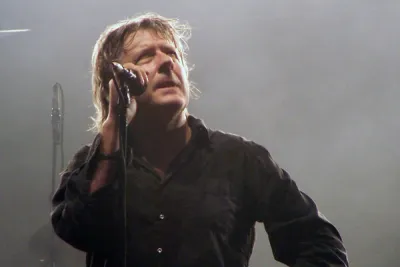
Photo: Wikimedia Commons
Erling Kagge
Human Design Chart
Biography
In 1990, Erling Kagge and Børge Ousland became the first people ever to reach the North Pole unsupported. The expedition started from Ellesmere Island on 8 March 1990, and reached the North Pole 58 days later on 4 May 1990. They travelled approximately 800 kilometers on skis, pulling their supplies on sledges.
Kagge attended Cambridge University to study philosophy for three terms. In 1996, he founded the eponymous Oslo-based publishing house, Kagge Forlag. In 2000 Kagge Forlag acquired one of Norway's oldest publishing companies, J.M. Stenersens Forlag. Kagge and Stenersens publish approximately 100 new titles annually and is the country's biggest publisher of nonfiction.
Kagge has written eight books on exploration, philosophy, and art collecting, which have been translated into 39 languages. He has written for the Financial Times, The New York Times, and The Guardian.
Human Design Analysis: Erling Kagge as Generator 5/1
Generator 5/1 — Design at a Glance
Erling Kagges Design sets a tendency for great endurance and inner strength, comparable to a workhorse that provides its energy as soon as it is needed for a task. As a Generator, he had a lot of sacral energy, which was released not through independent initiation but by reacting to signals from life. His strategy was to wait for impulses and then respond from the gut when his inner self gave a clear "yes."
This mechanism contained two specific pitfalls. On one hand, there was the threat of frustration or energy loss if he continuously did things that did not interest him and only wasted his strength. On the other hand, there was the danger of being held back from his heart project, even though he still wanted to continue working with full power. If he lived in harmony with this design by reacting rather than initiating, he was rewarded with a feeling of deep fulfillment. Deviating from this, such as by constantly initiating against inner resistance, would eventually lead to persistent frustration and a lack of energy. His strength did not lie in forcing things, but in resonantly responding to what life offered him, thereby not holding back anyone who moved in tune with their own energy.
Sacral Authority
Erling Kagge's Design inclines towards a direct, physical response to stimuli from the environment. His inner authority is the Sacral Authority, which he possesses as a Generator. This simplifies his decision-making process, as strategy and authority are identical.
The Sacral Authority manifests through a gut feeling or a surge of energy in response to an external stimulus. Erling Kagge learned to pay attention to these bodily signals, which can express themselves as grunts, hums, or a "mmhmm." When his sacral motor engaged with something, he felt vital and alive. He then had an inexhaustible supply of energy and tackled his work with great enthusiasm. His design foresees that he moves through life with joy and satisfaction, fully immersed in activities without the need for a specific purpose.
Additionally, the Spleen Center acts as a supporting authority. Since it is activated and connected to the Sacral Center, it allows Erling Kagge particularly quick and spontaneous reactions. He has immediate access to his physical well-being and instinctive perception. These instincts serve as reliable guideposts for decisions he can make in the moment.
The 5/1 Profile — Heretic / Investigator
Erling Kagge revealed himself as someone who, through his Profile 5/1, possessed a nearly magnetic presence that compelled others to seek answers from him. His design inclined him to be perceived as an authority figure possessing deep, fundamental knowledge – even if this projection from the outside was often greater than the actual knowledge available. This dynamic stems from Line 5, which exerts influence and inspiration, particularly on strangers, and offers solutions as long as they bring a personal benefit.
At the same time, Line 1 anchored him in a process of expanding awareness, comparable to an immigrant building a new foundation. This line requires time and patience to refine laws and structures. For Erling Kagge, this meant a constant tension: on one hand, the role of the hero who solves problems for others, and on the other, the necessity to withdraw to deepen his own knowledge. Without clear boundaries, there was the risk of being drained by the constant demands of others, similar to an expert who is exhausted after long conferences. His design therefore required the ability to say no to maintain the balance between researching for himself and problem-solving for society.
Split Definition — Defined & Open Centers
Erling Kagge revealed himself as someone who was constantly under an internal mental pressure to question and understand connections. His defined Head and Ajna Centers generated a permanent inspiration, but did not provide direct energy for implementation. Instead, this mental process was meant to stimulate others while he himself had to wait for the right moment to avoid frustration. This intellectual constancy was linked to his defined Sacral Center with an enormous, vital energy source. His design required him not to initiate but to react to life to use this power productively. Without this reaction, exhaustion and resistance threatened. The physical, adrenal-driven pressure of his defined Root Center continuously pushed him to move forward in the world and master existential challenges.
At the same time, Erling Kagge was vulnerable to external conditioning through several open centers. His open G Center meant that he did not carry a fixed inner identity but reflected in relationships and environments; he was dependent on others to initiate him in the right direction. His open Heart Center made him not designed for willpower or competition, so he tended to question whether he had enough value, which could lead him into spirals of self-proving. His open Solar Plexus Center made him absorb emotions from his environment, leading to confusion when he did not recognize them as foreign. Furthermore, his open Spleen Center was exposed to a fundamental survival fear, which could make him cling to unhealthy situations to simulate a sense of security. His open Throat Center finally meant that he could not communicate consistently but had to wait for invitations to speak effectively.
Channels for critical analysis and evolutionary change.
Erling Kagge's design laid a tendency towards evolutionary change, paired with a mind that rigorously tests patterns. This configuration showed him as someone who endured internal tension until new structures became clear.
Channel of Mutation 60-3 connects the Root Center with the Sacral Center. This format generates a pulsing, often melancholic energy that relies on limitation (Gate 60) and the principle of order (Gate 3). The change does not occur linearly but in sudden leaps. Erling Kagge had to learn not to rationalize the phases of silence and internal pressure but to patiently wait until the mutation revealed itself. This energy conditions the environment and forces adaptation.
Parallel, Channel of Logic 63-4 worked between the Head and Ajna Centers. Here, the doubting mind (Gate 63) is in dialogue with formulation (Gate 4). Logic arises only through filtering patterns for their consistency. Doubt is not a lack but essential for verification. Erling Kagge showed a stance that rejected unfounded belief and accepted answers only if they were practically verifiable and consistent. This channel served to ask questions and formulate solutions to give the collective orientation, not to solve his own uncertainties.
Additionally, individual gates shaped the profile: Gate 61 sought inner truth and silence as the opposite to mental noise. Gate 62 focused on detail work, patience, and the logical translation of facts into frameworks. Gate 50 fostered traditional values and protective reflexes. Gate 9 allowed focused attention on details without logical overload. Gate 19 sought secure resources and territorial safety. Gate 14 handled power with grace and direction. Gate 41 propelled emotional development through crises. Gate 59 pursued a genetic strategy of bonding. Gate 64 interpreted past experiences to gain mental clarity.
Collective Circuitry — Circuit Signature
Erling Kagge's design laid a tendency towards two separate, parallel operating energy fields. As a person with split definition, he did not have a continuous energetic connection between these areas but acted with two independent focal points.
The first focal point lay in the Knowledge Circuit. Here, Channel of Mutation connected the Sacral Center with the Root Center. This connection generated a pulsing, acoustic energy based on deviation from the known. It was about creating new knowledge through mutation processes that acted in the present. This energy drove transformation by replacing the old with the new.
The second, completely separate area formed the Understanding Circuit. Here, Channel of Logic connected the Head Center with the Ajna Center. This created a focused, visual energy of pure ratio. Without emotional involvement from the Solar Plexus Center, this connection served to develop logical structures and strategies. The goal was to order rational insights and guide society towards a better future through clear-mindedness.
These two groups – the emotional, transformative power of mutation and the cool, strategic clarity of logic – existed side by side in Erling Kagge without directly flowing into each other. They shaped his actions as two different, non-overlapping tools: once the intuitive breaking of patterns, once the analytical planning of structures.
Left Angle Cross of Obscuration 2
Erling Kagges Human-Design lays a tendency towards a deep, often unconscious search for the essential, coupled with the challenge of making one's nature clear to oneself and others. This configuration, the left cross of veiling, describes a life task of recognizing one's own abilities and role in life without being distracted by external expectations or internal illusions. It's not about inventing something new, but about discovering and integrating what is already there. This mechanism shapes an attitude of humility and learning, where true strength often lies in acknowledging one's limits and being willing to focus on the essential. It's a process of revelation, where layers of veiling are peeled away to reveal the pure, unadulterated essence of the self. This requires patience and continuous self-reflection, as the answers do not come from the outside but must be drawn from the depths of one's own being.
Saturn Return · Uranus Opposition · Chiron Return · 2nd Saturn Return — Life Cycles
Erling Kagges Human-Design lays a tendency towards groundbreaking, independent achievements that often defy conventional support patterns. This structure is evident in the willingness to test extreme limits to pave new paths. In 1990, at the age of 27, Kagge and Børge Ousland became the first people to reach the North Pole without support. This falls into the first Saturn Return, a cycle where years of groundwork and inner discipline often culminate in a solid, public result. The success here confirmed the effectiveness of his own path.
Another characteristic is the ability to transform and take over structures when the time is ripe. In 2000, at the age of 37, Kagge took over J.M. Stenersens Forlag. This correlates with the Uranus Opposition, a point where inner maturity and the urge for change externalize. It's a moment when old systems are replaced or expanded by new visions. The takeover was not just a business step but the result of an inner development that now took external form. Both events marked phases where Erling Kagge's inner architecture translated into concrete, visible realities that would shape his life path sustainably.
Generator · Sacral Authority — Synthesis
A central red thread in this design is the deep connection between energy, learning, and transformation. The sacral energy of the Generator is channeled through the Hero/Explorer Profile (5/1), acquiring knowledge and making it available to others. This process is reinforced by the defined mental pressure (Head-Ajna Definition), which requires constant questioning and understanding, and by the Channel of Mutation (3-60), which facilitates evolutionary change and the acceptance of limitations. The repeated experience of success and career development (documented events) suggests that this dynamic combination of energy, thirst for knowledge, and adaptability is a driving force in life.
The central paradox lies in the tension between the necessity to immerse oneself in work and the associated risk of burnout. The Generator needs the sacral reaction (Sacral Authority) to work with joy and endurance, yet the 5/1 Profile continuously attracts new challenges and questions, increasing mental pressure. The Channel of Mutation also brings a pulsating, unpredictable energy that requires limitation, while the knowledge circuit intensifies the drive for innovation and change. This interaction between deep engagement and the need for constant renewal shapes the design.
2 Defined Channels
Incarnation Cross - Left Angle Cross of Obscuration 2
Solar Return
The Solar Return shows the moment when the sun returns to its exact birth position - your personal solar year.
Life Cycles
Discover the life cycles with a detailed triple view (birth chart, cycle chart, composite).
Human Design Profile
- Type
- Generator
- Strategy
- To respond - wait for something to respond to
- Authority
- Sacral Authority
- Profile
- 5/1 - Heretic / Investigator
- Definition
- Split Definition
- Incarnation Cross
- Left Angle Cross of Obscuration 2
- Date of Birth
- 15.01.1963 12:15
- Place of Birth
- Oslo, Norway
Frequently Asked Questions
What is Erling Kagge's Human Design type?
What Profile does Erling Kagge have in Human Design?
What Authority guides Erling Kagge?
What incarnation cross is active for Erling Kagge?
When was Erling Kagge born?
Discover your own Human Design
Are you also a Generator? Find out in a personal reading how to use your sacral energy correctly and discover deep satisfaction.
More Personalities
Back to overviewAaliyah

Alexia

Angèle

Anne-Marie

Arcángel

Arno