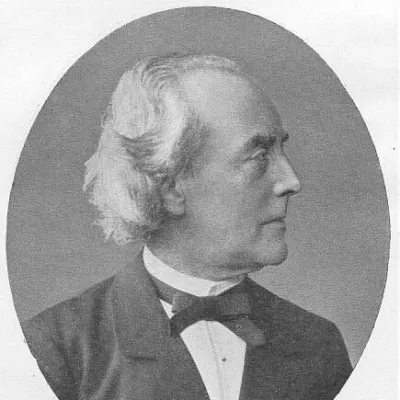
Ernst Curtius
Human Design Chart
Biography
In 1844 he became an extraordinary professor at the University of Berlin, and in the same year he was appointed tutor to Prince Friedrich Wilhelm (afterwards the Emperor Friedrich III), a post which he held till 1850.
He died on 11 July 1896, aged 81, in Berlin.
The Human Design of Ernst Curtius: Projector 4/6
Projector 4/6 — Design at a Glance
Ernst Curtius showed himself to be someone who focused his energy on his environment. His design indicated a tendency to immediately recognize where other systems or people were not functioning properly – he found the fault in the system. This ability was based on his nature as a Projector, whose aura acted like a bright flashlight, casting light into dark corners with precision.
Since Ernst Curtius did not have a defined Sacral Center, he lacked a constant intrinsic source of life energy. Instead, he experienced phases of high activity followed by necessary rest periods to prevent burnout. Traditional school systems and many professional environments often did not accommodate this rhythmic need, which could lead to friction.
His optimal strategy was to wait for an honest invitation from his environment. Rather than directly applying his observations – perhaps in a way that might be perceived as aggressive – he was most effective when radiating harmony himself. Other people were drawn to this emanation and actively sought out his advice. When Ernst Curtius followed this pattern, he was rewarded with success; deviating from it could lead to feelings of bitterness.
Emotional Authority
Ernst Curtius showed a fundamental disposition of emotional penetration: His inner impulses were subject to constant ups and downs that colored his perception of the world according to his current mood. What appeared inspiring at one moment could turn negative in the next. These fluctuations, however, were not an ultimate truth but only temporary impressions. Quick decisions made from this emotional heat often proved problematic as they were based on an incomplete perspective.
This pattern resulted from his Emotional Authority. Since his Emotions Center was defined, this center carried the responsibility for his inner guidance – a priority that held regardless of all other defined centers. The mechanics of this configuration required patience: Ernst Curtius needed time to let decisions mature. Only after withdrawing and giving space to his feelings did the intense waves subside. This process of "sleeping on it" allowed him to gain emotional distance. In this calmness, a deep clarity then emerged that was crucial for long-term life decisions. He learned to take his time and ask himself multiple times before acting. Thus, the initial often misleading impression transformed into a well-founded insight that profoundly shaped his life course.
The 4/6 Profile — Opportunist / Role Model
Ernst Curtius revealed himself as someone whose life revolved around the tension between the desire for community and the need for wise distance. In his first three decades, he intensely experimented with relationships and friendships, since Line 6 of his 4/6 Profile still functioned like a Line 3 at that time. This led him to seize opportunities in the network, but made him vulnerable to burnout if he prioritized quantity over quality or ignored his rest phases.
With the activation of Line 6, an inner conflict came to light: The Heart (Line 4) yearned for belonging, while the Head (Line 6) directed its focus towards higher questions of meaning. This duality could be confusing but shaped his development into a role model. He learned to assess the expressive power of others and make judgments, which made him vulnerable to propaganda as long as he was still gullible. Later, he developed an artistry that allowed him to achieve immortality in his accomplishments. When ideals were not met, depression threatened. His design suggested that he excelled through cooperation but always carefully protected his large heart from opening up to the wrong people and getting hurt. The balance between willpower and necessary pauses was crucial for him to function harmoniously in the network and seize correct opportunities for influence.
Split Definition — Defined & Open Centers
Ernst Curtius revealed himself as someone whose inner architecture was characterized by constant mental activity and clear willpower. His defined Ajna Center ensured a trustworthy, specific way of conceptual thinking; he processed data and creativity consistently in the same manner, unaffected by external opinions. This mental stability flowed directly into his defined Throat Center, allowing him to reliably express the conceptual knowledge of his mind. Thus, his communication was not an impulsive reaction but rather the expression of a well-thought-out theory. This was complemented by his defined Heart Center, which gave him natural willpower. He determined his life and resources himself, kept promises, and sought recognition for his contribution. This combination of intellect, voice, and ego created a figure of authority capable not only of thinking visions but also of implementing them with determination.
At the same time, his design revealed areas of receptivity. His open Head Center made him vulnerable to mental pressure and doubt when trying to find answers to questions that did not come from his inner authority. He tended to get caught in endless intellectual spirals rather than trusting his emotional clarity. His open G Center meant he lacked a fixed identity or direction; he absorbed the environment and people around him, making him susceptible to false initiations. Additionally, his open Sacral Center left him without a constant energy flow, risking overexertion through borrowed energy from others. Furthermore, his open Spleen and Root Centers made him sensitive to external stress and health concerns that he absorbed rather than generating himself. These receptivities required him to always rely on his defined centers – intellect, voice, and will – as stable anchor points to avoid being conditioned by the environment.
Channels for community spirit and logical acceptance.
Ernst Curtius showed a fundamental disposition based on logical order and building sustainable communities. His design tended towards not only collecting information but integrating it into a coherent mental system that he could then share with others.
This ability stemmed from Channel Accepting 17-62. He connected Gate of Opinions (17) in the Ajna Center to Gate of Details (62) in the Throat Center. This meant he visualized patterns and translated them into concrete details through language. Everything he could fit into his internal perspective, he understood; everything else remained unclear. He had a constant pressure to precisely explain his opinions and what he had grasped. This gave him the gift of logically organizing complex connections as theories or formulas that could be tested for feasibility. Important was his timing: he spoke most effectively when invited, which reduced resistance and ensured clarity.
Parallel to this, Channel Community 37-40 worked by connecting the Solar Plexus Center with the Heart Center through Gate of Friendship (37) and Gate of Solitude (40). He sought his place in the whole and recognition within a group. He waited for someone to ask him to be part of their organization. This channel emphasized the need for carefully formulated agreements based on mutual benefit. It was not about spontaneous deals but binding contracts that gained depth over time through willpower and emotional clarity. He understood how important it was to seal a good deal that all parties honored.
Additionally, Gates like Gate 16 contributed to an experimental spirit, while Gate 9 promoted detail work and perfectionism. Gate 4 helped him develop formulas for future security, and Gate 33 allowed reflection through withdrawal. Gate 47 supported collective understanding of past experiences to create sense coherence, and Gate 22 brought openness and calmness into social situations. This combination shaped him as someone who created structures based on logic, mutual respect, and clear communication.
Tribal Circuitry — Circuit Signature
Ernst Curtius revealed himself through his design as someone carrying two separate, parallel energetic focal points. As he had a Shared Definition, these areas were not directly connected but existed side by side as independent forces.
The Understanding Circuit in him linked the Ajna Center with the Throat Center via Channel Accepting. This meant a clear, logical expression ability. He could articulate internal visual strategies and rational thinking free from emotional coloring into words. This flow served to convey structured insights to explain connections – a purely cognitive performance without influence of the Solar Plexus.
Parallel to this, in the Ego Circuit, the connection between Heart and Solar Plexus Centers via Channel Community worked. Here it was not about individual identity but tribal dynamics: the principle of give-and-take. Ernst Curtius could use emotional waves to mobilize or receive support. Since this circuit did not connect with the Sacral Center, this energetic resource was not continuously available; it required pauses for regeneration before new impulses for cooperation and mutual aid could arise.
This constellation shaped him as someone who on one hand communicated soberly and strategically (Ajna-Throat) and on the other hand relied in social structures on emotional resonance and reciprocal exchange (Heart-Solar Plexus), with both areas acting independently of each other.
Right Angle Cross of Planning 3
Ernst Curtius showed a basic attitude that was shaped by the right cross of Planning 3. This configuration focuses on strategic approach and structured preparation. In Human Design, this pattern describes an energy that does not act impulsively but first gains an overview before taking action. Ernst Curtius tended to analyze situations and develop plans to minimize uncertainties. His design promoted a methodical approach to problems where logical deliberation was prioritized. He sought clear paths and defined goals rather than being driven by external circumstances. This tendency towards planning helped him break down complex challenges into manageable steps. Through this structured way, he could work effectively and make decisions based on well-founded considerations. The right cross of Planning 3 grants inner stability through preparation; Ernst Curtius used this trait to create orderly structures in his life. He avoided plunging into chaotic situations but preferred a controlled process. This discipline allowed him to act with long-term orientation and target the use of his resources. His character was marked by this forward-looking mindset, which helped him maintain an overview even in uncertain times.
Saturn Return · Uranus Opposition · Chiron Return · 2nd Saturn Return — Life Cycles
Ernst Curtius appeared as someone whose professional development was characterized by clear structural milestones. His design indicated a tendency towards institutional anchoring and academic recognition, which intensified during the phases of Saturn Returns. The first Saturn Return often marked the transition from education to established work; in 1841, at age 27, he earned his doctorate in Halle on the ports of Athens, solidifying his professional foundation.
The Uranus Opposition represents a turning point where inner maturity manifests as external authority. In 1852, at age 38, he gave a lecture on Olympia and was appointed an ordinary member of the Royal Academy of Sciences in Berlin. This was not a sudden coincidence but a visible confirmation of his long-term work by the establishment.
The second Saturn Return often brings full responsibility for systems or institutions. In 1871, at age 57, he became secretary of the Philosophical-historical Class of the Academy and worked on transforming the private archaeological institute into a Prussian state institution. These events illustrate the mechanics of his design: Through persistence and professional depth, he reached positions where he not only imparted knowledge but also created and secured structures that would endure beyond his own work.
Projector · Emotional Authority — Synthesis
Ernst Curtius’ life was marked by a persistent drive to recognize structures and make them accessible to others (Channel Accepting: Gate 17/62). This manifested in the ability to grasp complex interconnections – a defined mental focus allowed him to organize information and convey it through logical argumentation. The repeated professional successes (doctorate, lecture, state institution) demonstrate that he did not keep this knowledge for himself but actively shared it with others, which corresponds to Line 4 in his Profile – the desire for belonging through cooperation. He seemed destined to serve as a kind of lighthouse, directing light into areas still unclear to others (Projector Type).
At the same time, an inner contradiction between this analytical ability and the need for independent thinking was revealed. Emotional authority required time for decision maturation while the mind continuously created concepts and influenced the mental field. This led to a tension between the desire to logically penetrate things (Ajna Center) and the necessity of surrendering to one’s own feelings and incorporating them into the decision-making process. The transition from experimental phase (Line 3) to role model (Line 6) intensified this conflict between heart and head even further.
2 Defined Channels
Incarnation Cross - Right Angle Cross of Planning 3
Solar Return
The Solar Return shows the moment when the sun returns to its exact birth position - your personal solar year.
Life Cycles
Discover the life cycles with a detailed triple view (birth chart, cycle chart, composite).
Human Design Profile
- Type
- Projector
- Strategy
- Wait for the respectful invitation
- Authority
- Emotional Authority
- Profile
- 4/6 - Opportunist / Role Model
- Definition
- Split Definition
- Incarnation Cross
- Right Angle Cross of Planning 3
- Date of Birth
- 02.09.1814 09:00
- Place of Birth
- Lübeck, Germany
Frequently Asked Questions
What was Ernst Curtius' Human Design type?
Which Profile did Ernst Curtius have?
What Authority did Ernst Curtius have?
What incarnation cross did Ernst Curtius have?
When was Ernst Curtius born?
Discover your own Human Design
Are you also a Projector? Find out in a personal reading how to unfold your leadership qualities and recognize the right invitations.
More Personalities
Back to overviewSissy Spacek

Alain-Fournier

Anémone

Ann-Margret

Bourvil
Hergé