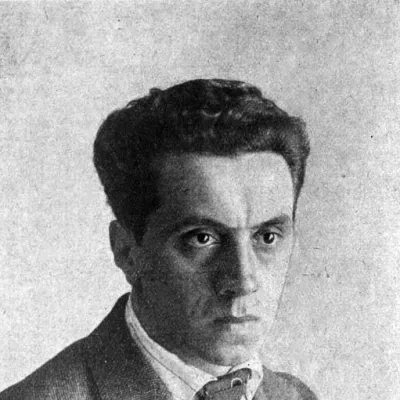
Ernst Toller
Human Design Chart
Biography
In 1933 Toller was exiled from Germany after the Nazis came to power. He did a lecture tour in 1936–1937 in the United States and Canada, settling in California for a while before going to New York. He joined other exiles there. He committed suicide on 22 May 1939 at age 45 in New York City. He hanged himself in his room at the Mayflower Hotel.
W. H. Auden's poem "In Memory of Ernst Toller" was published in Another Time (1940). In 2000, several of Toller's plays were published in an English translation.
Human Design Analysis: Ernst Toller as Projector 5/1
Projector 5/1 — Design at a Glance
Ernst Toller revealed himself as a person with a dense, focused aura that intensely touched his surroundings. As a Projector, he did not have an intrinsic life energy source through an undefined Sacral Center. Instead, he worked in phases of high intensity and speed followed by necessary rest periods for recovery. This up-and-down pattern significantly shaped his energetic profile.
His nature was to immediately recognize flaws in other people's systems – similar to a bright flashlight that directly illuminates dark spots. If these deficits are addressed abruptly without invitation, the recipient often feels uncomfortable or even offended. The optimal strategy for Projectors is to wait for a respectful and sincerely meant invitation before contributing their insights effectively, avoiding resistance.
If Ernst Toller lived according to this design, he was rewarded with success. Deviating from it by projecting his energy unchecked into an unprepared environment or ignoring invitations led sooner or later to his non-self theme: bitterness. This emotional reaction was not a character flaw but the direct signal of his design that he was acting against his natural rhythm and strategy. His path lay in radiating his light so others would come to him, rather than overwhelming them with his perception.
Splenic Authority
Ernst Toller demonstrated decision-making based on a fine, immediate impulse. His inner authority resided in the defined Spleen Center, indicating that he possessed an intuitive survival intelligence. This mechanism required the Emotional and Sacral Centers to remain open; only then could the spleen act as a guiding instrument.
This design marked him by spontaneous inner knowledge about whether a situation or environment was beneficial for his health. The first impulse was considered the right path, as it directly protected physical well-being from harmful influences. However, this was a very subtle signal that appeared only in the moment and required high alertness to prevent it from being drowned out by external advice or subsequent reflection.
Since spleen authority clarified things only at the concrete moment, long-term plans were often hard to maintain. Spontaneous changes of direction belonged to his nature, necessitating much flexibility and freedom so he did not get lost in rigid structures. A temporary retreat might have helped him hear this fine inner sound more clearly and make decisions that immediately served his protection.
The 5/1 Profile — Heretic / Investigator
Ernst Toller was a person who used deep, fundamental knowledge to offer solutions for complex problems. His design as a 5/1er – Hero/Researcher – shaped this dynamic: Line 1 provided the intense, often solitary research and grounding of insights, while Line 5 possessed a magnetic aura that drew others in seeking advice. This constellation created an inner rhythm between the need to withdraw for deepening and the external expectation to always be available as an expert.
Specifically, Gate 9 (Faith) and Gate 64 (Confusion) were at work here. Faith in recurring patterns helped him follow details with loyalty as long as he was convinced that the process would bear fruit. But when faced with confusion, he sought the pivotal point to clarify things. Without sufficient support from Gate 47, however, this pressure could lead to rash actions. The risk lay in constant requests by others depleting his energy if clear boundaries were not set. Toller had to learn to distinguish between the beneficial balance of research for himself and problem-solving for others to avoid being exhausted by the burden of expectations.
Single Definition — Defined & Open Centers
Ernst Toller revealed himself as someone whose expression was marked by a defined throat: he had a consistent, reliable way of carrying messages into the world. This communication ability, however, stood in tension with his open centers. His open Head Center made him vulnerable to mental pressure and doubt; he tended to be distracted by inspiring but unnecessary thoughts from others instead of trusting inner clarity. Similarly, his open Ajna Center allowed intellectual flexibility but often led him to interpret foreign concepts or opinions as his own truth and choose answers that belonged to others.
This mental insecurity was exacerbated by an open G Center. Without a fixed identity, Ernst Toller frequently sought external validation for his direction and self-worth. He blended into the environment to fit in, which resulted in often aligning his orientation with the expectations of others rather than finding it himself. His open Heart Center reinforced this pattern: he felt driven to prove his worth through promises and willpower, despite lacking the constant energy needed for that. This led to a cycle of overextension and self-doubt when he failed to sustain things he couldn't carry.
At the same time, Ernst Toller had a defined Spleen Center. It gave him a reliable, intuitive access to the present moment – a spontaneous bodily intelligence showing what was healthy or correct in the now. Yet this inner compass was often drowned out by the noise of his open centers: mental pressure from the Head Center, identity search from the G Center, and proof-seeking from the Heart Center. The challenge lay in not replacing the intuitive security of the Spleen with conditioned striving for intellectual or social validation.
Channels for intuitive perception and clear expression.
Ernst Toller combined intuitive depth with technical mastery. His design inclined him to build skills into talents through repeated experimentation and refinement. This occurred via Channel 48-16. Gate 48 looked out for life-critical information, while Gate 16 experimented with new possibilities and perfected dexterity. This combination transformed pure control into a unique form of expression that required acknowledgment and resources to flourish.
Parallel to this, Ernst Toller had the ability to articulate clear insights in the moment. Channel 57-20 connected the Spleen Center with the Throat Center. Gate 57 provided intuitive insight from ancient instincts, which was communicated as truth in the moment through Gate 20. This strengthened others in awakening their own survival intelligence by directly framing spontaneous knowledge into words.
Additionally, energy for detail work and refinement operated through Gate 9 at the Sacral Center. It enabled focused attention on details without strong logical support, with perfection achieved through repeated experimentation. Without adequate energy fulfillment, this could lead to depression. Mental processes were shaped by Gate 64, which interpreted past experiences and formed concepts, as well as by Gate 63, doubt that propelled mental process to improve uncertain patterns.
On the level of personality, Gate 8 promoted contributions for group goals and expressed identity, while Gate 32 sought continuity and enacted radical changes when stability was threatened. In design, Gate 45 supported the tribal level through willpower and material expression. Awareness and transformation were enabled by Gate 44, while Gate 35 propelled change through interaction and new experiences, with satisfaction arising from the meaning of experience.
Individual Circuitry — Circuit Signature
Ernst Toller expressed himself through a precise, focused manner of communication. His simple definition connected the Throat Center directly to the Spleen Center. This created a clear energetic channel for communication that did not rely on diffuse feelings but rather acute perception and intuition.
The Knowledge Circuit operated here via Channel 20-57, the 'Flash of Insight'. This connection between Spleen and Throat enabled him to immediately articulate innovative ideas and creative impulses. It was about translating inner insights into outer expression driven by the pulsating energy of the present moment.
Parallel to this, the Understanding Circuit operated via Channel 16-48, 'The Wavelength'. This channel also connected Spleen and Throat but emphasized logical structuring and sharing rational insights. Ernst Toller used this energy to clearly and strategically convey complex connections free from emotional overload. Both circuits flowed through the same connection: His voice became an instrument to directly and immediately pass on both creative innovation and logical understanding to others.
Left Angle Cross of Identification 2
Ernst Toller exhibited a fundamental disposition characterized by the drive to uncover hidden truths and actively share these insights with others. This configuration described his life task: making visible connections that lie beneath the surface and conveying them in such a way that others could truly take them on board. His design inclined him not only to recognize himself but also to carry this identification outwardly. It was a process of discovery and communication, where the search for truth was inseparable from the need to spread it. This mechanism acted as an ongoing impetus to bring hidden aspects into light and place them in the public domain without slipping into mere speculation. Instead, it was about clear, shared understanding that helped others better comprehend their own reality. Ernst Toller lived out this task of identifying and sharing consistently by transforming his inner processes outwardly.
Saturn Return · Uranus Opposition — Life Cycles
Ernst Toller appeared as someone whose internal structure was geared towards profound transformational processes and enduring pressure. His design combined a strong orientation toward collective values with the ability to find stability in times of crisis, integrating external circumstances not just as something to endure but as an essential part of his developmental path. This configuration shaped his life through phases of intense engagement with societal structures and personal boundaries.
The first Saturn return marked a turning point where long-term commitments and the reality of consequences crystallized. In 1920, at age 27, Ernst Toller began serving five years in prison. This event highlighted the saturnine mechanism: the weight of responsibility became palpable, and he had to learn to exist within tight constraints. It was not merely punishment but a phase of condensation where his stances were tested for their viability.
Later, the Uranus opposition acted as a catalyst for sudden changes and breaking with established structures. In 1933, at age 40, Ernst Toller emigrated to Switzerland. This step aligned with the uranian dynamics: the necessity of severing old ties and adopting new perspectives became a matter of survival. Through this emigration, his design demonstrated how unexpected upheavals could be utilized to continue his path, even if it meant losing familiar connections. Both cycles underscored his ability to maintain personal integrity in uncertainty and change.
Projector · Splenic Authority — Synthesis
He was a projector who moved through life, inevitably drawing attention to what did not work for others due to his natural talent for recognizing patterns (Channel of the Wavelength). This innate ability to identify flaws in the system was reinforced by Line 5/1 of his Profile: he attracted knowledge and shared it generously with others to offer solutions. However, this often led to overextension as he was constantly asked for answers without being able to set sufficient boundaries – a pattern that manifested during phases of intense activity followed by withdrawal.
A central paradox defined his essence: the combination of Spleen Authority based on spontaneous inner knowledge and the Knowledge Circuit driving him to continuously learn and transform. On one hand, he lived instinctively according to his own judgment about what was right (Spleen Center), while on the other, he was destined by his definition to disseminate this knowledge and instigate change. This tension between the need for internal demarcation and external demands for problem-solving created a life full of creative energy but also potential depletion – evidenced through phases of intense activity (1920) followed by periods necessitating withdrawal (1933).
2 Defined Channels
Incarnation Cross - Left Angle Cross of Identification 2
Solar Return
The Solar Return shows the moment when the sun returns to its exact birth position - your personal solar year.
Life Cycles
Discover the life cycles with a detailed triple view (birth chart, cycle chart, composite).
Human Design Profile
- Type
- Projector
- Strategy
- Wait for the respectful invitation
- Authority
- Splenic Authority
- Profile
- 5/1 - Heretic / Investigator
- Definition
- Single Definition
- Incarnation Cross
- Left Angle Cross of Identification 2
- Date of Birth
- 01.12.1893 16:00
- Place of Birth
- Szamocin, POL
Frequently Asked Questions
What is Ernst Toller's Human Design type?
Which Profile did Ernst Toller have?
What Authority Did Ernst Toller Have?
What incarnation cross was assigned to Ernst Toller?
When was Ernst Toller born?
Discover your own Human Design
Are you also a Projector? Find out in a personal reading how to unfold your leadership qualities and recognize the right invitations.
More Personalities
Back to overviewSissy Spacek

Alain-Fournier

Anémone

Ann-Margret

Bourvil

Hergé