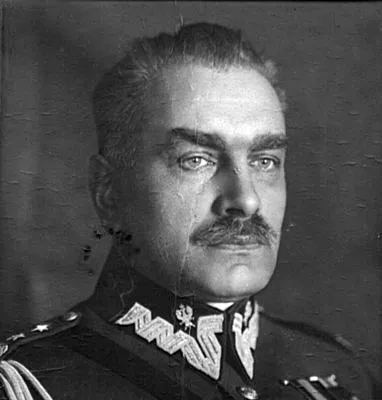
Felicjan Slawoj Skladkowski
Human Design Chart
Biography
Składkowski studied medicine at the Jagiellonian University in Kraków, graduating in 1911. He then worked as a physician in Sosnowiec. He fought in the Polish Legions in World War I and later in the Polish–Soviet War. In 1924, as a brigadier general, he was appointed head of the Polish military health service by Józef Piłsudski. After the May Coup of 1926, Składkowski served as Minister of the Interior, a post he held (with one short break) until June 1931. After that, he was appointed Deputy Minister of War. On 13 May 1936 Składkowski became Prime Minister and Minister of the Interior. He was Poland's longest serving prime minister in the inter-war years, his cabinet lasting for 3 years and 4 months, until 30 September 1939. He was also the first Polish Protestant (a converted Calvinist) to hold that position.
While serving as prime minister, he was appalled by the lack of sanitation in many of Poland's villages, and issued a decree that every household in Poland must have a latrine in working order. This prompted many village-dwellers to erect wooden sheds in their backyards for this purpose, which have been subsequently dubbed "slawojkis". After the German Invasion of Poland on 1 September 1939, he fled to Romania and was interned there. In 1940 he went to Turkey and thence to Palestine. In 1947, he went to London, where he died on 31 August 1962.
Human Design Analysis: Felicjan Slawoj Skladkowski as Manifesting Generator 2/4
Manifesting Generator 2/4 — Design at a Glance
Felicjan Slawoj Skladkowski revealed himself as someone who possessed hybrid energy: constant power paired with the ability to swiftly draw into his life. As an Manifesting Generator, he had a defined Sacral Center, giving him a steady energy source. The advice for him was not to initiate himself but to respond to impulses. However, unlike pure Generators, he could skip steps in implementation and thus quickly achieve results.
This speed, however, carried risks. Skladkowski tended to move too quickly and overlook important stages, forcing him to backtrack later and fill in gaps. This could lead to frustration, the specific non-self theme of his type. Additionally, he often reacted to multiple impulses simultaneously and started several projects at once. Without the approval of his inner authority and strategy, his enthusiasm for creation quickly turned into disappointment.
To make his speed beneficial, he had to respond to life and then act only when his Sacral Center gave a clear "yes". Regular checks to see if ongoing projects still had his inner approval were essential. With proper application, he drew deep satisfaction from his creations. For him, the advice to finish one thing at a time was counterproductive. His true power unfolded in "play mode," where variety and parallel work fulfilled him most, provided he listened to his inner signals.
Emotional Authority
Felicjan Slawoj Skladkowski revealed himself as someone who never made decisions immediately but consciously allowed them to mature. His design featured emotional authority, meaning his defined Emotional Center took over inner guidance – regardless of which other Centers were also defined. This configuration subjected him to a wave motion of feelings that fluctuated continuously. The world appeared to him always colored by the current mood: at one moment he could be enthusiastic about something, and in the next view the same thing completely negatively.
This initial emotional impression was, however, only a snapshot, not yet his deeper truth. Quick, spontaneous decisions from such a mood often had negative consequences for him. Instead, his system required patience and multiple nights to think over important questions. The more time he took, the deeper and more comprehensive he could perceive the situation. Over time, the intense feelings subsided, he gained emotional distance, and clarity and calmness set in. This process was particularly important for long-term decisions that significantly influenced his life path. Through waiting and hesitating, he found his true answer, rather than being led by passing moods.
The 2/4 Profile — Hermit / Opportunist
Felicjan Slawoj Skladkowski lived in a constant interplay between a deep desire for withdrawal and the wish to connect with his closest community. His design created a tension that forced him to set clear boundaries: He needed times of isolation to clarify inner processes and moments of closeness to share these insights with chosen people. This dynamic of Profile 2/4 required him to communicate his availability transparently so that his surroundings understood when he was in his "cave" and when he sought company. Only by using these quiet phases could he effectively reflect on the knowledge of his network and develop new ideas from it.
His Line 2 as "Tribe Leader" gave him an aura that was perceived as prepared leadership. He developed his own methods instead of accepting foreign conformist norms, which emphasized his selectivity. At the same time, his Line 4 ensured social openness based on sensitivity to the mood and tone of others. He avoided rigid formalities to cultivate authentic connections but was aware that pure stylistic mechanisms could suffocate relationships. Thus, he combined the authority of the Tribe Leader with the empathetic, external perception of Line 4 to be respected and understood in his personal network.
Split Definition — Defined & Open Centers
Felicjan Slawoj Skladkowski revealed himself through a reliable inner identity and a constant source of vital energy. His defined G Center gave him a deep sense of direction and the need to be loved without being dependent on others. This self-assurance combined with the powerful, generative energy of his defined Sacral Center. As a Generator, he possessed immense life force, which, however, only became sustainably effective through correct reactions to external impulses. Initiating actions that did not rely on a confirming sacral response often led to frustration and exhaustion, as the energy was not available.
His defined Solar Plexus Center determined his inner authority. He relied on waiting for the waves of his emotions before making decisions. Immediate judgments were misleading for him; clarity emerged only after going through the emotional cycle. This emotional depth allowed him to understand connections on a spiritual and emotional level, provided he gave himself the necessary time.
In contrast, his design revealed vulnerable areas. His open Head Center made him susceptible to mental pressure and the inspiration of others, without having a constant source of questions himself. He tended to get caught in thought whirlpools or seek answers that were not his own. Similarly, his open Ajna Center gave him a flexible but unstable mind. He could take on other people's ideas but had difficulty holding concepts as his own truth, which could lead to uncertainties in conceptual thinking.
His open Heart Center lacked consistent willpower. He was not designed to make promises or compete but tended to want to prove his worth through overcompensation, often ending in a cycle of self-doubt. Additionally, his open Root Center absorbed external stress, making him vulnerable to adrenalized pressure from the environment. His open Spleen Center made him pick up intuitive signals from others, leading him to cling to people or situations that gave him a false sense of security, rather than trusting his own, often anxious intuition.
Channels for emotional depth and persistent discovery.
Felicjan Slawoj Skladkowski showed himself as someone who strictly aligned his social interaction with the rhythm of his emotional wave. His design suggested that he did not act impulsively but waited for the right moment to transform his environment through voice and expression. This attitude stemmed from Channel of Openness 22-12, which connected the Solar Plexus Center with the Throat Center. Gate 22 brought in the passion and moodiness of individual emotion, while Gate 12 regulated through caution when this openness would come into play. Only when he felt like it could he touch others and inspire change; forced socializing led to harshness and misunderstandings.
Parallel to this, Channel of Discovery 29-46, which linked the Sacral Center with the G Center, also played a role. Here, Gate 29, the Gate of Saying Yes, connected the deep endurance of the Sacral with Gate 46, which stood for the self's determination and the right timing. This meant he had to let go of expectations to fully immerse himself in experiences without immediately recognizing their meaning. His persistence allowed him to make discoveries that revealed their significance only at the end of a process.
Additionally, other gates shaped his profile: Gate 26 in the Heart Center promoted innovation through a weak ego, while Gate 47 in the collective context transformed confusion into clarity. Gate 45 represented the hierarchical attraction of the tribe. On the personality level, Gate 25 with its mystical innocence, Gate 3 with the drive for mutation and order, and Gate 8, which sought individual contribution and promotion, were influential. Gate 15 organized collective behavior through logical rhythms, and Gate 37 built organic community structures. The hexagrams 23 and 20 rounded out the picture by emphasizing the translation of inner sounds into language and authentic action in the here and now.
Individual Circuitry — Circuit Signature
Felicjan Slawoj Skladkowski was marked by two separate, parallel functioning energetic streams that did not flow directly into each other. One stream connected the Throat Center with the Solar Plexus. This Knowledge Circuit Channel 'Openness' promoted the expression of individual identity through emotional waves. It was about going one's own unique path and transforming new knowledge, with creativity and a pulsating, acoustic energy in the present moment. The emotional wave from the Solar Plexus found its expression in the throat, initiating change for others.
The second, independent stream connected the Identity Center with the Sacral Center. This part of the Meaning Circuit, Channel 'Discovery', focused on emotions and experiences from the past. In contrast to the future-oriented logic of the left chart side, this right side reflected past events to find their meaning. The cyclical, visually marked energy served to share felt insights with the collective and learn together from history. Since Felicjan Slawoj Skladkowski had a split definition, these two forces - the creative, emotional expression of the present and the meaning-making reflection of the past - existed side by side without a direct, connecting flow between the centers.
Right Angle Cross of Rulership 2
Felicjan Slawoj Skladkowski carried the right cross of Governing 2, a configuration that endowed him with an inner drive, often unconscious, for control and structure. For him, life was not a passive flow but a field on which he actively had to create and shape order. This design inclined him towards authority and leadership, not out of vanity, but from an inner necessity to bring chaos into form.
In Human Design, this cross marks a specific energy combination that equips the individual with the ability to penetrate complex situations and regulate them according to their own principles. It is a force that sets boundaries and establishes hierarchical structures to ensure stability. For Felicjan Slawoj Skladkowski, this meant that he did not simply accept his environment but shaped it according to his inner standards. He sought ways to exert influence and guide processes, with his energy focused on taming the disorder. This mechanical orientation defined his way of being: he was someone who took responsibility to secure results and who expressed his true nature through the exercise of power or control. The right cross of Governing 2 endowed him with the instrumental power to shape his environment by establishing clear rules and enforcing them, which was essential for his emotional equilibrium.
Saturn Return · Uranus Opposition · Chiron Return · 2nd Saturn Return — Life Cycles
Felicjan Sławoj Składkowski's life path was marked by clear phases of structuring and transformation. His design inclined him towards strategic adaptation to changing circumstances, with inner authority and outer responsibility closely intertwined.
In 1911, at the age of 26, he completed his medical studies at the Jagiellonian University in Krakow. This marked his first Saturn Return, a phase in which years of hard work often condense into a solid result and lay the groundwork for future areas of responsibility.
In 1924, at the age of 39, he was appointed Brigadier General and head of the military health service. This coincided with the Uranus Opposition, a cycle that initiates deep changes and new authority structures. Here, the ability to create order in turbulent times and take on new roles was evident.
In 1936, at the age of 51, he became Prime Minister and Minister of the Interior of the Second Polish Republic. This corresponded to his Chiron Return, a fulfillment cycle in which one's incarnation cross unfolds and purpose becomes experiential. It was a phase of bloom, in which his life mission found full expression.
In 1939, at the age of 54, he fled to Romania in the face of the German invasion. This coincided with his second Saturn Return, a time of crisis and reorientation, in which old structures crumble and new paths must be found. His design showed the necessity to focus on the essentials and prove resilience.
Manifesting Generator · Emotional Authority — Synthesis
Felicjan Slawoj Skladkowski lived a life marked by an inner dynamic between initiation and reaction. As a Manifesting Generator (MG), he possessed the ability to quickly initiate processes, yet his emotional center (and the Channel of Openness 22/12) required careful maturation of decisions. This combination led to a pattern in which he actively shaped things – evidenced by career events such as his appointment as Brigadier General and ministerial office – but always went through an inner wave that balanced swift action with the need for emotional clarity. The profile as a natural talent and networker (Line 2/4) reinforced this trait by reflecting the pendulum swing between withdrawal and social interaction, a give-and-take that allowed him to gain clarity in isolation and then share it with others.
A central paradox in his design lay in the tension between the drive to initiate things – a characteristic of the Manifesting – and the need to listen to the sacral center and emotional authority. The fast energy at his disposal could lead him to skip steps, while the emotional wave urged him to slow down and weigh the consequences. This was evident in cycles where professional successes (graduation, appointment) were interrupted by crises (flight), hinting at a life marked by rapid developments followed by emotional processing.
2 Defined Channels
Incarnation Cross - Right Angle Cross of Rulership 2
Solar Return
The Solar Return shows the moment when the sun returns to its exact birth position - your personal solar year.
Life Cycles
Discover the life cycles with a detailed triple view (birth chart, cycle chart, composite).
Human Design Profile
- Strategy
- To respond - wait for something to respond to
- Authority
- Emotional Authority
- Profile
- 2/4 - Hermit / Opportunist
- Definition
- Split Definition
- Incarnation Cross
- Right Angle Cross of Rulership 2
- Date of Birth
- 09.06.1885 12:00
- Place of Birth
- Gabin, POL
Frequently Asked Questions
What was Felicjan Slawoj Skladkowski's Human Design type?
What profile did Felicjan Slawoj Skladkowski have?
What authority did Felicjan Slawoj Skladkowski have?
What incarnation cross did Felicjan Slawoj Skladkowski have?
When was Felicjan Slawoj Skladkowski born?
Discover your own Human Design
Are you also a Manifesting Generator? Find out in a personal reading how to unfold your multi-talents and direct your energy wisely.
More Personalities
Back to overviewAldair
Alizée

Angeli

Arletty
Artus
Balthus