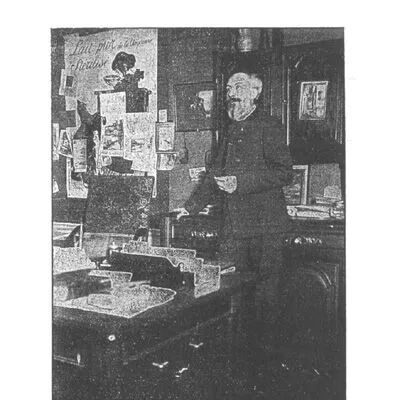
Félix Buhot
Human Design Chart
Biography
What does Generator 2/4 mean for Félix Buhot?
Generator 2/4 — Design at a Glance
Félix Buhot revealed himself as someone who unleashed his strength not through self-willed initiative, but by picking up life impulses. His Generator design laid out immense endurance and high energy potential – comparable to a strong workhorse – which only became effective when he responded to signals from his environment. His motto was not to initiate but to respond. When his sacral center, the motor of his energy, gave a clear “yes,” he could act with deep satisfaction and fulfillment.
This mechanism, however, contained two specific pitfalls. First, frustration and energy loss threatened when he did things he actually had no interest in, wasting his strength. Second, he suffered when prevented from working on his heart project, even though he still had plenty of power to continue. If he did not live by the principle of responding but tried to initiate, he likely encountered persistent frustration. In harmony with his design, by reacting from the gut to offers, he was impetuous and could not be stopped. His energy thus materialized not through sheer will but through the correct response to life.
Sacral Authority
Félix Buhot lived as a Generator whose strategy and inner authority were identical. This unification fundamentally simplified his decision-making process. His orientation was guided by sacral authority, based on physical reactions to external stimuli. Instead of intellectual deliberation, he followed a “gut feeling” or a sudden surge of power. These signals manifested in loud sounds like grunts or soft sounds like “Mhm.”
A prerequisite for this clear guidance was his open emotional center. When his sacral motor kicked in, Félix Buhot felt vital and alive. He seemed to have inexhaustible energy and tackled his tasks with great enthusiasm. His design predisposed him to live with joy and satisfaction, fully immersed in activities without strict purposefulness.
Additionally, his activated spleen center acted as a supportive authority. This endowed him with the ability to react especially quickly and spontaneously. He had an immediate access to his physical well-being and instinctive perception. Félix Buhot could reliably rely on these inner signals, making his actions direct and authentic.
The 2/4 Profile — Hermit / Opportunist
Félix Buhot moved in a constant interplay between the deep need for withdrawal and the desire to connect with a carefully chosen community. His design as a 2/4 profile laid out a tension: Line 2 demanded solitude to clarify inner processes, while Line 4 sought exchange with familiar people. This dynamic required him to clearly communicate his boundaries – when he needed company and when he wanted to be left alone. In his alone time, he reflected on what he had learned from his network and developed new ideas from it.
This structure was shaped by specific energies. Line 2, connected with Gate 53, brought an energy of “swing” and development line. It projected the ability to start anew outward, but demanded patience, as true success only became clear after the inner call. An early success here could lead to impatience, making waiting for the right opportunity central.
Simultaneously, Line 4, associated with the energy of shock and limitation, gave him a certain fixity in reacting to competition, but also a special inventive ability. Through the influence of Uranus, he could recognize new opportunities in crisis situations or “shocks” that others missed. His strategy was to use these specific reactions to remain learnable despite apparent limitations and to draw constructive impulses from chaotic environments. Thus, he combined the introspective depth of the hermit with the practical adaptability of the networker.
Split Definition — Defined & Open Centers
Félix Buhot revealed himself as someone whose expression and actions were guided by a constant, inner source of energy. His defined Sacral Center endowed him with a vital force that felt like a constant hum and urged him to be active. This energy was reliably available to him only when he waited for external stimuli and responded with an inner "yes" or "no," rather than initiating on his own. His defined Throat Center served as a pivot point, transforming this sacral power into clear communication and action, allowing him to express his truth with ease and honesty. Additionally, his defined Spleen Center ensured a spontaneous body awareness that enabled him to make intuitive judgments in the "now" and protect his well-being, while his defined Root Center provided a steady pressure to move forward in the material world and manage stress.
At the same time, Félix Buhot was vulnerable to external influences through several open centers. His open Head Center meant that he did not have a constant mental pressure but instead absorbed inspiration from the environment; he tended to get caught up in questions and doubts that were not his own and sought answers to quiet the mental noise. His open Ajna Center allowed for a flexible mind that gathered concepts and ideas from the environment without fixing them as personal truth, which could make him feel uncertain when he lacked clear answers. His open G Center lacked a fixed identity; he reflected the energy of his environment and sought the right place and people to feel at ease, rather than setting his own direction. His open Heart Center made him vulnerable to the need to prove his worth by making promises he could not keep, and his open Solar Plexus Center caused him to absorb the emotions of others, leading to emotional waves that he could not recognize as his own.
Channels for intuitive experimentation and cyclical maturation.
Félix Buhot revealed himself as someone who transformed intuitive depth into a concrete mastery through consistent practice. His design inclined him not only to engage with topics theoretically but to internalize them through repeated experimentation and refinement. This attitude was significantly shaped by Channel 48-16. This channel connected the inner, non-intellectual intelligence of Gate 48 with the technical skill of Gate 16. For Félix Buhot, this meant that he could only communicate a skill as a true talent after years of practice and refinement. Precision and excellence were his goals, achieved through engagement and repetition.
At the same time, his life went through a process of cyclical maturation. The maturation channel 53-42 connected the Gate of Beginnings with the Gate of Growth. This described his way of fully experiencing situations and only then reflecting on them to gain wisdom. Félix Buhot learned that he could not prematurely end cycles, or he would have to repeat them. His development was based on entering new experiences without rigid expectations, completing them, and then passing on the insights gained.
Additionally, other gates influenced his consciousness. Gate 57 promoted intuitive clarity and awareness of the present moment, while Gate 54 drove the desire for worldly success as a prerequisite for spiritual development. Gate 51 gave him a strong will to adapt to shocks. In the background, Gate 33 supported the process of reflection and withdrawal to learn from experiences. Gate 59 and Gate 3 involved genetic strategies of bonding as well as overcoming confusion through mutation. Gate 19 provided a need for secure resources and community, while Gate 35 demanded change through interaction and new experiences. Félix Buhot used this constellation to transform his intuitive depth into a communicable, perfected form.
Collective Circuitry — Circuit Signature
Félix Buhot was marked by two clearly separated, parallel energetic streams that did not merge with each other. On one hand, he had a precise, future-oriented perception. The Understanding Circuit connected his Throat Center to the Spleen Center through the wavelength. This gave him the ability to immediately grasp visual details and strategic structures and articulate these insights clearly. It was an emotionless ratio aimed at improving things and guiding society towards a better future.
At the same time, there existed a completely independent stream of emotional processing. The Meaning Circuit connected his Sacral Center to the Root Center through the channel of maturation. Here, it was not about cool logic but about cyclical emotions and experiences from the past. Félix Buhot had to process and mature these felt insights before they could be shared.
Since he had a Split Definition, these two systems – the rational understanding of the future and the emotional meaning-making of the past – were energetically separate from each other. He could not automatically switch between one force and the other. Instead, he had to learn to integrate these different, coexisting forces: the clear, visual communication of strategic ideas on one side and the deep, wave-like processing of past experiences on the other. This duality shaped his way of seeing and acting in the world.
Right Angle Cross of Penetration 2
Félix Buhot was marked by the right cross of the penetration 2, a configuration that fostered deep immersion into matter and the revelation of hidden structures. His design inclined towards analytical sharpness, where superficial appearances were penetrated to uncover the underlying truth. This mechanism acted as an inner drive to unravel complex connections and adopt a clear, often direct perspective.
The right cross of the penetration 2 connects specific energies that emphasize the need for precision and the ability to see through illusions. Félix Buhot lived with a natural inclination to reduce things to their core, which helped him stay focused in his areas of expertise. This structure supported an attitude that was not satisfied with half-truths but sought the essential truth.
Without external events in the raw content, the description remains limited to these characteristic traits. Félix Buhot was someone who, through his design, was enabled to delve deeply into topics while maintaining a certain directness. The energy of this cross shaped his way of looking at the world: with a sharp eye for what is truly important and the will to name it clearly. This created an inner discipline that drove him to always grasp the essence of things rather than getting lost in details.
Saturn Return · Uranus Opposition · Chiron Return — Life Cycles
Félix Buhot's design was marked by cyclical phases of professional condensation and international outreach. In 1875, at the age of 28, he regularly exhibited in the Parisian salons. This period marked his first Saturn return, a mechanism where years of internal groundwork often condenses into a tangible, visible result and strengthens one's own structure.
Later, in 1888 at the age of 41, he had an exhibition in New York City. This coincided with the Uranus opposition, a phase often associated in Human Design with sudden changes, new perspectives, or the expansion of one's horizon. Here, the tendency to break established patterns and open up to a broader, perhaps unknown audience was evident, making his career internationally visible.
The Chiron return, a fulfillment cycle between the ages of 49 and 51, where one's incarnation cross unfolds and the meaning becomes experiential, concluded in 1898. Félix Buhot died in Paris at the age of 51. His death in this specific life stage underscores the intensity of this cycle, which symbolizes the completion of the individual life task before the physical life ends. The events show a clear sequence: from local consolidation to international expansion to the final fulfillment of the personal path.
Generator · Sacral Authority — Synthesis
Félix Buhot lived deeply in his sacral center (Generator type, sacral authority), sustained by a constant energy source as long as he engaged in activities that activated him internally. This energy found expression through the throat center, serving as a voice for intuitive, bodily wisdom (Wave Channel). His profile as a natural talent and networker suggests that he oscillated between the need for inner depth and the desire to exchange with others, where retreats provided clarity to reconnect with his community afterward. The recurring career events marked by the cycles attest to his ability to perfect his skills and manifest them in the world.
A central paradox in his design lay in the tension between the deep, instinctive intelligence of the spleen center and the throat center's need to communicate and shape this wisdom. While the spleen center received information in subtle, non-rational ways, the connection to the throat center demanded a form of articulation and manifestation that might not always align with the original depth. This led to an inner dynamic where he constantly strived to translate authentic impulses into a comprehensible form.
2 Defined Channels
Incarnation Cross - Right Angle Cross of Penetration 2
Solar Return
The Solar Return shows the moment when the sun returns to its exact birth position - your personal solar year.
Life Cycles
Discover the life cycles with a detailed triple view (birth chart, cycle chart, composite).
Human Design Profile
- Type
- Generator
- Strategy
- To respond - wait for something to respond to
- Authority
- Sacral Authority
- Profile
- 2/4 - Hermit / Opportunist
- Definition
- Split Definition
- Incarnation Cross
- Right Angle Cross of Penetration 2
- Date of Birth
- 09.07.1847 05:00
- Place of Birth
- Valognes, France
Frequently Asked Questions
What was Félix Buhot's Human Design type?
What profile did Félix Buhot have?
What authority did Félix Buhot have?
What incarnation cross did Félix Buhot have?
When was Félix Buhot born?
Discover your own Human Design
Are you also a Generator? Find out in a personal reading how to use your sacral energy correctly and discover deep satisfaction.
More Personalities
Back to overviewAaliyah

Alexia

Angèle

Anne-Marie

Arcángel

Arno