
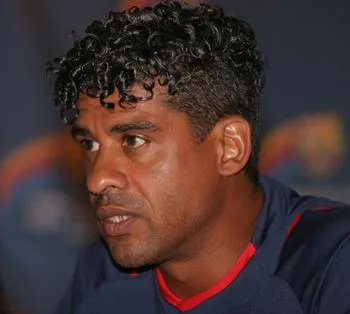
Frank Rijkaard
Human Design Chart
Biography
Rijkaard played for Ajax, Real Zaragoza and AC Milan. With Ajax, he won five Eredivisie titles and the 1994–1995 Champions League. With AC Milan, he won Serie A titles, as well as the 1988–89 and 1989–90 European Cup (Champions League) titles.
He earned 73 caps for the Netherlands national team. He was part of the team that won the 1988 European championship and finished third in the 1992 European championship. He also played in the 1990 and 1994 World Cups.
In his managerial career, he is most well known for his five-year tenure at Barcelona where he won the 2004–05 and 2005–06 La Liga titles, as well as the 2005–06 Champions League. He has also managed the Netherlands national team, Sparta Rotterdam, Galatasaray, and the Saudi Arabia national team.
He is twice divorced, and currently married and has four children.
Human Design Analysis: Frank Rijkaard as Projector 4/6
Projector 4/6 — Design at a Glance
Frank Rijkaard's design tends towards precise system analysis. As a projector, he did not have an intrinsic constant energy source but rather acted focused and dense like a bright light beam that targeted weaknesses in his environment directly. This mechanism allowed him to recognize errors in structures or processes immediately – however, with the risk that this direct confrontation would be perceived as unpleasant by others, similar to shining a light directly into someone's face.
His optimal strategy was not to push forward independently but to wait for an honest and respectful invitation from his environment. By following his own path and radiating harmony, he became attractive to others; they came to him of their own accord to seek advice. This passive attractiveness protected him from the typical projector trap of burning out quickly, as he only invested his limited energy where it was explicitly desired and respected.
If Frank Rijkaard lived according to this principle, he was rewarded with success. If he ignored the necessity of an invitation and instead tried to impose his insights, this led sooner or later to his non-self theme: bitterness. His design therefore required patience and restraint as keys to carrying his clear perspective effectively into the world without conflict.
Splenic Authority
Frank Rijkaard's design tends towards immediate, instinctive action. His inner authority resides in the Spleen Center – a defined health and alarm system. For this specific authority to be effective, both the Emotional and Sacral Centers must be open; this configuration is found exclusively in projectors or manifestors.
His survival intelligence showed as spontaneous internal knowledge about whether a situation or environment was beneficial. The first impulse served directly his health and allowed him to rigorously distance himself from harmful influences. This spleen voice, however, is a very fine impulse that appears only once at the moment; it could easily be ignored or drowned out by external influences, requiring high vigilance. Sometimes a brief retreat helped to follow this subtle signal clearly.
Since what was right became apparent only in the moment, plans could change short-term. Long-term commitments were difficult; instead, his design preferred spontaneity and flexibility. He needed much freedom so as not to be hindered by rigid obligations in his natural responsiveness. This mechanism shaped a lifestyle that relied on immediate physical intuition rather than long-term strategic planning.
The 4/6 Profile — Opportunist / Role Model
Frank Rijkaard's design tends towards intense experimentation during the first three decades of life, particularly in the areas of relationships and friendships. The Profile 4/6 acts initially like a pure Line 3: an area of testing and learning through direct experience before Saturn returns. During this phase, he sought connection and tested various roles driven by the need for connection.
With entering the second half of life, this dynamic fundamentally shifted. Activating Line 6 often led to an internal tension: on one hand, there was a deep desire to be part of a community (Line 4), while on the other, the need for distance and contemplative insight into the meaning of it all grew (Line 6). This conflict between heart and head shapes this profile's life task significantly.
At the same time, Gate 18 formed an attitude of correction and dealing with inadequacies, coupled with a fear of failure. This was in dialogue with Gate 52, which seeks inner peace and spiritual balance. The challenge lay in not transforming this peaceful longing into self-deception but to find genuine inner calm. Later, Frank Rijkaard was expected to act as an exemplary role model through cooperation with others, always carefully keeping his heart open only to the right people to avoid hurt.
Split Definition — Defined & Open Centers
Frank Rijkaard's Human Design profile suggests a tendency towards clear and conceptual communication. His defined Ajna Center created a consistent mental function: he processed data and creativity in specific ways, independent of external influences. This inner authority flowed directly into his defined Throat Center. The throat reliably transformed these mental concepts into speech and action. Frank Rijkaard thus spoke what he thought – fostering honesty and clarity as long as it did not become impulsive.
His defined G Center gave him a firm sense of self-identity and direction. He knew who he was and where he was going without relying on others. This contrasted with his open centers. The open Head Center made him vulnerable to foreign inspiration or mental pressure moments; he tended to take other people's questions as his own problems if he did not trust his inner authority.
The open Heart Center meant that he lacked a consistent willpower to keep promises or prove value. He was at risk of spiraling into self-doubt when trying to prove himself through competition. His open Sacral Center lacked generative endurance; he absorbed the energy of others and risked exhaustion by ignoring boundaries. The open Solar Plexus Center absorbed environmental emotions, making him vulnerable to foreign moods. Frank Rijkaard had to learn not to personalize these emotional waves to maintain his inner peace.
Channels for acceptance, leadership, scrutiny and structure.
Frank Rijkaard's Design tended towards logical, collective leadership based on the principle of invitation. He established his authority not through coercion but by understanding existing patterns and trends – similar to an alpha animal that leads only when accepted by the pack. This approach was shaped by the Alpha Animal Channel 7-31: Gate 7 provided the strategic role of "power behind the throne," while Gate 31 represented the voice of the collective leader. His leadership, therefore, always aimed at consensus and future security rather than absolute dominance.
Parallel to this, he had a pronounced ability for detailed analysis and mediation of complex relationships. The Accepting Channel 17-62 connected his visual pattern recognition (Gate 17) with the linguistic precision of Gate 62. This allowed him to structure and present information in such a way that it became mentally acceptable; he logically organized details before communicating them, which also meant that only what fit into his existing worldview was understood.
Another characteristic was his insatiable drive for perfection and correction. The Judgment Channel 58-18 pushed him to constantly question patterns (Gate 58) and correct what felt dysfunctional or unhealthy (Gate 18). This process was less personal and more a service to the collective, aimed at optimizing quality of life in the system. Additionally, his Design showed a tendency towards innovative thinking through the Structuring Channel 23-43. Here, Gate 23 processed spontaneous insights from Gate 43 and expressed them, often with a perspective felt as "ahead." However, success required patience: His unique solutions only became effective when the timing was right and others were ready to accept these new efficiency concepts. Without this invitation, his ideas appeared isolated or misunderstood.
Collective Circuitry — Circuit Signature
Frank Rijkaard's Design featured a tendency towards structured emotional expression strength. His Knowledge Circuit connected the Ajna Center with the Throat Center (Channel 43-23). This created a direct flow from inner imagery to spoken action: ideas were not only thought but also cast into clear forms and articulated. The energy was pulsing and acoustically driven, propelled by the necessity to walk one's own path and initiate change.
Parallel to this, the Understanding Circuit acted as a second independent force. Here, a group connected the Ajna, Throat, and Identity Centers (Channels 17-62, 31-7). This allowed for sharing logical strategies and rational insights free from conditioning – the "Alpha Animal" principle of clear leadership. A second, separate group within this circuit linked the Spleen and Root Centers (Channel 18-58), which connected intuitive judgment with direct physical energy.
As a person with Split Definition, these systems existed alongside each other: the emotional, transformative expression of the Knowledge Circuit and the focused, strategic logic of the Understanding Circuit. They were not directly merged but formed separate, parallel pillars of his personality – on one hand, creative transformation through voice, on the other, logical structuring of the future.
Right Angle Cross of Service 3
Frank Rijkaard's Human Design shows a tendency towards deep, often quiet dedication to the well-being of others. This attitude was not expressed as loud engagement or strategic planning but rather as an inner compass guiding him where support is truly needed. In Human-Design terminology, this configuration is referred to as 'The Right Cross of Service 3'. It describes a specific energetic alignment where serving is not a conscious moral act but a natural, almost instinctive reaction to the environment.
Frank Rijkaard acted less through dominant leadership and more through his ability to integrate into existing structures and stabilize or heal them from within. This involved taking on tasks that often remain unseen yet are crucial for the cohesion of a system. His energy grants a special empathy that is not sentimental but pragmatic: it recognizes need and responds with concrete action or presence.
For Frank Rijkaard, this meant his greatest potential was realized when he made himself available to others without losing his own identity. It was service born out of conviction and inner necessity rather than duty. This configuration shapes a way of life that operates in the background but is nonetheless fundamental for the success of communities or projects. Thus, Frank Rijkaard showed himself as someone whose strength lay in silent yet effective support.
Saturn Return · Uranus Opposition · Chiron Return · 2nd Saturn Return — Life Cycles
Frank Rijkaard's design was characterized by a clear structuring of life phases where inner maturity and outer change were closely intertwined. In 1990, at the age of 28, he won the European Cup – marking the first Saturn Return cycle. This period often signifies the crystallization of years of groundwork into a solid result and confirms the internal stability necessary for his path.
Later, another dynamic emerged: in 2003, at 41 years old, he was hired by FC Barcelona as their new head coach. This fell during the Uranus Opposition period, a phase requiring deep transformation and new perspectives. It was no longer just about confirmation but fundamental realignment of his role.
His life task involved integrating phases of consolidation and change. The Saturn Return provided the foundation for recognition through concrete achievements, while the Uranus Opposition challenged him to question old structures and take new paths. Both cycles shaped his journey as a player and later coach by enabling him to align inner development with external demands. His strength lay in experiencing these transitions not as breaks but as natural progressions of personal evolution.
Projector · Splenic Authority — Synthesis
A central red thread in this design is the ability to recognize patterns and project them in ways that can be both helpful and challenging. The defined mental center (Ajna) provides a consistent conceptual understanding, channeled through the Alpha Animal Channel (Gate 7/31) towards collective leadership. This points to a natural inclination to analyze structures and show paths for improvement – 'shedding light into darkness' (Projector), yet with the potential effect of questioning existing systems. Line 4 in Profile strengthens this desire for deep connection and recognizing patterns within relationships and communities, while Line 6 implies a search for meaning and higher understanding.
The central paradox lies in the tension between the need for recognition and belonging (Line 4) and the inner drive to distance oneself and act from a detached perspective (Line 6). This is reinforced by the Spleen Authority, which requires spontaneous, instinctive decisions to protect one's well-being. The ability to recognize errors in the system (Projector) collides with the necessity of tactfully communicating these insights to avoid rejection. Successes, as evidenced in certain cycles, seem most likely when inner wisdom and intuitive knowledge (Spleen) align with logical leadership style (Alpha Animal).
4 Defined Channels
Incarnation Cross - Right Angle Cross of Service 3
Solar Return
The Solar Return shows the moment when the sun returns to its exact birth position - your personal solar year.
Life Cycles
Discover the life cycles with a detailed triple view (birth chart, cycle chart, composite).
Human Design Profile
- Type
- Projector
- Strategy
- Wait for the respectful invitation
- Authority
- Splenic Authority
- Profile
- 4/6 - Opportunist / Role Model
- Definition
- Split Definition
- Incarnation Cross
- Right Angle Cross of Service 3
- Date of Birth
- 30.09.1962 12:00
- Place of Birth
- Amsterdam, NETH
Frequently Asked Questions
What is Frank Rijkaard's Human Design type?
Which Profile does Frank Rijkaard have?
What authority determines Frank Rijkards decisions?
What incarnation cross does Frank Rijkaard have?
When was Frank Rijkaard born?
Discover your own Human Design
Are you also a Projector? Find out in a personal reading how to unfold your leadership qualities and recognize the right invitations.
More Personalities
Back to overviewSissy Spacek

Alain-Fournier

Aldair

Anémone

Ann-Margret

Bourvil
