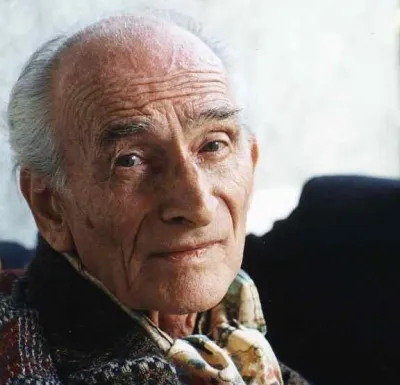
Frans Andriessen
Human Design Chart
Biography
He died on 22 March 2019, aged 89, in Bilthoven, Netherlands. He married Catherine Ten Holter in 1955; she survived him with their four children.
Human Design Analysis: Frans Andriessen as Manifesting Generator 4/6
Manifesting Generator 4/6 — Design at a Glance
Frans Andriessen showed himself to be someone who could achieve rapid results by skipping steps. His design as a Manifesting Generator combined the constant sacral energy of a Generator with the direct action of a Manifestor. This hybrid nature allowed him to quickly draw things into his life rather than just slowly reacting to them.
However, this speed carried the risk of missing important steps. When Frans Andriessen moved too fast or started multiple projects simultaneously without inner consent, it often led to frustration – his specific Non-Self theme. The path to deep satisfaction for him did not lie in linear task completion but in responding to impulses. Only when his sacral center gave a clear "yes" after an "antest," was the energy present and effective.
With correct application of this strategy, Frans Andriessen could draw deep fulfillment from his work. For him, it was no problem to work on different things simultaneously; in fact, the compulsion for linear completion would have stifled his creativity. His true strength ignited in a playful, varied mode where variety and fun shaped the process rather than rigid planning.
Sacral Authority
Frans Andriessen navigated his life through a direct, physical resonance to external stimuli. His design as a Generator fundamentally simplified the decision-making process: strategy and inner authority merged into one. He didn't need a complex head plan but listened to his sacral authority. This manifested as a physical response – a grunt, hum, or a palpable surge of energy in his abdominal area.
The prerequisite for this clarity was his open Emotional Center. Once his Sacral Motor responded to a stimulus, a wave of vital energy and inexhaustible vitality ensued. Frans Andriessen tackled his tasks with great enthusiasm and immersed himself fully in the doing, free from constant purposefulness. He lived out of the joy of the process itself.
Supporting this was his activated Spleen Center. It gave him the ability for quick, instinctive reactions. Through this connection, he had an immediate access to his physical well-being and a reliable, spontaneous perception. Instead of planning in his head, Frans Andriessen trusted this inner voice. It taught him to accept only what evoked this positive, energy-charged resonance in his sacral area, thereby generating contentment and life force.
The 4/6 Profile — Opportunist / Role Model
Frans Andriessens design is characterized by a clear developmental line that led from experimental behavior in his youth to a later, wisdom-oriented approach. In the first three decades of his life, he often acted like a networker who actively sought out and tested relationships and friendships. This phase served to find his own position within the community through trial and error.
Over time, this dynamic changed fundamentally. Frans Andriessen increasingly found himself in an internal tension: On one hand, he longed for belonging and connection with other people; on the other hand, a distant perspective attracted him to think deeply about the meaning of things. This conflict between the desire for closeness and the need for distance shaped his experience significantly.
In the further course of his development, it became evident that he had the ability to use misunderstandings and resistances not as obstacles but as catalysts. He developed an unyielding stance that allowed him to gain general insights from personal experiences. Ultimately, he served as a role model whose service to the common good was effective. His role involved exercising transpersonal leadership while carefully weighing opposing forces to respond appropriately. This transformation from the individual experimental field to collective responsibility formed the core of his human expression.
Single Definition — Defined & Open Centers
Frans Andriessen was characterized by a constant internal structure: five defined centers formed a stable foundation of mental pressure, conceptual thinking, reliable communication, firm identity, and generative life force. His design suggested that inspiration and questions (defined Head Center) flowed through specific concepts (defined Ajna Center) and ultimately articulated in the world (defined Throat). Here, his personal direction (defined G Center) and vital energy source (defined Sacral Center) served as driving engines. This architecture allowed him to not only think ideas but also express them with a unique voice and generate energy through reactions to life rather than initiating impulsively.
This clear internal order stood in contrast to the vulnerability of his four open centers. The open Heart Center lacked its own willpower; Frans Andriessen tended to feel pressure to prove himself or make promises to demonstrate his worth – a mechanism that did not rely on his own energy. Similarly, the open Solar Plexus Center acted as a barometer: it absorbed and amplified the emotions of the environment, leading him to personalize foreign moods as internal states or shy away from emotional confrontations to avoid conflicts.
Additionally, the open Spleen Center was prone to spontaneous decisions driven by fear of uncertainty or loss of well-being. This could lead him to cling to unhealthy situations just because they seemed momentarily secure. Finally, the open Root Center absorbed external stress; Frans Andriessen faced adrenalized pressure from his environment, which, if identified with, could result in overload or attempts to relieve unmanageable pressure through excessive activity. The challenge of his design lay in distinguishing between his own powerful structure and these situational conditions of willpower, emotion, intuition, and stress.
Channels for structure, inspiration, rhythm and awareness.
Frans Andriessen was characterized by the synchronous effect of inspiration and mutative life force. His design acted as an authentic role model that inspired others while his deeper structure had the capacity to transform these impulses into material reality. It was about living one's truth as a catalyst for collective change.
The Inspiration Channel 1-8 connected his G Center with the Throat Center through Gate 1 (Self-expression) and Gate 8 (Contributing). This allowed him to attract attention simply by being present and expressing himself individually, encouraging others to express their own creativity much like how a pianist inspires listeners. This effect did not come from explanation but through exemplary action.
Simultaneously, the Beat Channel 14-2 prepared the energetic resource for this inspiration. It connected his Sacral Center (Gate 14: Power Competence/Material Resources) with his G Center (Gate 2: Higher Knowledge). This gave him the power to materialize new directions and drive innovations. Through trust in his sacral reaction, he could translate mutative impulses into concrete life paths.
On a personal level, the Channel of Structuring 43-23 supported this dynamic. It connected his Ajna Center (Gate 43: Insight) with his Throat Center (Gate 23: Assimilation). This helped him process spontaneous mental breakthroughs and express them efficiently, making new perspectives understandable. The Channel of Awareness 61-24 (Head-Ajna) also provided mutative knowledge through sudden insights (Satori), breaking old thought patterns.
Additional Gates like Gate 10 (Integration/Behavior) and Gate 17 (Following/Organization) shaped his actions, while Gates such as 21 (Control) and 48 (Pattern Recognition) presented challenges in the material realm and understanding deeper connections. Frans Andriessen thus united Being and Doing: inspiration through role modeling and energetic drive of new directions.
Individual Circuitry — Circuit Signature
Frans Andriessen was marked by a pulsating, acoustic energy aimed at creating new individual identity through transformation of knowledge. His design directly connected Head, Ajna, Throat, and Identity centers with the Sacral center – one continuous flow without interruption. This connection allowed him to use emotional waves from the Solar Plexus as a motor for external expression in the Throat Center.
The Knowledge Circuit was fully active in Frans Andriessen. The Awareness Channel (24-61) promoted innovative flashes of insight and creativity, while the Structuring Channel (23-43) helped bring these ideas into tangible forms. The Inspiration Channel (1-8) provided spontaneous impulses that were rhythmically and timely expressed through the Beat Channel (2-14). This configuration emphasized his unique individuality and enabled him to initiate change by creating new knowledge and emotionally grounding it in communication. The energy was always directed towards the 'now,' carried by a melancholic depth nourishing his creativity. Frans Andriessen used this energetic structure to walk his own path and inspire others through his authentic expression.
Right Angle Cross of Tension 1
Frans Andriessen's design carried the signature of the right cross of tension 1. This configuration was a specific archetypal marker that, however, remained without further mechanical differentiation in the available data. It represented a structural assignment within Human Design whose concrete effects on daily action or inner disposition were not specified here.
Without a detailed description of the underlying mechanics, no behavior-related pattern could be derived. The design indicated this characteristic without it leading to a specific life task or a typical way of dealing with tension. It remained a formal entry in the chart pointing towards a certain energetic structure whose content was undefined.
Lacking an accompanying explanation of the dynamics of this cross or concrete biographical events illustrating this mechanism, Frans Andriessen regarding this aspect remained someone who carried this specific tension carrier configuration in his design. The mere mention of the name of this structure was not enough to make a deeper classification of his personality or life path. It was an element of his design that existed but received no further content in this representation.
Saturn Return · Uranus Opposition · Chiron Return · 2nd Saturn Return — Life Cycles
Frans Andriessen's design marked a clear transition from external structural maturity to internal, integrative authority. This development manifested concretely in two key years of his career. In 1971 at the age of 42, he took over as acting chairman of the KVP faction. This point coincided with a Uranus opposition which often signals turning points in Human Design where physical or structural maturity translates into new power structures. It was a moment of external breakout and assuming responsibility on an institutional level.
Six years later, in 1977, Frans Andriessen became Minister of Finance for the Netherlands. At age 48 he found himself in his Chiron Return cycle. In Human Design this period does not describe healing old wounds but a phase of fulfillment and bloom. Here one's incarnation cross unfolds increasingly in life; meaning and purpose become experiential. The step into the Ministry of Finance was thus more than just a career move, it was the realization of deeper integrative wisdom. The external power structure of faction leadership transformed into a position of high internal responsibility and authority. Frans Andriessen lived this mechanical shift: from structural consolidation through Uranus to wisdom-based leadership in the Chiron cycle, both phases supporting his specific life task.
Manifesting Generator · Sacral Authority — Synthesis
Frans Andriessen led a life marked by an inner dynamic between creative energy and the need for authentic expression. His design as a Manifesting Generator with Sacral Authority points towards someone who was always ready to react to impulses and set things in motion – yet always dependent on confirmation from his sacral center. This ability for quick reaction was strengthened by defined Head and Ajna Centers providing him a steady stream of inspiration and ideas which he could communicate through his Throat Center. The connection between G-Center and Throat (Channel 1-8) indicated a natural talent to inspire others through his individuality and generate new perspectives.
A central tension field in his design lay between the drive for quick implementation of new ideas and the necessity to rely on the inner authority of his sacral center. The connection between Gate 38 (Struggle) and Gate 17 (Logical Teaching) indicates that while he was ready to stand up for his beliefs, he also had a deep longing for order and clarity. This dynamic likely led to an ongoing interplay between impulsive actions and the need to critically question their consequences – a process further intensified by the open Root Center as he was particularly sensitive to external influences and the stress of his environment.
4 Defined Channels
Incarnation Cross - Right Angle Cross of Tension 1
Solar Return
The Solar Return shows the moment when the sun returns to its exact birth position - your personal solar year.
Life Cycles
Discover the life cycles with a detailed triple view (birth chart, cycle chart, composite).
Human Design Profile
- Strategy
- To respond - wait for something to respond to
- Authority
- Sacral Authority
- Profile
- 4/6 - Opportunist / Role Model
- Definition
- Single Definition
- Incarnation Cross
- Right Angle Cross of Tension 1
- Date of Birth
- 02.04.1929 19:30
- Place of Birth
- Utrecht, Netherlands
Frequently Asked Questions
What was Frans Andriessen's Human Design type?
What Profile did Frans Andriessen have in Human Design?
What Authority did Frans Andriessen have?
What incarnation cross did Frans Andriessen have?
When was Frans Andriessen born?
Discover your own Human Design
Are you also a Manifesting Generator? Find out in a personal reading how to unfold your multi-talents and direct your energy wisely.
More Personalities
Back to overviewAldair

Alizée

Angeli

Arletty

Artus

Balthus