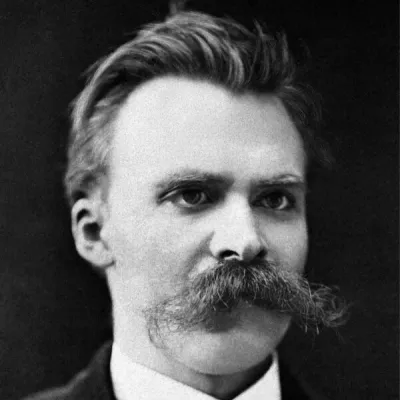
Friedrich Nietzsche
Human Design Chart
Biography
Nietzsche's work encompasses poetry, cultural criticism, and philosophical essays while displaying a fondness for aphorisms and irony.
Friedrich Nietzsche — Manifesting Generator with Profile 2/4
Manifesting Generator 2/4 — Design at a Glance
Friedrich Nietzsche's design features a hybrid nature: the lightning-fast action capability of a Manifestor paired with the constant energy source of a Generator. This configuration allowed him to skip steps and quickly draw results into his life. However, this speed harbored a central dilemma. The tendency to overlook important stages often led to having to return later to catch up on missing foundations – an experience that could quickly turn frustrating. Additionally, his design tended to pick up multiple impulses simultaneously and process diverse projects in parallel. Without clear inner orientation, this creative drive easily tipped into exhaustion or dissatisfaction.
The mechanics of the Manifesting Generator require a specific strategy: not initiating but reacting to life. Friedrich Nietzsche experienced deep satisfaction only when he examined each impulse through his defined Sacral Center – that inner space signaling a clear 'Yes! I love it!' Only such confirmation legitimized starting or continuing an activity. Instead of linear project closures, which restricted his nature, he found his true strength in the 'Play Mode'. Here, variety was no obstacle but the key to lasting satisfaction. As long as he sought this inner resonance and did not let himself be guided by external pressure, his unique speed could serve him rather than overwhelm him. His path to fulfillment thus lay in constantly reviewing his impulses and trusting his own energy as long as it responded authentically.
Emotional Authority
Friedrich Nietzsche's decision-making was inseparably linked with the rhythm of his emotions. His inner authority resided in his defined Solar Plexus Center, meaning he followed an emotional wave that manifested through a constant up-and-down of moods. The world appeared to him always colored by his current mood; an object could inspire enthusiasm one moment and appear negative the next. This immediate emotional reaction was only a first snapshot, not necessarily the deeper truth. Spontaneous decisions arising directly from this temporary excitement carried the risk of proving false later on.
The mechanics of his emotional authority thus required time and distance. The longer Friedrich Nietzsche let a decision mature, the clearer his judgment became. The process demanded patience and conscious reflection over important questions. Through this waiting period, initial intense emotions subsided, creating an emotional distance. Only then did calmness set in and true clarity emerge. This mechanism was independent of other defined centers in his design; the Solar Plexus Center always took precedence for decision-making. Friedrich Nietzsche therefore had to allow himself to be delayed, asked repeatedly, and wait out the wave before acting. This was especially true for long-term decisions with significant influence on his life course. Only through this waiting could he move from momentary mood-chargedness to clear insight.
The 2/4 Profile — Hermit / Opportunist
Friedrich Nietzsche revealed a constant oscillation between a deep longing for solitude and a desire for close connection. His design as Profile 2/4 created tension that constantly threw him between two poles: Line 2, which required retreating into the 'cave', and Line 4, which carried the need to spend time with chosen favorite people. This configuration made it essential for him to set clear boundaries. He had to communicate outwardly when he sought company and when he needed solitude to not disturb his inner processes.
During his alone times, Nietzsche delved into himself, created calmness, and gained clarity. Only after satisfying the need of Line 2 did he return to his network. There he gathered knowledge and experiences that he then reflected upon and evaluated during the subsequent phase of withdrawal. This cycle of isolation and exchange allowed him to organize what he had learned and develop brilliant ideas from it. Line 4 required harmony, simplicity, and waiting for the right moment to express details precisely. If he was pulled out of his asceticism too early, frustration and a need for correction loomed. Through conscious regulation of this rhythm – clear signals for withdrawal versus community – Nietzsche could protect his energy and unleash his full potential.
Single Definition — Defined & Open Centers
Friedrich Nietzsche's Human Design profile indicated a tendency towards constant, independent thinking that translated directly into consistent communication. His defined Ajna Center generated continuous mental processes and concepts which were reliably expressed outward through his also defined Throat Center. This was not an arbitrary expression but a mechanical necessity: He spoke what his mind conceptualized. This mental stability was reinforced by a defined Sacral Center with vital energy, yet this energy was only available in response to stimuli - his power showed itself in the reaction, not the initiation. Additionally, a defined Solar Plexus shaped his emotional authority; truth revealed itself to him after waiting out emotional wave cycles, giving him profound time-dependent clarity. The defined Root Pressure provided constant background stress that propelled him forward in the material world.
At the same time, Friedrich Nietzsche was vulnerable to conditioning through several open centers. His open Head Center meant a lack of mental fixation; he tended to be swept along by external inspirations or doubts from others rather than having his own questions. His open G Center led to situational identity: He adapted to his environment and those around him without a firm internal direction. The absence of a defined Heart Center left him lacking consistent willpower; he was not designed to give promises or prove his worth through competition, making him vulnerable in performance-oriented environments. Finally, the open Spleen Center revealed sensitivity to environmental fears and well-being without possessing spontaneous intuition as authority. He absorbed others' health vibrations rather than trusting an inner sense of security. This configuration described a person with strong internal energy and voice who was nonetheless heavily dependent on the quality of his environment and appropriate stimuli to express their potential.
Channels for powerful action, acceptance, change and maturation.
Friedrich Nietzsche exhibited an internal tension between constant pressure for logical organization and verbal clarification, and a charismatic urge towards immediate action. His design included Channel Accept 17-62, connecting mind and throat. This created a continuous inner process: mentally organizing information and translating it into words. Anything he could not fit into his own mental framework remained incomprehensible to him. Simultaneously, his Throat Center exerted pressure to communicate these structured opinions in detail, bringing relief when listeners were receptive.
In his personality, Channel Charisma 34-20 was at play, linking the Sacral Center with Gate Now. This gave him manifesting power that had to be guided by sacral reaction. Without this inner guidance, his energy risked breaking out chaotically or descending into obsession. The success of his expression depended on integrating logical explanation of his design with the impulsive yet reactive force of his personality.
Additionally, Gates like Gate 9 shaped the ability for detailed work and perfection through repetition, while Gate 61 described a struggle for inner truth and silence. This configuration challenged him to use his generative power only for things that truly resonated with him rather than being guided by mental 'shoulds'. The connection of logical analysis and charismatic projection formed the core characteristic of his energetic profile.
Collective Circuitry — Circuit Signature
Friedrich Nietzsche's design showed him as someone who structured and shared rational insights free from emotional influence. This orientation resulted from his simple definition: All defined centers were energetically directly connected, creating a cohesive flow.
The Understanding Circuit shaped a focus on logic and strategy for improving the future. For Friedrich Nietzsche, only Channel Accept was active here, connecting Ajna Center (conceptual thought) with Throat Center (expression). This allowed him to articulate visual ideas into words - an 'emotionless ratio', as Solar Plexus Center was not part of this circuit.
Parallel to this, the Meaning Circuit worked, dealing with emotions and past. Here, Friedrich Nietzsche connected two separate segments: Throat Center with Solar Plexus Center (Channel Transience) and Sacral with Root Center (Channel Ripening). This created a space to cyclically process past experiences emotionally before sharing them.
Additionally, Channel Charisma acted between Throat and Sacral Centers. This channel ensured his expression was underpinned by the power of his life energy (Sacral) and landed in the here and now. Together, these circuits formed a system where future-oriented logic and past emotional reflection coexisted but were always integrated through the common expression channel in Throat Center and the energetic base in Sacral Center.
Right Angle Cross of Maya 3
Friedrich Nietzsche carried the archetypal imprint of the right cross of Maya 3. This configuration acted as a structuring element of his personality and largely determined his inner orientation. The right cross of Maya 3 marks a specific identification deeply rooted in the psychological disposition. It is a firm pattern that shapes self-understanding and gives the individual a clear, though often unconscious, positioning. For Friedrich Nietzsche, this meant that his essence was shaped by this particular cross configuration. It provided a framework within which his experiences were processed and his attitude towards the world developed. This imprinting is not a transient state but a permanent component of the design. It ensures a certain coherence in character by uniting various aspects of personality under a common archetypal roof. Friedrich Nietzsche thus lived with this deep identification, which helped him understand his own role and place in the order, even if this was not always conscious. The structure of the right cross of Maya 3 therefore offered a stable foundation for his personal development and inner compass.
Saturn Return · Uranus Opposition · Chiron Return — Life Cycles
Friedrich Nietzsche's development took place in three distinct phases, structured by planetary cycles. In 1872, at the age of 28 during his first Saturn return, he published "The Birth of Tragedy Out of the Spirit of Music." This cycle condensed years of preparatory work into a solid result and established him as an authority in his field.
However, stability gave way in 1883, when Nietzsche was 39 years old at his Uranus opposition, marking a radical turning point. He fled to Rapallo and began "Thus Spoke Zarathustra." This cycle broke down old structures; he left the established framework to find a new, individual form of expression – a process of profound self-discovery and liberation from conventional paths.
The third turning point occurred in 1893 at his Chiron return when Nietzsche was 49 years old. In this fulfillment cycle, which should have culminated in the incarnation task, his sister Elisabeth returned after her husband's suicide and took control over the care of her dependent brother. Instead of an autonomous bloom, this cycle led to a final dependency for Nietzsche. Here, the mechanics do not show healing in the traditional sense but rather the end of self-determined unfolding: The person who once exercised authority and then radically broke away now fell into the care of others, losing his active life path its external form.
Manifesting Generator · Emotional Authority — Synthesis
Friedrich Nietzsche lived a life marked by a constant interplay between inner clarity and emotional turmoil. His defined sacral body (sacral center) provided him with a steady energy source, which was activated not through initiation but through reaction to impulses due to his Manifesting Generator Strategy (Design). This combination endowed him with the ability to grasp and implement ideas swiftly (Manifesting Generator), while he also followed the internal rhythm of his body. The Channel of Acceptance (Gate 17/62) indicates that he mentally organized information and gave it meaning—a process that helped him develop complex concepts and articulate them in words. Recurring cycles, particularly his Saturn Return in 1872 with the success of his first work (Cross), and the Uranus Opposition in 1883, which marked a writing phase (Cross), demonstrate his ability to draw creative energy from internal processes.
A central paradox in Nietzsche's design lay in the tension between his need for isolation and exchange (Profile 2/4). Line 2 demanded withdrawal and inner reflection to gain clarity, while line 4 reflected a desire for connection and community. This led to a constant oscillation between internalizing thoughts and the necessity of sharing them with others. This was reinforced by his emotional authority (Authority), which required maturing periods for decision-making—a process in contrast to the swift energy of the Manifesting Generator. Events around 1893, when control over him passed to others (Cross), might be an expression of this inner conflict.
4 Defined Channels
Incarnation Cross - Right Angle Cross of Maya 3
Solar Return
The Solar Return shows the moment when the sun returns to its exact birth position - your personal solar year.
Life Cycles
Discover the life cycles with a detailed triple view (birth chart, cycle chart, composite).
Human Design Profile
- Strategy
- To respond - wait for something to respond to
- Authority
- Emotional Authority
- Profile
- 2/4 - Hermit / Opportunist
- Definition
- Single Definition
- Incarnation Cross
- Right Angle Cross of Maya 3
- Date of Birth
- 15.10.1844 10:00
- Place of Birth
- Roecken, Germany
Frequently Asked Questions
What was Friedrich Nietzsche's Human Design type?
Which Profile did Friedrich Nietzsche have in his Human Design?
What Authority guided Friedrich Nietzsche's decisions?
What incarnation cross did Friedrich Nietzsche have?
When was Friedrich Nietzsche born?
Discover your own Human Design
Are you also a Manifesting Generator? Find out in a personal reading how to unfold your multi-talents and direct your energy wisely.
More Personalities
Back to overviewAldair

Alizée

Angeli

Arletty
Artus
Balthus