
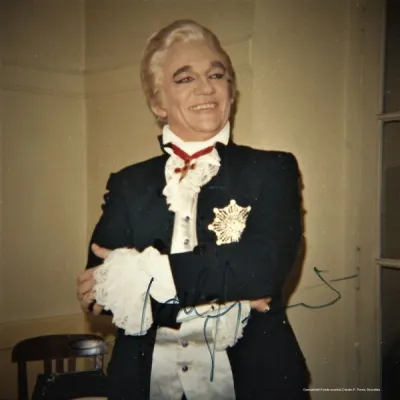
Gabriel Bacquier
Human Design Chart
Biography
He debuted at the Theatre Royal de la Monnaie, Brussels, in 1953. In the field of mélodies, he made recordings of songs by Maurice Ravel, Déodat de Séverac, Francis Poulenc and others. Two live recitals from 1961 and 1972 were issued on CD in 1987. He recorded six Poulenc songs, accompanied by Jacques Février, in June 1964 on DVD.
Bacquier was also active as a teacher, first at the vocal school of the Paris Opera and later at the Paris Conservatory until 1987, and from 2001 at the the Académie de Musique de Monaco, where he directed student productions.
Gabriel Bacquier died on 13 May 2020 at age 95 in Lestre, Manche, France.
Gabriel Bacquier — Projector with Profile 2/4
Projector 2/4 — Design at a Glance
Gabriel Bacquier revealed himself through a focusing aura that illuminated system weaknesses like a bright flashlight. His design predisposed him to immediately recognize errors in others' systems. Direct corrections, however, would have met resistance; instead, he was most effective by maintaining his own harmony and attracting those seeking his insights. The strategy involved waiting for appreciative invitations, which protected him from the bitterness of non-self themes. With an undefined Sacral Center, he lacked constant intrinsic life energy, leading to cycles of intense work phases followed by necessary rest periods to avoid burnout. Ignoring this need for recovery led to bitterness; living according to his design rewarded him with success. His way of working thus did not rely on constant effort but rather on the ability to shine purposefully and wait strategically for the right moment to influence.
Emotional Authority
Gabriel Bacquier's inner decision-making authority was his defined Solar Plexus Center, making him an emotional authority. This configuration was subject to a permanent emotional wave with continuous ups and downs of feelings. His perception of the world was always colored by current mood; he could be totally enthusiastic about something one moment while seeing it negatively in another. Yet this immediate feeling was only a snapshot, not necessarily his truth. Quick, spontaneous decisions from this emotional heat carried the risk of negative consequences.
The mechanics of his authority required patience and time for decision maturation. Gabriel Bacquier had to allow himself to rethink decisions multiple times and “sleep on them.” It was important for him to be properly deliberated upon and questioned repeatedly. Over time, intense feelings subsided, allowing emotional distance. Only then did clarity and calm set in – the sign that he had gone through the process. This strategy was particularly crucial for long-term decisions with significant influence on his life path. Emotional authority always took precedence over other defined centers; regardless of additional definitions in his design, this center determined his inner truth once activated.
The 2/4 Profile — Hermit / Opportunist
Gabriel Bacquier exhibited a characteristic interplay between a deep need for withdrawal and the simultaneous attraction to social networks. His Profile 2/4 design as a natural talent and networker created an internal tension: While Line 2 made him a recluse who preserved his integrity in silence and nurtured his specific talent, Line 4 drew him into community where he sought connections and influence.
This configuration required clear communication of boundaries. Gabriel Bacquier had to learn to distinguish between times for “Me-Time” and phases of social engagement. During withdrawal periods, he immersed himself in internal processes to find calm and clarity. This alone time was essential as it allowed him to reflect on knowledge and impressions from his network. Only after fulfilling this inner need for processing did he actively seek contact with his favorite people.
Line 4 also brought risks; as a transpersonal line, it tended to fixate on opportunities and could lead to emotional breakdown or burnout under overexertion. Yet through the combination with the reflective power of Line 2, Gabriel Bacquier could analytically process these experiences. From this synthesis of isolated reflection and network-based evaluation often emerged brilliant ideas grounded in a solid inner foundation. His life task was to create a safe environment where this cycle of withdrawal and connection could flow naturally.
Split Definition — Defined & Open Centers
Gabriel Bacquier was characterized by a persistent mental structure and a clear voice that always yielded to emotional waves. His defined Ajna Center ensured continuous, specific thinking that was not easily influenced from the outside; he processed data consistently according to his own patterns. This mental clarity flowed directly into his defined Throat Center, allowing him to express what he thought. As a result, his communication was reliable and authentic, an expression of his inner understanding.
The crucial filtering instance was his defined Solar Plexus as internal authority. Gabriel Bacquier did not make decisions in moments of excitement or frustration but waited patiently until the emotional wave subsided and clarity emerged. This process required time; only at the end of the emotional cycle did he recognize the deep truth of a situation. His defined Root Center provided the necessary pressure to move forward, especially when dealing with emotional stress.
This stable inner core sharply contrasted with his open centers. His open G Center meant that he lacked a fixed identity or life direction and instead absorbed and reflected it from the environment. He tended to question who he was if not in the right place. Similarly, lacking a defined Heart Center, he often felt compelled to prove his worth through promises or competitive behavior, which could spiral into self-doubt if he failed. His open Sacral Center also made him vulnerable to exhaustion as he amplified foreign energy without generating it himself. He had to learn to set boundaries and not rely on borrowed vitality.
Channels for logical order, intuitive impulses and emotional clarity.
Gabriel Bacquier was marked by a constant inner pressure to logically organize details and opinions. His mind continuously sorted information into a coherent worldview; only what could be logically categorized was understood by him. This drive in the Throat Center pushed him to express structured explanations.
This dynamic stemmed from Channel of Accepting 17-62. Gate 17 visualized patterns, while Gate 62 translated them into language and named details. Anything that did not fit this inner perspective remained incomprehensible. The gift lay in precisely translating complex visual patterns into theories or formulas. However, the success and clarity of communication critically depended on timing: speaking effectively only occurred upon invitation or when the counterpart was assuredly receptive. This reduced resistance and friction that could arise from the uncompromising nature of logic. Debates served to test existing patterns but often became a source of interpersonal stress.
Alongside this cognitive structure, other energies were at work. Channel of Recognizing 30-41 connected Root and Solar Plexus. Gate 41 generated restlessness and a drive for new experiences, while Gate 30 steered the emotional wave. This led to an intense need to deeply feel life and fulfill desires, with patience required to gain clarity before making decisions.
Channel of Emotion Releasing 39-55 added a provocative component. Gate 39 in Root Center provoked to strengthen the mind from Gate 55 in Solar Plexus. This created a pulsating wave between joy and melancholy. Gabriel Bacquier used this energy to perceive and tease out the nature of others' minds, enabling authentic life within emotional alchemy to express deep spiritual truth often through art or music, while ignoring his own mood led to inner unrest.
Additionally, Gates like 8 (Contribution), 14 (Power), and 29 (Persistence) contributed to individual orientation, with Gate 52 (Silence) and Gate 24 (Renewal) supporting mental processes.
Collective Circuitry — Circuit Signature
Gabriel Bacquier was characterized by a split definition that anchored two independent energetic poles within him. This separation created dynamic tension between rational structure and emotional creativity as the two groups did not directly connect but existed as parallel forces.
The first pole consisted of the Understanding Circuit, connecting Ajna Center with Throat Center. This connection enabled focused visual logic and strategic planning for the future. Gabriel Bacquier used this energy to structure and clearly express rational insights free from emotional influence. It was an 'emotionless ratio' aimed at improving things through intellect and focus.
Simultaneously, he possessed the Knowledge Circuit, connecting Solar Plexus Center with Root Center. Here pulsating acoustic energies drove his unique identity and creativity. This component generated emotional waves and promoted new expression as well as transformation through individual experience.
Furthermore, the Meaning-Finding Circuit was active between Solar Plexus and Root Centers. This circuit referred to cyclical visual energies from the past. It helped Gabriel Bacquier reflect on past experiences and recognize their meaning, learning together with others.
The synthesis of these separate systems shaped his essence: on one hand, clear, future-oriented logic of the mind; on the other, deep emotional processing of identity and past. This duality required a constant balance between the head that plans and feelings that feel and remember.
Right Angle Cross of Contagion 2
Gabriel Bacquier's Human Design chart featured the right cross of the Imprint 2. This configuration establishes a specific energetic alignment that is not further elaborated upon in the available data. It remains to mention this structure without providing detailed behavioral or character descriptions.
In Human Design, such a cross marks a profound archetypal imprint often associated with themes of trust, transmission, and inner resonance. The term 'imprint' here does not refer to illness but rather to the ability to absorb and transmit energies or states – similar to how one can catch an emotion or idea from another person. This right cross in this group indicates that such dynamics were active in a specific, individual manner.
As the raw content does not provide further mechanical details, it cannot be specified how this manifested concretely in Gabriel Bacquier's daily life. It is only noted that this energy source was part of his overall configuration. Without additional information on channels or centers, the interpretation remains limited to the existence of this cross alone. This underscores that Human Design is a complex system where individual elements are fully comprehensible only within the context of the entire chart. Gabriel Bacquier lived with this imprint whose specific impact cannot be detailed here.
Saturn Return · Uranus Opposition · Chiron Return · 2nd Saturn Return — Life Cycles
Gabriel Bacquier's design indicated a tendency towards structural anchoring, particularly evident in the transition from youth to adult responsibility. He lived as someone who solidified his foundation through concrete steps before building further life work on top of it. This approach aligned with the first Saturn Return cycle, a phase of consolidation and identity formation.
During this period, years of groundwork coalesced into a stable result. In 1953, at age 29, Gabriel Bacquier made his debut at the Théâtre Royal de la Monnaie in Brussels. This event marked not only a career milestone but also a typical moment of confirmation for his design: The internal structure found its external form and recognition. The Saturn cycle demanded taking responsibility through laying a stable foundation. In this phase, Gabriel Bacquier was someone who clearly defined his role, thereby creating the groundwork for further development. The mechanics of the first Saturn Return always emphasized securing what had been achieved and situating one's identity in the context of adult life. Through this debut, it became evident how his inner design responded to external structuring: not through impulsive action but by building a sustainable base for future achievements.
Projector · Emotional Authority — Synthesis
Gabriel Bacquier lived a path marked deeply by an understanding of human interaction patterns and nuances. His design as a Projector, combined with emotional authority and the Profile of Natural Talent/Networker, points towards someone destined to understand the world through observation and selectively share this knowledge. The open definition in Root, Sacral, Heart, and Spleen centers underscores his ability to perceive and accept others' energies without being bound by rigid patterns – a life flowing with the environment that allowed him to grasp subtle vibrations and needs of his surroundings. This openness enabled him to act as a catalyst for change by opening new perspectives through his presence and communication and inspiring others.
A central paradox in Gabriel Bacquier's design lies in the tension between his deep emotional perception (Solar Plexus Center) and the lack of constant drive from Motor Centers. He was receptive to other people's energies, yet not designed to use this energy indefinitely or maintain it independently. This led to a dynamic between needing to connect with others for inspiration and the need for withdrawal and regeneration to preserve inner balance. This dynamic shaped his path as an observer and mediator who could pass on his energy when circumstances allowed.
3 Defined Channels
Incarnation Cross - Right Angle Cross of Contagion 2
Solar Return
The Solar Return shows the moment when the sun returns to its exact birth position - your personal solar year.
Life Cycles
Discover the life cycles with a detailed triple view (birth chart, cycle chart, composite).
Human Design Profile
- Type
- Projector
- Strategy
- Wait for the respectful invitation
- Authority
- Emotional Authority
- Profile
- 2/4 - Hermit / Opportunist
- Definition
- Split Definition
- Incarnation Cross
- Right Angle Cross of Contagion 2
- Date of Birth
- 17.05.1924 04:45
- Place of Birth
- Béziers, France
Frequently Asked Questions
What was Gabriel Bacquier's Human Design type?
What profile did Gabriel Bacquier have?
What authority did Gabriel Bacquier have?
What incarnation cross did Gabriel Bacquier have?
When was Gabriel Bacquier born?
Discover your own Human Design
Are you also a Projector? Find out in a personal reading how to unfold your leadership qualities and recognize the right invitations.
More Personalities
Back to overviewSissy Spacek

Aaliyah

Alain-Fournier

Alexia

Alizée

Anémone
