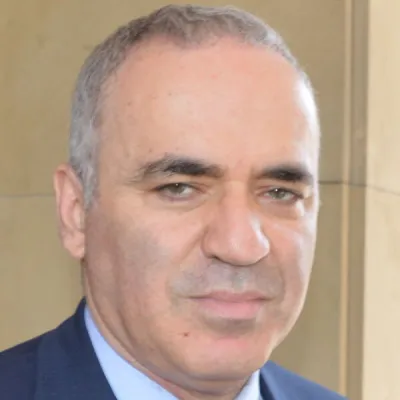
Garry Kasparov
Human Design Chart
Biography
Kasparov became the youngest undisputed world champion in 1985 at age 22 by defeating then-champion Anatoly Karpov, a record he held until 2024. He defended the title against Karpov three times, in 1986, 1987 and 1990. Kasparov held the official FIDE world title until 1993, when a dispute with FIDE led him to set up a rival organisation, the Professional Chess Association. In 1997, he became the first world champion to lose a match to a computer under standard time controls when he was defeated by the IBM supercomputer Deep Blue in a highly publicised match. He continued to hold the "Classical" world title until his defeat by Vladimir Kramnik in 2000. Despite losing the PCA title, he continued winning tournaments and was the world's highest-rated player at the time of his official retirement. Kasparov coached Carlsen in 2009–2010, during which time Carlsen rose to world No. 1.
Garry Kasparov — Projector with Profile 3/5
Projector 3/5 — Design at a Glance
Garry Kasparov's design marked him as someone with a dense, focused aura that shines like a bright flashlight. This energy casts its beam directly onto areas in others that are still in the dark or not functioning optimally. His core ability was to immediately identify errors in systems and bring 'light into darkness' for others.
However, a direct attack on these weak spots would generate resistance, similar to shining a bright light directly into someone's face. The more elegant strategy for his design was to glow pleasantly through his own harmonious example. This made him attractive; others came to him automatically and sought his advice. His essential life task lay in waiting for a respectful and sincere invitation rather than initiating himself.
As a projector, Garry Kasparov did not have a defined Sacral Center, meaning he lacked a constant intrinsic source of life energy. Instead, he experienced phases of high energy and rapid productivity followed by the imperative need for rest periods to prevent burnout. Living according to this design rewarded him with success. Deviating from it sooner or later led to his non-self theme of 'bitterness'. His effectiveness thus depended less on constant effort than on the right timing and acceptance of his specific energetic limits.
Emotional Authority
Garry Kasparov's design inclined towards cyclical decision maturity: he showed himself as someone who did not find clarity in the first impulse but only after emotional waves had subsided. This structure arises from his defined Emotional Authority, carried by the Solar Plexus Center.
In Human Design mechanics, this authority is always prioritized regardless of other defined centers on the chart. For Garry Kasparov, this means that his inner truth did not lie in momentary moods but revealed itself over time. His feelings followed a natural rhythm of ups and downs; what excited him at one moment could appear negative in the next. This fluctuation is not a source of error but a filtering mechanism.
Quick, spontaneous reactions to these initial impressions would have had negative consequences for his design as they only reflected colored snapshots. Instead, his inner logic required patience and conscious distance through 'sleeping on it'. Only when intense feelings subsided and emotional distance was gained did calmness set in for him. This process of multiple checks served to separate transient moods from deeper insight – especially in long-term decisions with significant influence on his life course.
The 3/5 Profile — Martyr / Heretic
Garry Kasparov's design inclined towards acquiring knowledge not through passive acceptance but through active, often risky experimentation. His Profile 3/5, that of the experimenter and hero, defined this dynamic: The Line 3 inside dictated a learning path of 'trial and error'. Mistakes here were no defeats but necessary steps for developing practical competence and assertiveness. This self-earned experience formed the basis for his external impact as a hero (Line 7).
The mechanics of Line 5 describe a projection of wisdom and influence on others, particularly in public spaces or towards strangers. Others tended to see Garry Kasparov's experiences as superior solutions, which endowed him with attractiveness and authority. This role of the competent rescuer flattered his design but also contained vulnerability: If he failed at an experiment before an audience, this projected hero role would crumble, felt especially painful.
His influence worked less through close, private bonds but rather globally and inspiringly. Line 5 brings solutions under the condition of mutual benefit; it shapes generations through the authority of an enlightened father figure (Saturn energy). Garry Kasparov's design thus showed a clear path: first to accept his own failure and learn from it, then use this practical wisdom to attract and lead others. The tension always lay between the private learning process of Line 3 and the high public expectations of Line 5.
Split Definition — Defined & Open Centers
Garry Kasparov's Human Design suggests a tendency towards constant inner tension, driven by the pressure to question and develop concepts. His defined Head and Ajna centers generated a steady mental stream but lacked energy for direct implementation; this pressure primarily served as an inspirational source for others. Simultaneously, his defined Solar Plexus center acted as an emotional authority: decisions were only valid if made at the end of an emotional wave, not in impulsive highs or lows. The also defined Root Center provided constant stress energy and a drive towards forward movement, which had to be guided by strategy to avoid obsessive effort.
The challenge was to patiently endure mental pressure until it showed as inspiring clarity rather than reducing it through hasty actions. At the same time, discipline was required not to make emotional decisions in moments of impulse. The open centers revealed specific vulnerabilities: His open Throat Center tended to feel under pressure and force attention through constant speaking instead of waiting for natural invitations to speak. His open G Center lacked a firm identity; Kasparov tended to orient externally to find direction and love, rather than trust external initiation. His open Heart Center pushed him to prove his worth through promises and competition despite lacking consistent willpower. Finally, his open Sacral Center was vulnerable to overload from borrowed energy of others, leading to exhaustion if he did not listen to his own energy fluctuations. The open Spleen Center made him sensitive to uncertainty and the urge to cling to unhealthy situations for a sense of security.
Channels for skeptical analysis and mystical synthesis.
Garry Kasparov's Human Design suggests an active, skeptical mind that constantly filters patterns to test their consistency. This attitude shapes him as someone who generates mental pressure from instability, which transforms into urgent questions seeking answers. The mechanics behind this are the Logic Channel 63-4 connecting Head Center with Ajna Center. Here doubt is essential: logic can be formulated correctly and still be wrong. The channel requires logical experimentation and proof rather than blind faith; an answer only holds until a consistent, verifiable pattern emerges.
Personally, this showed as the ability to make well-reasoned predictions based on current data with the aim of serving the collective. Garry Kasparov was always tempted to share both the question and the answer regardless of others' interest. Since his mind is not designed to resolve doubts about his own life, unresolved mental pressure could lead to fear if it wasn't alleviated by benefiting others. The pressure served best in being useful to others as this is a collective channel.
Interpersonally, the channel created a pleasant mental connection: Gate 63 wanted to share doubt while Gate 4 enjoyed revealing solutions. This dynamic worked successfully only when strategy and authority determined the right moment for sharing. Additionally, the Synthesis Channel 19-49 linked tribal forms of mysticism through pressure towards sustenance and protection. It pushed towards approach (Gate 19) and rejection of what was not compatible with highest ideals (Gate 49), regulating emotional waves to loyalty and belonging. Additional influences came from Gates like 62 (details, logic) and 32 (continuity, material success), reinforcing his analytical depth and pursuit of stability.
Collective Circuitry — Circuit Signature
Garry Kasparov's Human Design suggests a tendency towards clear separation between strategic intelligence and resource-oriented cooperation. Two complementary but energetically separate circuits shaped his configuration: The Mind Circuit and the Ego Circuit.
The Mind Circuit connected his Head Center with Ajna Center (visual intelligence). This created an 'emotionless ratio' aimed at logic, strategy, and structure to improve things or guide society towards a better future. Energy here is focused and visual, free from emotional conditioning, enabling precise, forward-looking thinking.
Parallel to this, the Ego Circuit, connecting Solar Plexus Center with Root Center, belongs to the tribal group and focuses on cooperation as well as the joint creation of resources. Through the Synthesis Channel (49-19), it was about a balanced relationship between giving and taking - mutual support in the sense of 'today I give, tomorrow you give'. Since this circuit lacks connection to Sacral Center, there is no constant life force; therefore, managing energy pauses for resource creation was central.
The tension lay between individual visual intelligence of the mind and collective traditional resource accumulation through exchange in the Ego Circuit. These two systems existed as separate forces alongside each other: on one side rational future planning, on the other emotional wave movement to stabilize tribal resources via council mechanisms and tactile experiences.
Right Angle Cross of Maya 1
Garry Kasparov's design carries the archetypal structure of the Maya Right Cross 1. This configuration marks a specific energetic alignment within his Human Design chart, without further mechanical details or behavior-related implications being specified in the given material. Since no detailed description of the underlying mechanics—such as involved Gates, Channels, or Centers—is provided, this designation alone does not yield a concrete personality profile or predictable behavioral pattern. The presence of this Cross indicates a particular structural condition whose substantive depth and impact are not elaborated upon in the given context. Without additional information about how this structure functions, the characterization remains at the level of merely naming the archetypal pattern. No assumptions are made regarding Garry Kasparov's behavior, life events, or psychological tendencies as these do not emerge from the provided facts. The analysis strictly confines itself to the established fact of the presence of this specific Cross in his design without filling it with unfounded interpretations.
Saturn Return · Uranus Opposition · Chiron Return · 2nd Saturn Return — Life Cycles
Garry Kasparov's life journey shows a clear structuring through astrological cycles marking phases of maturation and confrontation. The first Saturn return around the age of 27 often brings institutional responsibility. In 1990, at 27 years old, Kasparov left the Communist Party of the Soviet Union and participated in founding the Democratic Party, becoming its deputy chairman – a step that highlights this phase of political positioning.
The Uranus opposition around ages 41 to 42 represents rebellion against established norms and a drive for individual freedom. This was evident in 2004 with his win at the Russian national championship, a success occurring during this period of realignment.
The Chiron return between the ages of 48 and 50 is a fulfillment cycle where one's incarnation cross increasingly manifests in life, making sense if living according to strategy and authority. In 2012, at age 49, Kasparov was arrested during a demonstration against the conviction of members of the punk-rock group Pussy Riot and later released. This event underscores the intensity of this phase of life's mission.
The second Saturn return around the age of 59 deepens institutional confrontation. In 2022, at 59 years old, Kasparov was classified by Russia’s Ministry of Justice as a "foreign agent." These four cycles thus form the structural framework of his public development.
Projector · Emotional Authority — Synthesis
A central red thread runs through the design: the ability to recognize patterns and make them accessible to others (Projector with defined Head Center and Logic Channel). This energy is not passive; it pushes to reveal inconsistencies (Gate 63), then formulate solutions (Gate 4) – a process amplified by Line 3/5 of the Profile: first personal experimentation, then sharing knowledge. The recurring crisis events in the Saturn and Chiron cycles seem to confirm this tendency by highlighting situations where uncovering problems is met with resistance or consequences.
The design reveals a central paradox between the need for recognition as a competent source (Line 5) and the inherent challenge of using that competence (Projector). Recognizing errors in the system (Head Center) leads to insights but can also meet with rejection if communicated without filtering. Emotional authority requires time for judgments to mature, which contrasts with quick analysis and the desire to offer solutions – a constant balancing act between intuitive insight and the need to choose the right timing.
2 Defined Channels
Incarnation Cross - Right Angle Cross of Maya 1
Solar Return
The Solar Return shows the moment when the sun returns to its exact birth position - your personal solar year.
Life Cycles
Discover the life cycles with a detailed triple view (birth chart, cycle chart, composite).
Human Design Profile
- Type
- Projector
- Strategy
- Wait for the respectful invitation
- Authority
- Emotional Authority
- Profile
- 3/5 - Martyr / Heretic
- Definition
- Split Definition
- Incarnation Cross
- Right Angle Cross of Maya 1
- Date of Birth
- 13.04.1963 23:45
- Place of Birth
- Baku, Azerbaijan
Frequently Asked Questions
What is Garry Kasparov's Human Design type?
What Profile does Garry Kasparov have in Human Design?
What Authority does Garry Kasparov have?
What incarnation cross does Garry Kasparov have?
When was Garry Kasparov born?
Discover your own Human Design
Are you also a Projector? Find out in a personal reading how to unfold your leadership qualities and recognize the right invitations.
More Personalities
Back to overviewSissy Spacek

Alain-Fournier

Anémone

Angeli

Ann-Margret

Bourvil