Georg Büchner
Human Design Chart
Biography
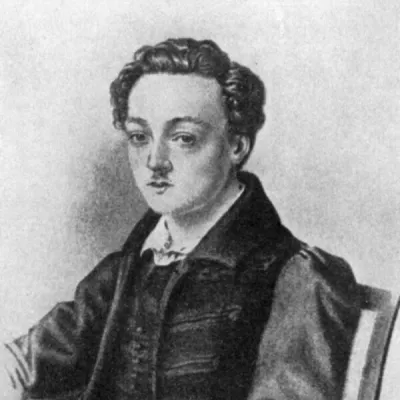
Büchner studied medicine at the Universities of Strasbourg and Giessen. Caught up in the movement inspired by the Paris uprising of 1830, Büchner published a pamphlet, Der hessische Landbote (1834;The Hessian Messenger), in Giessen calling for economic and political revolution, and he also founded a radical society, the Society for Human Rights. He escaped arrest by fleeing to Strasbourg, where he completed a dissertation. This earned him an appointment as a lecturer in natural science at the University of Zürich in 1836.
His unfinished and most famous play, Woyzeck, was notable as a literary work because the main characters were members of the working class. Published posthumously, it became the basis for Alban Berg's opera Wozzeck which premiered in 1925.
He died 19 February 1837, Zürich, of typhoid fever, age 23.
Human Design Analysis: Georg Büchner as Projector 3/5
Projector 3/5 — Design at a Glance
Georg Büchner revealed himself as a Projector whose design was characterized by a specific way of perception and interaction. His aura acted like a focused light beam used to bring 'light into the darkness' for other people, quickly uncovering systematic errors. However, this ability to swiftly identify weaknesses in his surroundings could be perceived as unpleasant when directly addressed – similar to shining a bright light straight into someone's face.
The optimal strategy for his design was to wait for a respectful and sincere invitation from others rather than taking the initiative independently. Due to his undefined sacral center, Georg Büchner did not have a constant intrinsic source of life energy. Instead, he experienced phases of high activity followed by necessary rest periods to prevent burnout. The traditional school system and most work structures of his time barely accommodated this need for rhythm.
If Georg Büchner lived in accordance with his design, he was rewarded with success. However, if he deviated from this strategy or ignored waiting for invitations, it would eventually lead to his non-self theme: bitterness. His character trait was thus less defined by continuous energy production than by the ability to guide others and penetrate their systems – provided that he received the appropriate recognition and invitation from outside.
Splenic Authority
Georg Büchner demonstrated decision-making based on a fine, physical alarm and health system. His inner authority lay in his defined Spleen Center while his Emotional and Sacral Centers were open – a configuration unique to Projectors or Manifestors. This structure endowed him with pronounced survival intelligence: spontaneous internal knowledge about whether a situation, environment, or society was healthy for him or not. His instinct and physical well-being served as reliable indicators for the right choice.
Decisions had to be made in the moment; the first, spontaneous impulse was the correct way to protect himself rigorously against harmful influences. However, this Spleen impulse was very subtle and only appeared once at the moment. It could easily be ignored or drowned out by other voices, requiring high vigilance. Sometimes a brief retreat helped to hear this fine voice clearly.
Since what was right became apparent in each moment, plans could change short-term. Long-term commitments were difficult and often counterproductive. Instead, Georg Büchner needed much freedom and flexibility in his life. He had to commit as little as possible to do justice to the spontaneous nature of his authority and prioritize his health and well-being.
The 3/5 Profile — Martyr / Heretic
Georg Büchner revealed himself as someone who learned through personal experimentation to later help others. His design tended towards initially not believing anything prescribed but testing everything practically – a hallmark of an experimenter (Line 3). This self-acquired knowledge then served to solve other people's problems, giving him the role of helper or rescuer (Line 5). This combination created a strong attraction in his environment that wanted to learn from his experiences.
However, this configuration also brought specific challenges with it. The third line in his chart highlighted a lack of continuity and indecision. During times of change, this could lead to a loss of instinct or changes happening too late. At the same time, the fifth line demanded absolute clarity about details. Büchner had to think everything through and repeat it until it was perfect before presenting it externally. This necessity to work on nuances in darkness stood in contrast to his environment's expectation for attention to his orderly solutions. Failing in front of others could therefore be particularly painful since the hero role was strongly tied to his own reputation.
Split Definition — Defined & Open Centers
Georg Büchner revealed himself as someone with a fixed, reliable self-identity and a clear sense of direction. His defined G Center gave him a deep feeling of connection and the ability to guide others on new paths without being unsure himself. This inner stability was complemented by his defined Spleen Center, which provided him with spontaneous, intuitive intelligence in the present moment. He had an instinct for perceiving what was healthy for his survival and well-being, allowing him to make trustworthy judgments without having to rationalize them. His defined Root Center supplied the physical pressure and energy needed to move forward in the world, channeling this stress in a specific way. His communication, guided by the defined Throat Center, was a consistent expression of these inner sources; he spoke or acted with a clear, honest voice that emerged directly from his identity and intuitive knowledge.
In contrast, his open centers revealed themselves as fields sensitive to external influences. His open Head Center made him vulnerable to mental pressure and confusion; he tended to get entangled in questions not originating from himself and sought inspiration to quiet this inner noise. The open Ajna Center meant that his mental awareness was flexible but also that he could take on concepts and opinions of others without always identifying them as his own truth. His open Heart Center lacked a constant willpower; he was not designed to be competitive or keep promises to prove his worth, making him vulnerable to self-doubt when trying to meet expectations. The open Sacral Center lacked a consistent energy level; he absorbed the vital energy of his environment and amplified it, often running on borrowed power and risking exhaustion as he did not have his own constant source of generative life force. Finally, his open Solar Plexus absorbed the emotions of others, leading him to oscillate between happiness and depression without always recognizing these feelings as his own.
Channels for leadership, reflection and transformative ambition.
Georg Büchner showed himself as someone who sought logical leadership but only acted when invited by his community. This stemmed from the Alpha Animal Channel 7-31, which defined collective authority through understandable patterns and trust; his voice gained influence by steering the future from a position of recognized competence, not through coercion. Parallel to this, he gathered experiences with great patience to share them later as deep truths. The Lost Son Channel 13-33 connected listening and storing secrets with withdrawal for reflection; this process of maturation allowed him to pass on complex connections only after thorough processing, bringing continuity into the development of his environment. Another drive was the ambition to improve his position through constant effort and support the tribe. The Transformation Channel 54-32 urged him to recognize talents and work up through loyalty; this instinct sought support to make change sustainable and secure the existence of the collective.
Additionally, specific Gates shaped his attitude: Gate 62 demanded logical precision and pattern recognition while Gate 61 described the struggle for inner peace and individual knowledge. The evolutionary development through crises (Gate 41) and the ability for abstract storytelling (Gate 56) rounded off his mental profile. Protective reflexes and traditional values (Gate 50) as well as resistance for personal integrity (Gate 38) created boundaries that preserved his identity. Finally, he sought secure resources and spiritual connections within his community (Gate 19), emphasizing his need for reliable structures.
Collective Circuitry — Circuit Signature
Georg Büchner's design laid a tendency towards separated but parallel processing of intellectual clarity and emotional reflection. His Split Definition meant that he did not act as a continuous energetic flow but consisted of two independent power zones that did not communicate directly with each other.
The Understanding Circuit connected his Throat Center to the Identity Center through the Alpha Animal Channel. This shaped an ability for logical, emotionless analysis and strategic structuring aimed at future improvements. Parallel to this, the Meaning Circuit also between Throat and Identity linked by the Lost Son Channel was active; here stood the cyclic processing of past experiences in focus; emotional waves from history were reflected and shared to learn collectively. Both circuits used the same centers but generated different qualities: cold ratio versus felt past.
Regardless of that, a third area existed: The Ego Circuit connected Spleen and Root Center through the Transformation Channel. This concerned intuitive perception of resources and handling pressure or fear, separate from the communicative aspects of the other two circuits. Georg Büchner thus revealed himself as someone experiencing rational future planning, emotional past processing, and instinctive resource security as separate, non-intersecting processes.
Right Angle Cross of Maya 3
George Büchner's design suggests a tendency towards profound, often fateful turning points. His chart contains the configuration of the right cross of Maya 3. This structure does not mark an everyday trait but rather a specific archetypal pattern within Human-Design mechanics. It indicates life phases where external circumstances or internal constraints could lead to radical changes. For George Büchner, this meant that his path was not linear but characterized by sudden breaks and new beginnings. The energy of this cross often acts as a catalyst: it forces confrontation with reality when old structures fail. This was a dynamic force that dissolved stability to make way for new, often unexpected directions. Thus, George Büchner emerged as someone whose development was shaped by such intense transitional phases. The mechanics of the right cross of Maya 3 describe precisely this process: the old must fall so that the new can arise. For him, this did not happen gently but with the intensity of a necessary upheaval. His life energy followed this rhythm of dissolution and rebirth. Each such phase brought a deeper level of truth to light, even if it was painful. George Büchner's design challenged him to embrace these moments as part of his evolutionary path rather than resist them. The power of this cross lay in its ability to break through stagnant states and enforce new perspectives.
Projector · Splenic Authority — Synthesis
Georg Büchner was a Projector whose life seemed to be marked by a deep-seated drive to perceive patterns and imbalances in his surroundings (Projector Design). This ability to recognize "errors in the system" (Throat Center) went hand in hand with a natural tendency towards leadership through logic and structure – the channel of Alpha, which connects Identity and Throat Centers. He seemed repeatedly called upon to reveal hidden truths and transform them into understandable forms to make them accessible to others. This did not happen through direct confrontation but rather through the subtle "shining" of his own harmonious stance (Projector Strategy).
A central paradox in Büchner's design lay in the tension between a desire for recognition of his insights – Line 5 of Profile points towards a Hero role – and the need to protect himself from the consequences of failure (Line 3). He apparently experimented intensively to gain firsthand knowledge, yet the public presentation of these insights always carried the risk of not being understood or even rejected. This oscillation between the urge to effect change and the resulting vulnerability shaped his work.
3 Defined Channels
Incarnation Cross - Right Angle Cross of Maya 3
Solar Return
The Solar Return shows the moment when the sun returns to its exact birth position - your personal solar year.
Life Cycles
Discover the life cycles with a detailed triple view (birth chart, cycle chart, composite).
Human Design Profile
- Type
- Projector
- Strategy
- Wait for the respectful invitation
- Authority
- Splenic Authority
- Profile
- 3/5 - Martyr / Heretic
- Definition
- Split Definition
- Incarnation Cross
- Right Angle Cross of Maya 3
- Date of Birth
- 17.10.1813 05:30
- Place of Birth
- Goddelau, Germany
Frequently Asked Questions
What is Georg Buchner's Human Design type?
Which Human Design Profile did Georg Buchner have?
What authority did Georg Buchner possess?
Which incarnation cross did Georg Buchner have?
When was Georg Buchner born?
Discover your own Human Design
Are you also a Projector? Find out in a personal reading how to unfold your leadership qualities and recognize the right invitations.
More Personalities
Back to overviewSissy Spacek

Alain-Fournier

Anémone

Angeli

Ann-Margret

Bourvil