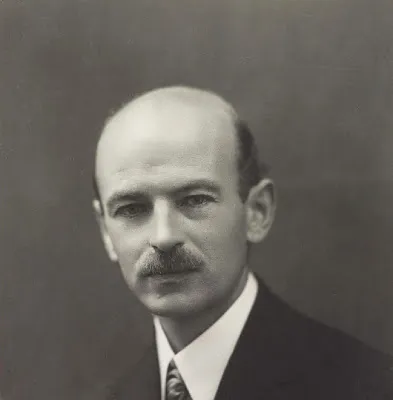
Georges Ribemont-Dessaignes
Human Design Chart
Biography
In addition to numerous early paintings, Ribemont-Dessaignes wrote plays, poetry, manifestos and opera librettos. He contributed to the Dada (and later surrealist) periodical Literature.
Among Ribemont-Dessaignes' works for the theater are the plays The Emperor of China (1916) and The Mute Canary (1919), and the opera libretti The Knife's Tears (1926) and The Three Wishes (1926), both with music by Czech composer Bohuslav Martinů. His novels include L'Autruche aux yeux clos (1924), Ariane (1925), Le Bar du lendemain (1927), Céleste Ugolin (1928), and Monsieur Jean ou l'Amour absolu (1934).
He died on 9 July 1974.
Georges Ribemont-Dessaignes as a Manifestor 1/3 in Human Design
Manifestor 1/3 — Design at a Glance
Georges Ribemont-Dessaignes emerged as a pioneer and visionary whose design aimed to lead the world into a new future. His Human Design characterized him as a Manifestor, a type that acts similarly to an emperor in ancient Rome: he had the vision of a great empire but did not fight the necessary wars and battles himself. Instead, he sent others to conquer foreign lands for him. This role came with a specific pain body: Georges Ribemont-Dessaignes was often misunderstood because he thought ahead of others, and he polarized strongly. His great dreams were loved by some who followed him, but hated by others precisely because of these visions. For the right followers to find him, it was crucial for him to inform others timely and accurately about his plans. This formed the ideal strategy for his design. If Georges Ribemont-Dessaignes lived by this strategy and his authority, he was rewarded with a sense of inner peace. If he acted against his design, he instead felt a persistent, deep anger. His life task was to minimize resistance through clear information and to let his visionary power take effect without getting entangled in conflicts resulting from lack of communication.
Splenic Authority
Georges Ribemont-Dessaignes showed a decision-making process based on a fine, spontaneous inner impulse. His design placed authority in the Spleen Center, meaning his health and alarm system directed the course. This configuration required both the Emotional and Sacral Centers to be open; only Projectors or Manifestors can possess this specific authority.
His inner voice served as survival intelligence. It provided a clear signal at the moment of decision whether a situation, environment, or society was right for him. This first impulse served his physical well-being directly and allowed him to rigorously distance himself from harmful influences. Since this impulse was very fine and only occurred once in the moment, it required high vigilance not to miss it or have it drowned out by external influences. A brief retreat could be helpful in decision-making.
Since Georges Ribemont-Dessaignes could only know what was right for him in the concrete moment, his plans often changed at the last minute. Long-term commitments were therefore difficult. His design promoted flexibility and freedom; he acted best when he did not commit himself too much and reacted spontaneously to the given circumstances. This structure shaped his life through constant adaptability and a protection mechanism that relied on immediate intuition rather than long-term strategies.
The 1/3 Profile — Investigator / Martyr
Georges Ribemont-Dessaignes was someone who combined theoretical knowledge and practical action inseparably. His design as Profile 1/3, the Researcher and Experimenter, established a basic attitude based on learning through trial and error. Line 1 drove him to deal intensively with fundamentals and duties, often with the concern of not knowing enough before acting. At the same time, Line 3 demanded direct experimentation in the here and now, with errors being seen as indispensable teachers.
This dynamic created a tension between the fear of inadequate preparation and the urge to simply act. Success was not his primary goal but a byproduct of authentic, sensitive living. His judgments were therefore particularly valuable, as they had stood the test of both theoretical scrutiny and practical validation. When Georges Ribemont-Dessaignes evaluated something as good, he had previously tested it thoroughly. He had to endure shocks and failures to recognize that innocent action alone did not guarantee success. This configuration marked him as someone who worked out his insights through his own actions and verified them through experience, rather than relying on dogmas. His life task was to uncover hidden connections through his own actions and share these verified truths with others.
Single Definition — Defined & Open Centers
Georges Ribemont-Dessaignes revealed himself as someone with a reliable, clear voice and a strong sense of personal identity. His defined Throat Center ensured that he conveyed messages from his inner self consistently and honestly outward, without wavering. This expressive ability was rooted in his defined G Center, which gave him a firm self-love and a clear inner direction. He knew who he was and could guide others on their path without being dependent on them. Additionally, he had a defined Heart Center, which endowed him with willpower and the ability to keep promises and control his own resources. He enjoyed working autonomously and sought recognition for his contribution, using his ego strength purposefully to achieve his goals. His defined Spleen Center rounded out this profile by giving him spontaneous, intuitive intelligence in the present moment. He trusted this physical warning and his immune system to stay healthy and well, rather than relying on rational thought.
At the same time, Georges Ribemont-Dessaignes was marked by several open centers, making him vulnerable to external influences. His open Head Center often left him struggling with mental pressure and doubts, as he lacked a steady source of inspiration and was easily overwhelmed by the questions of others. His open Ajna Center also meant that he absorbed concepts and ideas from the environment rather than generating them consistently, which could lead to confusion if he identified with these foreign thoughts. His open Sacral Center made him susceptible to the energy of others; he tended to overextend himself by using borrowed life force rather than listening to his own, fluctuating energy flow. His open Solar Plexus Center caused him to absorb and amplify emotions from the environment, leading him to fluctuate between joy and depression without recognizing these waves as his own. Finally, his open Root Center absorbed the stress of the environment, pushing him to become hyperactive to escape this pressure, even though the stress did not originate from him.
Channels for intuitive elegance, presence, clarity and love.
Georges Ribemont-Dessaignes revealed himself as someone whose survival and expression were based on a deep, intuitive self-love and the ability to act in the absolute present moment. His design inclined him towards spontaneous, authentic presence driven by inner clarity, not external validation.
This attitude was shaped by the Awakening Channel 10-20, which connected his G Center with his Throat Center. It allowed him to transform his individual knowledge directly into appropriate action, guided by an underlying code that ensured successful interactions. This was not a conscious strategy but a natural state of awakening, where his mere presence and self-confidence inspired others to be themselves.
Parallel to this, the Channel of Perfect Form 57-10 linked intuitive insight from the Spleen with the self-behavior in the G Center. This endowed him with a rare ability to act spontaneously and appropriately to perfect his physical well-being and unique form. He acted not out of fear of the future but from a deep, acoustic sensitivity to the quality of his environment, allowing him to existentially and unburdenedly traverse the world.
The connection of these two channels in the Brainwave Channel 57-20 strengthened this dynamic. Here, his intuitive insight gained the clearest voice in the present. His verbal outbursts were often pure intuition, finding the core of a matter faster than reflective analysis. This served to encourage others to awaken their own inner survival intelligence by speaking the truth of his moment.
Additionally, the Initiation Channel 51-25 carried a competitive energy, yet it was connected to the universal love of the Higher Self. It awakened and reinforced individualization in others, often through the 'shock' of confronting their uniqueness. This was a mystical process of mutation, enabling him to survive transcendent encounters and change the collective through his authentic example.
Individual Gates like 15 (collective rhythm), 46 (surrender in the present), and 16 (experimentation) supported this structure by helping him adapt to natural flows and gain mastery through continuous experimentation.
Individual Circuitry — Circuit Signature
Georges Ribemont-Dessaignes revealed himself as someone whose inner convictions and creative mind worked in a clear, coherent structure. His design was simply defined, meaning all his energetic centers – Throat, Spleen, Identity, and Heart – were directly connected to each other. There were no separate, isolated energy fields; instead, energy flowed through the entire system as a single, coherent unit.
The Knowledge Circuit connected his Throat Center with his Spleen through the Flash of Insight Channel. This enabled innovative, creative insights that were directly translated into expression. The Spleen provided the intuitive knowledge and creativity that emerged through the Throat as new ideas or words into the world.
Simultaneously, the Centering Circuit, which connected his Identity Center with his Heart Center through the Initiation Channel, strengthened his self-worth and firm convictions. As these centers were connected to the rest of the system, these inner values shaped his entire expression.
The Integration Circuit completed this picture. It connected Throat, Identity, and Spleen through the Awakening and Perfect Form Channels. Here, it was about drawing strength from the reaction to life, guiding it through proper stance and intuitive perception, and expressing it in the present moment.
Together, these circuits painted a picture of a person who combined their unique, intuitive insights (Spleen) with strong inner convictions (Heart/Identity) and carried them outward coherently, at the right moment (Throat). The energy was pulsing and acoustic, always focused on expressing individuality and initiating change through new, creative input.
Right Angle Cross of the Vessel of Love 2
Georges Ribemont-Dessaignes had the design of the right cross of the Vessel of Love. This configuration established a specific energetic structure oriented towards deep emotional connection and the protection of loved ones. His Human Design described a nature capable of holding and transforming intense feelings without losing its own identity.
The right cross of the Vessel of Love marks a person who can act as an emotional anchor for their environment. Georges Ribemont-Dessaignes demonstrated through this mechanism someone who was able to feel and carry the emotions of others without being overwhelmed by them. This was not passive receptivity, but an active, structured ability to foster love and emotional security.
His energy work consisted of being a safe vessel for emotional currents. Georges Ribemont-Dessaignes lived this role by offering stability in interpersonal relationships. The design challenged him to clearly define his own emotional boundaries to provide others a space of safety. He was not there to solve other people's problems, but to give them a place where they could feel grounded. This structure shaped his work as someone who acted through presence and emotional reliability without losing his own center.
Saturn Return · Uranus Opposition · Chiron Return · 2nd Saturn Return — Life Cycles
Georges Ribemont-Dessaignes’ design set a tendency towards structural consolidation and later, mature unfolding. This dynamic was concretely visible in his first Saturn Return in 1915, at the age of 31. In this cycle, years of groundwork often condensed into solid results; for him, this manifested in the completion of his military service. This step marked a phase of discipline and the establishment of boundaries, a typical Saturn task that creates stability.
Ten years later, in 1924, the Uranus Opposition occurred. At 40 years old, Georges Ribemont-Dessaignes faced a deep transformation phase, where old structures were broken to make way for new impulses. This pressure towards change and liberation culminated in the success of the publication of the novel “L'Autruche aux yeux clos”. It was a moment of explosive creativity that broke through the previous stability.
The peak of this development was the Chiron Return in 1934. At 50 years old, he entered a phase of blooming and fulfillment of his incarnation purpose. If he had lived according to his strategy, his life's meaning was now experiential. This was evident in the publication of “Monsieur Jean ou l'Amour absolu”. This novel was not just a product, but an expression of a mature, self-realizing power that carried the inner core of his design outward.
Manifestor · Splenic Authority — Synthesis
Georges Ribemont-Dessaignes was a Manifestor whose life was marked by a strong drive towards initiation and an unconventional path. The connection of the Manifestor Center and the Awakening Channel (10/20) points to a person who not only had visions but also brought them into the world – often against existing norms. The Profile as Researcher/Experimenter (1/3) reinforced this impulse by nurturing a deep need for personal experience and testing of concepts before communication. The authority in the Spleen underscored the importance of spontaneous, intuitive knowledge as a compass for decisions, indicating a person who strongly relied on gut feelings and distanced themselves from external influences to find their own inner truth.
A central paradox in his design lay in the tension between the drive to be a pioneer and explore new paths (Manifestor) and the necessity to validate these paths through personal experience (Researcher/Experimenter). While the Manifestor tended to act quickly and initiate, the profile required thorough testing and gathering of evidence before sharing insights. This dynamic may have led to phases of intense research, followed by bold but well-considered steps that embodied both innovation and stability.
4 Defined Channels
Incarnation Cross - Right Angle Cross of the Vessel of Love 2
Solar Return
The Solar Return shows the moment when the sun returns to its exact birth position - your personal solar year.
Life Cycles
Discover the life cycles with a detailed triple view (birth chart, cycle chart, composite).
Human Design Profile
- Type
- Manifestor
- Strategy
- To inform others before acting
- Authority
- Splenic Authority
- Profile
- 1/3 - Investigator / Martyr
- Definition
- Single Definition
- Incarnation Cross
- Right Angle Cross of the Vessel of Love 2
- Date of Birth
- 19.06.1884 16:00
- Place of Birth
- Montpellier, France
Frequently Asked Questions
What was Georges Ribemont-Dessaignes' Human Design type?
What profile did Georges Ribemont-Dessaignes have?
What authority did Georges Ribemont-Dessaignes have?
What incarnation cross did Georges Ribemont-Dessaignes have?
When was Georges Ribemont-Dessaignes born?
Discover your own Human Design
Are you also a Manifestor? Find out in a personal reading how to use your initiation power peacefully and dissolve resistance.
More Personalities
Back to overviewAlain-Fournier

Angeli

Christian-Jaque

Juninho

Kesha

Lucebert