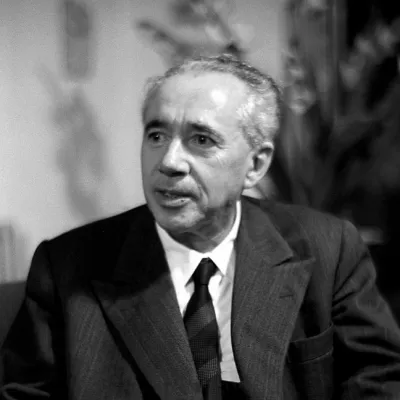
Photo: Wikimedia Commons
Giulio Natta
Human Design Chart
Biography
He was the son of a prominent Italian judge. His wife was a literature professor and they had two children.
Natta died on 2 May 1979.
Giulio Natta — Generator with Profile 2/4
Generator 2/4 — Design at a Glance
Giulio Natta possessed the characteristic endurance of a Generator, who unleashed his power not through spontaneous initiatives but through reactive actions. His design dictated that he waited for signals from his environment before acting. This 'reacting' was the key to his efficiency: as soon as an impulse came and his sacral center – the motor of his energy – signaled a clear 'yes', he could work with immense intensity and consistency. He functioned like a strong workhorse that could only call upon its full power when it did not dictate the path itself but responded to a clear request.
This mechanism protected him from energy depletion. If he had done things that did not resonate internally, his strength would have quickly been exhausted. Instead, he sought tasks that felt right from his gut. By following this strategy, he responded to life's offers with a deep, lasting satisfaction. His success lay in not swimming against the current by initiating where no response came, but waiting until life called, then answering with full power. This way, he avoided the typical frustration that arises when working against one's design and instead found a steady source of inner fulfillment in his work.
Emotional Authority
Giulio Natta showed himself to be someone who did not make decisions on the first impulse but let them ripen over time. His design carried emotional authority, meaning his defined emotional center held the lead in all decision-making processes. Regardless of which other centers were defined in his chart, this emotional level always took precedence.
This mechanism generated an inner dynamic of wave-like emotional movements. Natta experienced the world always colored by his current mood, which showed in a constant up and down. A moment of enthusiasm could quickly be replaced by a negative assessment of the same thing. Since the immediate feeling was merely a snapshot and no guaranteed truth, spontaneous reactions to these first impressions often led to wrong decisions.
Instead, he used time as a crucial tool. By hesitating and 'sleeping on' decisions multiple times, he gained emotional distance. As time passed, the intense feelings subsided, leading to clarity and calm. This process was indispensable for him to carry out long-term, life-defining steps with the necessary depth and prudence, rather than being led by fleeting mood swings.
The 2/4 Profile — Hermit / Opportunist
Giulio Natta showed himself to be someone who lived in a constant interplay between a deep need for withdrawal and the urge to connect with his closest people. His design laid a tension that resulted from Profile 2/4: on the one hand, the necessity to be alone to gain inner clarity, on the other hand, the desire to spend time with a chosen community. For him, it was crucial to create a safe environment where he could clearly communicate when he sought company and when he wanted to be undisturbed. In his 'me-time', he immersed himself in internal processes to find calm. Only after this need for solitude was satisfied did he emerge from his 'cave' to meet his favorite people. This structure allowed him to reflect on the knowledge of his network during his alone time and develop brilliant ideas from it. Line 2 emphasized individual responsibility within an organic community and the need to work undisturbed, while Line 4 focused on externalization and influence, which often under stress resulted in disciplined detail work. Giulio Natta used this dynamic to navigate between spiritual or familial connection and individual reflection, learning to belong to find resources.
Split Definition — Defined & Open Centers
Giulio Natta was revealed through a design that conveyed a deep, inherent stability and a clear inner direction. His defined G Center gave him a reliable sense of self-identity and the feeling of being lovable without being dependent on others. This allowed him to provide natural orientation to others without needing to direct them. Parallel to this, he possessed a strong will and a drive to determine his life and resources for himself through his defined Heart Center. He could keep promises and recognize his own worth, which helped him act as an independent agent who used his energy purposefully.
His life energy was fueled by his defined Sacral Center, a constant source of vitality that was, however, dependent on reaction. Only by waiting for invitations could he unleash his full power and avoid frustration. Emotional decisions were subject to the authority of his defined Solar Plexus Center; here it was important to give the emotional wave time to reach clarity rather than acting impulsively. His defined Spleen Center provided a sharper instinct and a strong body awareness that protected him in the "now" and helped him recognize what was correct for his well-being. The defined Root Pressure propelled him forward by transforming stress into existential alertness and survival energy.
In contrast, his Head, Ajna, and Throat Centers were open. The open Head Center meant that he did not have a constant mental focus and was vulnerable to getting entangled in the questions or confusion of others rather than trusting his own inspiration. His open Ajna Center made his mind flexible but tended to adopt foreign concepts or opinions as his own truth if he did not listen to his inner authority. The open Throat Center led to his inability to communicate consistently; he tended to feel pressured to gain attention or to remain silent when no invitation was present. These open centers required him to not try to force mental or communicative control but to let situations arise in which he could speak and think authentically.
Channels for intuitive power, community and authentic being.
Giulio Natta revealed himself through a deeply rooted ability to use his individuality and self-love as a central driving force. This attitude stemmed from the Channel of Exploration 34-10, which connected the Sacral Center with the G Center. Gate 34 provided the inner strength to hold onto personal convictions, while Gate 10 initiated behavior from the deepest inner self to honor himself. Natta lived this energy not through imposition, but through pure reaction to his environment, allowing him to act authentically and independently.
Parallel to this, the Channel of Perfect Form 57-10, which linked the Spleen Center with the G Center, was also influential. Here, Gate 57, with its intuitive insight and acoustic sensitivity, supported the behavior initiated by Gate 10. This allowed Natta to be guided moment by moment by deep, spontaneous impulses, to let go of unfounded future anxieties, and to secure his survival in the present through a perfect adaptation of his form. His creativity was distinct from pure intellect or emotional sensitivity; it was existential and unburdened.
In the personality domain, the Channel of Recognition 30-41 and the Channel of Community 37-40 shaped his inner dynamics. The Channel 30-41 connected the root drive of Gate 41 with the emotional wave of Gate 30, creating a strong desire for new experiences and deep emotional processing. At the same time, the Channel 37-40 demanded a careful weighing of relationships and community bonds, with Gate 40 emphasizing the need for pauses and rewards, while Gate 37 sought recognition.
Additionally, Gates like Gate 9, with its attention to detail and taming power, and Gate 16, with its mutative experimental drive, contributed to refining his abilities. Gate 51 brought a strong willpower that could react to shocks, while Gate 36 used cyclical crises as a driver of development. This combination created a profile marked by intuitive presence, detailed perfection, and a deep, emotional search for experience.
Individual Circuitry — Circuit Signature
Giulio Natta appeared as a person with a firm inner core, whose actions were marked by a clear, individual identity. His design featured a Split Definition, meaning that two energetically separate power blocks existed parallel to each other without directly merging. The first block connected the Sacral with the Identity Center. Here, the Projector Circuit operated through the Channel of Exploration. This gave him the ability to explore his inner truth and strengthen himself. At the same time, he integrated intuitive impulses from the Spleen, leading to a high sensitivity for the "now." This connection strengthened his self-esteem and fostered a brave, individualistic attitude, even though his outward expression often remained reserved, as the Throat Center was not included.
The second, independent block encompassed the Solar Plexus, Heart, and Root Centers. Here, the Manifestor and Personality Circuits were active. The Channel of Perception linked emotional waves from the Solar Plexus with the stress energy of the Root Center. This enabled him to reflect on past experiences and learn from them to share insights. Simultaneously, the Channel of Community connected the Heart with the Solar Plexus Center. This promoted cooperation and mutual support based on fair give and take. Since there was no direct connection to the Sacral Center, he needed pauses to regenerate resources for these social interactions. Both blocks worked side by side: one for inner strength, the other for emotional and social dynamics.
Right Angle Cross of Planning 1
Giulio Nattas Human-Design profile indicated a tendency towards structured, long-term planning. He was someone who did not react to spontaneous impulses but carefully prepared his steps. This attitude stems from the mechanics of the right planning cross. It is a configuration that promotes strategic thinking and the ability to foresee complex processes in advance. Giulio Natta lived with this inner architecture, which helped him reduce uncertainties through clear intentions. Instead of being driven by external environments, he oriented himself to an internal rhythm of preparation. This did not mean that he was rigid, but rather that he valued thoroughness. His energy flowed more efficiently when he knew where he was going. The right planning cross gives an inner map that allows early recognition of obstacles and finding paths that lead to the goal. Giulio Natta used this gift to maintain a certain stability in his life and work. He sought solutions that were not just short-term but sustainable. This kind of planning created a space of security in which he could make decisions without being overwhelmed by the unpredictability of the world. It was a quiet but powerful presence marked by clarity and intention.
Saturn Return · Uranus Opposition · Chiron Return · 2nd Saturn Return — Life Cycles
In the 1960s, Giulio Natta was in a phase of highest confirmation that coincided with his second Saturn return. In 1963, at the age of 60, he received the Nobel Prize in Chemistry together with Karl Ziegler. This was no coincidence but the typical expression of this astrological cycle: The second Saturn return often marks the peak of material and professional achievements after years of disciplined work and structuring have borne fruit.
For his Human-Design, this period marked the culmination of a long journey of integration. The energy he had previously invested in his field now condensed into a solid, widely recognized result. The Nobel Prize served here as an external proof of his inner maturity and consistent alignment with his life's mission. It was the moment when the previous groundwork manifested in a socially visible form - not as a sudden stroke of luck, but as a logical consequence of a long-term, strategic alignment. This phase underscored how his design aimed at the ability to transform complex connections not only into understanding but into stable, applicable structures that then found their highest appreciation.
Generator · Emotional Authority — Synthesis
Giulio Natta lived deeply in the tension between inner clarity and emotional depth. His design as an emotional generator (Sacral Center defined) points to a person who, although possessing immense endurance and energy, was bound to the rhythmic wave of his feelings. Decisions matured over time to recognize the inner truth, while the sacral energy (Channel 34-10) propelled him to explore and perfect his behavior and self-acceptance in the world. This connection of inner strength and emotional sensitivity shaped his work approach and his pursuit of confirmation.
A central paradox in his chart lay in the interaction between the need for withdrawal and the desire for community (Profile 2/4). He needed phases of inner reflection to gain clarity and focus his energy, yet at the same time, he sought connection and exchange with others. This led to a constant oscillation between self-discovery and social interaction, with the recognition of his behavior (Gate 10) by others playing a crucial role. The success that was evident in documented events could only be achieved when these inner needs were reconciled.
5 Defined Channels
Incarnation Cross - Right Angle Cross of Planning 1
Solar Return
The Solar Return shows the moment when the sun returns to its exact birth position - your personal solar year.
Life Cycles
Discover the life cycles with a detailed triple view (birth chart, cycle chart, composite).
Human Design Profile
- Type
- Generator
- Strategy
- To respond - wait for something to respond to
- Authority
- Emotional Authority
- Profile
- 2/4 - Hermit / Opportunist
- Definition
- Split Definition
- Incarnation Cross
- Right Angle Cross of Planning 1
- Date of Birth
- 26.02.1903 17:30
- Place of Birth
- Imperia, Italy
Frequently Asked Questions
What was Giulio Natta's Human Design type?
What Profile did Giulio Natta have in Human Design?
What Authority guided Giulio Natta?
What incarnation cross did Giulio Natta have?
When was Giulio Natta born?
Discover your own Human Design
Are you also a Generator? Find out in a personal reading how to use your sacral energy correctly and discover deep satisfaction.
More Personalities
Back to overviewAaliyah

Alexia

Angèle

Anne-Marie

Arcángel

Arno