
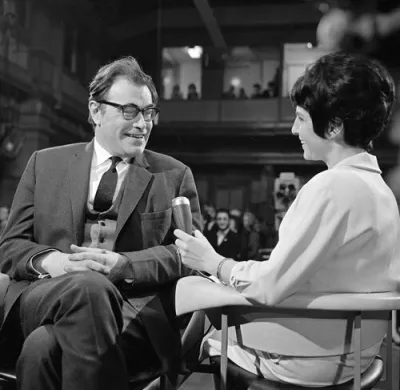
Godfried Bomans
Human Design Chart
Biography
Bomans was the fourth child of a dominant father, the Catholic writer, lawyer and politician Johannes Bernardus (Jan Bernhard) Bomans (1 May 1885, Amsterdam - 20 March 1941, Heemstede) and Arnoldina Josina Oswalda Reynart (19 Dec 1883 Rotterdam- 2 Dec 1955 Heemstede). His parents married 9 July 1908 in Rotterdam and got seven children. Their second daughter (1911) and third son (-1921) died at very young age. Being the eldest living son, Bomans was in the Dutch Catholic tradition expected to become a priest or at least do the will of his father, but he took a another route and became a beloved Dutch fairy tale writer.
Bomans was born in Den Haag but he spent his youth in Haarlem, where his father started a lawyers practice in 1913 when he was a several months old. Haarlem was also the city where his grandfather Johannes Michiel Bomans (22 Jan 1850 Schiedam -19 July 1909, Den Haag) was head of the daily newspaper Haarlems Dagblad.
Bomans visited the Catholic Trinity Lyceum in Overveen (Sept 1926-5 July 1933). He was as a youngster active in school papers, and studied Law from Sept 1933 till 1939 at the University of Amsterdam (UvA). He got his "Kandidaats" exam Law 4 July 1936, but he was not the serious Law student his father wished him to be. As he was more interested in Letters. In 1932 he released poetry and proza in "Het Venster". Under the pseudonym Bernard Majorick he wrote in 1932 "Drijfjacht en Gebed voor Nederland" and historical drama "Bloed en liefde".
He became a member of Catholic student association "Saint Thomas van Aquino". Summer 1936 he decided to step out of urban life to become a member of the Monastery "Monte Olivete" in Italy, but before he could enter the monastery he became physically ill and doubted a lot.
Godfried Bomans as a Manifesting Generator 6/2 in Human Design
Manifesting Generator 6/2 — Design at a Glance
Godfried Bomans was someone who could achieve results quickly by skipping steps. His Manifesting Generator design combined the constant energy of the Sacral Center with the ability to directly implement ideas. This hybrid configuration allowed him to pull things into his life rapidly, but differed from pure Generators due to this manifesting component.
The challenge lay in speed: Often he acted too quickly and skipped important intermediate steps. This forced him later to backtrack and fill gaps, causing frustration – the specific non-self theme of this type. Additionally, he tended to tackle multiple projects simultaneously, driven by various impulses. Without inner consent, his creative drive risked turning into exhaustion.
Deep satisfaction arose for him only in the 'play mode'. Crucial was not initiating but reacting to external impulses and then acting when the Sacral Center gave a clear 'yes'. With correct application of this strategy, he benefited from variety. The pressure to finish one thing before starting another did not suit his nature. Instead, he drew strength from parallel work and enjoyment of the process as long as he was guided by inner confirmation.
Emotional Authority
Godfried Bomans always needed time to gain clarity when making decisions. His design featured emotional authority, meaning his defined Emotional Center set the compass for his inner truths. Regardless of other defined centers in his chart, this authority always took precedence; it was the central mechanism through which he found orientation.
This center operated under a constant emotional wave with steady ups and downs. Godfried Bomans saw the world colored by his current mood. What appeared inspiring at one moment could seem negative the next. His immediate feeling was merely a snapshot, an initial impression that did not necessarily reflect his deepest truth yet. Quick, spontaneous decisions based on such emotion often risked negative outcomes due to their fleeting nature.
The mechanics of his design required patience and conscious hesitation. Godfried Bomans had to allow time for decisions to mature; sleeping on important questions was essential to separate momentary mood from actual clarity. By hesitating and asking multiple times, intense feelings gained distance over time. Only when these waves subsided did calmness set in. This process was especially crucial for long-term decisions that significantly shaped his life path. Through waiting for the initial emotion to fade, he accessed his true inner truth.
The 6/2 Profile — Role Model / Hermit
Godfried Bomans' design featured a clear two-phase life journey. In his youth, up until around age 30, an intense drive for experimentation and the principle of trial and error dominated. This phase served to accumulate raw life experience, driven by Line 6 (Gate 37), emphasizing purposefulness and transition from familial context into society. Bomans actively sought meaning here, with projects aimed at helping others recognize their own destiny.
After age 30, his approach fundamentally changed. The activation of Line 6 led to a deep withdrawal, metaphorically described as 'cave on the mountain'. In this phase, he turned away from external experiments and devoted himself to intense introspection. This was not a passive pause but a time of healing and integrating earlier experiences. Line 2 (Gate 5) promoted calmness, self-control, and adherence to an inner rhythm. It helped him maintain inner peace without mistaking it for stagnation.
The result of this process was late, well-considered wisdom. Emerging from his withdrawal with a clear perspective, he attracted others seeking to learn from his deep self-awareness and ability to distance themselves. His path showed how early experimentation leads to mature reflection, with Line 2 ensuring that this wisdom is conveyed in harmony with his own pace and inner calm.
Split Definition — Defined & Open Centers
Godfried Bomans was characterized by a design marked by constant internal structure and clear expressive ability. His defined G Center gave him reliable self-identity and a firm sense of direction in life, allowing him to guide others on new paths without becoming dependent himself. This inner security was strengthened by his defined Heart Center, which provided constant willpower and ego strength; he knew his worth and could keep promises, thereby building trust.
His communication wasn't random but followed a consistent pattern arising from his defined Throat Center. As a Generator with a defined Sacral Center, he had an enormous vital energy source that needed to be correctly utilized only through reacting to external impulses. His strategy was to wait until life asked him something and then respond from his sacral power – a 'Yes' or 'No', which allowed for satisfying work.
He didn't make decisions impulsively in the moment but let himself be guided by his defined Solar Plexus Center, his emotional authority. He needed time to wait out an emotional wave and gain clarity before acting. Additionally, his defined Spleen Center supported him with intuitive, spontaneous judgments in the here and now, helping him distinguish between healthy and harmful.
In contrast, his Head and Ajna Centers were open. This meant he didn't have constant mental processing but was situationally inspired. He tended to identify with questions or concepts of others when not trusting his inner authority. Instead of constantly seeking answers, he could learn to use the open mind as a tool for exploring various perspectives without being overwhelmed by mental confusion. His design thus promoted a balance between firm internal identity and flexible reactive energy.
Channels for community, change, rhythm, meaning and expression.
Godfried Bomans was someone whose inner drive was characterized by a pulsating, often melancholic change. This tendency came from Channel of Mutation 60-3, connecting the Root Center with the Sacral Center. Through Gate 60, which demands acceptance of limitation, and Gate 3, which creates order out of confusion, an energy emerged that didn't act linearly but in sudden impulses. This channel created inner tension when the pulse stopped, manifesting as moodiness.
Stability Godfried Bomans found through Channel of Rhythm 5-15. It connected his Sacral Center with his G Center and anchored him in biological habits (Gate 5) as well as a magnetic attraction to others (Gate 15). His timing wasn't arbitrary but followed a deep, natural flow that propelled him forward.
At the same time, Channel of Life Struggle 38-28 exerted pressure. It connected his Root Center with his Spleen Center and pushed Godfried Bomans to go his own way (Gate 38) and only engage in struggles intuitively deemed valuable (Gate 28). This struggle for individuation needed channeling. Here, the Community Channel of Personality 37-40 acted as a filter. It connected his Solar Plexus Center with his Heart Center and demanded emotional clarity before any engagement. Godfried Bomans didn't seek spontaneous connections but correct agreements (Gate 37) and the safe harbor of belonging (Gate 40), to integrate his mutative energy into social structures without slipping into chaos.
Individual Circuitry — Circuit Signature
Godfried Bomans was characterized by a split definition, meaning two parallel, not directly connected energy blocks in his design. This created tension between his own path and communal support. His Knowledge Circuit linked Sacral-, Root- and Spleen Centers. Here the mutations of Channel 3-60 worked to foster deviation from the known, as well as Life Struggle Channel 28-38. This configuration pushed him to express individual identity and transform new knowledge, marked by pulsating, acoustic creativity. Parallel to this, his Ego Circuit consisted of Heart and Solar Plexus Centers connected through Community Channel 40-37. This area focused on cooperation, mutual support, and the give-and-take relationship within a tribe. Since this circuit didn't connect to the Sacral Center, there was no constant life force; thus, mandatory pauses for resource generation were required. The format energy here was timeless and conservative. Additionally, Understanding Circuit (Identity-Sacral, Channel 15-5) worked for logical sharing and Meaning Finding Circuit (Throat-Solar Plexus, Channel 35-36) for emotional reflection on the past. The separation of these systems meant that Godfried Bomans had to situatively switch between individual transformation and tribal reciprocity without a continuous energetic flow between these poles.
Left Angle Cross of Migration 1
Godfried Bomans' design was characterized by the 'left cross of progression.' This configuration profoundly shaped his identity and life path. It established a fundamental attitude that placed the process of letting go at its center. For him, transformation wasn't a single event but an ongoing journey forward.
The 'left cross of progression' defines life through the necessity to leave old structures behind in order to gain new perspectives. This isn't merely about moving on; it's about having the courage to let go of the familiar without clinging to the past. This archetypal dynamic demanded a constant inner movement. Those who follow this pattern must learn that growth often involves saying goodbye to what is familiar.
In Godfried Bomans' case, this was a central theme: the ability not to get stuck in rigid patterns but to focus on the new. It was a life task that required continuous letting go so that space could be created for further development. The design emphasized less the goal and more the quality of the path itself – the courage to say goodbye to the old to meet the new. This structure created an inner compass that always pushed him forward rather than allowing him to stagnate.
Saturn Return · Uranus Opposition · Chiron Return · 2nd Saturn Return — Life Cycles
Godfried Bomans' design included a phase of profound maturation, where his life's work integrated and condensed. This process culminated in 1971 at age 58 with his death from heart attack. For his configuration, this marked the end of the second major Saturn cycle phase. During this period, often situated between the first and second Saturn return or shortly thereafter, there was a final consolidation of one's structure. What had begun as development or search became now a solid foundation. The cycle brought a time of consolidation where inner values merged with external realities. Godfried Bomans lived out this integrative power until his physical life ended. His death wasn't abrupt but followed the logic of this maturation process: the energy invested in his existence over years found its final form and rest. The design shows here how Saturn cycles are not just about burden but primarily about creating and concluding structure. Godfried Bomans' path demonstrated this mechanism clearly: through engagement with time and personal limits, a coherent life substance was created that held up until the end.
Manifesting Generator · Emotional Authority — Synthesis
Godfried Bomans' life was marked by a deep inner dynamic between the need for authentic expression and the ability to flow with life's currents. The combination of defined throat, heart center, and G center points to a strong self-identity and clear will to communicate one's truth (Throat Center). At the same time, the Sacral Center as Manifesting Generator allowed quick responses to impulses and productive energy, provided the inner authority – emotional Solar Plexus Center – cooperated. This shift between inner guidance and spontaneous reaction formed a red thread through his work and shaped his ability to develop profound insights as well as bring them into the world. The connection of Root and Spleen centers further strengthened a strong body awareness and intuitive understanding for survival, which could manifest in a pragmatic approach to creative processes.
A central paradox in Godfried Bomans' design lies in the tension between the need for control and acceptance of change. The defined heart center points to strong willpower and the desire to shape one's life self-determinedly. At the same time, open centers head and Ajna challenge him to remain flexible and open to new ideas and perspectives. Channels of Mutation (3-60) and Transience (35-36) further strengthened this dynamic by forcing a constant movement between stability and change – a creative tension that drove him to continually explore new paths.
5 Defined Channels
Incarnation Cross - Left Angle Cross of Migration 1
Solar Return
The Solar Return shows the moment when the sun returns to its exact birth position - your personal solar year.
Life Cycles
Discover the life cycles with a detailed triple view (birth chart, cycle chart, composite).
Human Design Profile
- Strategy
- To respond - wait for something to respond to
- Authority
- Emotional Authority
- Profile
- 6/2 - Role Model / Hermit
- Definition
- Split Definition
- Incarnation Cross
- Left Angle Cross of Migration 1
- Date of Birth
- 02.03.1913 09:00
- Place of Birth
- The Hague, Netherlands
Frequently Asked Questions
What was Godfried Bomans' Human Design type?
What profile did Godfried Bomans have?
What authority did Godfried Bomans have?
What incarnation cross did Godfried Bomans have?
When was Godfried Bomans born?
Discover your own Human Design
Are you also a Manifesting Generator? Find out in a personal reading how to unfold your multi-talents and direct your energy wisely.
More Personalities
Back to overviewAlain-Fournier

Aldair

Alizée

Angeli

Arletty

Artus
