Gottfried Von Cramm
Human Design Chart
Biography
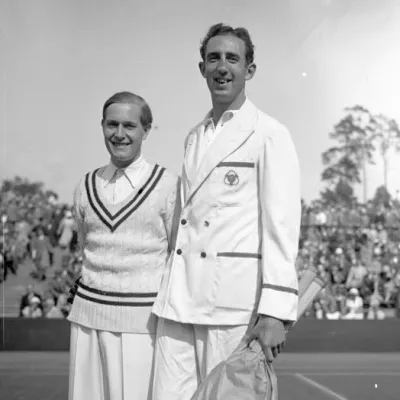
The Nazis wanted to exploit his blonde good looks as a symbol of Aryan supremacy, but he refused to identify with Nazism. Probably in revenge, they jailed him for an earlier homosexual relationship with a Jewish actor, and this damaged his career abroad. However, a more probable reason for his imprisonment was because of his losing streak in international tennis; he had lost in the 1937 Davis Cup deciding match to the American Don Budge and Germany did not continue to the finals. In the war, he was discharged from the military because of frostbite.
After the War was over and he was released from captivity, von Cramm resumed his tennis career. He won the German Championships in 1949 at the age of 40 and played his last Grand Slam event at Wimbledon in 1951, where he lost in the opening round to Jaroslav Drobny. Von Cramm became a successful businessman and was tragically killed in a car crash on 8 November 1976 aged 67.
Gottfried Von Cramm as a Manifesting Generator 6/2 in Human Design
Manifesting Generator 6/2 — Design at a Glance
Gottfried Von Cramm was someone who possessed a hybrid energy structure: He was a Manifesting Generator. This design combined the constant power of the sacral center with the ability to skip steps and quickly pull things into his life. Like all Generators, his strategy involved not initiating himself but reacting to impulses from his environment. Only when the Sacral said a clear 'yes' should he act.
However, his speed brought specific risks. Often Gottfried Von Cramm was too quick and skipped necessary intermediate steps, leading him to return later to fill gaps. This could quickly turn into frustration, the typical non-self issue of this type. Additionally, he tended to handle multiple projects simultaneously as he responded to various impulses. Without strict adherence to his inner authority, his creative enthusiasm easily turned into exhaustion.
When the strategy was followed – reacting rather than initiating and constantly checking sacral approval – Gottfried Von Cramm drew deep satisfaction from his actions. In this state, parallel work was no obstacle but a source of energy. He then operated in a 'play mode' where variety and fun best fostered his creative power instead of forcing him to focus on just one thing.
Emotional Authority
Gottfried Von Cramm exhibited a fundamental stance where inner clarity did not immediately present itself but followed a natural rhythm. His inner authority lay in the defined Emotional Center, meaning that his decisions never rested on a single moment but had to run through the wave of his feelings. In one moment something could appear extremely attractive, in another completely inappropriate. This fluctuation was not a lack of judgment but the mechanics of his system: The feeling offered only an initial impression, not the final truth.
Quick, spontaneous reactions from a temporary mood state would often lead him astray. Instead, his design required patience and conscious hesitation. Gottfried Von Cramm had to give himself time for a decision to mature. Often it was necessary to sleep on something or discuss it multiple times until the initial emotional heat subsided. Only when this wave ebbed and emotional distance was gained did true calm set in. This process of delay served to recognize deeper patterns rather than reacting only to superficial impulses. For long-term direction setting in his life, waiting for emotional clarity was essential to act from a stable, thoughtful position instead of being driven by passing moods.
The 6/2 Profile — Role Model / Hermit
Gottfried Von Cramm's design inclined towards experimental learning in youth, followed by an intense phase of distance and reflection. As a 6/2-Profile, the energy before his thirtieth year was similar to that of a 3-line: Trial and error marked his early experiences. After around three decades, the sixth line activated, prompting him into a metaphorical 'cave'. There he looked back with great distance on his earlier experiments. This period served for healing and deep self-awareness.
His configuration also included problem-solving ability combined with altruistic intention for others. Yet this gift often provoked or was initially not accepted due to its long-lasting effectiveness. Parallel to this, Gate 51 showed a specific aura of willpower and ego strength. When his ego felt threatened, he withdrew to find recovery. Only on correct calls did he respond bravely and show his power. Ultimately, Gottfried Von Cramm emerged as a wise person from this reflective phase. Others recognized his life wisdom and sought his counsel to learn from his deep introspection ability.
Split Definition — Defined & Open Centers
Gottfried von Cramm's Human Design profile set a tendency towards clear, willful communication that spoke from deep inner security. His defined centers – G Center (Identity), Heart (Willpower) and Throat (Expression) – formed a closed loop: He knew his worth, possessed the energy to keep promises, and could articulate this directly. This configuration marked him as someone who not only acted but openly and honestly communicated his intentions and boundaries. His voice was no random product but a reliable mirror of his 'I'.
At the same time, he had immense vital force through his defined Sacral Center (Generator Type) along with defined Spleen (Intuition), Solar Plexus (Emotions) and Root (Stress/Pressure). This gave him endurance, spontaneous perception ability, and the capacity to carry emotional waves as well as physical pressure. However, his decisions should not be impulsive from the Head but based on his sacral response – an inner yes-no tone – combined with patience in waiting out his emotional fluctuations before acting.
His open Head Center (mental pressure) and open Ajna Center (conceptual thinking) showed another side: He was vulnerable to external mental inspirations or confusion that did not originate from himself. Instead of seeking endless answers in the mind, he tended to be distracted by foreign questions when he didn't trust his inner authority. This openness also allowed him to flexibly take up new ideas as long as he didn't accept them as personal truth. His path lay in using the silence of his sacral and emotional clarity to penetrate the noise of an unstable mind rather than getting entangled in intellectual debates without his own energy basis.
Channels for community, maturation, pioneering spirit and life purpose.
Gottfried von Cramm's Human Design profile set a tendency towards strategic action at the interface of material power and emotional experience. He was someone who combined the struggle for resources with a deep search for meaning. The Money Line Channel 21-45 connected his Heart Center to the Throat Center, giving him the authority of a tribal leader: Gate 21, the Hunter, sought control to preserve energy, while Gate 45, the Gatherer, decided on resources and demanded loyalty. Gottfried von Cramm had to learn to use his will in such a way that he remained independent rather than serving or ruling only.
Parallel to this, the Initiation Channel 51-25 shaped his attitude. It connected the competitive energy of shock (Gate 51) with the spirit of self (Gate 25). This drove him to be initiated through competition and challenges to unfold his unique potential. Competition was not an end in itself for him but a means towards individualization and conscious growth.
The Life Struggle Channel 38-28 connected Root Center to Spleen. Gate 38, the Fighter, gave him the pressure to defend his integrity against external forces while Gate 28, the Player, intuitively recognized which struggles made sense. Gottfried von Cramm found his life purpose in stubbornly standing up for what he deemed valuable and transformed survival pressure into individual confirmation.
Emotionally, he was driven by the Transience Channel 35-36. This connected Solar Plexus to Throat Center. Gate 35 sought constant change while Gate 36 used crises as entry points to new experiences. Gottfried von Cramm learned wisdom through fully living emotional cycles and later shared these insights.
The Community Channel 37-40 linked Solar Plexus and Heart. Gate 37 sought recognition in the whole, Gate 40 needed breaks after work for others. This challenged him to see relationships as fair contracts that required time for emotional maturity. Finally, the Ripe Channel 52-42 (here mentioned as 53-42) secured cycle completion. Gate 53 initiated new experiences while Gate 42 reflected on them. Gottfried von Cramm had to complete each cycle fully to gain wisdom from it and not fall into frustration.
Additionally, Gates like 57 (intuitive clarity) and 39 (provocation for mutation) sharpened his awareness of the here-and-now and challenged him through analysis.
Collective Circuitry — Circuit Signature
Gottfried von Cramm's Human Design profile set a tendency towards inner strength and strategic caution. Through the Centering Circuit, which linked his Identity with Heart Center, a strong core emerged from self-worth and personal convictions. This energy worked centrally and individualistically; however, without connection to Throat Center, these firm stances often remained unspoken or hard to verbalize. Parallel to this, his Ego Circuit showed clear alignment towards cooperation and resource exchange. Here he connected Throat, Heart, and Solar Plexus Centers into a coherent flow. This fostered an instinct for giving and taking as well as material security but required regular pauses for regeneration due to missing Sacral energy in the circuit. Another feature was the Knowledge Circuit linking Spleen with Root Center, which gave intuitive ability to recognize the right moment for survival and focus on essentials. The Meaning Finding Circuit worked in two separate areas: On one hand, it connected Throat with Solar Plexus Centers, translating emotional waves directly into communication. On the other hand, it linked Sacral with Root Centers, where life energy and drive interacted. Overall, these distinct but defined groups formed a profile that swung between deep inner certainty, social exchange, and intuitive adaptability without all energies forming one continuous flow.
Left Angle Cross of Individualism 1
Gottfried von Cramm's design indicated a tendency towards inner independence and the pursuit of individual integrity. This attitude did not manifest as rebellious separation but rather as a deep necessity to walk one's own path, free from external expectations or collective constraints. The left cross of Individualism 1 describes a life task that involved prioritizing authenticity over conformity. It was about the ability to remain true to oneself even if it led to loneliness or misunderstanding. For Gottfried von Cramm, this configuration was an ongoing call to listen to his own voice and values, independent of societal norms. It shaped his actions through a quiet yet unshakable conviction that true strength arises from accepting one's uniqueness. This trait prompted him to make decisions not by the majority standard but by aligning with his inner compass. The mechanics of this cross promoted an attitude of respectful distance from group pressures in favor of personal clarity. Gottfried von Cramm lived this dynamic as a continuous struggle with how to assert oneself in a world that often demands conformity. His design supported him in setting boundaries and not tying his identity to external recognition but drawing it from the depth of his own character. This created a foundation for actions that were perhaps not always popular, but were always carried by a clear inner logic.
Saturn Return · Uranus Opposition · Chiron Return · 2nd Saturn Return — Life Cycles
Gottfried von Cramm's design was characterized by a strong orientation towards structure and social responsibility, which became particularly evident during crises. His first Saturn return around the age of 28 marked a turning point: in 1937, he reached the Wimbledon final, lost to Donald Budge, and was arrested for violating Section 175, receiving a one-year prison sentence. This Saturn cycle condensed years of tensions into an existential crisis that profoundly shaped his public role.
The Uranus opposition around age 39 brought a drive towards renewal and breaking free from old bonds. In 1948, he co-founded the German Tennis Federation (DTB) – an act of institutional reformation that underscored his ability to develop structural solutions based on personal experience.
The Chiron return around age 51 ushered in a phase of fulfillment and purpose clarification, deepening his incarnation goal. In 1960, he divorced Barbara Hutton. This step was not merely separation but part of a process where external ties were loosened to free the inner compass and clarify his life mission.
Manifesting Generator · Emotional Authority — Synthesis
Gottfried von Cramm lived a life marked by a profound inner drive for authentic expression. As an Manifesting Generator (MG), he possessed the ability to seize opportunities quickly and set things in motion, yet always connected with the necessity of surrendering to the flow of the sacral center – not initiating but responding. This combination of apparent spontaneity and deeply rooted inner wisdom, enhanced by emotional authority, guided him through phases of intense experimentation (Profile 6/2), followed by times of reflection and withdrawal to integrate gained insights. The defined Throat Channel indicates that he had a strong voice that communicated his inner truth, with the Heart Center (Channel 21-45) pushing him into the role of a responsible protector.
A central paradox shaped his existence: the tension between the need for control and surrendering to one's process. The knowledge circuit challenged him to explore new paths and initiate changes while the emotional center required careful consideration. Crisis events, such as arrest (Saturn Return), revealed the consequences of hasty steps but also his ability to transform and realign (Uranus Opposition). This interplay between the drive for individuality and emotional depth formed a character that was both courageous and reflective.
6 Defined Channels
Incarnation Cross - Left Angle Cross of Individualism 1
Solar Return
The Solar Return shows the moment when the sun returns to its exact birth position - your personal solar year.
Life Cycles
Discover the life cycles with a detailed triple view (birth chart, cycle chart, composite).
Human Design Profile
- Strategy
- To respond - wait for something to respond to
- Authority
- Emotional Authority
- Profile
- 6/2 - Role Model / Hermit
- Definition
- Split Definition
- Incarnation Cross
- Left Angle Cross of Individualism 1
- Date of Birth
- 07.07.1909 17:45
- Place of Birth
- Nettlingen, GER
Frequently Asked Questions
What was Gottfried von Cramm's Human Design type?
What profile did Gottfried von Cramm have in Human Design?
What authority did Gottfried von Cramm have?
What incarnation cross did Gottfried von Cramm have?
When was Gottfried von Cramm born?
Discover your own Human Design
Are you also a Manifesting Generator? Find out in a personal reading how to unfold your multi-talents and direct your energy wisely.
More Personalities
Back to overviewAldair

Alizée

Angeli

Arletty

Artus

Balthus