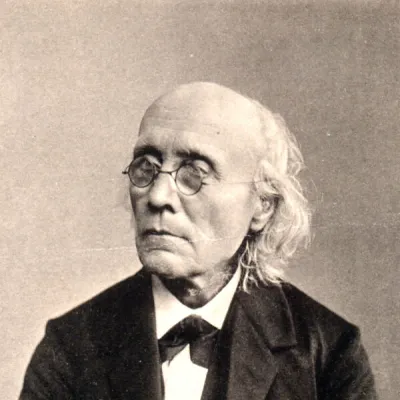
Gustav Fechner
Human Design Chart
Biography
S
=
K
ln
I
{\displaystyle S=K\ln I}
, which became known as the Weber–Fechner law.
Gustav Fechner as a Generator 3/6 in Human Design
Generator 3/6 — Design at a Glance
Gustav Fechner revealed himself as someone with considerable endurance, comparable to a workhorse that only effectively used its strength when it had the necessary inner energy. His design as a Generator indicated that he functioned best not through self-initiated efforts but by reacting to external signals. The motto 'not initiate, but react' shaped his operational approach: Only when his sacral center gave a clear internal yes did he respond with action.
This mechanism offered him the potential for deep fulfillment and satisfaction as long as he followed his impulses. Conversely, frustration and energy depletion threatened if he acted against this nature – for instance, by completing tasks that did not interest him or being prevented from pursuing his heart's project while still full of power. The risk of burnout was particularly high where he wasted his intrinsic creative force on tasks he had no real desire to do. His path lay in acting from the gut and reacting to life rather than forcing it actively. Thus, nobody could stop him when he lived in harmony with his energy source.
Emotional Authority
Gustav Fechner displayed a fundamental attitude characterized by emotional wave movements: His perception of the world was always colored by his current mood. What seemed inspiring at one moment could appear negative in the next. This fluctuation resulted from his emotional authority, carried by the defined Emotional Center. In Human Design mechanics, this authority always takes precedence over all other defined centers regardless of further configurations in the chart. Gustav Fechner's immediate feeling was merely a snapshot, an initial impression that did not necessarily reflect his deeper truth. Quick, spontaneous decisions made directly from this emotional excitement often proved problematic. Instead, his design required patience and conscious hesitation at important life decisions. By repeatedly sleeping on a question, he gained the necessary emotional distance. Over time, intense feelings subsided, leading to clarity and calmness. This process of maturation was crucial for long-term direction setting, as only then did deeper, more comprehensive insight become accessible. Gustav Fechner therefore had to take his time properly and ask multiple times to ensure that he was not just reacting to a passing mood wave but following his true inner direction.
The 3/6 Profile — Martyr / Role Model
Gustav Fechner emerged as an experimenter and role model whose life path was shaped by Profile 3/6. In the first half of his life, he acted like a Line-3 personality: mutating, survival-oriented, and ready to test extremes. This phase served for biological testing of boundaries and partnerships, often accompanied by inner uncertainty between the desire for playful experimentation and the wish for control.
Only with Saturn's return around age 30 did his orientation fundamentally change. The activation of Line-6 energy prompted him to withdraw and reflect on his previous experiences. Now, the playful Line-3 nature received the wise guidance of Line 6, which sought a comprehensive overview. Fechner carried both his youthful and older self within him from then on.
Gate 60 in Line 6 endowed him with unwavering resolve and strictness as a role model. Acceptance of limitations became a prerequisite for profound mutations. His intuitive judgment enabled the right application of this rigor without compromise. Through this long phase of waiting and strict acceptance, significant changes often emerged. In his later years, around age 50, he became a great role model for others through the combination of charm and wisdom, the result of a life task based on learning from both perspectives.
Split Definition — Defined & Open Centers
Gustav Fechner was characterized by a design marked by constant mental activity and profound emotional waves. His defined Ajna Center fostered a trustworthy, conceptual thinking style; he processed data in the same way consistently and his ideas were hard to influence. This mental structure flowed directly into his defined Throat Center, allowing him to articulate what his mind conceived – a clear line from theory to communication.
His drive came from his defined Sacral Center, a source of immense vitality that waited for reactions rather than initiating action. Parallel to this, his defined Solar Plexus and Spleen acted as inner authorities: He needed time to find emotional clarity and relied on spontaneous intuitive impulses in the present moment. The defined Root Center provided the necessary pressure for existential awareness and survival.
In contrast, his vulnerability was revealed in the undefined centers. His open Head Center made him receptive to external inspiration but prone to confusion by foreign questions or mental pressure not originating from himself. An open G Center meant a lack of fixed identity; he adapted to his environment and sought the right place to feel belonging rather than following a rigid life plan. Additionally, his Heart Center was open, making him vulnerable to the pressure to prove his worth through promises or competitive thinking – a trap that he could only avoid by listening to his inner authority and not trying to assert himself consciously.
Channels for acceptance, change, intuition and emotions.
Gustav Fechner was characterized by a mechanism that combined evolutionary change with analytical precision. The channel of Mutation 60-3 connected the Root Center with the Sacral; here, Gate 60 acted as a pivot for limitation and Gate 3 for order. This constellation generated pulsating energy, pairing melancholy with sudden bursts of innovation. Gustav Fechner had to learn to accept these unpredictable phases rather than trying to rationalize them.
Parallel to this, the channel of Wavelength 48-16 shaped his work style: Gate 48 in the Spleen Center sought deep intuitive information while Gate 16 in the Throat Center perfected skillfulness. This connected inner intelligence with the need for repeated practice to manifest talents and communicate precisely.
The logical framework was provided by the channel of Acceptance 17-62 between Ajna and Throat Centers. Gate 17 visualized patterns that Gate 62 translated into detailed language. Gustav Fechner mentally organized complex information before structuring it verbally; understanding only arose through this logical categorization of details.
Emotionally, the channel of Emotion Release 39-55 shaped his experiential world. Gate 39 provoked in the Root Center to set the emotional wave of Gate 55 in the Solar Plexus into motion. This generated a moodiness between joy and sadness that prompted Gustav Fechner to listen authentically to his emotions rather than suppress them.
Additionally, prioritized gates contributed: Gate 50 provided protective reflexes and traditional values while Gate 56 abstracted mental processes into pictorial narratives. Gate 18 discriminated necessary corrections in the collective process without taking it personally. In the design, Gates 37 (Friendship/Community), 4 (Formulas for Future Security) and 54 (Connection of Worldliness and Spirituality) supported his development. Finally, Gate 43 enabled breakthroughs of individual insights through spontaneous realization that he clearly communicated to others.
Collective Circuitry — Circuit Signature
Gustav Fechner's design inclined towards pulsating, acoustic creativity separate from focused visual logic. This divided structure created two parallel, not directly connected energy flows. The Knowledge Circuit linked his Sacral, Root and Solar Plexus Centers. Here, the mutations of Channel 3-60 promoted deviations from the norm together with Channel 55-39 for emotion release. This shaped a unique identity manifesting through emotional waves and new expression – yet isolated from the mind. Parallel existed the Understanding Circuit connecting Ajna, Throat and Spleen Centers. Through Channels 17-62 (Acceptance) and 16-48 (The Wavelength), he sought logical strategies for improving the future. This 'emotionless ratio' served to share rational insights free from conditioning. Since the groups were separate, these forces acted alongside each other: once as an impulsive, individual expression of new paths, at other times as strategic visual analysis. Gustav Fechner thus showed himself in the tension between the urge to emotionally live out his mutations and the drive to clearly communicate structured future visions – without these areas energetically overlapping or forming a common flow.
Right Angle Cross of Laws 1
Gustav Fechner's design established a tendency towards a specific inner tension that is marked by the presence of the right cross of Law 1 in his Human Design chart. This configuration does not describe mere rebellion but rather a deeply rooted impulse to test established structures and authorities for their legitimacy. At its core, it's about distinguishing between arbitrary oppression and legitimate order.
For Gustav Fechner, this meant that he often found himself in situations where he had to fight against rules or expectations, not out of defiance but from the necessity to understand the true meaning behind these guidelines. The right cross of Law 1 signals a life task to penetrate power structures and discern whether they serve or hinder. It was a process of constant testing: Where did the necessary end and arbitrariness begin?
This mechanism shaped his way of dealing with his environment. He sought the truth behind facades, often aware that accepted norms didn't always reflect reality. His energy focused on uncovering these discrepancies to maintain personal integrity not dictated by external constraints. It was a path of clarifying confrontation with the system to find his own authentic place within it.
Saturn Return · Uranus Opposition · Chiron Return · 2nd Saturn Return — Life Cycles
Gustav Fechner's design established a tendency towards structural anchoring that manifested in clear life phases. The first Saturn return marked often the transition from preparation to an established role. This occurred in 1828 when he was appointed extraordinary professor at age 27 – a moment where years of groundwork condensed into a solid position.
Later, his design presented through a profound transformation phase. The Uranus opposition stands for a necessary break with established structures often triggered by external constraints or inner inconsistency. In 1839, at the age of 38, this led to him resigning from his physics professorship due to health issues. This crisis was not merely defeat but a mechanically induced hiatus that dissolved old patterns to make way for new developments.
The second Saturn return then confirmed long-term stability in his design. Following the phase of dissolution came renewed consolidation later in life. In 1859, at age 58, Gustav Fechner was elected as a member of the Leopoldina Academy of Sciences. This success showed as confirmation of his scientific substance that remained intact despite earlier breaks and now found its final anchoring in an acknowledged institution.
Generator · Emotional Authority — Synthesis
Gustav Fechner lived deeply within a dynamic tension field between inner perception and outer expression. His Generator type, fueled by sacral energy (Design), required constant connection to fulfilling work while his emotional authority (Authority) compelled him to let decisions mature over longer periods – a process that clashed with the pulsating, present format of the Knowledge Circuit. This combination led to a profound ability to develop and implement concepts (defined Ajna Center), yet always filtered through an ever-changing emotional landscape.
This man showed throughout his life a tendency towards experimentation (3/6 Profile) and reflection, where the Channel of Mutation (Channels/Gates) continually led him to new paths even if these were accompanied by melancholy. The cycles confirm this: Career successes like being appointed professor (Saturn Return) alternated with crises and necessary realignments (Uranus Opposition), up until recognition from scientific societies in advanced age (second Saturn Return). He was a seeker who explored both the new and order – a continuity that shaped his entire work.
4 Defined Channels
Incarnation Cross - Right Angle Cross of Laws 1
Solar Return
The Solar Return shows the moment when the sun returns to its exact birth position - your personal solar year.
Life Cycles
Discover the life cycles with a detailed triple view (birth chart, cycle chart, composite).
Human Design Profile
- Type
- Generator
- Strategy
- To respond - wait for something to respond to
- Authority
- Emotional Authority
- Profile
- 3/6 - Martyr / Role Model
- Definition
- Split Definition
- Incarnation Cross
- Right Angle Cross of Laws 1
- Date of Birth
- 19.04.1801 17:00
- Place of Birth
- Großräschen, Germany
Frequently Asked Questions
What was Gustav Fechner's Human Design type?
Which profile did Gustav Fechner have?
What authority did Gustav Fechner possess?
What incarnation cross did Gustav Fechner have?
When was Gustav Fechner born?
Discover your own Human Design
Are you also a Generator? Find out in a personal reading how to use your sacral energy correctly and discover deep satisfaction.
More Personalities
Back to overviewAaliyah

Alexia

Angèle

Anne-Marie

Arcángel

Arno